
Tagged: Christ
Seven Last Words: Paradise
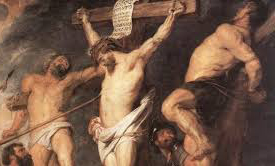
“Truly, I tell you, today, you will be with me in Paradise” (Luke 23:43)
Our world is a world that has closed itself off from the transcendent. We have bought into the discourses of science that tells us the immediately tangible is all there is, everything else is suspected as superstition.
Do not get me wrong, science has earned its place in the world, and many need to listen to its voice more. Science has offered enormous explanatory power for our worldview. In the great feuds between scriptural literalism and science, science will usually win. We have found the sun does not revolve around the earth, that the earth is much older than chronicled, that rain comes from weather systems, illness from poor hygiene, etc.
The world has pushed God out of its purview. God has been viewed as too burdensome a notion to trust.
The events of the primordial church fade into the distance of history. History, itself, seems to crocked a path to see providence. Divine intervention seems like misconstrued co-incidence. Many of the great political advances have been done despite religious influences.
We immerse ourselves in the comforting hum of media noise. Talk of God becomes as rare as genuine conversation itself. Hearing from God becomes as rare as genuine listening itself. An atheism falls over us because we feel the blunt force of divine absence.
Our daily lives, even for many Christians, are often practically atheist. Church becomes an cumbersome ritual. Work is more important than worship. Singing praise to God does not feed a family. Prayer and Scripture reading get sidelined to more relaxing practices: Television, sports, etc. So, we say to ourselves, why bother believe?
However, we deceive ourselves into thinking the modern world was the first to discover doubt, as if doubt was an invention by the same brilliance that discovered flight, electricity, or the theory of relativity. Yet, doubt is not a modern novelty.
The cross was a scary time for Jesus and his followers. The cosmos, let alone their little band of disciples, hung in the balance. The circumstances had become so chancy that most of the disciples deserted Jesus: belief in this man as the messiah was simply too insecure at that moment. Peter initially drew his weapon to defend his lord, but upon realization that violence was not going to resolve the conflict between Christ and the priests, upon seeing his master taken rather than fighting back, unleashing the kingdom of power that he was expecting him to unleash, Peter himself turned to deny Christ, three times in fact. Other disciples deserted him far sooner, unfortunately.
Thus, there Christ hung, condemned, and by all accounts at that very moment, defeated and disproved. Jesus as messiah was no longer a tenable conviction anymore. He did not seem to be bringing in a new kingdom, as prophesied. He did not defeat the Roman occupation, as prophesied. Far from! There he was pathetic, disheveled, beaten into irrevocable submission to the powers he should have pulverized with legions of the faithful, perhaps having even angel armies come to assist. Thus, Pilate, either out of mockery to the Jewish people or out of some deep seated pious guilt over killing a truly innocent man, wrote “King of the Jews” and hung it over Jesus’ head.
If one was to look for a reason to believe in Christ at that moment, one would have looked in vain. The man on the cross was exposed many times over as just a man, flesh and blood, ashes and dust, rejected by his people, betrayed by his closest followers and friends, accused of blasphemy by his own religion’s authorities, tortured and in the midst of his execution by his people’s most hated enemies, the most idolatrous power in existence, hanging there, slowly bleeding out, slowly succumbing to his wounds, to thirst, and to death.
Atheism’s objections pale in comparison to the scandal of Good Friday.
As onlookers mocked and jeered, even a man, a wretched thief, dying the same death as Christ next to him, felt no solidarity with the co-condemned, no compassion for his neighbor in this death, only cynicism and despair. Even the thief on Jesus’ one side mocked him.
At this moment, there seems to be no good reason to trust Jesus. Jesus hung there, discredited.
Would you have believed that Jesus was the messiah then? I know I probably would not have. Sadly, that is because I am a “reasonable” person.
More sadly, is that the only reasonable people in this story are monsters: Judas, who calculates how to profit from Jesus’ arrest; the Pharisees, who have the foresight to plan against possible agitators; the Romans, who brilliantly invented means of rebellion suppression.
And yet, in this moment of darkness and doubt, despair and destruction, one person believed! One person dared to see something more. One person had faith. The other thief, what tradition refers to as the “penitent thief,” dying at Jesus’ side. He believed. He had nothing left to hold back. He could have mocked like the other thief, but he didn’t.
We know next to nothing about this person. The Gospels left him unnamed. Having no hope left in this world, he still says to the other thief, “Do you not fear God? You are under the same punishment.” He admits that his punishment is just, yet Christ’s is not. Christ is innocent and he is not.
At the very end of his life, he is moved with humility and honesty.
But his confession is more radical than that. If one was worried about self-preservation, they would have petitioned far more prestigious powers than a dying messiah.
When no one else believed in Jesus, this man did. And so he simply requests that Jesus would remember him when he comes into his kingdom. He, in the darkness moment of his life, in the darkness moment in history, chose to trust the kingdom is still coming.
This man had perhaps the greatest faith in all history, and yet we do not know his name! But God does. God is not dead because God did not stay dead.
Jesus did promise to remember him. In fact, this man, in his final moments of life, was given the most definitive assurance anyone had before the resurrection: Jesus turned to the man and said, “Today, I truly tell you, you will be with me in paradise.”
Sadly, it is only when we realize that our lives stand on the edge of oblivion that we can feel assured that our lives are in the hands of something more absolute than what this world offers.
Father,
Help us to have even just a fraction of the faith this man had.
We complain about our lot in life, yet we are unwilling to admit our faults.
We so often mock and mistrust your salvation. When we do that, we must acknowledge that our punishment, like his is just.
But we must also cling to the hope of your kingdom of forgiveness.
Remember us Lord Jesus, as you remembered him.
May your kingdom come.
Amen
The Risk of Becoming A Father: A Theo-Poetic Reflection

This is a reflection I wrote back in 2011, when my first son, Rowan, was born. It is, as I call it, a “theo-poetic” reflection, as I could not help but think about the grandness of this event as connected with faith in God.
Some would question whether fatherhood is a valid impetus for religious reflection. What do the two have to do with each other? I am of the opinion that even an atheist, when gripped with the beauty of life’s greatest moments ultimately resort to religious-like vocabulary: words of transcendence like “sublime” or even, “sacred.” There is a reason why the Hebrew prophets were not scientists or philosophers – those who think the mysteries of life can be objectified, scrutinized, and exhausted, those that naively hold that thought begins in doubt and ends in certainty rather than beginning and ending in wonder. Rather, all of the prophets were poets.
Many know their fathers as appearing cold and silent, perpetually poker-faced. After my son was born, my wife turned to me wondering why I did not cry at the sight of my son. I said that I did not know. I almost felt ashamed that I did not. Could I be that emotionless? However, as I reflect on this, and many of the powerful moments of my life, I have found that there are, for me, moments so profound that their magnitude invokes such a complex polyphony of emotions, our bodies do not know how to express one where our minds are wrestling with many. It is not that men are emotionless or emotionally shallow (as some have said), it is, I think, that sometimes we are so complicated, no one expression of emotion does justice. Thus, we appear reductionistically simple.
For this reason the Christian scriptures were not written as pure historical reports, logical propositions, and empirical data – objective yet dry, stale, and irrelevant – but rather as narratives, poetry, proverbs, and epistles – subjective, personal, and thus, real and relevant. Poetry is the enemy of science, as science accuses poetry of un-realism, yet it is poetry that seems to come to grip with what reality is for the human experience more than science. In French, the same word is shared for an account of history and a story, l’histoire, as it is understood that in order to communicate the flavor of life’s memories accurately, one must ironically use the metaphor, forsaking the demands of the factual in order to fulfill it and employing the rich meanings found typically in fiction. The wondrous thing about poetic reflection is that it is the attempt to wrestle into words the things that matter most to us, yet render us silent and speechless.
It is a strange wordless feeling becoming a father. Watching my wife’s pregnancy was just that: watching, a position that intrinsically predisposes a father to a sense of aloofness. Another’s pregnancy, for all its power to produce the sense of maternity, is no process to prepare for one’s own paternity: no inherent connection is formed between father and fetus, no nesting instinct clicks on automatically. A guy does not spend his childhood unwittingly rehearsing for childcare with his toys and their many nursery related accessories. Compared to the astounding ability to produce life from within oneself, to shift seamlessly and intrinsically into a parental-consciousness, men are left feeling as the “weaker sex.” Fatherhood, at least in its initial impulse, far from its place in perceived male headship, subverts the great chains of social hierarchy – hierarchy with all its promise of strength and security – that we as men wish to remain unthreatened.
I take Meagan in to be induced on the evening of Good Friday. We stay the night for observation. I don’t sleep. I can’t sleep: part anticipation part the stiff hospital chair-bed-thing is not actually suitable for sleeping.
Then the labor happens in the morning, Easter Saturday, April 23. Trumpets from heaven might have well of blasted: all the signs were there, all of it expected, however, an urgency sweeps over you that makes you feel you were never ready for what is to come. All preparations feel illusory and inadequate. It is the eschaton of my life, as I know it.
Moments become eternal as memory fragments into snap-shots that somehow also bleed together like a long exposure photograph: At the hospital, Cervidil administered, epidural, lunch from the Hospital’s Subway, contractions set in, the movie Ben-Hur plays in the background, cervix is fully dilated and ready to push. I look at my watch, its 4:25. Ben-Hur is at the chariot race scene. I hold Meagan’s hand. I hold her leg. Meagan’s mother, on the other side, does the same. Breathe. Push. Pause. Breathe. Push. Pause. I see the head.
I am not going to lie, it is gross. Life in it’s most raw forms, we often find disgusting; without all our prim and proper adornments to shield ourselves from the overwhelmingly messy purity that life is, we find it scary before we can properly appreciate it as sacred.
A haze of helplessness, ignorance, and anxiety from watching my wife have contractions, have pain, have labor, have something I have never witnessed before and can never understand, leaves me unsure of what is going on, what I should be doing, what I could even do at all. Men are supposed to “fix things.” I don’t know what to do. I say, “Good job,” as if I am the expert, as if I am not feeling awkwardly pathetic.
It all comes to the pivotal moment I see the little body and the loud cries begin. The sur-reality of labor splits sunder by the sharpness of the in-breaking reality of delivery. Adventus at 4:57.
The image behind the shadowy ultra-sound phantasms and amorphous movements within the belly manifests itself for the first time in one tiny distinct form: the crying naked body of a tiny baby boy. The tohu-wa-bohu of childlessness break by the bara of conception, that leads to the badal and miqveh of pregnancy, and culminates in the final barak of birth.
I give my wife a kiss, no longer simply between two lovers, but from the father to the mother of our child. A mature love is affirmed, love that culminated in new live, a new journey: our family. I hold my wife, my wife holds the baby, the baby holds my hand. Bone of my bone holding flesh of my flesh: we are three, yet, in love, we are one.
We named him Rowan Albert Boersma, Albert after my dad, John Albert Boersma. However, I was so tired after the birth that when I called my family to tell them the news, I told them the wrong name! It was the most pleasant point of exhaustion, I’ve ever felt!
I take my son in my arms and I look at him, and he opens his eyes and stares at me. Some refer to a religious experience as an “I-Thou” encounter, the finite “I” encountering God’s absolute “Thou.” The presence of the infinite being produces a sense of being infinitesimal, under the weight of the wonder of that which is Wholly Other. To hold my son for the first time is an similarly unspeakable feeling, apophatic yet oddly inverse: I feel like the thou, staring down at this being that is in my “image and likeness,” this person that is utterly dependent on my providence: so small, so fragile, so vulnerable, so innocent, but above all else, just so. With all that I am, I pronounce blessing on this being: I see him as “very good.” His finger reaches out and touches my finger in Michelangelo-esque sublimity.
As I sense myself as the Thou, the child becomes the I. And thus, I see myself in something other than me. In doing so, eye to eye, I sees I, self-hood is seen in another and otherness in self, an infinite reciprocal circle of identity and alterity. A type of self-transcendence occurs. The I-Thou reverses as I stand before a new tiny Thou. All senses of deity, the feeling of being bigger than you have ever been, paradoxically permeates with the sense of being smaller than you ever have been, feeling the full weight of fatherhood, the magnitude of responsibility, and the fear of innumerable potentialities of failure. The future in all its awesome potentiality presents itself, simultaneously dazzling as dangerous.
In holding that child for the first time, with the instantaneous love, you feel that you are more sure about what is right in the world than ever before, yet at the same time the most unsure. With love, an kenotic agape occurs as someone other than yourself becomes the measure of your essence. As you love this little someone, you see yourself in them, and your own idenity as a loving person becomes bound to them, covenantally. You bind your self-hood to something other than yourself, freely allowing yourself to be taken hostage to this someone that you know has the uncontrollable judgment to pronounce you a success or a failure in your task of loving, in your ability to be loving. The certainty in love appears also as the greatest risk. For those that define masculinity as a man’s self-sufficiency, power, and ability, fatherhood appears as a threat-to more than a fulfillment-of manhood.
Is this what God felt like as he beheld Adam? Is this what the Father felt as he looked down upon Christ lying in a manger? Through the divine tzimtzum, is this the risk of God’s essence as love entails as he constantly proclaims to his children, those other than himself yet from himself? Is this the mystery of God’s promise and proclamation to all humans, when he says, “I am love; I created you from love; I love you; I will always love you”? Is it in the finite response of gratitude for God’s love that God’s infinity is realized? Did God, as a being whose supreme ontological predicate is love, risk his very deity in the act of creating humans? It is only when every “knee bows and tongue confesses” the Spirit’s love, Christ’s lordship, and the Father’s paternity that God will truly be “all in all.” The marvel of God’s sovereignty is his willful vulnerability.
How can God be vulnerable? In Greek mythology, Cronus the Titan devours his children so that none can challenge his sovereignty. Zeus the all powerful, Cronus’ son, slays his father, only to become an absent uncaring father himself to myriads of bastard children of the women he seduced. He, the “father” of all gods, is a god that intervenes to win wars for his subjects – wielding the symbol of his power: the lighting bolt – only for the profit of more temples, more worship, more reputation, more fear of his might. The gods of the Greeks were defined as timeless, impassible, unchangeable, omnipotent and omniscient. And because of this, the Greeks logically concluded, in all their metaphysical sophistication, that the gods do not care about us. They must not care, or else they would not be gods! To care is to be weak. This is what the world conceives of as divinity: power and control.
Some wonder why an infinite deity would choose to identify himself as gendered and allow himself to be named by his people as “our father” (although there are many parts of scripture, I should point out, where God is depicted as motherly too), yet everywhere in our world we see absent fathers – people, perhaps, afraid of the risk of love – broken homes, abandonment, even abuse. And yet in our darkest moments something, someone, beyond all our experience, beyond all notions of how the world is, pierces the veil of despair and shines through in glorious consolation: God as love appears as the one that never abandons, always keeps his promises, always protects, is always proud, is always daring to love.
The God who identifies himself with the stories retold by the community that claims their brother is Christ is a God that we profess does nothing like what a god is expected to do: he comes into history, changes himself into a sacrifice, suffers with us, becomes weak and helpless choosing powerlessness over violence, chooses compassion over wrath, and even is said to have become the very thing God is not: the misery of sin and death. Though the vile yet beautiful cross – the symbol of the Christian God’s awesome ability – all this was done to say to all the fatherless: to all victims those crying out for rescuing, to all the abandoned that will never understand themselves as being worthy of a father’s proud smile. All this to say to all people: you have a father! Daddy loves you. He is proud of you. He will rescue you. He is never going to leave you.
Indeed, no psychological projection, no philosophical system, no misguided mythology constructed by human minds could invent the notion that a God would choose to use masculine language to define his magnificent characteristics yet fundamentally in his very essence, in his very being and becoming, be something so unbecoming of the impassible power and sovereign invulnerability of our notion of “male” deity, that is, the unfathomable and ineffable reality that God is love.
Hearing my crying child, holding him for the first time, and not knowing what to do to end the crying is an absolutely terrifying experience. Something so small renders someone so much older, bigger, and more capable that itself, ultimately incapable: omnipotence dissolves into omni-incompetence. However, he calms down and sleeps sweetly, and I pause to take in the strange soothing fragrance of a new born baby at peace on my chest, his soft head against my cheek. We both rest, I in pride and Rowan in purity. I think to myself that this is how God must have felt on the seventh day. Shalom, the peace that all existence strives for, engulfs us.
I use the blue musical teddy bear to comfort him, the same one my father used to comfort me. Now I understand what my parents felt, and I regret every moment that I ever took their love for granted. My father has passed away, my mother also, yet I am here. I say, “Daddy is here. Daddy is never going to leave you.” A generation passes, a generation comes, and yet in the flux of life’s frailty, for all its uncertainty, love is what remains eternally and assuredly the same. Death is no competitor to the renewing power of life through love. The “risk” of becoming a father, love’s risk of being inadequate, vulnerable, and the potentially a failure, in turn, is then what becomes illusory, dissolving into epiphany, as love’s jeopardy becomes life’s victory, as love demonstrates itself as the essence of immortality, as love demonstrates that love “always protects, always trusts, always hopes, never ends and never fails.”
Let’s Go Idol Smashing

So, this past week was Black Friday. People lined up in a frenzy to get good deals on electronics and clothes and whatever else. Some go under the pretense of selflessness: that they are just trying to save a buck or two on Christmas shopping. Of those, I wonder what is the actual percentage of items bought for others and items bought for oneself.
While most are fairly decent about walking through the busy malls, this obsession with Black Friday has had darker moments. Since 2006, there has been a 98 reported injuries due to the craze of Black Friday shopping: everything from people fighting, rioting (in which cops had to deploy pepper spray), etc.
To date, there has been 11 reported fatalities: An old man was pushed and collapsed, getting trampled; people have gotten hit in the busy caring lots; others have gotten stabbed in the back as they ran ahead of someone for a sale; still others, have fallen asleep at the wheel, exhausted from shopping, crashing to their deaths.
The stabbings and trampling a helpless elderly man are what really get me. When I think of what would propel someone to enact violence of that nature, you have to care about your money, having things, in such a way that you have placed it way to high up your priority list in life.
You might just say that these people have a screw loose, but the truth is scarier.
If you have inflicted violence on another human being over a sale, this is not an emotional problem. It is a spiritual problem. You have invested a spiritual level of energy in it. You have invested your soul in it. You in essence worship it. I derived ultimate meaning from it. It for you is an idol.
I for one think secularism is a bit of a farce sometimes. Everyone is spiritual. Everyone worships. Everyone has a religion. Everyone has a god of sorts.
It is just that in the downfall of Christendom and the collapsing of modern ideals of political progress and enlightenment, the only thing left is the religion of consumerism.
Go to the mall, and you are bombarded with religious messages; Messages on how to find the “true you;” products purporting to change your life with overly salvific tones; advertising attempting to proselytize you to a certain brand name.
I know a lot of people that don’t believe in “organized religion” because it is full of narrow-minded, repressive, shallow people that just want you money. Yet, no one I know who holds such things is consistent and gives up shopping. Whatever authoritarianism, demagoguery and fideism religion can be accused off, consumerism is even worse.
Consumerism is a religion. Its products are idols. And they are not even that good.
Idols always disappoint us. Christ will not. That is why we need to smash them.
What Is An Idol?
Wikipedia gave a good definition, which I will add to: An idol is an image or other material object representing a deity to which religious worship is addressed or any person or thing regarded with admiration, adoration, or devotion.
My own definition is this: Anything we trust more than God is an idol, AND anything you care about more than what God wills for us to is an idol. The second part is often missed. We can turn some of the best things in life into idols by caring about them more than what we should (I’ll explain how to discern this shortly).
There are important examples of idolatry in the Bible.
Right from Genesis 1, we see a notion that God is transcendent from creation. Nothing in creation deserves our worship. The only image he has is humanity, and that means that only worship that is acceptable is one that respects God’s transcendence, and God’s love for people.
Our typological parents fell because they choose to eat of the tree of the knowledge of good and evil, in essence, claiming that they could be their own god. The result of that, however, was alienation from each other and God, spiritual death.
Abraham is told to “leave his father’s household” and this implies leaving his father’s religion of idols.
The Exodus is essentially a battle narrative between God and Pharaoh. The ten plagues show God is in control of all the things the Egyptians revered as god: the sun, sky, river, animals, etc. The most striking example is the hardening of Pharoah’s heart. Pharaoh claimed to be god, and yet, in the narrative, God has control over his very will! That passages sometimes gets turn into a double predestinationist theology, but what this is trying to say is that those that claim to be god are not. Such self-assertion against God is futile.
Of course, as soon as the Israelites leave Egypt, they commit idolatry. While Moses is up on the mountain, the Israelites compel Aaron to give them an image to worship. John Calvin once said that the human heart is a “factory of idols.” Here we see that at work. The people did not want to worship another god, they wanted a representation of YHWH to worship. They felt like they needed an image. They could not conceptualize a fully transcendent God – the “I am who I am.” When God brings this to Moses’ attention, God then threatens to disown his people and restart with Moses. Moses begs God to punish him instead, and because of Moses’ intercession and atonement, God “changes his mind.” God reveals that he is the God, who “has mercy on whomever I have mercy.” Here the transcendence of God manifests itself not in sublime terror, but in the surprising, unpredictable mercy that only a living God can offer. No idol could do that.
The war with idolatry is throughout Israel’s history. It is either the perpetual temptation of kings or their greatest concern to eliminate. The kings of Judah and the Northern Kingdom are assessed in 1 and 2 Chronicles according to whether they tear down the Asherah poles or offer them praise. Sadly many turn to idolatry, and for that the people are sent into exile.
In the narrative there are powerful confrontations between the Prophets and the false-prophets of idols. Elijah demonstrated that the Baal was lifeless, unable to cause flame to his altar as his prophets prayed to the point of cutting themselves in devotion. Elijah, on the other hand, drenched his altar with water, prayed, and it went ablaze. Similarly, Shadrach, Meshach and Abednego refused to bow down to the golden statue of Nebuchadnezzar, and for that, were thrown into a furnace only to be protected by angels. The biblical narrative attests to this constant struggle with idols, and the constant superiority of God over these lifeless, finite things.
Idolatry is a concept that gets expanded in the Bible. Isaiah and Micah turned to their own religion and saw any ritual that caused apathy to be detestable. Habakkuk looked at the empires of his day and saw trust in military power to be idolatry: “their might is there god” (Hab. 1:11). The prophets were truly brilliant people. They are the greatest social critics history has ever produced. They were capable of scrutinizing their beliefs in faith in a way that no secular atheist could do to their own. Why? Because they know that God was beyond all of it.
In the New Testament, idolatry gets applied to sin. Anytime we prioritize our sinful desires, we are placing ourselves before others and God. This is what I mean by idolatry as “anything you care about more than what God wills for us to is an idol.” Colossian 3:5 reads: “Put to death, therefore, whatever belongs to your earthly nature: sexual immorality, impurity, lust, evil desires and greed, which is idolatry.”
Why Are Idols So Harmful?
(1) Any god except God will disappoint us.
We have a thirst for transcendence. According to anthropologists and theologoans, humans are the only species that has refused to settle into a habitat. We are not at home in the world. We, as a species, always want something more (see discussion in Stanley Grenz, Theology for the Community of God, 130-131).
This thirst can be ignored, however. This thirst can be quenched by illegitimate things. There are commercials that have been designed to stimulate the religious centers of the brain, fabricating spiritual experiences. Why? Companies want people to be that attached to their products. Kind of messed up isn’t it?
The things of this word only satisfies us so far. Nothing but the forgiveness and love of the true God satisfies this. Why? Because only the perfect love of God casts out fear.
Will our houses always keep us safe? No.
Will our computers, Facebook, cell phones, really produce authentic relationships? No.
Will our clothes and cars gives our lives vocation and purpose? No.
Will our IPods safe us from the fear of death? No.
Can our possessions forgive our worse failures? No.
Nothing we are, have, do, nothing can satisfy us, protect us, forgive us, save us in the way God can.
Unless you know that God will do these things, that fear will always be there. That fear will drive you to destroy yourself within and destroy others.
We see the most deadly example of this in Scripture: the worshipers of the detestable god, Molech. Molech was hated by the Prophets because he demanded your first born son to be offered in the flames. One of the earliest metaphors for hell in the Prophets comes from the followers of Molech burning their children, and the Prophets warning that idol worshipers will have that done back to them. If they did not stop, Jerusalem will burn like the poor children they are sacrificing.
What drives a person to sacrifice their own children? It seems so distant to us. However, if you live in an agrarian society were fertility was life or death, the fear of whether God was on your side was an all consuming terror. People would do anything to know that God was one their side. To prove that, naturally, came the notion of the altar, offering something to show the gods gratitude in order for them to bless you. Of course, in desperation, knowing that one’s whole family might starve, feeling like one’s mistakes could be the cause of a drought – that fear could drive a person to make the calculated choice to sacrifice one of their children.
People were so afraid of the gods. Their worry and guilt and need for control drove them to murder their own children.
We might look at these people and consider them primitive, but we do the same.
In order to preserve our idol of self-importance, we will sacrifice our marriages, family and friendships.
In order to preserve our idol of safety, we sacrifice the lives of innocent Arabs as we drop bombs on them.
In order to preserve our idol of comfort, we sacrifice Syrian refugees.
We don’t want to pay more taxes, so the poor don’t get the programs they need.
In order to preserve our idol of consumption, we sacrifice our planet.
In order to preserve our idol of standards of living, we sacrifice our time working too much.
In order to preserve the idols of our own privacy, we avoid religious gatherings, even our own family and friends.
In order to preserve our religious idols of certainty, we shut out all other opinions and perspectives. We will shun those that remind us of how fragile our faith can be.
(2) We become what we worship.
We become what we worship, and if we worship the lifeless things of this world, we will become lifeless as well. David Foster Wallace, a college literature professor and one of the greatest novelists of our time, wrote this graduation speech. We wrote it shortly before he committed suicide from a loosing battle with severe clinical depression.
Because here’s something else that’s weird but true: in the day-to day trenches of adult life, there is actually no such thing as atheism. There is no such thing as not worshipping. Everybody worships. The only choice we get is what to worship. And the compelling reason for maybe choosing some sort of god or spiritual-type thing to worship—be it JC or Allah, be it YHWH or the Wiccan Mother Goddess, or the Four Noble Truths, or some inviolable set of ethical principles—is that pretty much anything else you worship will eat you alive. If you worship money and things, if they are where you tap real meaning in life, then you will never have enough, never feel you have enough. It’s the truth. Worship your body and beauty and sexual allure and you will always feel ugly. And when time and age start showing, you will die a million deaths before they finally grieve you. On one level, we all know this stuff already. It’s been codified as myths, proverbs, clichés, epigrams, parables; the skeleton of every great story. The whole trick is keeping the truth up front in daily consciousness.
The Scriptures know this well. Psalm 135:15-18 reads,
The idols of the nations are silver and gold,
made by human hands.
They have mouths, but cannot speak,
eyes, but cannot see.
They have ears, but cannot hear,
nor is there breath in their mouths.
Those who make them will be like them,
and so will all who trust in them.
In this regard anything can become an idol. Our possessions can become idols. Our jobs, our longing for recognition can become an idol. Our sexual gratification, when outside of God’s loving intent, can become an idol. Drug addiction, with how much the addict invests there life into their addiction, is an idol. Sports, when that euphoria and thrill of victory can lead to, for instance, rioting like the 2011 riots in Vancouver (where over 800 charges of violence were laid), can become an idol. The military, trusting in war to keep peace, is an idol, especially in the United States where its war spending is now three quarters of a trillion dollars and are now locked into perpetual war.
Even things like our marriages, family, and children can become idols. Our desire for comfort and provision for our families can cause us to be morally apathetic. Yet, my children need to know that there are certain matters of integrity that are fundamental.
Atheism can become an idol. While there are atheists who are more moral than Christians, the idea that reality is all there is, my life is all I have, can lead to a dangerous sense of self-concern.
On the other side, our religion can become an idol. When ever we use the Bible in an unloving manner, we violate the principles it gives us to use it appropriately. There is a big difference between believing the right things and believing in the right way.
If your “biblical beliefs” lead you to open fire on an abortion clinic. You religion is an idol.
If your “biblical beliefs” lead you to hate gay people, and exclude them from church. Your religion is an idol.
If your “biblical beliefs” lead you to demonize Muslims and fuel the longing for war. Your religion is an idol.
If your “biblical beliefs” lead you to hold any of your convictions in a way that causes hate, anger, disgust, condemnation, etc. towards others. Your religion is an idol.
So How Do We Smash Our Idols?
So, if we know these things will harm us and leave us unsatisfied, in fact, will even destroy us, how do we smash these idols? Smashing idols is the work of discipleship in a community. The church, a place of instruction and encouragement, is any believer’s best resource for learning what is an idol and working to bring all aspects of our lives into its proper place under Christ.
Stay open minded. Dietrich Bonhoeffer once said that, “He who cannot listen to his brother will soon find himself unable to hear the Word of God also.” When we can make the Bible and our interpretations into idols, listening in open-mindedness, humility, and fallibility to others will expose our own religious idols.
Test everything against the law of love. The Bible does not want you to read it in a shallow manner. The most pervasive test for any interpretation or prophecy or application in the New Testament is the law of love. If a biblical law is not loving, the biblical thing to do is to understand it as non-applicable today, to think about a better application, or to revise it.
Finally, draw close to Jesus. The crucifixion was a scandal to the Jews. Why? The pharisees made the law into an idol, and the cross smashed the arrogance of their legalism. God showed his only try representation, his incarnate self. At the cross, God became forsaken. God was found in the other, dying for others. God gave himself up for his very murderers. An idol, in so far as it appeals to our need for self-assertion over others and fear of the other, cannot stand when submitted to the test of cruciformity, dying to self. In the cross’ perfect way of love, every idol will break.
The Motherly Love of God: Theological Reflections on Mother’s Day

A mother held her new baby and very slowly rocked him back and forth, back and forth, back and forth. And while she held him, she sang:
I’ll love you forever,
I’ll like you for always,
As long as I’m living
my baby you’ll be.
This is from the story by Robert Munsch. It is very dear to me because my mom would read it to me. She read it to me to remind me that she loved me no matter what, that one day she won’t be around, so she wanted me to remember how much she loved me and how I should pass on that love.
That sounds a lot like the love of God, don’t it?
Today we are going to reflect on mothers. We are going to reflect on the significance of the gift of our mothers, and how the love of our mothers remind us of God’s love.
First I’ll tackle the tough stuff of metaphors we used to understand God: Is God a he or a she, a father or a mother? Or neither and both? Second, with that ground work laid, we will survey the rich images of motherly love in the Bible.
Understanding God as Father to understand God as Mother
First, we need to understand what God as Father means. Why in the Bible does God refer to himself as a “father,” or at least as a “he” rather than a “she” or both? I have often wondered that.
God in the Bible is almost always referred to as “he.” Jesus teaches us to pray to God as “Our Father.” Some people get offended at that. They think that is sexist. Some Christians have advocated modifying liturgical documents, editing out male references on that basis. I think that misunderstands why male references are used. Changing, for instance, the prayer, “Our Father” to “Our Mother” misses why it is the way it is.
Nevertheless, many conservative Christians don’t understand why God is portayed this way. One feminist objector to the faith, Mary Daly said, “If God is male the male becomes God,” and sadly, a lot of Christians think that. And so, church history has seen the Bible used to value men more than women under the notion that men are closer to God than women because God is male and not female. Their concern is not without warrant. Some Christians have argued on theological grounds that women were not in the image of God (based on a misreading of 1 Cor. 11) or that women are less human then men (which followed the Greek philosophical traditions of Plato and Aristotle that saw women as “defective” males). However, this is not why God refers to himself as a father. The abuse does not necessarily invalidate the use, but it does reiterate that to call God “Father” begs questions about why we are saying it. If you are calling God “Father” because you think these things, your notion of God has been reduced to something idolatrous. God is not male because God is not a thing.
Why does God get communicated as a father in the Bible?
First off, God in beyond gender, but God communicates with us personally, so he takes on gender. God is the “I am that I am” (Ex. 3:14) indicating freedom of existence, but God is not an “it.” So the use of the personal pronoun, “he,” is not to insist God is male so much as to prevent God from being abstracted. God is beyond creation and therefore beyond gender and sexuality. God is beyond everything. Yet he reveals himself to us using the good things around us. God allows himself to be imaged in order to have relationship.
God uses many images, not just gendered ones. Anything that is good can be used to communicate God’s goodness to us. God is a shepherd, a warrior, a king, a servant, a midwife, an artist, rock, light, fire, etc. This includes fatherhood as well as motherhood, because these roles are intrinsically good. While the Bible uses “he,” God is not more a he than a she. God is these things to get to the inherent goodness of himself that his created order shares from him.
God is understood as a “he” and a “father’ in the Bible for a very good reason. We, just like in the world of the Bible, have many absent fathers. God constantly communicates himself as a father, because there are so many people out there that, while they have a good mom, they don’t have a father. God communicates himself to us as a father, primarily because that is the love that most of us our missing, the love of a father. God seeks to be a father to the fatherless. God is a loving father in a way that says to absent fathers, true fathers do not do this. God communicates himself primarily as a father not because of patriarchy but to counter its abuse.
In fact, one of the first displays of God as a father in the Bible is the blessing and protection of Abram. God acts like a father to him as Abram leaves his father’s household. Abram is left fatherless, leaving his father’s idolatry for God’s call of obedience, and here God promises to be his father, protecting and blessing him. God is a father to the fatherless.
God is a father and the Holy Spirit is a “he” as well, particularly in the New Testament to reiterate the closeness of relationship they have to Jesus.
So, God primarily communicates to us that he is a loving father, the Father of Jesus Christ. However, many people neglect that God often does in the Bible speak of himself as a mother, loving us like a mother. This only makes sense:
God’s love is good.
Our mother’s love is good.
All that is good is of God.
Therefore, our mother’s love shows us God’s love.
Or, God’s love is good like a mother’s love.
Specifically, God loves like a mother.
Now this is important. While the Bible only uses the pronoun “he” for the reasons sketched out. To call God a “mother” or even to provocatively say “she,” is not actually against Biblical faith. Jesus does refer to the figure of Lady Wisdom, a figure that is divine in the inter-testamental books he seems to be alluding to, and Jesus says that “Wisdom is vindicated by her children” (Luke 7:35). Other than this, while God is not primarily referred to in the Bible as a “she” there is no reason to say God is more a “he” than a “she” or that masculinity is closer to God than femininity.
To use the term “she” to refer to God is similar to referring to God as a “Trinity.” No where in the Bible is the word “Trinity” used. Nowhere is the language of “three-in-one” used. While they are not explicitly found in the Bible, they are compatible with its logic. In fact, the trinity makes sense of its logic, helping us to image the God of the New Testament. If God is good and motherliness/femininity is good, then their goodness can be used to communicate God.
Think of a similar example. In the Chronicles of Narnia, God is portrayed as a lion: majestic and powerful. One could just as easily use a dog to represent God. Any dog lover will understand this simile: God is loyal, a companion, a protector, a friend. Yet God is not a lion or a dog.
Scripture goes further to use non-living objects to communicate God. God is a rock, connoting secure firmness. God is a fire, indicating warmth, power, the capacity to purify and even to destroy.
Now, like I said, when we understand why Scripture uses “he” and “father” we know that it is not in a sexist or patriarchal way, although some abuse them for that purpose. We don’t need to jettison that language, nor do we need to have such a fuss about conceptualizing God as feminine. All the goodness of creation communicates God, not least of which is motherly love.
So, this is what we are going to mediate upon today. God’s love is like the procreative, unconditional, sacrificial, protective love of a mother. Our mother’s love points us to the love of God, and this will allow us to appreciate both God and our mothers today.
1. We come from God like how a mom gives birth to us
“You have forgotten the Rock who bore you and put out of mind the God who gave you birth.” (Deut. 32:18)
Deuteronomy warns don’t forget that you came from God. God is your creator like how a mom gave birth to you. Don’t forget that you owe who you are and what you are because God created you like a mother.
My earliest memory was when I was a little over three. I remember the day we moved into our house that I grew up in in Stoney Creek. I don’t remember anything of the house before that. I don’t remember anything of what my parents had to do for me before that. At three I was walking and talking.
That means for three years before that, I don’t remember how much my mom had to work to feed me, clothe me, bath me, brush my teeth, change my diaper, put me down for naps, comfort me when I was upset.
My mom told me that I cried incessantly for months after I was born. My mom brought me to the doctor, concerned about how much crying I did. The doctor told my mom that it was nothing, and she was just being crazy. After several times insisting to the doctors that she was not crazy. They ran some tests to find that I had a herniated stomach from birth. It took six months for them to finally get around to diagnosing it and operating on it.
My mom told me that the operation happened late December, and on Christmas morning, my mom woke up in a panic. I did not wake her up in the night, so she, like most mothers naturally do, assumed I had died and ran to my bedroom. She found me waking up smiling. My mom, until that day, had not slept a full nights rest in six months up until that point. You can imagine the patience, the perseverance, the devotion that takes? That is the same patience, perseverance, and devotion God has for us.
Deuteronomy warns don’t forget God who bore you; don’t forget the God who gave you birth. You are not a self-made person. You exist because someone cared for you while you could not care for yourself.
God here feels forgotten and under-appreciated like a mom!
I admit that I am a man. Red Green has taught me the important mantra “I am a man; I can change; if I have to; I guess.” Nevertheless, I forget special occasions often. I am also a human. There is something about me that causes me to be very forgetful of God some days.
In the times that I have forgotten Mother’s Day, I don’t think my mom was mad at me or disappointed because she missed out on her reward for all her good work in my life. Moms don’t do what they do for any recognition. Saying “thank you” to your mom on Mother’s Day is not rewarding her because she needs a reward, right? But every parent wants to know that they have raised their kid right. That means they have come to recognize goodness done to them when they see it, whoever is doing it, and they respond appropriately: with gratitude and appreciation.
The same goes with God. God wants to see us mature in his goodness, and that includes learning to have gratitude towards him and responsibility towards others. This is why praising God in church is so necessary. It is not necessary to God. God does not need us to sing to him. We need to sing to God. We need to be constantly thankful so that we can dwell deeper in the awareness of all that is good.
Thus God reminds us: Don’t forget the one who bore you, says Deuteronomy. Don’t forget.
2. God protects us like a mother bird
God guides Israel like a mother bird teaching her young to fly:
“Like an eagle that stirs up its nest, that flutters over its young, spreading out its wings, catching them, bearing them on its pinions, the Lord alone guided him” (Deut. 32:11-12)
This is a fascinating picture of God’s providence:
How often do we refuse to trust God in order to guide us?
How often do we think God is making us fall when actually he is helping us fly?
God, in the Bible, is often described as a mother bird protecting her young.
Be merciful to me, O God, be merciful to me, or in you my soul takes refuge; in the shadow of your wings I will take refuge, until the destroying storms pass by. (Ps. 57:1)
Jesus even looks at Jerusalem and longs to protect them like a mother bird in Matthew 23: 37-38:
“Jerusalem, Jerusalem!.. How many times I wanted to put my arms around all your people, just as a hen gathers her chicks under her wings, but you would not let me! And so your Temple will be abandoned and empty.”
Paul, similarly, guides the church not as a father but as “a mother caring for her little children” (1. Thess. 2:7). Both examples, taken to their ultimate conclusion, poses the possibility that gender identity is porous with regards to roles and abilities, roles like be an apostle or a pastor not necessarily being “patriarchal” or innately “fatherly” roles.
Again, God is often described as male, as a father, as a king in the Old Testament to draw on the cultural experiences of men as protectors of the home. However, have you ever seen a female bird defend its nest? You can see what even Jesus prefers a motherly metaphor here, particularly, that of a mother bird.
Hawks have the ferocity to beat up bears if their nest is disturbed. Think about that. A 4 pound bird has the ability to send a 400 pound bear running for its life. Go ahead and look it up on the internet. It’s amazing. When a bear disturbs the tree where a hawk nest is, the mother hawk in a protective frenzy swoops down and claws the bears back. The bear runs yelping as the hawk continues to fly down, dive-bombing it. It’s incredible. The hawk beats up an animal 100 times its size in order to protect it’s young.
How confident that God will fight for you when you are in trouble?
How often to you think the things that are attacking your life are too big?
How often do we forget that God will fight for the death for us?
Believe it or not, God is fighting for you right now. The terrible thing about some of our sins – some of the dark things we are trapped in – is that we don’t know what trouble we are in. We don’t worry about all trouble we could be in.
Two things I look forward to seeing when I get to heaven. The first is all the moments God protected me in life that I did not realize. I imagine we will get to see the play by play of our lives in heaven, sort of like on sports channels. When that happens we will see all the moments God was there for us, saving us, protecting us, providing for us, and we did not even know it.
The second thing I look forward to seeing is all the prayers my mom prayed for me. How many times I went out and goofed around with my friends late at night and my mom could not sleep because she was waiting, worrying, and praying for me.
Moms fight for their kids, physically and spiritually. Moms want to protect their children with every ounce of their being. God is fighting for us right now and always. Do you realize it?
3. God also is wrathful like a mother
God’s wrath is often attributed to male metaphors, emphasizing power and patriarchal authority. However this appeal is not uniform. God is also seen as wrathful in a special way that only a mother can be.
“I will fall upon them [disobedient Israel] like a bear robbed of her cubs” (Hosea 13:8)
Notice that while God does not directly get the pronoun “she,” here the simile employs the feminine pronoun “her” to speak of God. God is wrathful like the awesome ferociousness of a mother bear whose cubs are in jeopardy.
Similarly, the salvific wrath of God is likened to a woman angrily in labor:
“For a long time I have kept silent, I have been quiet and held myself back. But now, like a woman in childbirth, I cry out, I gasp and pant…I will lay waste the mountains and hills and dry up all their vegetation…I will lead the blind by ways they have not known, along unfamiliar paths I will guide them; I will turn the darkness into light before them and make the rough places smooth. These are the things I will do; I will not forsake them.” (Isa. 42:14-16)
I remember when my wife was in labor with our second son. Labor came on so quickly by the time we figured out that she had gone into full labor and got to the hospital (this happened in about three hours) our son was born within minutes of her arriving.
I will never forget on the way to the hospital seeing my wife in pain. She furiously tried to hit the wall of the van. I grabbed her hand trying to stop her, so that she would not damage a knuckle. She looked me with a killer look in her eye and lunged at me to bite my hand like Bilbo when Frodo did let him see the ring. That was a whole other level of wrath I had never seen before. I have never felt that angry.
Understanding God’s wrath as motherly helps to understand it rightly. God has wrath not because God has stopped loving us but because God loves us passionately. When I have done wrong, my mom was angry at me because she knew I was capable of better and would do anything to help me be the best I can be. That is God’s wrath. It is a loving wrath that wants to help us not hurt us.
4. God as motherly by professional role
There are other uses of feminine language that employs cultural language that refers to typically female roles. God is portrayed as a midwife attending a birth in Psalm 22:9-10, 71:6, and Isaiah 66:8-9.
“‘Yet no sooner is Zion in labor than she gives birth to her children. Do I bring to the moment of birth and not give delivery?’ says the Lord. ‘Do I close up the womb when I bring to delivery?’ says your God” (Isa. 66:8-9)
Paralleling God as shepherd (male) in the parables, God and his kingdom is described as being like a woman working leaven into bread (Lk. 13:18-21) and a woman seeking a lost coin (Lk. 15:8-10), both chores of Galilean peasants woman. Jesus identifies God in these parables as women.
This again reiterates that if something is good it can communicate the divine. If a role is good, it can in some way, metaphorically communicate God’s goodness.
5. God refuses to let us go like a mother
“Listen to me, descendants of Jacob, all who are left of my people.
I have cared for you from the time you were born. I am your God and will take care of you until you are old and your hair is gray. I made you and will care for you; I will give you help and rescue you.” (Isa. 46:3-4)
God here is described as a mother, who bares her child Jacob, but continues on for the rest of our lives, providing, caring, rescuing. What wouldn’t a mom do to rescue their child?
Fire broke out in Harrison, Arkansas of January 7th of this year. Police and firefighters worked to search the homes of a burning multiplex to evacuate anyone inside. One of the homes was engulfed in flames on all sides. The firefighters sprayed through and ran in the home to check it. In the upstairs bathroom they found a woman, Katherine Benefiel, 41, heavily burned, arms wrapped around her five year old son, covering him from the flames. Both were rushed to hospital, but the mom succumbed to her burns. The son, while badly burned himself, remained in critical care, but lived. The story continues to mention that the pastor of the nearby church stepped in to help the family.
Katherine Benefiel with her last strength, when it was apparent that there was no way out, used her self as a shield to protect her son.
What wouldn’t a mother do to rescue her children? She would give her very life. Is it any wonder why Scripture uses the metaphor of the love of a mother to teach us about God’s love for us? Isn’t that exactly what God did for us in Jesus Christ on the cross? God loved us so much that God would die to save God’s children. God died so that we could have life, eternal life.
So, it goes much further than that. God’s motherly love goes beyond any earthly motherly love. Creation is limited. God is infinite. Thus, the love of a mother is similar, but also infinitely dissimilar.
“But God’s people say, ‘The Lord has forsaken me, the Lord has forgotten me.’ Can a mother forget the baby she is nursing, and have no compassion on the child she has borne? Though she may forget, I will not forget you!” (Isa 49:14-15)
Here Isaiah in his poetry enacts a similar move to the apophatic traditions of Christianity where God is ineffably more than all created things. God’s love is unspeakable better than any metaphor we use to talk about it. God reminds us that even the beautiful love of our mothers, while it points to his love, while God uses it to illustrate his love for us, it is inadequate at fully representing the perfection of love God has for us.
God bore us like a mother to physical life, but even more than that. God causes us to be born again of his Spirit to receive everlasting life.
God protects us like a mamma bird, but more than that, God protects us perfectly.
God has wrath like a mother, but perfectly, never doing so abusively.
God refuses to let us go like a mother, only God has laid down his life for us so that we can not only live this life, but for ever and ever in heaven afterwards.
This mothers day I am deeply reminded of this. My grandmother passed away this year. This means this year I do not have any of my families mother’s life alive. This week is a particular bizarre week. This week marks the anniversary of the passing of my grandmother (my Dad’s mother 16 years ago and the passing of my Dad from pancreatic cancer 8 years ago. My mom passed away 5 and a half years ago. That means, like I said, I don’t have any of the mothers directly related to me left.
Yesterday was also my wife and I’s six anniversary. We have been married for 6 years. It makes this time odd. It means I go out to celebrate the gift of having Meagan in my life, but it also reminds my that I don’t have my mother or grandmothers left to celebrate.
I do have a wonderful step-mom and mother-in-law, but of course, the can never replace my mom.
God, as I have been saying from Deuteronomy, says don’t forget where we came from; don’t forget who cared for us; don’t forget who gave us birth. He is urging us never to forget him, the author redeemer, sustainer of life, but to truly understand what God is communicating to us in these metaphors, we cannot take for granted the love we get from our mothers. Sadly, we won’t have them forever. I learned that the hard way.
May you cherish your earthly mothers as a gift from God that points us to his perfectly love.
May you know that God loves you like the perfect mother, who cares for you, protects you, even disciplines you when you are have strayed.
May you know that God in motherly love has died your death and given you life in Jesus Christ.
***
For those interested, my book The Father and the Feminine: Exploring the Grammar of God and Gender, is forth coming, hopefully by the fall of 2024. This blog post was the first attempt to put my thoughts down on the matter. Since then I have written several scholarly articles, the most succinct of which is published with Council for Biblical Equality’s academic Journal, Priscilla Papers, also entitled “The Father and the Feminine,” and the link for that article online is here.
 Spencer Boersma