
Tagged: Christianity
Laying Down the Stones: God’s Mercy and John 8
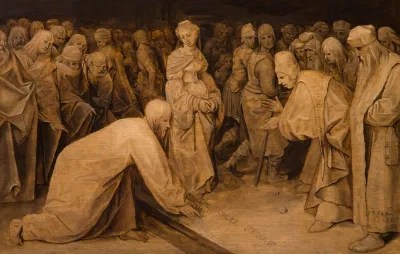
Preached at Billtown Baptist Church, Sunday March 22, 2026.
1 while Jesus went to the Mount of Olives. 2 Early in the morning he came again to the temple. All the people came to him, and he sat down and began to teach them. 3 The scribes and the Pharisees brought a woman who had been caught in adultery, and, making her stand before all of them, 4 they said to him, “Teacher, this woman was caught in the very act of committing adultery. 5 Now in the law Moses commanded us to stone such women. Now what do you say?” 6 They said this to test him, so that they might have some charge to bring against him. Jesus bent down and wrote with his finger on the ground. 7 When they kept on questioning him, he straightened up and said to them, “Let anyone among you who is without sin be the first to throw a stone at her.” 8 And once again he bent down and wrote on the ground. 9 When they heard it, they went away, one by one, beginning with the elders, and Jesus was left alone with the woman standing before him. 10 Jesus straightened up and said to her, “Woman, where are they? Has no one condemned you?” 11 She said, “No one, lord.” And Jesus said, “Neither do I condemn you. Go your way, and from now on do not sin again.” (John 8:1-11, NRSV)
So, Pastor Angela asked me to speak on the next sermon in this series on the rocks of the biblical narrative. When she told me that the next passage was going to be John 8, I was excited but also a bit nervous. John 8 is one of those passages that is powerful but also perplexing.
Let me put it this way. When I was in college, I took a course on the Gospel of John my freshman year. I loved it. As preparation for the course, the professor made us read the whole of the Gospel of John in its entirety twice before we began. I had never done that before, and when you read the Gospel of John all at once in one sitting from start to finish, you start to realize just how poetic, beautiful, emotionally charged, even thrilling, the Gospel of John is. If you have never done that, I would encourage you to.
And if you do that, you will find as I did, there are so many cherished passages: John 3:16, Jesus washing the disciples’ feet, Jesus giving his disciples the new command of love, or the promise of the Holy Spirit. But one of my favourite passages is this one right here: Jesus defending this woman caught in adultery.
The course dove into the book chapter by chapter, and so, the week came around that this passage was next. I was eagerly looking into my textbook to learn more. What was Jesus writing in the dirt after all? But I noticed in my textbook, which was a commentary, this section was not treated. The commentary began at verse 12 and simply offered this explanation: “This passage is not in the originals so it doesn’t belong in the Bible. Therefore it will not be treated as such here.” Oh. The commentator, a respected conservative evangelical New Testament scholar, dismissed it and moved on. “What?!” I thought, “Are you telling me this beloved passage actually isn’t part of the Bible?” As you can imagine, I was a bit thrown off (and maybe you are too—maybe you feel a little bit like the rug has been pulled out from under you as I did). Ever since then, I have pondered this passage and researching it, wondering about it.
Now, before we even get to what God might be telling us in this passage (which I do believe God very much has say something to us through this), we must ask the difficult questions of this passage: Where did it come from? Does it actually belong in the Bible?
For those of you who think I or my textbook have suggested something farfetched or even blasphemous, you can look at any Bible like the ones in our pews (I checked before the service). All of them will say in the little footnotes in the bottom, something like, “not in the earliest manuscripts.” So, don’t shoot the messenger.
I admit I felt tempted to just skip over this issue and pretend it was not there. Most of us would be none the wiser. However, I feel like we owe it to ourselves to be honest with this. Woe to the version of Christianity where you cannot talk about the tough parts of the Bible! Perhaps you have seen that line in the footnotes and wondered. I remember seeing that line in the footnotes in my NIV Bible when I was in high school, when I first read through my Bible. I asked my pastor about it, and he more or less just struggled it off as nothing important and said all we need to do is keep believing. That answer did not really satisfy me and I can’t imagine it satisfying you either.
So, when it says that this passage is not in the earliest manuscripts, what does that mean? One thing that is fascinating to study is the history of the transmission of the manuscripts of the New Testament from the earliest times to now. If you do that kind of study (which I admit some of my colleague are much better studied on this subject then I am), it overwhelming shows just how meticulous and faithful the copies have been preserved from generation to generation.
But I have to admit this instance is one of those head scratchers: This passage first appears in the copies of the Gospel of John in the third century. Why did this passage all of a sudden get tacked on at the bottom of a manuscript of John’s Gospel in the third century? If this is the case, why is it still in our Bible despite Bible translators knowing about this?
Does this mean the Bible has been corrupted and we, modern folk, are just cluing into the conspiracy? Is this like something out of a Dan Brown novel, where the truth has been hidden for centuries by some evil secret order of the church? That is where our mind goes because we live in a culture that is deeply sceptical about institutions and claims to authority.
Well, the reality is actually less exciting. It seems that the Bible copyist in the third century tacked this passage on because he really did feel this was an authentic account of Jesus’ life. It was meant, it seems, like some kind of appendix to the Gospel of John, noting there is another memory of Jesus’ life that the copyist wanted to preserve. Over time, later copyists simply copied it into the main text of the Gospel of John.
But later copyists wondered about this passage, and they would often copy it with the rest of the Gospel of John but put a note around it, flagging that they were not sure if it was original. Copyists have been doing that since the third century to the modern day.
Well, those are the facts. As I said, that is not as exciting as Tom Hanks uncovering a conspiracy as the illuminati chase him, but there it is. That is the non-sugar-coated truth about this passage. So, why did this copyist, two centuries after the events of the New Testament think this passage was an authentic story of Jesus’ life? What gave him the gall to tack it on to the end?
Well, the only reason I see as to “why?” is that there was a common understanding that this was a short memory of Jesus. In fact, there are writings from just after the time of the Apostles where their students and successors talked about what they had been taught. One of these people is a man name Papias, who lived from 60 AD to 130 AD. So, he was a young man when the Apostles were old. Papias was a church leader and, in his writings, he talks about how the Gospels were written by the eyewitnesses of these events and that is why they are trustworthy.
But, of course, there were many more eyewitnesses of Jesus’ life and deeds than just the writers of the New Testament. What is also interesting is that Papias also talks about a story about how Jesus intervened when a woman was caught in adultery. So, it seems like this is a story of Jesus’ life that the early church knew about.
It seems that this cherished story was passed along from generation to generation until it was finally tacked on to a manuscript of John’s Gospel in the third century.
This passage may have been written by an apostle or at the least may trace its origins to an eyewitness to Jesus’ life, who that was, we don’t know.
This passage does not seem to have been added out of any deceitful intention. It looks like the copyist really did think this was legit and wanted to preserve it.
Well, what do you do with that? As I said, my textbook in seminary insisted it should be taken out of the Bible. Perhaps, you feel the same. If that is the case, this sermon could have been much shorter.
On the other hand, one New Testament scholar, far from wanting to take it out of the New Testament, has argued it should be left in and we should recognize it as something like a very short “fifth Gospel.”
Others think that maybe God was up to something in having this story come into the New Testament. Perhaps the whole thing was providential rather than scandalous.
I will leave you to ponder that, but for me, perhaps the most interesting argument for seeing this as part of the New Testament is not in my mind the level of certainty I have about where it came from. It is what it says.
When it comes to what is says, we can at least recognize, as whoever it was that copied it down centuries ago, that this story really does sound like the Jesus of the rest of the New Testament. This story sounds like something Jesus would do.
On that note, I think we can continue to ponder all the perplexities of where this story came from, how it got into the New Testament, and what that means for how we understand the nature of the Bible as inspired and things like that. Those are all interesting questions that I continue to ponder and think about—and I continue to ponder them because, I would hope to impress on you that God very much wants us to ponder these questions; God is not threatened by us asking difficult, honest questions, nor do I believe that the central truths of the Bible are harmed by the existence of a difficult passage like this. We can continue to ponder and think about these questions, but as we do, we can also ask God, “What are you trying to say to us with this passage?”
When we ask that question, there is little wonder then that the church, even Christians that knew about these complications about its origin, have nevertheless cherished this as a story that profoundly speaks about who Jesus is. Jesus challenges hypocracy and condemnation with mercy. That sounds like who Jesus is from Matthew to Revelation.
As one Canadian Baptist writer, Stanley Grenz, once put it, the “Bible is the book the Spirit uses.” This story, despite all the questions we might have of it, is a text that the church has heard something from the Spirit for the last 1700 years.
What is the Spirit saying? This story challenges us with Jesus’ prophetic mercy and justice.
A woman, who is caught in adultery is brought to Jesus while he is teaching and a crowd has gathered. Jesus is stealing the show from the religious leaders, so they try to do something about it. She is brought to him in order to test him, to try to trap him. They try to do this in other instances. Think of them coming to ask Jesus about taxes, seeing if he will say something against Roman taxation that will get him in trouble, but Jesus brilliantly says to them after getting them to point out that Caesar’s image is on the money they love so much, “Render unto Ceasar what is Caesars, and what is God’s onto God’s.” Jesus outsmarts them.
Here they try to see if they can pit Jesus’ compassion against his message of justice. Jesus has been eating with tax collectors and sinners, enraging the religious leaders. By included these people, he is robbing the leaders of their status. So here, they try to force his hand: Will he condemned her to death and contradict his practice of showing mercy to the unworthy? Or, if he doesn’t, then they have him explicitly refusing to carry out a command of the Bible.
After all, there is a law in the book of Deuteronomy that said if a couple is caught in adultery, they are to be stoned. If Jesus resists having her stoned, they got him. Or so they think.
Of course, one cannot help but notice how the law says that both the man and the woman who are caught cheating should be stoned. Interestingly enough it is only a woman. Where is the man?
Also, the law stated that witnesses had to be brought forward and a formal trial had to take place. That is not happening here.
This woman—while she by all accounts seems to have the act in question—she is also a victim of sexist injustice. You don’t need to go far today to see this happening today: cover-ups instead of inquiries, sex scandals in the church where the male leadership protects other men while the woman gets scapegoated.
So, are these religious leaders even interested in justice? It seems they are only interested in their own deeply skewed, self-serving version of it. Again, you don’t have to go far to see examples of that today.
It looks like Jesus sees through this. But how does he respond? He does kind of a weird thing: Jesus starts writing in the dirt.
Weird time to start doodling, right? What was Jesus writing in the dirt? We are not really sure, but there is a passage in the prophet Jeremiah that says that God writes the sins of the people in the dirt, and so, some wonder whether Jesus was writing the sins of the religious leaders down in the dirt, and this is one of the things that spooks them, pressuring them to back off as Jesus says, “Let he who is sinless cast the first stone.” Subtext: You’re not, and you need to get off that high horse.
When we look at the laws of the Old Testament, there was nothing in them that said you must be sinless in order to carry out an execution. Yet, for Jesus to declare this, he is in essence challenging the religion of his day to step further into God’s justice, true justice. The laws of the Old Testament where just the beginning of the journey God has us on, teaching us and leading us into deeper and better ways of living.
In the Old Testament, God begins to teach us justice and fairness, that there are consequences to sin that we need to take seriously and avoid. But are the consequences the point?
It should be noted that the early church, while the Old Testament had laws that had the death penalty, based on who they understood Jesus to be, we see that they simply stopped practicing it. Jesus revolutionized how they saw their scriptures.
Abraham Joshua Heschel writes, “Justice dies when dehumanized, no matter how exactly it may be exercised. Justice dies when deified, for beyond all justice is God’s compassion.”
If you think faith is about how right we are and how evil everyone else is, how people deserve punishment and how we are safe, you have missed the point.
It has been said, “If justice is an eye for an eye, the whole world would be blind.”
And the sad reality is that many Christians are blind, and when we are they inevitably give our vices a free pass and judge the vices of others as so much worse and unforgivable.
These folks come to Jesus trying to trap him and they are the ones that end up getting trapped. They come to Jesus trying to get him to contradict his message of love and compassion using the law of God, but in the process, Jesus exposes how they are the ones who fundamentally don’t get what the law of God is about.
Jesus starts writing in the sand, some think he starts recounting their sins, and then he dares them: The one who is without sin, cast the first stone.
The Prophet Micah says, “And what does the Lord require of you? To act justly and to love mercy and to walk humbly with your God.”
Justice, God’s justice, can only happen when we are merciful and when we stop thinking of ourselves as better than others.
So, the leaders are caught, do they come forward to throw the stone, if they do that, they will look really arrogant, and I think they realize that. They are the ones who are caught.
And so, each leader sheepishly drops their stones and slips away, leaving just Jesus and the woman.
Jesus turns and says, “Where did everyone go?” And of course, Jesus, who actually is one who is sinless, he turns to her and simply says, “Well, if they don’t condemn you, I don’t condemn you. You’re free. Go and have a new life.” Jesus frees her from condemnation and frees her for a new life.
This end of this story feels all too familiar for what else we know about Jesus: The woman at the well joyously goes and tells everyone she knowns what Jesus did for her. Zacchaeus the tax collector is so overwhelmed at the hospitality of Jesus, he changes his life, repaying several times over what he has taken from other people. Jesus’ compassion and mercy transforms people.
This is what the message of Jesus does today.
One time a number of years ago, we were doing a community meal with the church I pastored. At this meal one man showed up. He didn’t look too good. He ate his food. I said “Hi.” He proceeded to want to chat. But he started asking questions. You could tell these were really loaded questions.
He turned to me, and asked, “You’re a pastor right?” “Yes, I said.” “You know about God and stuff, right?”
“I try my best, yes.”
He turned to me and asked, “Is it okay to kill in war?”
I stop, and asked, “what does that question mean for you?” He tells me he has seen war.
We did not get to finish our conversation, but a little while later, I hear this man has ended up in the hospital. So, I got to visit him.
I sit down at his bedside, and he we start chatting. He asks me again, “Is it okay to kill in war?”
I ask again, “What happened to you?”
He told me that he served in the military and he was deployed in a war-torn area. The areas was an area that was ruled by a war lord that had recruited child soldiers, and one kid came at him, and he killed him.
He confessed this to he and I quickly realized, this burden of guilt, the trauma, has been consuming him for years. He felt like he had done something truly unforgivable. His life was marked with this sense of being condemned. Drugs and alcohol, I think for him, was self-punishment.
It wasn’t any use trying to convince him that war is tragic and it was self-defence, at the end of the day, he still had this memory that he kept reliving.
So, I prayed with him and I asked him to close his eyes and imagine that Jesus was in the room with us and just rest in that fact. This is an exercise called imaginative prayer. I read a number of scriptures. I can’t remember if this scripture was one of them.
After a bit, I asked him, can you picture that child, but this time, picture him with Jesus. He agreed to. Is he in a good place now? Yes he said. Is that child hurt anymore? He said no, he is with Jesus now.
I asked him, if he was willing to picture his wrongdoing, to picture it like a box in his hands. He agreed. And I asked him, can you give that chest to Jesus? He agreed.
At this point, he turned to me, with his eyes closed, and he said, I see Jesus taking that box from me. Jesus walked over to a well and he through that box down a well so that it was no more.
I was not expecting that.
I don’t pretend to understand everything what that person saw at that very moment, but I do believe this person realized then and there that Jesus did not condemn him and that Jesus was freeing him from the darkness of his past.
He realized for the first time that God is not the exacting judge in the sky, waiting for us to fail, delighting in pronouncing judgment against us when we fail. God is love and mercy and forgiveness.
If God is revealed in Jesus, God has died the penalty of sin—our penalty—at the cross for us, all to show us that God’s will, God’s justice, is mercy.
If that is the case, if God is willing to invest his very life in us, as I got to say to that person that day and what I am here to tell you today, I just don’t believe that God has given up on us.
The only reason we believe God’s grace is limited is because we are limited people and we have such a hard time fathoming that God is truly love.
As I saw vividly that day, whether or not God is gracious and merciful is not an abstract notion: it can literally make the difference between life and death.
God is not up in heaven holding a stone.
God is with and for us and we can trust it. Can you trust that today?
Can you trust it enough to lay down your stones? Cause we all have our stones. The stones we condemn ourselves with; the stones we condemn others with.
Some of us we cling to that because it’s all we know. We cling to it because freedom is frightening; we cling to it because, at the end of the day, we really don’t want to face the reality that the people we condemn are just like us.
But what if God really does not look at us and divide us up into worthy and unworthy, righteous and wicked, allies and enemies—what if God just looks at all of us, every single one of us, and he simply sees his beloved child; he sees all of us as his family, not one more loved than another? That is an unsettling thing to ponder for what means for our laws, our privileges, our status and place in this world.
What if that whole way of thinking is what Jesus is asking us and that woman to be liberated from when he says, “Go and sin no more”? Are we ready to lay down our stones and step into God’s mercy?
Let’s pray…
The Why is Love: Advent and Incarnation

“All this took place to fulfill what the Lord had said through the prophet: ‘The virgin will conceive and give birth to a son, and they will call him Immanuel” (which means “God with us”).’” (Matt. 1: 22-23)
“And the Word became flesh and dwelt among us, and we have seen his glory, the glory as of a father’s only son, full of grace and truth.” (John 1:14)
“For God was pleased to have all his fullness dwell in him, and through him to reconcile to himself all things…” (Col. 1:19-20a)
There is a movie by the Coen brothers called Hail, Caesar. The movie is, well, about a movie. A movie studio is filming a movie about the life of Christ through the eyes of a Roman soldier, played by George Clooney, who we find out gets kidnapped. I won’t ruin any more of the plot. If you have ever watched a Coen Brothers movie, you will know that it has witty, dark, dry humour.
And, in my humble opinion, one of the best scenes of the film is also, believe it or not, deeply theological. I think all the best scenes of every film are theological, but whatever.
In this film about a film, Josh Brolin plays the manager of the movie studio, who is shooting this film on the Christ. Brolin, whose character is named Eddie Mannix, knowing this film is going to be the biggest film of the year (think something like the old Ten Commandments or Ben Hur kind of movie), gives a copy of the script to a panel of religious experts: an Eastern Orthodox patriarch, a roman catholic priest, a protestant minister, and a rabbi.
And I know what you are thinking, what next, they all walk into a bar? Not quite.
Brolin’s character explains that this prestige picture is aiming to tell the story of the Christ powerfully and tastefully, so he wants to see if the story is up to snuff.
The Rabbi pipes up: “You do realize that for we Jews any depiction of the Godhead is strictly prohibited.”
Eddie looks at him, disappointed. He had not considered this.
But the Rabbi continues: “Of course, for we Jews, Jesus of Nazareth was not God.”
Eddie looks again, confused but also pleased. He reiterates again that he wants to make sure that the script is realistic and accurate and would not offend any American person’s religion.
The Patriarch blurts out, “I did not like the chariot race scene. I did not think it was realistic.”
Eddie again is confused.
The Priest jumps in: “It isn’t so simple to say that God is Christ or Christ God.”
The Rabbi agrees: “You can say that again, the Nazarene was not God.”
The Patriarch, waxing mystical for a moment, replies: “He is not not God.”
The Rabbi exclaims: “He was a man!”
“Part God also,” says the Protestant Minister.
“No, sir,” says the Rabbi.
To which Eddie turns, trying to smooth things over, but also clearly out of his element: “But Rabbi, don’t we all have a little God in all of us?”
The Priest jumps in again and finishes his thought: “It is not merely that Jesus is God, but he is the Son of God….”
Eddie is now confused: “So are you saying God is all split up?”
“Yes,” says the Priest, “and no,” suggesting it is a paradox.
Eddie is now deeply confused. “I don’t follow…”
The Rabbi interjects: “Young man, you don’t follow for a very simple reason: these men are screwballs! God has children? What, next a dog? A collie, maybe? God doesn’t have children. He’s a bachelor. And very angry!”
The Priest is upset: “He only used to be angry!”
Rabbi: “What, he got over it?”
The minister accuses the Rabbi: “You worship the god of another age!”
The Priest agrees: “Who has no love!”
“Not true!” says the Rabbi, “He likes Jews!”
The minister continues: “No, God loves everyone!”
“God is love,” insists the Priest.
The Patriarch jumps in: “God is who he is.”
Rabbi replies, upset: “This is special? Who isn’t who is?”
Everyone is getting frustrated with each other.
The Priest tries to bring the conversation back around: “But how should God be rendered in a motion picture?”
Rabbi exclaims, exasperated: “This is my whole point: God is not even in the motion picture!”
Eddie turns, sinking into his chair: “Gentlemen, maybe we’re biting off more than we can chew.”
Now, I probably did not do this scene justice. You will have to watch it yourselves. I showed it to my wife, who, for some reason, did not laugh as hard at it as I did.
Today, we light the love candle. It is the candle we light on the way to Christmas, where we celebrate the deepest mystery of our faith: the incarnation of Jesus. This Advent season, I have been reading a wonderful little Advent devotional compiled from the writings of Dietrich Bonhoeffer, called God in the Manger (I deeply recommend this to you for next year’s reading). Bonhoeffer was the German pastor who opposed Hitler, sought to organize the church against the power of the Nazis, and was executed, falsely accused of being a part of an assassination plot.
For this week of Advent, the candle of love, the devotional turns to the question of incarnation, why and how is God with us in an infant, born in a stable? Why and how did God become flesh? Why and how was the fullness of deity pleased to dwell here, bodily? How is that possible?
The questions might evoke the same response as Eddie in Hail Caesar: “People, I think we have bitten off more than we can chew!”
Such ideas feel at best unanswerable: above our pay grade as humans. Or at worst illogical, prone to the endless arguing that the Rabbi, Priest, Minister, and Patriarch fell to.
How the Incarnation?
Yet, this question—how and why did God become human?—is the question that all of Christian faith rests on.
How and why did God become human? This week, we light the love candle, and I am going to suggest that incarnation and love—the two are inseparable.
Now, you might insist, that does not really answer the “how” question exactly.
Indeed, let me put the question this way: God is infinite, all-powerful, present to all things, everywhere, all knowing, transcendent, above and beyond all things—how can God be found in human form, let alone the form of a baby?
Put that way, it sounds like trying to fit the ocean into a shot glass. It does not seem like it can work.
Frederick Buechner once said: It feels like a vast joke that the creator of the universe could be found in diapers! He goes on to say, however, that for those of us raised in the church who have grown up with this idea, until we are scandalized by it, we can never take it seriously.
How can God come in human flesh?
As you can imagine, Christian thinkers have found this a bit difficult to answer. Some have said, well, maybe Jesus wasn’t fully human, he only appeared to be human—sort of like how Clark Kent is Superman and only appears to be a mild-mannered reporter. He appears human, but he is actually Kryptonian.
Others came around and suggested that maybe Jesus is not fully God. Perhaps he is like God or has a part of God’s presence in him, but God, the real God, is up in heaven, untarnished by the world, away and transcendent.
Others came around and said, maybe Jesus has the mind of God and the body of a man, or maybe Jesus had something more like a split personality: a divine person in him and a human person in him.
Again, you might be getting the feeling that we have bitten off more than we can chew.
Each of those answers, Christian tradition has found to have its problems. And the ongoing commitment Christians keep coming back to is that in all the ways God is God, Jesus is God. In all the ways humans are humans, Jesus is human, except without sin. Jesus has “two natures.” Well, that still does not answer the question. that still feels like the ocean in the shot glass problem.
Does that mean baby Jesus was omnipotent? Was a little infant, who cannot speak was also all-knowing, knowing about the paths of comets on the other side of the universe? That still sounds like one nature is swallowing up the other.
Bonhoeffer reflects on this problem, and he answers it this way: “Who is this God? This God became human as we became human. He is completely human. Therefore, nothing human is foreign to him. This human being that I am, Jesus was also. About this human being, Jesus Christ, we also say: this one is God. [But] this does not mean that we already know beforehand who God is.”
In other words, Bonhoeffer is trying to tell us that when we look at Jesus, he does not merely fulfill what we expect God to be like in the human Jesus, but he fundamentally redefines God, upsetting our assumption about what God must be like.
He writes, “Mighty God is the name of this Child [based on Isaiah 9:6]. The child in the manger is none other than God himself. Nothing greater can be said: God became a child. In the child of Mary lives the almighty God. [But] Wait a minute!… Here he is, poor like us, miserable and helpless like us, a person of flesh and blood like us, our brother. And yet, he is God…Where is the divinity, where is the might of this child?” Bonhoeffer answers, “In the divine love in which he became like us. His poverty in the manger is his might. In the might of love, he overcomes the chasm between God and humankind…”
How does God, the infinite, transcendent, all-powerful God, become a finite, vulnerable, human baby? The only answer we have is that God is love. Because God is love, God can be all that God needs and wants to be for us. God desires to be with us. So God can.
One church father, Gregory of Nyssa, put it this way: God’s true power is to be even things that God is not. For God to become a lowly and vulnerable human, this is not something that contradicts his power, but rather it is proof of his true power, the power of God’s love.
If we start thinking, you know what makes God a God? Power! If what we worship as God is something we understand as power first and foremost, we will forever see the life of Christ as a scandal. Worst still, we will also probably come dangerously close to worshiping human power as something “god-like” as well.
But if God is essentially love, perfect love is capable of drawing close to us in weakness and vulnerability, and that, ironically, is true power.
That still leave my answer somewhat inadequate. I don’t understand all the mysteries of God. But love is the best clue we have.
Thankfully we don’t need to solve theological mysteries in order to trust them and to be saved by them.
Why the incarnation?
Now, if God was able to become human because of love, maybe we need to back the truck up for a second and ask, why? Why did God need to do this?
Afterall, God is portrayed as loving and gracious in the Old Testament. What does Jesus add to it, if we can call it that? Could God just keep telling us that he is love and that God loves us?
Let’s ask it this way: Why does love need a body?
Modern times cast humans as brains on sticks—the fact that many of us live and work barely moving our bodies as we type on computers can lead us to believe this.
We are told messages that we can surpass the limits of our bodies by sheer willpower; some of us, when we were younger, actually believed that. Then you get a sports injury, and next thing you know, your body aches for no reason, and you catch yourself groaning every time you bend over to tie your shoes. Our bodily’s limits catch up with us.
Some of us don’t particularly like our bodies. Our bodies represent our weaknesses, our vulnerabilities, our imperfections. Companies love preying upon our bodily insecurities to sell us more products. Buy this to fix your hair. Buy this to help lose weight. And so on.
Stanley Hauerwas, Professor at Duke University, wrote one of the great books on Christian medical ethics, called Suffering Presence. In it, he reflects on how medical ethics made him profoundly aware of the significance of our bodies.
He tells this one story of a nurse he interviewed. The nurse worked in a branch of the hospital that dealt with severe infections. Severe inflections have a way of making people hate their bodies. I remember one time in high school, I had a severe tissue infection in my forehead, and I woke up looking like a character from The Goonies. Let’s just say it took a few years for my self-esteem to recover.
Well, for some of these folks with severe infections—gangrenous, swollen infections—the nurse reported that often the people would just want their limbs amputated. Faced with the threat of severe infection, some patients quickly concluded their limbs, their bodies, are irredeemable.
What did she do to prevent that mentality? The nurse spoke about how, when she did her rounds, she would make a point of touching the person’s limbs, even if that strictly was not necessary. You can tell a person their limb is okay, but having a person touch their bodies, the nurses said, reminded them that they were worth saving.
Why did God take on human flesh? Why was the fullness of deity pleased to dwell bodily?
To remind us that our bodies are worth saving.
We can start to see why then that the church fought so much about all this theology about Jesus being fully God and fully human: if there was an element of our humanity that God was not apart of fully, not at one with fully, not able to be found there fully, then that part remained unredeemed. If Jesus is not anything less than fully God and fully human, God is not with us.
Because the Incarnation…
There is a hymn that goes like this:
Good is the flesh that the Word has become,
Good is the birthing, the milk in the breast,
Good is the feeding, caressing, and rest,
Good is the body for knowing the world,
Good is the flesh that the Word has become.Good is the body, from cradle to grave,
Growing and ageing, arousing, impaired,
Happy in clothing, or lovingly bared,
Good is the pleasure of God in our flesh.
Good is the flesh that the Word has become.Good is the pleasure of God in our flesh,
Longing in all, as in Jesus, to dwell,
Glad of embracing, and tasting, and smell,
Good is the body, for good and for God,
Good is the flesh that the Word has become.
If you look at so many of the religions around the time of the church, you will see a startling fact: nearly all of them did not care about bodies.
Romans and Greeks often had a deeply tragic outlook on life.
Egyptians were obsessed with escaping this life into an afterlife.
Gnostics believed that if you were spiritual, it did not matter what you did with your body. In fact, salvation was found in escaping from your body. The body was evil.
Eating and bathing, sex and sleep, for many, these were fallen and evil things. Sadly, there are a lot of Christians who still have that mentality today: to be spiritual is in some way to disregard your body, get away from it. The body, for some, is at best an obstacle to be conquered and, worse, a thing to be ashamed of.
However, one reason why Christianity grew in the ancient world is that it rested on a revolutionary truth for people: If God became human, you matter. The incarnation says that God made the world very good. The goodness of creation is a part of what it means to have a body, the body God gives us, the body God is pleased to dwell in. Your life matters.
Because God took on flesh, because God was found in a body, there is nothing we experience that is meaningless to God.
Our hunger and needs, our frustrations and pleasures, our vulnerabilities and our strengths, our desires and dreams, our thoughts and emotions, every event, right down to every mundane moment, these all matter to God. God is found there.
What writer says the message of the incarnation means that “there is nothing so secular that it cannot be sacred” (Madeleine L’Engle).
Whether it is singing in church, answering emails at work, eating a bowl of cereal in the morning, or lying still at night: every moment can be the site where God meets with us. Every moment can be a place where we know God’s love finds us. Why? God came in Jesus, God Immanuel: God with us.
And because God took on flesh, we also know God will never let us go. No matter who we are or what we have done. God is on our side. Paul puts it this way:
“For I am convinced that neither death nor life, neither angels nor demons, neither the present nor the future, nor any powers, neither height nor depth, nor anything else in all creation, will be able to separate us from the love of God that is in Christ Jesus our Lord.” (Rom. 8:38-39)
How did God become human? Why did God become flesh? How do we know we have forgiveness and hope? This morning, we lit the love candle. In it, we have the foundation of our faith: Because God loves us so much, because God is love, God became one of us.
Let’s pray:
The Unlikely Family of God

Sermon delivered at Billtown Baptist Church, Sunday October 26th, 2025.
Therefore, remember that formerly you who are Gentiles by birth and called “uncircumcised” by those who call themselves “the circumcision” (which is done in the body by human hands)— 12 remember that at that time you were separate from Christ, excluded from citizenship in Israel and foreigners to the covenants of the promise, without hope and without God in the world. 13 But now in Christ Jesus you who once were far away have been brought near by the blood of Christ.
14 For he himself is our peace, who has made the two groups one and has destroyed the barrier, the dividing wall of hostility, 15 by setting aside in his flesh the law with its commands and regulations. His purpose was to create in himself one new humanity out of the two, thus making peace, 16 and in one body to reconcile both of them to God through the cross, by which he put to death their hostility. 17 He came and preached peace to you who were far away and peace to those who were near. 18 For through him we both have access to the Father by one Spirit.
19 Consequently, you are no longer foreigners and strangers, but fellow citizens with God’s people and also members of his household, 20 built on the foundation of the apostles and prophets, with Christ Jesus himself as the chief cornerstone. 21 In him the whole building is joined together and rises to become a holy temple in the Lord. 22 And in him you too are being built together to become a dwelling in which God lives by his Spirit. (Ephesians 2:11-22, NRSV)
Introduction: Animals Adopting
One morning in Churchill, Manitoba—that is a small Innuit village of about a thousand people on the Hudson Bay at the top of Manitoba—Brian Ladoon woke up, made breakfast in the dark of the short winter days, and as he sipped his coffee he look out his window and saw an unusual sight: out his backyard, which was open and stretching out into the frozen countryside, he saw his pack of sled dogs (Innuit dogs that are large dogs similar to huskies). That is not the strange part. The strange part was that his pack of powerful sled dogs were playing with a polar bear cub.
What are sled dogs, known to be powerful guard dogs, natural enemies of bears, playing with a polar bear cub?
As Ladoon investigated, he realized that this cub wondered into his backyard looking for food after its mother was killed a way away. The pack of dogs, as I said, would normally be the natural enemy of a bear, but this family of dogs saw the vulnerability of the cub, and adopted it into its pack. And so, to the befuddlement of Brian Ladoon, he watched his dog pack raise a polar bear cub. You can see a video clip of this on the internet. This was some years ago, and the polar bear grew to full size, and so you can see the strange sight of a fully grown polar bear running and rolling around playing with a pack of dogs.
The phenomenon of one animal species adopting the member of another animal species is not unheard of.
Dolphins have been known to adopt orphaned whales. Lionesses have adopted leopard cubs. Eagles have been known to adopt hawks. Ducks and loons have been known to adopt each other’s young.
Those I think are at least a bit more understandable as at least leopards and lions, hawks and eagles have some similarities.
But there are instances of orangutans adopting lion cubs in zoos or mother tigers adopting piglets. Those just don’t seem to make sense. Those two species have nothing in common. But it does happen.
These examples from the animal world illustrate a profound truth: you don’t need to be biological related to be family.
Of course, we humans know that full well. Ask any family that has ever adopted a child. Why do some folks adopt? Some are not able to have children biologically. But there can be all kinds of reasons. You commonly hear things like “Well, we just had more love to give” or “We recognized there were children in need out there and we just decided to open up our home.” Often adoption happens in foster families as the family seek to care temporarily for a child and then says, “You know what? We just can’t see ourselves being a family without this child.”
You don’t need to be biologically related to be a family. Families come in all shapes and sizes. Families can be composed of members that are all quite different from each other but have resolved to be a family.
So, what makes a family, a family? I am going to channel my inner John Lennon here and say it seems that all you need is —you know what the word is, starts with an L and rhymes with dove—love. That sounds like a platitude, but it is true.
It begins with compassion, the recognition that others are in need, a realization that love can go further, a strong bond that claims the other as one’s own, the ongoing practices of care and concern. While these things often normally happen through biological reproduction and the sense of family obligation from that biological bond, whether of parents to children, grandparents to grandchildren, children to their aging parents in turn. Not all families are biologically related. Some come together simply because individuals have chosen to love each other and to care for one another.
God’s Quest to Recover God’s Family
This is what God is trying to show with the church. God is choosing to bring God’s family together from folks that would not normally see themselves related. Through God’s love overflowing and God’s care always going beyond, God is bringing together people that are not normally biologically related into one greater human family.
This visible display of family, these weekly practiced routines, this global reality is called the church.
When we look throughout scripture and history, we see that God has been trying to bring us together as one family ever since the beginning.
In the book of Genesis, God is described as making humanity in God’s image and likeness. What does it mean to be in the image of something? Well, if you were to look at my sons, you might say, particularly Rowan and Asher, they are spitting images of me (by the way, why spitting? Where did that adjective come from?—I don’t know). That is a clue: God looks at humanity, these creatures that are quite clearly not gods, not infinite or perfect or anything like that, but God says, I am going to make you and I will regard you as my children. You are in my image and likeness, you are my children, my family, I choose to see myself in you.
Family begins with unconditional love, seeing the other as having worth, needing care.
If you can remember the first moment you held your child or a niece or nephew or a grandchild—that feeling of delight in this little one being related to you. It’s mixed with a sense of obligation: I need to care for this little one. This little one depends on me. This is my family.
Well, the church is God prompting us to take that feeling, extend it further: see the person sitting in the pew next to you as someone you are responsible to. If they are hurting, do you feel sad with them the way you would with your own family? If they are in need to do, try to care from them the way you just would want anything bad happening to your family. That bond of care is what God wants for his church.
We are not all biologically related. Some of us are (it is the Annapolis valley after all), but the ways of growing more and more into a family of love and care for each other is what the church is. The church is the family of God.
We know that the human family did not stay a family. Cain killed his own brother out of resentment and jealousy. God asks him where Abel is and Cain answers, “Am I my brother’s keeper?” (well the answer to that question is yes: families keep each other safe). But Cain’s answer was, in other words, I don’t care. He is not my problem. I don’t care that we are family.
As long as there have been humans, we have been turning from God and turning on each other, and we have been tragically prone to showing the next generation how to do those things as well.
When we stop seeing God as our source, we stop seeing our fellow humans as are siblings.
How many of the world’s troubles today come down to our refusal to see other human being as having dignity we need to uphold, deserving of our care? Instead, we say things like sorry you’re not my problem. You’re not a member of my tribe, whether that my family, my ethnic group, nation, or local sports team. I’ll say it again: When we stop seeing God as our source, we stop seeing our fellow humans as are siblings.
Of course, God was not content to just let this be the case. God attempted to restart and rebuild. The Biblical narrative shows the calls of God to individuals to recover this ideal of the family of God as a way of being a light and example to others.
God takes a man named Abraham and says, I am going to bless you and your descendants and through you all the families of the world are going to be blessed. Through this family, I am going to bring all families back together.
Abraham had sons, father Abraham had many sons, many sons had Father Abraham. I am one of them and so are you, so let’s all praise the lord. (That was a Sunday school song we used to sing growing up, never mind).
Abraham’s grandson Jacob had 12 sons and from them came the nation of Israel, and that was the next step in try to restore the family of God. Hundreds of years later, this nation, Israel, was enslaved in Egypt, and God led Moses to ransom them out of Egypt to be their own nation, bringing them into the promise land. This small, insignificant nation of former slaves, he tells Israel, “I regard you as my first born. You are going to be a kingdom of priests.” That’s interesting language. It gives you a clue to what the church is.
In this recovery mission of the family of God, who does God choose to model this new family with? God chooses the insignificant, the powerless, the marginalized, the family-less, the screw-ups. If God treats these folks like family, we know God is on the side of everyone.
Any firstborn children in the room? Do you feel you parents were stricter with you or less strict with you? So, you were the rule to set the example then? Okay. Any ignored middle children in the room? Ya, I know how you feel. Any youngest’s in the room that know deep down they you could have gotten away with murder? Ya.
Israel was declared the firstborn (even though it has none of the qualities of being the first born, whether power, size, etc.) of the restored family of the nations, the other nations as siblings. How God treated Israel, how Israel related to God, would set a witness to all the other nations. So much so, God calls them priests. A priest is someone consecrated so that others can encounter God through that person. God is going to restore his human family, and he is going to use this one family, Israel, as the example. Other peoples are going to look at Israel and encounter who God is through them. That is what God’s people is intended to do. That is what God intends to do with people.
Sadly, Israel was not particularly faithful to this calling. More often than not, Israel has interpreted their call as divine entitlement (and we Christians can do the same): God obviously loves us more than others; we are obviously better; we will obviously be blessed regardless of whether or not we do what is just and merciful.
Just like any family, family can go wrong. We can turn this gift of love and care into places where we compete with one another, put each other down, manipulated and control one another, be dishonest and even cruel. And so, you have the prophets come and keep telling them, “No this is not what God had in mind. God envisions his family encompassing all nations.”
Paul in Ephesians: Jews and Gentiles, One Family
So, what does God do about it? Well, here is one way to put it: Do you have someone that is the “glue” of the family, the person that keeps people together? When we come to what Paul has written to the congregation in Ephesus, Paul describes how God has acted decisively to bring his family back together: God has sent Jesus Christ. Jesus is God’s unique son, perfectly one with God and one with us to bring the human family back together.
And Jesus has come and he has, it says, “destroyed the barrier, the dividing wall of hostility.”What is this dividing wall? What is causing the hostility? Well, it seems that for this congregation and several others that Paul has to deal with, Jewish Christians are insisting to Gentile or non-Jewish Christians that if you want to be a part of God’s family, the people of God, the nation of Israel, what you need to do is basically become Jewish: You need to get circumcised, you need to commit to obeying all 613 laws of the Torah, you need to adopt the dietary restrictions, and so on and so forth.
In some way you might say, they are saying something that goes against what true and good families are: true families allow you to be yourself. Toxic families are built on expectations of perfectionism, uniformity, and conditional acceptance. And if anyone has had a parent or sibling treat them that way—the feeling that you are just never good enough, the feeling like you are just not allowed to be you—you know who hurtful that is.
And so, this faction of folks is saying to the others, “Sorry, you don’t belong. You’re not good enough to be in this family.” And the really sad thing is that they are using God’s law, religion, to separate, to divide. They are using God’s laws that were intended to help us become humbler and more merciful, to be an example to other, they use it to be self-righteous and judgmental.
Well, Paul turns to them and says, that is not what God’s family is about. Why because that is not what Jesus is about.
Jesus, the one who was perfect and sinless, the very fulfillment of the law, died as one punished by the law, cursed by the law.
Jesus, the Messiah, died as one executed by the law, the law you folks love so much. If you know Jesus saves you, your whole way of using the law to exclude others does not work.
If that is the case, your whole way of saying who is in and who is out no longer makes sense. Because the one who by his very nature should have been included, died as one excluded. And if he is the one who fulfills the law, that says something about who belongs in God’s family: God includes the excluded.
You see Jesus doing that all through the Gospels: The Samaritan woman, the Syrophoenician woman, the Roman centurion, the tax collectors like Zaccheus, folks with diseases—folks that God’s people at the time kept saying, sorry you don’t belong—Jesus turns to them and says, “Actually, yes, you do belong. God’s family is for you. You are a true son or daughter of Abraham, even those you are not a biologically descendant of Abraham.”
Jesus has destroyed the thing that keeps us from being a family together. The division we have, the hate, the hostility, God has said, I want my children to be together and the only way this can be the case is if I take that hostility and bear it myself.
This whole way of saying who is in and who is out is done. Paul says God has taken that and nailed it to the cross. It is no more. There is nothing you can do that will stop God from looking at you as God’s child. Because Jesus died on a cross, no one is excluded.
This is what God’s family is about. That is what the church is all about.
God is bringing people who would normally be unrelated, maybe even at odds with each other, and he is teaching them how to be one family, a family through Jesus Christ.
Living as the Family of God
I had this illustrated to me one time pastoring in Sudbury. One guy, new to the area, called me up, wanting to come to church. They guy faced a lot of problems, mental health and poverty. But he had a strong sense of commitment to faith, and so, I would pick him up on my way in to prepare for church service.
People were not quite sure what to do with him for a bit, but then two of the older women took it upon themselves to start to get to know him.
I distinctly remember one Sunday, he was walking in to sit down and they were walking behind him. These two older women turned to him and said, “Young man pull your pants up.”
I was at the church computer. I heard this and thought, “That’s not appropriate. That’s how you offend someone.” I need to say that the one lady was like 90 years old and did not have much of a filter.
Sure enough, the guy fired back, “Don’t tell me how to dress. You do you think you are, my mother?”
To which the one ladysaid, “I sure am. Don’t you know I think everyone in this church is my child? And I try to look after every one of them.” The other piped up, “I am your mother too. You know I am going to tell you what’s best.”
Now, before I tell you that this story has a happy ending, I need you to understand that just because it does have a happy ending that this does not mean we should go around tell people what we think of their fashion choices. Good families have boundaries—I’m just saying.
Nevertheless, these women had taken upon themselves to cook food for this guy and help him out on several occasion. They were bantering but they really did mean that.
The person stopped, and then brightened up: “Wow, this is great. I don’t even know who my mother is, and now in this church I have two mothers.”
I remember just sitting there realizing I had just witnessed something of a holy moment. God was making God’s family here, this unlikely family.
This is what the church is: people who would not normally have anything in common. People who are not biologically related. Yet through what Jesus has done, have begun to regard each other as family.
Now, it needs to be said: If the church is like a family, it is important to say that it is not going to be perfect.
We are not going to think all the same, whether it is politics, theology, or what colour the church carpet should be. Families will argue. Good families will argue passionately, but also, hopefully, respectfully.
I say this with full disclosure: It seems that God has a sense of humour or at least a twisted sense of irony: of all Sundays, one the Sunday I have to preach on family, my older kids go to the Challenge youth rally this week. They came back tired, and they woke up super grumpy. We did some arguing this morning.
Anyways, some of the most difficult challenges Paul faced was people in the church, members of God’s family were not treating other people truly as family.
Some are tempted to say family is just not worth the headache. I was talking to one person that said, “I don’t want to be a part of a church. I just can’t stand dealing with people. My religion is found in watching a sunset or taking a nature walk.”
Perhaps you have heard similar sentiments: I so badly want to say to them that it is really easy to encounter God in a sunset. If you did not encounter God in the beauty of nature, I would be concerned for you. If you can’t deal with people, you need to realize, however, you are one of those people too.
The church exists because we fundamentally cannot encounter God fully on our own.
Why? I don’t know the full sense of how I am forgiven of sin until I forgive others.
I don’t know the full sense of how God has cared for me until I care for another.
I don’t know the full sense of how God has refused to give up hope on me until I refuse to give up hope on another.
I don’t know the full sense of how God has claimed me as God’s family until I am ready to extend that to another.
That is what the church is. Not all families are biologically related. Some come together simply because individuals have chosen to love each other and to care for one another. That is what God is doing for us. That is what God wants us to do for each other.
Church like family is not easy, but when we try to live this out, with love, albeit imperfectly, hat is how we encounter God in a deeper way.
Paul says at the end of this passage: “in him you too are being built together to become a dwelling in which God lives.”
Brothers and sisters, does God live here? Are we allowing God to dwell in this space? Are we allowing God to dwell in us? We know this when we love each other.
Let’s pray…
The Courage to Keep Going: The Journey of Faith

Sermon preached at Billtown Baptist Church, Sunday September 28, 2025.
Scripture Reading: Hebrews 11:1-40 (NRSV).
Faith is like a journey toward God’s destination, a journey we don’t see the end of, but we trust, knowing who God is, that God will bring us there.
Out of curiosity this week, I looked up the longest unbroken walk on record.
The longest unbroken walk on record was done between 1976 and 1983 by a man named George Meegan.
Meegan was born in England. He grew up in a disadvantaged home. His father left him after his mother died of cancer. He was raised by his uncle, and when he was old enough, he ran away to the Navy. He served in the British Merchant Navy until his early 20s and then retired from it with the idea that he would hike the furthest hike on foot anyone has ever done.
He started at the very bottom of South America, walked north, up along the mountain range that runs along the coast (up Argentina, Bolivia, Peru, into Colombia). He went up through Panama, Mexico, into the United States, turned East, and hiked up the Atlantic coast all the way to Canada. From there, he hiked across the Trans-Canada to the West Coast, then went north as far as he could go, ending his hike at the very top of Alaska.
In doing so, Meegan set the world record for longest unbroken walk, walking a total of 19,019 miles. That is roughly 41 million steps.
It took him six years and 12 and a half pairs of hiking shoes.
In crossing into Panama, he hiked through one of the most dangerous areas in the world at the time, the gap between Panama and Colombia, an area controlled by gangs, where he was shot at and someone tried to kill him with a knife. Yet he kept going.
Why did he do what he did? What inspires—or possesses, it depends on who you look at it—what drives a person to spend 6 years of their lives hiking non-stop?
Meegan gave a simple answer: He believed, as a person growing up disadvantaged, he needed to tell the world that “No journey is impossible, especially not if you have the courage to take the first step.”
Meegan went on to be an award-winning educator, inspiring kids in poverty to rise above their circumstances.
Meegan wanted to live his life as if his life was a message to inspire other people: nothing is impossible. Have Courage. You can do it. Take the first step in your life’s journey.
Faith is like a Journey
Faith is kind of like a journey. It can feel impossible, but with God it is possible. Take courage. Keep walking.
One Baptist theologian from about a century ago named William Newton Clarke once put it this way: “Faith is the daring of the soul to go further than it can see.”
This chapter in Hebrews is really a climactic moment for the book of Hebrews. And for the writers of Hebrews, faith is about continuing on the journey with God.
The author of the book of Hebrews is trying to encourage Jewish Christians who are being ostracized for their faith in Christ to continue and not renounce Jesus and go back to Judaism, even if that lands them in prison.
And so, if you read through the book of Hebrews, a book that some Christian scholars have called one of the most sophisticated books of the New Testament it is rich reading of the Old Testament and its careful presentation of faith in Christ—the book of Hebrews is building this case over 13 chapters that Jesus is worth preserving on with in the journey of faith.
Jesus is the reflection of God’s glory and the exact imprint of God’s very being, and he sustains all things by his powerful word, says Chapter 1.
Jesus is superior to any angel and the law.
Jesus is superior to Moses and the promised land.
Jesus is superior to priests or even the mysterious figure Melchizedek.
Jesus is superior to any sacrifice or covenant in the Old Testament.
Jesus is worth staying on the journey of faith for. And the writer just keeps driving home this message: don’t fall away, keep going, Jesus is greater. The journey of faith in Jesus is worth it.
That brings us to chapter 11, where the writer gives the climax of their argument. Now faith is the assurance of things hoped for, the conviction of things not seen. Indeed, by faith our ancestors received approval.
By faith, we know the world was made.
By faith, Abel offered an acceptable sacrifice over his brother Cain.
By faith Enoch was carried up to heaven.
By faith, Noah built the ark.
By faith, Abraham journeyed for God and became the father of a great nation.
By faith, Moses led the Israelites out of Egypt and to the promised land.
Example after example. By faith, great people of the Bible went on the journey with God; they endured difficult things, they did great things for God, and they persevered on the journey. You can do.
God can do amazing things in your life and through your life. Have faith.
Faith as Seeing
Now, I need to say this: Faith involves trust, but that does not mean it is utterly blind faith, nor is it irrational, nor is it foolish, properly understood.
You can only imagine that someone like George Meegan did a lot of planning. He didn’t just crack his knuckles and decide he was going to walk 19,000 miles on sheer willpower.
He had support. He had friends. He had encouragement.
He apparently had good shoes. The record is keen to tell us that they were Italian hiking shoes—fancy—so not just some pair you bought at Walmart for a few bucks in September for a new school year for your kids, since your kids’ feet grow like crazy, then they, in turn, wear out those by November, not like those shoes, thank-you very much. They were good shoes. Just saying.
He had help, but that did not make the task any less daunting.
He still had to start somewhere, and it began with him saying to himself: I want to do this. I believe I can do this. I believe in doing this in order to make myself a better person, to make the world a better place. This, I believe, is something worth doing.
In order to press on in the journey of faith, you need to believe certain things and keep reaffirming that belief. The writer of Hebrews suggests something similar:
And without faith it is impossible to please God, for whoever would approach God must believe that he exists and that he rewards those who seek him.
This seems like one of those “Duh” moments. If you want to go on a journey with God, you need to believe in God. Thanks, Captain Obvious.
It seems simple, but it is true.
If you want to go on a journey with God, you need to trust that God is there. God is always there, but if you don’t trust that, you don’t know it, and you won’t see it.
One scripture says, “We walk by faith, not by sight” (2 Corinthians 5:7).
Faith is like a form of seeing. It is how we walk. It’s how we know where we are going. It’s how we know who we are walking with.
What We Believe in Changes How We Walk
Sometimes it is important to state the simple things because we forget the simple things: What we believe about God matters.
If we want to have a sense that we know where we are going and how to get there, we need to grow in our understanding of faith. We need to think about our convictions and work them out in reading our Bibles, studying the advice of saints who have walked before us, praying, and serving. That doesn’t mean we all have to be academics and go on and do courses at ADC (although you can, and that is my shameless plug to convince you to come and study with us there), but we all need to attend to what our convictions are. Why do I believe in Jesus? What does Jesus mean for my life? Why is Jesus’ way the best way?
Hebrews puts a fine point on it as the writer is encouraging Jewish Christians not to go back to Judaism. It probably has the strongest warnings against “falling away” in the whole New Testament. Why not? Why does the author put it so strongly? Does the author really not believe people don’t get second chances? What is so bad about Judaism? Don’t Jews and Christians believe a lot of the same things? In many ways, yes. We share three-quarters of the same Bible.
You can say the same thing about other religions like Islam, Buddhism, and Hinduism. I am not of the view that we should be putting other religions down. There is much wisdom in these religious traditions, not that all religions are the same. I have read reflections by Islamic theologians that, in many ways, are far more kind and gracious than what some Christians believe.
But I don’t have a problem with this because I don’t believe Christianity teaches that we Christians are superior to others or that we always get things right, far from it. That’s essential advice for the journey.
However, with the author of Hebrews, I can’t get around the fact that Jesus is greater. Jesus is God revealed. Jesus is the perfect embodiment of the law—the perfect way to follow God, the perfect sacrifice—the perfect display of God’s forgiveness and mercy. There is no one else like him.
Jesus, his incarnation, cross, and resurrection show God drawing near to us, dying for us, and giving us hope in a way I just don’t see anywhere else.
Jesus shows us what God is truly like, and that changes things.
And this gives me a different way of seeing myself, others, and our world on this journey.
If I believe that God is revealed in Jesus, in his incarnation, I believe that God is on the side of every person. That changes how we walk the journey.
If I believe that God is revealed in Jesus, who died at the cross, I believe that God is on the side of every person, no matter what they have done, myself included, my worst enemy included. I believe that renouncing the quest for status and power and taking up a way of self-giving love for others reflects the very heart of God. That changes how we walk the journey.
If I believe that God is revealed in Jesus, who rose from the grave, I believe that death does not have the final say, there is no evil in this world that ultimately has victory, there is no sin that cannot be forgiven, no tragedy that cannot be righted, no pain that cannot be mended into joy. That changes how we walk the journey.
You can say it another way, by trusting Jesus, I know God is with us on this journey.
I know his cross is the best and only way to walk this journey—loving others, sacrificing for God’s kingdom, his justice and truth.
I know because of Jesus’ resurrection that nothing is going to stop us on this journey to God: not sin, not death, not anything.
“For I am convinced that neither death, nor life, nor angels, nor rulers, nor things present, nor things to come, nor powers, nor height, nor depth, nor anything else in all creation will be able to separate us from the love of God in Christ Jesus our Lord.”
Knowing those kinds of things, trusting those kinds of things, sustains us for the journey.
Faith Means Taking the Next Step
But here is the thing: You can have all the right food for the hike. You can have the right shoes, walking stick, everything packed. But it still comes down to whether you are going to choose to take those first steps.
It still comes down to wherever you are, you’ve got to keep on walking: One foot in front of the other.
Some of us are taking our first steps. Some of us are down the road a bit. Some of us —how shall I put this?—may be on their 12th pair of Italian hiking shoes.
God is with us on this journey, but as the author knows, the journey is still tough. It will have rough spots. There will be wandering. You will feel lost at times. You might fall down, trip, and feel like quitting. Or you will have moments where you are walking, but the joy is gone, and you are just dragging your heels.
I can only imagine that after being shot at in Panama, Meegan was probably thinking, “What did I get myself into. I hiked across one continent. Maybe this is far enough.” He probably had a moment where he had to muster up the motivation and conviction to keep going, knowing it would be worth it.
Faith is a journey. There will be obstacles. Keep going.
“Faith is the daring of the soul to go further than it can see.”
In recounting all the stories of people’s faith, the writer of Hebrews says knowing his audience is facing their obstacle of persecution: Some “were tortured, refusing to accept release, in order to obtain a better resurrection. Others suffered mocking, flogging, and even chains and imprisonment. They were stoned to death; they were sawn in two; they were killed by the sword; they went about in skins of sheep and goats, destitute, persecuted, tormented— of whom the world was not worthy.”
We are not facing the same obstacles that the Jewish Christians of this time were facing. Ours is different. Ours are not the same, but we will have obstacles. If we somehow think that the walk of faith shouldn’t have obstacles in it, we are doing it wrong.
In our day, we could have our own list of modern-day saints, faith-trailblazers.
By faith, Billy Graham presented the Gospel to millions,
By faith, Mother Theresa served the destitute.
By faith, Dietrich Bonhoeffer opposed tyranny.
By faith, Martin Luther King fought racism.
By faith, Jimmy Carter worked for peace.
By faith, believers today give witness to Jesus’ coming kingdom in big ways and small.
By faith, God is still working. God is still walking with us. Keep going.
By faith, daily sins are forgiven,
By faith, despair is overcome with hope,
By faith, hate is healed with love,
By faith, injustice is confronted with truth
By faith, lives are transformed by God’s grace.
By faith, God is still working in people’s lives. God is still walking with us. Do you see it? Can you trust this?
By faith, what do you trust God can do with your life?
No matter where you are in your journey, can you, by faith, trust God enough to take the next step?
Whether that is a step into baptism, a step into deeper discipleship and learning, a step into a new way of serving, a step into a new way of giving, a step into a new path for your life or career: big or small.
Can you trust that God is leading us into better things on this journey?
There is an old poem called Footprints about a person walking with God along the beach in life, and the person turns back and notices that during the toughest times of life, there was only one set of footprints. Angry, they turned to God and said, “Where were you in those difficult times?” And God replies, “That is when I carried you.”
My friend has an addendum to this poem: He looked back at some of the best times of life, and instead of footprints, he sees thrashing, claw marks. What happened there, God? God replies: My son, that was when I had to drag you!
Some of us know both of those moments in our journey with God. Hopefully that helps us to be a bit more aware that God is there in the dark times and a bit more ready to step forward in faith into better times God has prepared for us.
May you trust this so that you can take your next step.
And may you trust that wherever we go, God goes with us, leading us deeper into a relationship with him.
Let’s pray,
Faithful and loving God,
God, who is with us in the journey of life.
God, you have never left us or forsaken us.
God help us remember all the moments of our lives, good and bad, and see you there, with us, working goodness, leading us into better.
God, give us your grace so that we can keep walking forward.
God help us to know by trusting you, you are leading us ever deeper into eternal life.
God forgive us for how we stumble. Some of us may be feeling very lost on this journey. Remind us that your grace has no limits. Remind us that you are always with us.
God help us to take that next step.
God, we long to step out courageously as a church, to reach our community, to be witnesses of our kingdom. God give us the eyes of faith to see the opportunities around us.
God, for where you have been with us and where you are leading us, we are thankful.
Amen.
The Election and the Choice of Empathy

I had a long and wonderful chat with my oldest driving home from volleyball about politics and the election. I felt so proud as a father that my son has taken an interest in matters of justice, to see him mature, care, and think (and also grace me with talking to his poor, uncool Dad). The conversation was spurn on by the fact that I had bought a used copy of a book by Jimmy Carter awhile ago, and I pulled it off my shelf that day looking for a quotation, all to find that it was actually signed by Carter itself. I felt a drive to read the whole book out of some impression of just how precious this work was, how pertinent for our time. I could not put it down, reading his wise and saintly words.
So, it spurred a conversation about why don’t all Christians think the same way about politics with my son. I tried to say there have been Christian influences in all the different political parties in Canada and it depends on what set of concerns some Christians believe are the most important. At University of Toronto, I had the pleasure of being the TA for Rev. Dr. Reginald Stackhouse for his course on the Ethics of Wealth and Poverty in the Christian tradition. He was a man who served at one point as an Anglican priest and a Red Tory MP before becoming a professor, and he got me to read Edmund Burke (the principle thinker of what it means to be “progressive conservative”: the notion that social progress can be enacted through traditional values and institutions), as well as the great Canadian philosopher, George Grant, who believed in a timeless good that must found our approaches to liberty and use of technology. Grant’s vision of a Canadian Nationalism against American corporate, empire-like forces is as important today as it was then. At a conference as U of T, I also had the pleasure of meeting and having a conversation with Nicholas Wolterstorff, and he lectured on his book, which shows how the liberal tradition and its commitment to inalienable human rights is actually, historically, based on the Christian commitment to humans being made in the image of God. Human rights were developed in Europe by Christians well before the Enlightenment, and Christians continue to taken up this logic: if humans have dignity being made in God’s image, there are certain things we will do to uphold that dignity and certain things we will not against that, whether that is banning the death penalty or refusing as best we can to violate the choices we all have to make as to what our convictions are and which God will we worship (or not). If God sees us all as having equal worth we ought to live towards a way of realizing that, despite as well as in and through our differences. I took courses at the Institute for Christians Studies—a wonderful learning community of Christian philosophers—and did course work on the Frankfurt school of critical theory: mostly Jewish philosophers that saw what happened in Nazi Germany and in Russia with Stalinist-Lenninist Communism and reflected deeply on the nature of oppression and authoritarianism in culture. Theodor Adorno’s work, Minima Moralia, is an attempt to ponder “all things broken awaiting messianic light” in a way that has the kind of brutal honesty a modern prophet should have. Also, I pastored a church that had historic roots in the Social Gospel: folks who walked with Tommy Douglas, fighting for unions and worker rights. Douglas believed in universal health care because if we need our bodies to be free, to make health based on one’s financial means was to directly say the rich are worth more than the poor and will thus always be more free. One lady in my church told me how her father, a union advocate for the mines in Sudbury, would at dinner read the Bible and the minutes of parliament and pray God’s kingdom come. The Social Gospel holds that salvation touches all parts of life, not mere souls escaping a hopeless earth to get to a blissful hereafter, and so, seeking a common life where violence is reduced, poverty is alleviated, and illness is healed are all parts of what it means to see “God’s will be done on earth as it is in heaven.” Yet, when I was pastoring in Sudbury, I was an active member of the Green Party, supporting them because I was very impressed with Elizabeth May. Green thinking around sustainability combines ethical and fiscal responsibility that deeply impresses me. The local Green candidate, who of course did not have a blessed chance at getting elected (the area is an NDP stronghold), was a friend, an organic farmer that helped the church build our community gardens, and I decided that supporting good people was more important than trying to vote for who I thought could “win.” Christians have all kinds of reasons and influences for thinking the way they do, and my own convictions have changed significantly over my life.
I tried to say that many Christians have not thought well about what convictions they see as applicable to everyone politically and what should be reserved for one’s conscience or their own religious community. Some think issues like abortion, traditional marriage, and somehow denying the realities of what transgender individuals face (much less the responsiblity to make society and church community safe for them) are so clear and uniform in the Bible and Christian tradition that they warrant being something Christians should seek to advance on behalf of everyone—even if others don’t want it (I must admit some frustration with these folks, if only because it feels like the loud default of so many—and let me be the first to say that theologically these matters are not as clear as they often claim). Some are solely concerned at preserving an individual’s liberty against any and all government interference as a chief good (I don’t know how that is possible in modern, interconnected society without this allowing corporations to take over our common life or this merely reinforcing a privileged class’ liberty against a marginalized one but okay). Meanwhile, others see issues of social justice and social rights, how we care for the most vulnerable and voiceless of society through our political and democratic will is really the more apparent convictions that Christians ought to advance as our witness (and of course, others would say these are only things for the churches and charities to do). Others see environmental sustainability as the primary issue effecting human flourishing today and for the future. Some see wars we need to support as essential to advancing good, while other Christians are pacifists, believing Christians should have no part in violence. The list goes on.
On top of that, there are practical complexities to voting in Canada: Does my vote support the local MP (their experience and character), the party and its policies, or the person who will be Prime Minister? How do we ensure an accountable democratic process, honest journalism, and rigorous education so that we can even be at liberty to vote and discuss these things that matter well? (I will here admit my frustration at the stuff being turned out by American-owned news companies in Canada like the Sun and the National Post as opposed to the publicly owned and funded CBC, which, while certainly not unbiased, still offers so much more balance and accuracy). Fundamental to this election for many is a candidate that is economically and morally qualified to stand up to Donald Trump and what Trump means as an existential threat to Canadian prosperity and global stability, but of course, people don’t all agree. There are some Canadians that really do believe Canada should become the 51st state and follow suit.
I hear those voices and I struggle. I struggle to see them as thoughtful, informed, and consistent, but it would be a sad error to believe all the people that disagree with me are obviously dumb or dangerous. And so, I tried to say something to my son that I hope all Christians in this election season can understand: it is not obvious. If you think things are obvious, you are probably doing it wrong. To understand just how complex people and politics are should always be, as a Christian, a cue towards gentleness and understanding. Christians should read, think, and care about their convictions (see the read list above of books that have influenced me), if only to resist the poisonous noice of outrage, scapegoating, and spin that the powers so much want us to drink up and accept as the way things are and should stay, despite it slowly killing us. Don’t listen to the pundits and sycophants. Listen to the great lights of the past for inspiration like Jimmy Carter or MLK, folks who walked with integrity, paid dearly to do what is right, and offer something that will feed our souls in this soulless age. Christians should passionately advocate for justice in our world, but understand Christianity is diverse, the Bible and tradition are many-voiced conversation of what God’s kingdom looks like and how we might see it. I ask myself continually: who am I privileging in thinking this way? Who could I be hurting if this is my vision of an ideal society? Are not those folks just as much God’s children as I? Can my vision of justice really be so if it is willing to leave someone behind? It is possible to be honest without being haughty as well as kind without compromising. In light of that, choose empathy over judgment.
The Humility of God: Palm Sunday and How the “Weakness of God” Saves Us

Rejoice greatly, Daughter Zion!
Shout, Daughter Jerusalem!
See, your king comes to you,
righteous and victorious,
lowly and riding on a donkey,
on a colt, the foal of a donkey.
I will take away the chariots from Ephraim
and the warhorses from Jerusalem,
and the battle bow will be broken.
He will proclaim peace to the nations.
His rule will extend from sea to sea
and from the River to the ends of the earth. (Zechariah 9:9-10, NRSV)Zachariah’s Vision of a Lowly King
If you were to skim through the Bible, you would not be hard-pressed to find some grand depictions of God.
Jacob in the Book of Genesis has a vision of God when he is asleep at Bethel. God is at the top of a heavenly stairway, where angels are descending and ascending. It’s spectacular.
In the Book of Second Chronicles, the prophet Micaiah has a vision of God seated on his throne, and again, angels attend to him in a magnificent court.
Or, think of the vision of Isaiah where he sees God the king in the temple, and the train of his robe fills the temple, smoke and thunder bellow, and six-winged angelic seraphim continually praised God, saying, “Holy, Holy, Holy.” It’s amazing.
Or, you could go to prophet Ezekiel, who has a vision of God on a flying throne of sorts. This vision has this throne laden with gemstones, carried by four surreal angelic creatures, each with four heads glowing and spinning. It’s remarkable.
Or you could go to the prophet Daniel, who has a vision where God stands on the clouds above all the powers of the earth in judgment, and he is called the ancient of days.
God in these visions is majestic, all-mighty, holy, transcendent, and awesome.
These visions were given to these prophets in times of turmoil to remind the people that God is beyond their circumstances. God is of a magnitude that makes all our problems look small.
All of these depictions are true and good and comforting, but that is not what Zechariah does. The passage I just read is a prophecy from Zechariah, spoken to the people during a time of great chaos as well, but the vision takes a very different path to comfort the people than these other ones. Zechariah, in other passages, has similar descriptions of God to the ones we just listed, but here it is different. This one doesn’t give us the lofty vision.
And this morning, I want to reflect on a quality of God that we probably don’t think as much about: the humility of God, the lowliness of God. When was the last time you thought of God as humble or lowly? It doesn’t seem like something God should be.
Zachariah lived more than 500 years before Jesus, and he gives visions in his book that are meant to warn the people of their complacency but also comfort them with hope. Like most prophetic books he begins very heavy on the words of warning but moves into the final chapters with words of comfort, which is where this one happens.
So, what do these visions pertain to? The people have returned from being exiled, and their land has been decimated. Life is hard and uncertain. Enemies prowl the countryside to raid innocent people. There is lawlessness in the land. The great empire of Babylon has fallen, but the Persian empire now reigns. Persia is more tolerant of the Jews, but this is still a far way off from the visions of restoration the earlier prophets spoke about. And so, the people are wondering where is God’s kingdom? Why isn’t God showing up in power and glory, in fire and fury? When is God going to restore King David’s rule? Why isn’t God appearing like he promised to crush our enemies, make them pay, and make things better? Isaiah promised a day of peace so extraordinary cosmic that one day the lion will lay down with the lamb. When is that coming?
Zechariah’s answer to all of this is somewhat strange. God is coming; he is sending his king, his messiah representative, who will bear this redeeming presence perfectly. What does he look like?
See your king comes to you, righteous and victorious, but lowly—humble—and riding on a donkey.
Oh, okay? And this is the image Jesus uses when he rides into Jerusalem, praised as a prophet and messianic hopeful by the people. The people expect a mighty king, riding in on a stallion in armor and gleaming sword. The people cut palm branches, which were the symbol of the house of the Maccabees, legendary warriors and freedom fighters from Israel’s history. The people are thinking, finally now that day has come.
Yet, Jesus invokes this passage from Zechariah by choosing to ride in on a donkey: Humble, lowly. You can only imagine this might have been a bit confusing for some of the crowds: this guy?
I mean it is sort of like a world leader strolling into parliament driving a rusty, old delivery van. Somewhat underwhelming, you might think. And let’s be real: that is not what we want our leaders to do. We want the motorcade of limos and police escorts driving in perfect synch with lights flashing and little flags on the aerials. We want the expensive suits. We want people behind them also in suits, wearing sunglasses and eye pieces, concealing body armor and pistols. We want the displays of power.
Because let’s face it, when the going gets tough when my place in the world feels threatened and I feel like I need protecting. I don’t want a pushover in my corner.
If things get tough, who do I want on my team? Do I want Clark Kent, the mild-mannered reporter who bumbles about, or do I want indestructible Superman flying in in his red cape and laser vision?
Do I want the wussy Prince Adam, or do I want He-Man?
Do I want Popeye before he eats his spinach or after?
The choice is kind of obvious. Or at least it certainly seems so.
But a scan through world history might give us some caution. Just how often are the mighty on the side of the needy? Just how often are the rich on the side of the poor? Just how often are those of status on the side of those who are marginalized?
How often are the powerful good? Not very often.
Zechariah’s description almost sounds contradictory: Righteous, victorious, lowly. It feels like history usually only grants one of those at a single time.
You get one or the other. After all, “nice guys finish last” we say.
History shows that when we feel vulnerable, we don’t want the nice guys. We will choose the Alexander the Great’s, the Julius Caesar’s, the Constantine’s, not the Gandis, not the Mother Teresa’s, not the Desmond Tutu’s. And where does that get us?
How often are the powerful good?
Bonhoeffer and the “Weakness of God”
Dietrich Bonhoeffer reminds us of this. Bonhoeffer was a pastor who lived during Nazi Germany. He founded a school that educated pastors against what the Nazis were trying to indoctrinate people with. The Nazis, as I am sure you all know, taught that Germany was God’s nation, the church, and the state were very much not separate, and so its leader must be God’s chosen, and Germany wanted to be strong and indeed was willing to be cruel to reclaim the prosperity it thought it deserved. Bonhoeffer saw this for what it was and denounced it as idolatry, even when most Christians in Germany didn’t listen. (Feel free to draw your own parallels to today’s political situation).
Bonhoeffer was censored by the police, and so, at one point he fled Germany for the US, only to reconsider and return. He believed that he could not rightfully lead the German people after the war if he ran from the problems they were facing.
So he returned, and in an effort to undermine the Nazis, he started using his contacts for the resistance. He began passing information around, some of which pertained to a possible assassination attempt on Hitler, which he was caught with and imprisoned and awaited execution. This part of his story is kind of complicated and debated as Bonhoeffer was, by conviction, a pacifist, but it seems that he was willing to help the resistance, and what that meant for his convictions is not clear.
Whatever the case, as Bonhoeffer awaited execution in prison, he kept a journal and wrote profound papers reflecting on the meaning of Christ in this messy, modern world he saw, this “world come of age” he called it.
Bonhoeffer realized how the power of God came to be used to justify the power of the state, the power of dictators, the privilege of the people against other people, and how the church can get corrupted by all this all too easily. If God is primarily about power—if that is the primary way we think about deity—then there is a dangerous possibility that you can easily slide from worshiping the God who is powerful to simply worshiping power itself. When you do that, you will be more than willing to oppress or even kill anyone who threatens your power.
How often are the powerful good? Not very often.
And so, in his Letters and Papers from Prison, Bonhoeffer wrote these famous words:
“[God] is weak and powerless in the world, and that is the way, the only way, in which he can be with us and help us… Man’s religiosity makes him look in his distress to the power of God in the world… The Bible, however, directs him to the powerlessness and suffering of God; only a suffering God can help.”
The God who can save humanity must be a weak and suffering God, a God humble and lowly.
Why? It is only this that breaks our fatal addiction to power and privilege, our proclivity to solve our problems with violence and greed.
After all, if God is only a God of power like Zeus or Odin or Baal, who will one day obliterate all his enemies, why shouldn’t we do the same?
If God is the lofty God that does not tolerate any grievances against him, why shouldn’t we do the same?
If God is just a dictator in the sky, even if he is the most powerful one, this will never stop us from worshiping earthly dictators and secretly dreaming of how it would be nice to have that kind of power ourselves.
We can never see God’s kingdom by stockpiling power; we will never see the kingdom by eliminating our enemies. It doesn’t work like that. It never has.
This is a part of the lesson Jesus is trying to show us when he rides into Jerusalem on that first Palm Sunday. See your king comes to you, righteous and victorious, but lowly—humble—and riding on a donkey.
Jesus, the King who Refuses Status
Jesus, throughout the Gospels avoids and rejects the marks of status and position. It is not the way. Even though he, of all people, deserves it. He is a descendant of David, after all. He is someone claiming the status of messiah, the rightful king of Israel. He is the one shown by the Spirit to be the bearer of God’s kingdom, God’s presence. The dove descended on him in baptism, claiming, “This is my beloved Son.” He is favored by God.
What does Jesus do with this status? When you look at the Gospels, you see Jesus very intentionally refusing to take up his status or seek recognition. He does things that almost bewilder us like when he heals a person, he just tells them to show themselves to a priest and go on their way as if he does not want any money or fame from it all.
Or when Peter confesses that Jesus is the Messiah, Jesus tells him not to tell anyone. That’s a head scratcher: Hold on, there is a new king in town, and you don’t want us to spread the word? It’s like he is a completely different kind of king.
Jesus could have marched himself into a palace and said, “This is mine now.” He could have demanded servants bring him the finest clothes, the best foods, the purest wine, the latest version of the Iphone. He could have raised an army and punished anyone who questioned him. He could have made the masses bow down to him and grovel.
But if he did, would he be offering us anything different from what we see in the world today?
Jesus: born to a poor peasant girl, suspiciously out of wedlock.
Jesus: born in an alleyway stable, found lying in an animal’s feeding trough for a crib, wrapped in rags.
Jesus: the homeless rabbi, who has to live off of the donations of a few women.
Jesus: the miracle worker, who does not want any credit for what he does.
Jesus: who, after giving the most clear instructions on who he is at the Last Supper, took a towel and began to wash his disciples’ feet like a household servant.
Jesus: who when a band of thugs came to arrest him on false charges, refused the path of insurrection and violence and, in fact, even healed one of the men sent against him.
Jesus is showing us a different way.
Jesus: executed on a Roman cross—the most shameful way to die in that world—betrayed by his own disciples, denounced by his own religion’s authorities, abandoned by the people that just days earlier declaimed them his king, did not curse anyone but prayed, “Father forgive them. They know not what they do.”
Let’s just put it simply: If Jesus is the kind of person who cared about being treated with the importance he deserved and if Jesus cared at all to use his power to make sure the people who wronged him got what they deserved, our prospects for salvation would be zero. But that is not who Jesus is.
As Jesus said to his disciples, “The Son of man came not to be served but to serve and to give his life as a ransom for many” (Mark 10:45)
Or Paul says in his letter to the Philippians, chapter 2. Jesus:
Who, being in very nature God,
did not consider equality with God something to be used to his own advantage;
rather, he made himself nothing
by taking the very natureof a servant,
being made in human likeness.
And being found in appearance as a man,
he humbled himself
by becoming obedient to death—
even death on a cross!
Not a “Clark Kent Christology”
Now, often when I have heard this, I know what I have thought, and I think a lot of Christians have a tendency to read this with what I like to call the “Clark Kent Christology.” Because, again, we want Superman. We want the power, not the humility. We prefer to believe that Jesus really is Superman incognito. He came for a short time disguised as Clark Kent. But you better watch out, because any moment he is going to go into a phone booth and come out in all his glory and start beating people up.
Yes, Jesus is coming in resurrected glory, but it would be a fatal error to see this as different from what he has been showing us his whole life till that point.
And if we make that mistake, we are back to where we started again: A God whose power works all too similar to the powers of this world.
But the Gospels are not trying to say this: Jesus did not become less God by becoming human or any less God by becoming a servant or any less God by dying on the cross for us. Quite the opposite.
The Apostles use all kinds of language to express this mysterious truth: The Gospel of John says Jesus is the logos of God, the word made flesh. Paul says in Colossians that Jesus is the visible image of the invisible God; Jesus, the one in whom the fullness of deity dwells bodily. The Letter to the Hebrews says that Jesus is the radiance of God’s glory and the exact representation of his being.
These are all trying to get us to see that when we look at Jesus, the God who gives up the powers and privileges we think God rightfully has, we are actually looking at the very essence of God: a God who forgives the worst wrongs done to him, a God willing to suffer with us in our darkest moments, a God willing to be in those god-forsaken places like an execution cross.
This God does not put his status above others. This is a God of humility, and this is how we know God is with us.
The Gospel of John even goes so far as to call the cross of Jesus his “glorification” as King, as if to say, if you miss seeing God here in Jesus, on this cross, suffering and dying in this wretched place. If this is not the apex moment for how you think about God, you have missed the point, and you are very likely going to miss seeing God with you in your lowest point, too, sadly. The two are connected.
That is the point of Palm Sunday. The humility of God is the true power and glory of God. Neil Copeland writes about this in a poem:
Mary sang to the unborn Christ,“The Lord on high be praised,
Who has brought down the mighty from their thrones,
and the humble to honour raised!”
And if she had heard the laughter of God,
Still she would not have seen the joke,
When her son rode into Jerusalem,
Riding his borrowed moke,
As all through the shouting jostling crowd,
And over their cloaks he trod—
The highest of all on a poor man’s beast,
And a donkey the throne of God!
Copeland’s poem says there is almost an ironic humor to the whole thing—the “laughter of God,” “the joke”—God raises up the lowly by showing us the true power of humility.
It is the humility of God that is our hope. It is the weakness of God that saves us. It is a notion so counter-intuitive to what we want and know. It sounds almost blasphemous to think about the weakness of God, but that is the words the Apostle Paul himself used to get us to realize the truth we need to hear:
“Christ the power of God and the wisdom of God. For the foolishness of God is wiser than human wisdom, and the weakness of God is stronger than human strength. Brothers and sisters, think of what you were when you were called. Not many of you were wise by human standards; not many were influential; not many were of noble birth. But God chose the foolish things of the world to shame the wise; God chose the weak things of the world to shame the strong. God chose the lowly things of this world and the despised things—and the things that are not—to nullify the things that are, so that no one may boast before him. It is because of him that you are in Christ Jesus, who has become for us wisdom from God—that is, our righteousness, holiness, and redemption.” (1 Cor. 1: 24-30)
The Humility of God is the Possibility of the Church
Did you hear the connection there? The humility of God, the weakness of God—this is also the possibility of the church, the possibility of real change, for this is the true wisdom and power of God.
How often do we forget this? In the 1990’s, the Baptist Pastor Jeffery Brown came to a small church in a dilapidated part of Boston. Violence in Boston at the time was careening out of control. Gunshots could be heard through the night most nights. Brown tells the story of how he prayed that God would do something, feeling powerless, like he was too insignificant to be able to do something about what plagued his community.
When a young man was killed on the doorstep of the church, Brown realized that God was calling him to do something. Sometimes, when you pray for change, God calls you to be that change. So, what did he do? He decided he would start a group of pastors, and they started staying out at night, coming up to gang members and befriending them, hoping to see if this would make some difference. People said that doing this was a waste, unbecoming of a pastor to do. In fact it was not safe.
Yet, in time, the gang members started trusting these guys and the pastors started asking these boys, “Do you really want to live like this? What can be done to actually help make sure you boys are safe so that you don’t need guns, drugs, and violence?” They listened, and they were able to engage community services.
Through Brown’s efforts, gang violence went down nearly 80%. The result, you can listen to Jeffery Brown’s amazing Ted Talk on this. It came to be called the “Boston Miracle.” They call it that because, sociologically, that level of violence reduction is impossible.
The change did not come by some slick politician making promises. It did not come with some grand show of force to clean up the streets, to arrest and jail all those criminals that society deemed irredeemable. It came by ordinary people, these pastors, getting over their feelings of security and status to go out and dwell with struggling kids on the street. That is all it takes for miracles to happen.
If God can use the cross to defeat sin and death in all its weaknesses, God can use you. God can use us. God can choose people who feel they have no business claiming to be holy and respectable, let alone powerful and important, to do the things we sometimes only believe are reserved for those who are worthy.
The kingdom of God does not come through billionaires or celebrities. It does not come to the extraordinary and special. It is not reserved only for some elite class of super-spiritual folk.
The kingdom of God is possible in you and through you, in us and through us: the body of Christ.
If you can imagine the strange sight of a group of pastors hanging out with drug dealers, playing basketball with gang members at 2:00 in the morning, you are not far off from the feeling it might have been to see Jesus that first Palm Sunday.
And what will we see if we dare to imagine Jesus’ way in our lives, in our communities today?
See your king comes to you, righteous and victorious, but lowly—humble—and riding on a donkey.
Amen.
Counting Garbage

Further, my brothers and sisters, rejoice in the Lord! It is no trouble for me to write the same things to you again, and it is a safeguard for you. 2 Watch out for those dogs, those evildoers, those mutilators of the flesh. 3 For it is we who are the circumcision, we who serve God by his Spirit, who boast in Christ Jesus, and who put no confidence in the flesh— 4 though I myself have reasons for such confidence.
If someone else thinks they have reasons to put confidence in the flesh, I have more: 5 circumcised on the eighth day, of the people of Israel, of the tribe of Benjamin, a Hebrew of Hebrews; in regard to the law, a Pharisee; 6 as for zeal, persecuting the church; as for righteousness based on the law, faultless.
7 But whatever were gains to me I now consider loss for the sake of Christ. 8 What is more, I consider everything a loss because of the surpassing worth of knowing Christ Jesus my Lord, for whose sake I have lost all things. I consider them garbage, that I may gain Christ 9 and be found in him, not having a righteousness of my own that comes from the law, but that which is through faith in Christ—the righteousness that comes from God on the basis of faith. 10 I want to know Christ—yes, to know the power of his resurrection and participation in his sufferings, becoming like him in his death, 11 and so, somehow, attaining to the resurrection from the dead. (Phil. 3:1-11)
The Birthday Debacle
“Pastor, could you wish Mary Lamega happy birthday at announcements? She’s 90 years old.” One of our deacons, Miriam, asked me just before service on Sunday morning. I had heard of Mary before: She was one of the matriarchs of the church and a Ukrainian immigrant to Canada. She survived the holocaust, and then her family and she had to flee communists who tried to imprison them in their country; they escaped the Iron Curtain to come to Canada.
Of course, I was new to the church, so I was eager to build a good rapport with the congregation. Prove to them they made a good choice in hiring me. Prove I was relatable.
“Oh wow, that’s special. Certainly,” I said, “Umm…by the way, which one is Mary?” I had never been formally introduced, or I probably had, but it takes a while to learn names and faces.
Miriam pointed.
“Okay, got it.”
Service began, which meant after the call to worship, the first song, and the First Baptist tradition of passing the peace that devolved into a several-minute hug fest, an introvert’s worst nightmare. Ya, it was beautiful to see the folks regard each other as family, but as one regular attendee, Dale would mutter every Sunday as everyone went around shaking hands, “Well, that is how we all get sick.” Dale was ahead of his time.
Well, announcements came, and so I, the pastor, got up and announced, “Well, everyone, today is a special Sunday. It is a certain, special person’s birthday today.” I proceeded to give a short impromptu speech about how valuable this person was to the church. I came and sat down next to the lady. “Well, how old are you on this special day?” The lady responded sheepishly, “Oh, it’s not my birthday today.” I responded, “Now, now, you can’t get out of it that easy, Mary; I know it’s your birthday today.” She responded, “I’m not Mary.”
Now, my immediate thought was, “Wow, this Mary character really loves to play games.” But then she said, “I’m not Mary; I’m Gwen.” The lady next to her, Marguerite, confirmed with an embarrassed nod. “That’s Mary Lamega over there,” she pointed. I turned my head to find a lady sitting there with the most horrified, bewildered look on her face. And she awkwardly waved.
To add insult to injury, our worship leader, Bill, witnessing the whole thing, said under his breath, and yet standing too close to his mic, we all heard him say, “Wow, that’s embarrassing.”
What do you do when that happens? I felt like calling it a day and going home. Nope, couldn’t do that.
I awkwardly walked over to Mary and told her some sad, condensed, half-hearted, soul-sucking version of the same shpiel about her being special and valued that everyone there knew to be an exercise in attempting to close the proverbial barn door after all the animals run out. I think we may have sung Happy Birthday, or we didn’t out of the painful awkwardness of it all. I don’t remember. I may have blanked out. I remember preaching a sermon. I remember forgoing the usual pastoral chit-chat after church, hiding out in my office to “get something.” And then, I went home, and I just said to my wife, “I just need to be alone for a little bit.”
I can tell you that I wanted to curl up in a corner and die.
I am not going to tell you how many episodes of Seinfeld it took for me to watch before I started feeling better and ready to rejoin humanity—Seinfeld is my therapy sitcom (it’s a thing; you’ll learn about that in pastoral care and counseling I am pretty sure).
I have learned one thing: Miriam was way off. So, I also learned the vital life lesson that Miriam points out with the accuracy of a stormtrooper. If she gives you directions, get a second opinion. Follow me for more life-changing advice.
(Also, I need to go on record saying that Miriam and her husband Carl are actually great people).
I learned one thing: Making the Christian life and ministry about looking good and getting status and approval never goes well…especially if you are nerdy and awkward like me and, apparently, can’t follow basic directions.
Paul’s Problem: People and God’s Approval
Paul, when he writes to the Philippians, is talking to a church that has lost sight of the important things, about how the Christian life is about grace above all else, following Jesus, no matter how messy it looks.
They have put their own egos, their own quests for status and looking good, you might say, ahead of simple faith. You can see what this means through this beautiful letter: it looks like those who are preaching the gospel for the wrong reasons in the first chapter. It looks like the petty grumbling and arguing described in the second chapter, and particularly here in the third chapter, it goes a bit deeper. There are Judaizers whom Paul calls the “mutilators of the flesh,” those who argue that the marks of circumcision are true signs of status, of whether one truly deserves to be in God’s family.
Well, Paul has some words to say about that. I used to think that Paul was just humble bragging, but I think our boy Paul here is doing something cheeky and brilliant (this is where I cite that I am not a New Testament scholar, and I give a hat tip to Danny and Grace for safety’s sake). He says, “Hey if you people want to make faith about ways to flex your muscles, if you want to make ministry about one-up-man ship, allow me to take you down a notch.”
“My Jewish heritage is purer than yours. My rabbinical credentials are more prestigious than yours. My ability to follow the law you think makes God love you, that you think gives you the status to say you belong here and those Gentiles don’t….Well, guess what, I was better at that than you, but—and here’s the problem—I was so obsessed with it that it led me to literally persecute and kill people—God’s people— before I realized how misguided I was.”
That’s a reality check.
Paul realized that this whole way of thinking about faith is worthless; it’s a distraction, and it’s worse than that: garbage.
When you turn your faith into a way of having status before God and others, other people become your competition or worse, threats to be eliminated (as Paul or Saul, the zealous young Pharisee, saw Christians), and if you keep going on that path, you can have something really humiliating happen. You might have a Jesus moment like Paul did on the road to Damascus, where you realize all the stuff you tried to fill your life with is worthless garbage.
Pastoring: Are We Doing It to Seek Approval?
The Great May Lamaga birthday debacle was twelve years ago (wow, that makes you feel old when you casually reminisce about what happened a decade ago). I had just started as pastor of the First Baptist Church of Sudbury, a small struggling church four hours north of my stomping ground in Southern Ontario.
Moving up there was not something I foresaw myself doing. I had aspirations of planting a thriving, sheik church plant in the GTA area.
However, my contract ended as a church planter in my denomination at the time. My aspirations were abruptly ended when the leader of the association found out I was supportive of women in ministry (which this particular denomination was fiercely against), and he proceeded to give me several ultimatums: if you value your job, your funding, you won’t rock the boat, you will toe the party line. I refused: my wife says I have the spiritual gift of not knowing how to shut up about things.
After a few months of unemployment, dozens of applications sent out, and a handful of interviews with no call backs—the whole process felt so humiliating—Big churches said things like, “We are a large church, so we need a pastor with a lot of experience to guide us.” Little churches would say, “We are a little church, so we need a pastor with lots of experience to guide us.” Finally, this little church in the great white north took a chance on me.
My first couple of years were tumultuous. I had convinced myself I can grow this little church: All I needed to do was work harder, organize more programs, and put more time into sermon prep.
I can’t fail at this. My wife gave up her job to relocate here to pursue my vocation. My family relies on this job.
But it was more than that: When I moved, one former classmate of mine who, shall we still ardently held to all the things I no longer did, took it upon himself to invite me out for coffee. When I thought it would be a time of reminiscence with a college mate, it ended up being an hour of this person telling me I don’t have what it takes to be a Baptist pastor because I am too academic, too radical in my views. “Your church is going to be ill-served with you in it,” he kept saying. He also said that I would probably just end up teaching at some liberal theology school one day (I will leave that comment to your apt judgment).
This was just one of many hurtful conversations I had when I left the denomination I used to pastor in (the denomination my Grandfather helped found), and while I believed I was authentically following truth and justice, God’s will in scripture, in doing the things I did, I have also learned that our actions in life can be deep, entangled knots, forming layers of complicated motivations.
Actions like pastoring a church, preaching a good sermon, and organizing an event can all be, in some sense, good things that God calls us to, but they can be fronts for pride, fears, deep resentments, and hurts.
You can say to yourself as I did: “I hope so deeply that my church grows, that it sees hearts changed, disciples made,” and that is true. But that can also be intermixed with an undercurrent of spite deep in one’s heart, “I hope it grows so that it proves to that church that didn’t hire me, they were wrong. I hope it grows so that those classmates of mine know they underestimated me.”
Preaching a good sermon can be both the delight in knowing a biblical truth as impacted people, but it can also be intertwined with pride, “I hope people see how smart I am, how capable I am, how pious I am.” (How is this sermon going, by the way?)
Your character can be the result of God’s grace at work in you; indeed, praise God. However, it can also very quickly become a source of judgment against another: “Oh, you do that. Well, I am thankful I didn’t make those choices.”
Ministry can be the best job in the world. I deeply believe that. A job where you get to encourage and serve people, help them know God loves them, study and teach God’s word, where you get to be at the center of a community of good, saintly folk.
Ministry can also be one of the toughest jobs in the world. The time demands, the emotional weight of caring for people, the worries of particularly smaller, less financially stable churches, and also the feelings of being put on a pedestal that happens in larger churches.
And if you let it, ministry can be about appeasing your insecurities—your need to feel liked, all the ways you desire an ego boast and seek recognition, or just surround yourself with the safe and familiar—and what can make pastoring particular hazardous is that there can be nothing more satisfying then rubber stamping success and status with God’s will. See, this is why God is pleased with me.
When we do that, when we equate ministry with our worth, our need for secure status and recognition, there will always be pressure then to hide our faults or, worse believe we have none. We will feel like we are living behind a mask. We will refuse to ask difficult, costly questions. We will bend the truth to make it more palatable and convenient. We will neglect the needy and broken of this world since they serve us no purpose. We will treat people as a means to an end.
Some of us will be wise enough to see these hazards early on and self-correct. Some of us will just move on to the work that needs to be done. Others, some of you, might be looking at me like, “Wow, Spencer is really hard on himself and really overthinks things.” That’s true, I’ve learned. (As I have regularly said in interviews, my greatest flaw is that I just care too much).
Also, we are all human.
Learning to Count Garbage…Literally
And in the daily grind of ministry, I felt like I lost sight of things. I did not have a vision of Jesus where I fell off my horse and went blind as Paul did, but you might say I did have a come to Jesus moment. Two years into pastoring, the honeymoon phase ended. The church had not really grown. In fact, a number of people either died or retired and moved away, meaning the loss of several key leaders.
I soon realized that an ongoing challenge of the church was relating well to the daycare it founded years ago but had since taken on a life of its own, and many church people felt that in terms of space usage and other resources, the daycare was the tail wagging the proverbial dog.
I tried my best to do programs that might appeal to the daycare families and build good relationships with the staff of the daycare.
Well, it felt like it all came crashing down one day. A bear got into the garbage. By the way, Sudbury had a lot of black bears. On my back deck, every evening in the summer, I would watch about a half dozen black bears scurry along the edge of the forest to begin scavenging for food, usually from the dumpsters of the different apartment buildings in the town.
However, this time, it was our building’s garbage. Here is a fun fact: bears love diapers. That is actually a disgusting fact. Bears tore open the dumpster lid—they are that strong—got into the garbage, and so torn up, half-eaten diapers were all over the church’s lawn.
Well, I got a call from one member of the church, “The daycare needs to clean that up; it looks terrible; it’s their diapers.” Then I got an email from the daycare operator, “The church needs to clean that up; after all, we pay rent.” One church leader responds, “We don’t have money for that. The daycare can pay. And while we are at it, we need to charge more rent!” And it went back and forth like that. It got ugly.
Well, guess who has two thumbs and ended up cleaning all those diapers up? This guy. I’ll tell you one thing: I did not feel like “the Reverend” anything that day.
It was so gross. I think I threw up in my mouth a couple of times. I remember thinking, “How can it get any worse.”
Then it started raining. That’s just great. And you know what is more disgusting than regular diapers? Wet, water-logged diapers. That’s what.
I remember wanting to quit. I wanted to fire up what Chris Killacky has come to know as his “Rez-um-may.” (By the way, that counted as a Chris Killacky reference, so you can check that off of your ADC Chapel bingo cards).
There I was, literally doing, as Paul called it, counting garbage. (See what I did there: How’s that for a thematic unity?)
I remember thinking to myself words similar to Marta from Arrested Development (my other therapeutic sitcom): “I’ve made a huge mistake.”
This is not what I thought my ministry would look like. Any aspiration of looking like that cool, successful pastor looked literally like hot, steamy garbage at that moment.
What made that moment feel so degrading was the fact that I had made ministry into this desperate obsession with growth performance: more programs, more events, working more hours—all the ways I needed to do more in order to show people I was more.
I realized I lost sight of the stuff that mattered.
You are Enough
At that moment, I remembered the words of one of my mentors, Pastor Tim Walker. I was his intern back at Bradford Baptist, and we have been able to meet every year and just talk for hours. When I told him that I was moving up north to pastor this small church, he gave me the best advice I have ever been given in ministry. It’s advice that is so easy to lose sight of amongst all the work and all the worries of life and ministry.
“Spencer, you know it’s not your job to make the church grow. It’s your job, first and foremost, to simply be faithful.”
Ya, church growth is important, but if you make ministry about the numbers, if you make success strictly about that, it’s worth nothing but garbage, and you will probably feel like garbage by the end, too. You may have to say this as Paul had to…
I count it all garbage, that I may gain Christ and be found in him, not having a righteousness of my own…
Compared to all the other things that Paul and his community considered successful, worthy, and righteous, the only thing that mattered was having Jesus.
And so, in case you just have not heard it enough:
To Jesus, you are enough. With Jesus, you are enough. In Jesus, you are enough.
Can I just tell you how incredibly freeing it is to pastor a church and say, you know what? I don’t know what this church’s future will be. I can’t say that I will be successful at everything I do in ministry. But if I am seeking to know Jesus. If I’m trying to sincerely follow Jesus, it’s worth it. That’s all it ever has to be. Once you have that in sight, everything else is in its proper place.
I know I am not the most eloquent preacher, the best event planner, the learned bible scholar, and if I am honest, some days in my faith, I don’t even feel all that pious either: I feel like Paul when he calls himself the chief of sinners.
If you are still looking to Jesus, then nothing else matters.
Paul says this in this congregation in Philippi, where people used their religious and ethnic status as a way of securing God’s approval and excluding others. I saw it in my own ministry every time I made ministry about performance and achievement.
Same Goes for Education
(No, this is not the point in the sermon where I tell you that Jesus wants you to do your homework…but also, ya, you should be doing your homework). There is a reason why we call ourselves disciples, students of Jesus’ way.
I have realized that how we treat our education is really a practice run for how we will end up treating ministry. How we approach our convictions in assignments trains us for how we will work on our convictions in life. If you make seminary about achieving, ticking the performative box, getting the quick answer, and looking smart, you’re going to get yourself into some more garbage.
I remember doing a course for the history professor of my Bible College, Dr. Paul Wilson, who was known to be one of the toughest profs at the college. (Why is it always the history professors, right?)
I took his History of Western Civilization part one course by distance education in my first year, and I thought I got this. I was one of the top students in my high school; I can do this. I wrote a paper on reasons for how the early church grew. I don’t want to toot my own horn here, but I started the paper in advance, not on the night before. That’s right. I actually looked up sources, like the ones that are on paper. I even looked over my paper for typos before submitting it. Can you believe that?
Dr. Wilson scheduled a time to debrief the course at the beginning of the new semester. I strolled into his office and sat down. Here it comes. He is going to tell me how much he loved the paper: “Well done, good and faithful student.”
“Spencer, I have to tell you,” he began, “Your paper, I’ll be honest, just wasn’t good.”
I think I heard that record player, “burrrt,” noise go off in my head.
And like a dagger in my heart: “Spencer, I don’t think you really understand how history works.” I feel you judging me, Melody: “Spencer still doesn’t understand how history works.” Church history is not just older theology written by dead people, ya, ya; I get it.
“Spencer, where did you do your research?”
Sheepishly, I answered, “A library…?”
“Which University?”
“Umm…it was my church’s library?”
Exactly. He made that same wince noise. Then he proceeded to pull book after book off of his shelf and stake it right on my lap. “Spencer, you should have read this book on Roman culture, and this book on Greek household churches, and this book on…”
I remember saying to myself, “Hold it together, Spencer, don’t let him see you cry.” I said, “Thank you for your feedback; I have to go now,” and I got up and left.
And you know what? I felt like garbage (I’m nailing these thematic tie-ins, aren’t I?). I left feeling so, so dejected. I scurried back to my room and said to myself, “I need to watch some Seinfeld.”
And yet, when I look at my education, the courses that I did the worst in were also the ones that I actually learned the most in. If there was one course that taught me the most about how to think critically, write, and research well, it was Dr. Wilson’s History of Western Civilization course…part two.
I can even say that I got an A+ in his Ancient Near Eastern and Greco-Roman history course. The second time I took it.
I say I had to take it a second time because, during one semester in college, I failed several courses.
My Dark Summer
It feels weird to admit this to some of you who are students here looking to me as the professor, but I have probably failed more courses in my seminary education than anyone else in this room (if you have failed more, feel free to share!).
As some of you know, in my third year of college, my dad died of cancer. Meanwhile, my mother was also facing cancer and died two years later. My best friend at the time tried to commit suicide, and my pastor friend and mentor had a meltdown, snapped one day, and walked away from his family, his faith, his whole life, and ran off with someone else.
To make matters worse, the only job I could find was working the night shift four nights a week at Tim Hortons. My job every night was, you guessed it, taking out the garbage (Ya, I know, now I am just shoe-horning the garbage theme in—oh well).
The result was many nights left to my own thoughts, and I didn’t know how to process all the grief mixed with anger and frustration mixed with doubts and despair.
I remember sitting there one night, feeling like everything that mattered in my life, in my faith, had come crashing down. My dad died a terrible death. Good friends that I looked up to had lost faith, and as someone who prided myself in my studies and, moreover, in my faith, always finding the right answer, the notion that for the first time in my life, I didn’t know what to believe anymore, was the scariest thing I have ever experienced.
For some of us our way of knowing we have God’s approval in our lives is whether we have the right answers, and that all gets stripped away the second you don’t know something.
And yet, at that moment, in that moment of sitting in my basement apartment, sitting there thinking, “Is anything true anymore? Is life just a veneer over an abyss of meaninglessness?” I remember having a profound, even mystical moment. It occurred to me that even if all my truths (small t) are wrong if Jesus is who he is, if Jesus is Truth (capital T), I can fail; my beliefs can fail, but God’s grace won’t.
Humility is What Saves Us
I have learned that God sometimes reveals Godself most beautifully, not when we are at our best, but when we are at our worst, and if we are afraid of failing, we will never fully see God redeeming.
If we cannot humble ourselves, we cannot know fully that it is God’s humble love that saves us. That kind of vulnerability is scary, but we can trust it. Because, as Paul said earlier in Philippians, Jesus…
Who, being in very nature God, did not consider equality with God something to be used to his own advantage; rather, he made himself nothing…
That Jesus is the God who became nothing for us, humbled himself even to the point of death on the cross for us…If that is who God is, as Julian of Norwich would say, then all shall be well; all shall be well, and in every manner of thing, it shall be well.
I can tell you that from that moment on, my studies took on a new drive, a delight and curiosity for asking the tough questions, all the ones I was afraid to ask before, and this led me to want to pursue a doctorate in theology. I can also tell you that after that reality check, picking up diapers on the church lawn, things, for one reason or another, turned around.
But, of course, that is not the point though. And if we ever make it the point, we need to remind ourselves again with Paul’s words:
Not that I have already obtained all this or have already arrived at my goal, but I press on to take hold of that for which Christ Jesus took hold of me. Brothers and sisters, I do not consider myself yet to have taken hold of it. But one thing I do: Forgetting what is behind and straining toward what is ahead, I press on toward the goal to win the prize for which God has called me heavenward in Christ Jesus. (Phil. 3:12-14)
Let’s pray:
Gracious God. You love us despite our sins and failures. You love us even when we think it is because of our achievements and successes. We thank you that you love us simply because you are who you are, revealed in your son Jesus Christ, his cross, and resurrection.
God, teach us how to count garbage. Remind us how nothing else matters compared to knowing and walking with you, how everything matters properly when we see all things through you.
God, there are some today that might be here, and the only thoughts on their minds are words of thanksgiving. There are others here where the only thoughts they feel are ones of worry, doubt, and discouragement. God, comfort us and remind us that you are always with us. You never leave us or forsake us. Thank you that you love us as we are and that you are leading us always to know further the power of your resurrection.
For these and so many other reasons, we praise you, God. This we pray in your name, amen.
Defending Jesus: The Olympic Games, Depicting the Last Supper, and Learning How to React in a Post-Christendom Culture
The Olympic Games opening ceremony featured what seemed to have been a parody of the painting from Leonardo da Vinci’s Last Supper; only the members of the supper were represented by drag performers. And, in case you live under a rock or are one of those blissful souls who are not on any social media, the reaction to this has not been positive. The organizers gave a somewhat half-hearted apology, but again the reaction to that has also not been positive.
There is something about all this that feels like the internet just being the internet. Did you know that the Christmas Starbucks Cup is now only green and red? Did you know there is an ice cream store called “Sweet Jesus”? Did you know someone somewhere changed the words to a Christmas song? Excuse me while I yawn and keep scrolling. However, there is something about reacting this way to things in the name of faith that is a whole lot more disconcerting to me.
To put it one way, I think the offense at the offense is worse than the original offense. I remember seeing the display of the Last Supper and thinking, “That’s odd and a bit in poor taste, but if they want to do that, oh well,” and then I pulled up that day’s Wordle to crack (I admit, yes, I still play Wordle). Then I watched post after post of people losing their minds over this, shaming everything from the entire Olympics to the whole country of France to pronouncing God’s judgment over every non-Christian everywhere that wasn’t offended at this. To that, I don’t know what to say to that. In internet-speak: Insert meme where Jean Luc-Picard face palms here.
Perhaps in the grand scheme of things, I just believe there are so many more important things to be upset about. Perhaps, in my old age, I have grown desensitized to internet hoopla. Perhaps, I am the one that isn’t normal. Perhaps, I am okay with that. But if you are reading this thinking, “Yes, Spencer, there is something wrong with you; you as a Christian need to be upset about this,” let me suggest that, perhaps, getting upset makes its own unintended offenses.
Speaking of being upset, I want to take this time to point out an irony that I so often see. I watch right-wing folk complain about how “woke” the left is, how it is always offended at things, and how this portrays a lack of emotional stability or something like that. Well, sometimes, the thing we hate in another is what we embody ourselves, and we just can’t see it. Pause and reflect on that one.
Now, indulge me for a second if you are a Christian. We live in a secular culture. We live in a culture where Christianity has taken on layers of negative connotations based on its past, a past typified by exclusion and violence against various minor groups. Polls suggest that in the minds of the average Westerner, Christianity is associated with words like “homophobic” and “anti-science” more often than “love” or even “Jesus.” Now, you see a display where drag queens replace the figures of a Di Vinci painting of the Last Supper (if that is what is going on here—that is debated), and your first impulse is to say to yourself, “What will further Christianity in a world that no longer sees the value of faith anymore? I know—I have an ace up my sleeve—I’ll rant about it on Facebook!” Let’s pause and reflect on that one.
Is that really a strategy to defend the Christian faith? The organizers gave a half-hearted apology, but even if they somehow convincing gave some sort of “we are really, sincerely, sorry” routine, trying to close the proverbial barn door after all the animals ran out, I really don’t believe this would be a win for the Christian faith. Crying offense often only works when there is a loud outcry, and that means that attempts to shame the culture into respecting the Christian faith can still very much be a Constantinian strategy of power and privilege.
While we are at it, let’s think about who might be on your social media. Are there gay people on your social media? Trans folk? Queer folk? Perhaps not. Perhaps they don’t share that information. Ask yourself why? Can you ask yourself: What do you think they saw? They probably saw the fact that there are numerous other portrays of Jesus in our culture—the blasphemous portrays of Jesus by evangelical leaders in order to support Donald Trump, the rhetoric of “blessing Israel” invoked by some to justify the genocidal actions of the Israeli army in Gaza or just the myriad of other portrayals of the Last Supper in popular art—literally by almost every major TV series—that for some reason does not get people of faith worked up. Yet, Christians got upset over the one that had sexual minorities in it. What does that say? It says, implicitly, that it is not alternative depictions of Jesus that offend me; those people do. Let’s again pause and think about that.
Why did the artistic director of the Olympic ceremony do this? By his own intention, the director did not think he was trying to directly offend Christians. He says he was not even alluded to the Last Supper at all (which may just be an attempt to save face). It does seem that he was trying to portray something of the Greek mythic backgrounds of the Olympic, as well as what current French art is about: its capacity to be over the top, parody previous art pieces, making statements about inclusivity, etc. To that, I would say that if you designed a public portrayal of any religious figure in an unconventional way and did not think it would offend people (or if you really thought arranging the table that way with a centre figure like that would not be taken as an allusion to the Last Supper), you clearly did not think that through. If that is the case, as I said, I thought the display was in poor taste: Surely there could have been better—smarter—ways to celebrate French art and inclusion in a venue like the Olympics.
However, there is something profoundly indicative of our cultural situation where a classic Christian work of art is portrayed with members of a community Christians have often excluded as an act that says, as a culture, “we value inclusivity.” There is also something profoundly ironic about Christians getting angry at an art piece as an “attack” on their faith that fuels the very secularizing impulse that protects these displays in the name of inclusion and free speech. Let’s remember that the very reason, historically, that Europe started secularizing was because, after brutal religious wars, faith was no longer trusted as a discourse to build public flourishing upon. Again, let’s pause and think about this.
How should we defend the Christian faith? Let me suggest that it does not need “defending” at all. Such language implies Jesus needs to be defended, that the ones doing this are our “enemy,” etc. Is that kind of militancy the path forward? I have to ask: How did that go for Peter? What did Jesus do to the very person Peter tried to defend him from? If someone feels that there is a group of people that are the enemies of Christianity, the Christ-like response is to find a way to do good to them. Perhaps, in the name of defending Jesus we have inflicted our own wounds on others Jesus wants us to heal. That should be our reaction. If we are offended at someone representing drag queens at the Last Supper, perhaps the best “defense” is to ask ourselves, “What would it take for these people to feel safe enough, loved enough, understood enough, to be at our table?” Maybe then we will see what the Last Supper was actually trying to depict.
A Surprising Holiness

Preached at Valleygate Vineyard, Sunday, June 9, 2024.
Well, I am so glad to be with you again. It has been a busy week for me. It was my birthday on Friday. Last weekend, I flew out to Denver, and I presented a paper at a conference there (that is what we theology nerds do when we are not teaching classes, by the way, among other things). I presented at a society that is mostly a Catholic theology society, with a few of us who were Baptists. So, that means around this time last week, I was attending a Catholic mass that the organizers of the society put on, trying rather hopelessly to flip through the booklet of what prayers to recite and things like that. Now I am here, at a vineyard church. So, I feel like I have experienced the spectrum of worship styles in Christianity this week, from high church to charismatic.
The weekend was a good time connecting with colleagues and friends in Denver, but I must admit that I don’t like traveling. Specifically, I don’t like airports. This time, yet again, proved my point. The only time Meagan would be off and be able to come get me involved in a long layover in the middle of the night in Toronto for me. So, I tried to sit there in the concourse and rest. I ended up reading all the books I had purchased at the book vendors at the conference, which was not so bad, but when my flight finally arrived, I felt completely done and tired. Then, of course, they announce that there is something wrong with the airplane and we have to switch flights; the next available plane will be here in a few hours. After spending some 24 hours in transit, I was picked up by Meagan in Halifax, and I was a vegetable—a hungry, smelly, tired, incoherent vegetable.
On the plane, while I was wired awake from too much coffee, I thought about what I wanted to speak with you about, and one passage kept coming to me. It is one of my favorite passages in the Old Testament, and I have never had the chance to preach on just this text. So, I am excited to share it with you today. It comes from the Prophet Hosea.
Hosea is part of 12 books at the end of the Old Testament called the “Minor Prophets,” 12 short books, although calling them “minor” feels like that does not do them justice.
Hosea was a prophet who started his ministry of preaching around the mid-700s BC, so 700 years before Christ.
Hosea is also one of the most fascinating prophets because he had possibly the most bizarre calling. Hosea was called by God to marry a prostitute named Gomer, have children with her, and then when she left him to be with another man, God called Hosea to pursue her. God did this to use his life as an illustration for how God’s people had acted unfaithfully to him and that Hosea could now understand the hurt in God over Israel’s infidelity because he felt it with his wife. But also, despite all the unfaithfulness, God continued to pursue Israel out of God’s rich love, and so also, Hosea had to do this, learning and exemplifying what this striving kind of love is like.
Now, there is a whole sermon on just that right there—there are so many truths there that are as bewildering as they are beautiful—but what I really want to talk to you today about is in a passage 11 chapters into the book. You see in this travail of the people being unfaithful to God, and God warning that if the people go their own way, they will face the consequences, there is an astonishing passage. After the prophet blasts the people for their sins, God, quite surprisingly, tells Hosea to say this to the people:
When Israel was a child, I loved him,
and out of Egypt I called my son.
The more I called them,
the more they went from me;
they kept sacrificing to the Baals
and offering incense to idols.Yet it was I who taught Ephraim to walk;
I took them up in my arms,
but they did not know that I healed them.
I led them with cords of human kindness,
with bands of love.
I was to them like those
who lift infants to their cheeks.
I bent down to them and fed them.They shall return to the land of Egypt,
and Assyria shall be their king,
because they have refused to return to me.
The sword rages in their cities;
it consumes their oracle priests
and devours because of their schemes.
My people are bent on turning away from me.
To the Most High they call,
but he does not raise them up at all.How can I give you up, Ephraim?
How can I hand you over, O Israel?
How can I make you like Admah?
How can I treat you like Zeboiim?
My heart recoils within me;
my compassion grows warm and tender.
I will not execute my fierce anger;
I will not again destroy Ephraim,
for I am God and no mortal,
the Holy One in your midst,
and I will not come in wrath.Hosea 11:1-9, (NRSV)
I am God and no mortal, the Holy One in your midst, and I will not come in wrath.
What is Holiness?
What is holiness? Any bible scholar or even a Google search will give you the standard definition of holy, which comes from the Hebrew word, “kodesh,” which means to be “set apart.” When we look at some of the early foundational stories of the Bible where God is talked about as holy, we get a sense that the holiness of God is potentially quite frightening. God is so perfect and pure and transcendent that to come in contact with this is as beautiful as it is terrifying.
The Prophet Isaiah had a vision of God in his heavenly temple, where he saw the angelic Seraphim flying around chanting, “Holy, Holy, Holy!” and Isaiah describes this experience as ruining him. Seeing the holiness of God makes him feel unclean as all the goodness in him, the righteousness he thought he had compared to the people that he spends several chapters chastising, pales in comparison to the pure holiness of God. Isaiah exclaims, “Woe is me, for I am ruined.”
Even more severe, there are stories that speak about people coming into contact with something holy, whether it is the temple, touching the ark of the covenant, or stepping onto the foot of Mount Sinai; if they did this unprepared or even if they did this unintentionally, there are narratives that speak about how they risked death. The holiness of God is so pure it’s dangerous.
Growing up, I often felt like the holiness of God was portrayed as something like radioactive plutonium or something. Moses came down from the mountain, and he was always pulsating in all the children’s bibles. I admit, I may have had an overactive imagination.
Well, there is something certainly important about these stories. The holiness of an infinite God is an awesome thing. These stories help us see that God’s holiness has to be taken seriously. Things that are holy—the temple, the ark, the Sabbath—in the ancient mindset are the things that have been set apart, that possess the power and presence of purity and thus orient life properly, and so, must be respected. To violate these things is to invite defilement, disorder, and destruction.
In a way, the plutonium analogy is not too far off: plutonium can be used to produce awesome energy to power whole cities but is also not something you would want to fool around with. You have to handle it with care, knowing what it is capable of.
Well, all of this is true, but to just say that is to miss quite a lot. In fact, you have actually profoundly missed the point with its own dangerous consequences if holiness only means this.
What are those consequences?: A few years ago, I met for coffee with a person who faced addictions. I remember one particular morning we sat there for coffee and this person shared her story of going through some really dark times, some rock bottoms that I just cannot even fathom.
Out of my pastoral training, I felt obliged to ask her after she gave her story, “Where do you think God was in all of this?” I was hoping for some obvious Sunday School answer: “I know that Jesus was with me and that he loves me”—something like that.
My heart sank as she confessed that she did not know where God was in all this in her life. In fact, she insisted God could not have been with her. She had rebelled against God and was unfaithful. God is not with people like that. She had sinned again and again, and there is one thing she knew from growing up in church is that God cannot stand the presence of sin. God is holy.
God is holy, and that is why she was certain God could not have been with her, a sinner. Is that what that means? God can’t be with us because of who he is?
How many of us have heard messages like that?
You see if your notion of holiness is about being morally perfect and how God cannot stand the presence of anything that cannot measure up to this kind of moral perfection, you, like many Christians, probably have an idea of God in your head where God actually is not with sinners at all. God really just tolerates us.
Now, to say it like that, many of us would immediately know that to be untrue. However, as I had illustrated to me on that day, in the ups and downs of life, certain convictions we are taught growing up have a way of staying deep in us, lying dormant, festering, waiting to come out one day when life has you down: You mess up, people desert you, the ones you love hurt you, or you hurt them, you get caught in sin’s vortex of lies and bad choices and more lies—whatever those dark moments could be, and all of a sudden it occurs to you, that if God is holy, God probably wants nothing to do with a sinner like you.
Perhaps you were raised with a strong perfectionism like I was, where you may have been taught, “With enough faith, you should be able to stop sinning. If faith the size of a mustard seed can move mountains, surely a little bit of faith is all you need to stop committing this sin or that sin.”
And so you say, “If God can do miracles, why can’t he take away this sin in my life?” And you are left wondering, “Maybe it is just because I don’t believe enough.”
Perhaps some of you have come to those dark moments—like I did one day, and you said to yourself, “If I am saved by faith, but I don’t have enough faith to stop sinning, maybe I don’t have enough faith to be saved at all. Maybe I’ve committed that unforgivable sin that one scripture talks about. Perhaps, somewhere down the line, I took God for granted one too many times, and I filled up my quota; and that was it; God cut me loose.” After all, as people are fond of saying, God is loving, but he is also holy.
The “but” there suggests love and holiness in most people’s heads is a zero-sum game, one limited by the other.
Many of us have heard messages like that, whether we were taught it growing up or it is just the voice of our inadequacies trying to get the better of us.
Holiness as Surprising Mercy
As I said, while God is perfect and pure and holy, yes, and God wants us to live in the right relationship with God and others, yes, if we leave it there, we shortchange the discussion because effectively this says that God loves us only when we perform best, when we get things right, and when we don’t mess up. And if not, God is done with us. Is that what holiness means?
The people of Hosea’s day were stuck in their sins. They had gone after idols and were unfaithful to God. They had forgotten all that God had done for them, and they had been doing this for hundreds of years.
And so, God sends the Prophet Hosea to warn them. If you keep worshiping idols, you’re going to keep getting hurt. If you keep making dirty political alliances, your luck will run out, and the empire of Assyria is going to come and conquer you. If you keep oppressing the poor, you are going to have more and more problems in your society. Wrongdoing has real consequences, and the Prophet keeps warning them: “Stop acting this way.”
Hosea condemns the people for their apathy and corruption, but then something unexpected happens. The people had not repented, and yet God out of the blue in Chapter 11, confesses God simply cannot bring himself to give up on the people. God looks at the people as God’s precious child and says:
How can I give you up? You are my child. I fed you. I taught you to walk. I led you as you took your first steps. Even though you rebelled against me and ran away, even though you hurt me, I simply can’t go through with punishing you. My heart recoils, and I feel my compassion growing warm and tender. I love you too much.
How can this be? Why is God doing this? God simply says: I am God and not like a mortal. I am the Holy One. I choose to be in your midst, not far away. And I have chosen not to come in wrath.
The logic of this passage goes in an unexpected direction from all the other passages before it on holiness. Indeed, God is holy—pure, unpolluted, and perfect—but there is something about God, the living God, where God is always surprising us.
When we are tempted to think our worth is found in our own moral performances…
When we are tempted to think God’s grace has limits…
When we are tempted to think that God simply is not there…
God says, I am holy; I am completely different from the god you have expected me to be.
I am holy, and therefore, I am uncontrollable and have unlimited compassion.
I am holy, and therefore, I will not use fierce anger.
I am holy; therefore, I will not punish.
My holiness is my limitless, unimaginable, incomparable love, love unlike anything else out there.
When you run from me, I still choose to be with you. That is who I am.
If you have a child who did something terrible, and yet you simply cannot bring yourself to punish them, you may have a sense of what the Prophet is trying to communicate.
In our very worst moments, God simply looks at us and seeks not the sinner, the screw-up—God does not see all the damage we have caused or all the disappointment—God simply sees you, his child.
God made you, sustained you, and simply is not going to give up on you.
When we look at the story of Scripture, from Genesis to the Gospels, we see a God whose holiness is full of surprises, constantly amazing us with how much deeper his love is.
How Jesus Shows Us Holiness
Indeed, we keep reading, and we learn that God so loved the world that he came in the form of a baby, the Holy One of Israel, God Immanuel, God with us, as Matthew says. And Jesus continued this work of surprising people with the holy-different love of God.
Jesus did things like touch an unclean woman, but in doing so, he healed her.
Jesus did things like invite the riff-raff of society, the folks the religious leaders saw as disgusting and degenerate—Jesus invited these people over for dinner and ate with them.
And while these things got Jesus in a lot of trouble, we have to look at these stories and ask, if Jesus truly is the holy one, God himself, how are these actions showing us the true meaning of holiness? It is a holiness that is radical compassion. It is a holiness that says, “I am not afraid to get my hands dirty to show you that you are loved.”
And in the most surprising act, Jesus goes to the cross. God incarnate, who came as the messiah of God’s people, chose to come and die on an executioner’s cross.
At the cross, we know God is with us because, God became a godforsaken corpse. The holiness of God was found in the place viewed as the very opposite of God. Cursed is anyone who hangs on a tree, one scripture says. God chose to be there in order to say that there is no place God is not with us.
God died in the place of a sinner to say nothing separates us from God.
God’s love binds Godself to our fate, saying, “I love you so much that if you are lost in the death of sin, I will be with you there.” What happens to you happens to me, and that is how I will prove to you what love I have for you. Through this I will show you the hope of resurrection.
Why? Because God is a holy God, different from all our expectations of what God should be.
When we are lost in sin, when we expect God to condemn us, when we deserve nothing less, the holiness of God appears.
Let me tell you a story. Perhaps you have heard it before. There once was a woman who said she had visions of Jesus. The bishop of the area heard that one of his older parishioners was claiming to have had visions of Jesus, and so he, quite skeptically, goes to investigate. He tells this woman, “This is how I will know that your visions are authentic: ask Jesus, ‘What were the sins I confessed in my last confession?’” The woman agreed to ask Jesus this.
Sometime later, the woman claimed to have another vision of Jesus, and so the bishop went to investigate. The bishop stepped into her house and said, “Well, did you ask Jesus my question?”
The woman answered, “Oh yes. Come sit.” At this, the bishop grew afraid and sat down trembling. The woman took the bishop’s hand in hers, and said, “I asked Jesus what were your last sins you confessed. And he told me, ‘Tell him that I don’t remember.’”
That is the holiness of Jesus.
In our worst moments, God shows us his best. When we are farthest from God, that is when God chooses to be nearest to us.
Living as a Holy People
And this causes us to ask ourselves: how are we to live out this kind of holiness? God says to be holy as I am holy. How do we do that?
We all know that other version of holiness. Baptists had a rhythm I heard growing up: “We don’t drink, don’t smoke, don’t chew, and we don’t date girls who do.” That list of no’s was considered what holiness was, and certainly, there is truth to some of that. There are things that are not good for us. Sure, but if that is all holiness means, we have missed the point.
However, holiness in the way that Hosea witnessed and Jesus modeled has a whole lot more to do with what we are willing to do so that others can know that they are loved by God in the way we have seen in our own lives.
A life of holiness says I have encountered a God who is remarkably there for me and so I am free of the obstacles in myself that keep me from being there for you, even if these obstacles come from my religion.
I realized this one day when I was pastoring in Sudbury. Early on, a friend of mine, an Anglican priest, sat me down for coffee, and he gave me the most astute observation about the city I would learn for my ministry there. “Spencer,” he said, “Sudbury is not an unchurched town. It is a de-churched town.” What he meant by that was simply that most of the people I met in Sudbury had grown up in church or had some bad experience with one of the churches in town. However, as I realized, this meant nearly everyone I met knew what Christianity was basically about but had been burned by a judgmental church or cut loose by a pastor who clearly thought it best to go after less time-consuming sheep.
They knew Jesus, but how Jesus was modeled to them said that God was no different than all the other conditional forms of love in their lives.
I remember talking to one pastor who proudly admitted that he took his holiness so seriously he rarely hung out with non-Christians…hmmm…Well you can imagine churches like that have a lot of people fall through the cracks.
I said to myself, you know this whole game churches have been playing for all these years. It is great at attracting people whose lives are relatively put together, but if we are really going to reach people in need, we have to be different.
I adopted two rules that I felt were necessary to pastor in these parts: one was I believed that the love of God convicts people of sin. I don’t need to condemn folks or finger-wave. Enough Christians have already done that to them and a good deal of people I encountered were much harsher on themselves than I could ever be. So, I would be different. I would let the love of God convict people.
Two, if someone needed help in my town, even if it seemed like they never stepped foot in my church at all, I was going to do my best to help them. Believe it or not, I was criticized for this. One pastor I knew thought that was foolish. You aren’t going to grow the church that way, he said.
One day, I took a few guys to the food bank, and afterward, I invited them out for coffee at the local Tim Hortons. One guy remarked beforehand that he was on new medication, and he just did not feel like himself.
Well, over coffee, our conversations took an unexpected turn. They, one guy started going on about he realized that Snoop Dog is probably named Snoop Dog because he actually looks like a real dog. The other guy found that remark offensive and told him that he did not care for what he said. The first guy kept going, “No, no, no, I am not being racist or anything. I am just saying. He looks like a dog; that’s why he’s called Snoop Dog.”
Before I knew it, a chair was flung across the room, and the two guys were up in each other’s faces, yelling. Meanwhile, the third guy just sat there with a dopey grin on his face. Turns out he was sauced the whole time. To all of this the manager yelled, “Get out, all of you, and don’t come back. You’re banned from here.” She motioned at all of us.
We all walked out. I was stunned and a little bit mad. Did I just get banned from the only coffee shop in town? I turned to the two guys and said, you need to go in there and fix this.
So, they tried to go back in and plead with the manager to unban them. A minute or two went by. The manager came out, looked at me, and motioned that she wanted to speak with me. “So, they tell me you are their pastor.”
Sheepishly, I said, “By God’s grace, I supposed I am.” And I promised her that if I could keep them in check, they could keep coming around.
I remember coming out of that Tim Hortons, a bit annoyed, and looking at those guys. It was that look in their eyes, “Is this it for us? Is this where pastor spencer just says this is too much trouble; I’m going to focus my energies on more deserving folk?”
At that moment, I realized that the witness of holiness for them wasn’t really about whether I was a morally perfect person (which, of course, I am not,) nor was it about all the things I don’t do. In a moment where it seemed quite natural to be mad and storm off, holiness was saying, “I am not going to give up on you.”
God says, “I am God and not like a mortal. I am the Holy One. I choose to be in your midst, not far away. And I have chosen not to come in wrath.”
And so, we who have encountered this love, this holiness, how we will live so that we say with our lives, “I am not perfect, but I have been encountered by a God who sees us all as his children.”
Holiness says I keep messing up, but God is the kind of God that simply does not give up on us.
Holiness says I have ignored God, ran from him, acted like he does not exist, but God is simply the kind of God that chooses to be with us, no matter what.
Holiness says I am here today because God is a God very different than what I expected.
And our message as a holy people is simply this: because God is different, that is why I will not give up on you.
Let’s pray…
We’ve Missed The Point: Ascension and the Meaning of the Bible

Preached at Lawrencetown United Baptist Church, Ascension, 2024
Then he said to them, “These are my words that I spoke to you while I was still with you—that everything written about me in the law of Moses, the prophets, and the Psalms must be fulfilled.” Then he opened their minds to understand the scriptures, and he said to them, “Thus it is written, that the Messiah is to suffer and to rise from the dead on the third day and that repentance and forgiveness of sins is to be proclaimed in his name to all nations, beginning from Jerusalem. You are witnesses of these things. And see, I am sending upon you what my Father promised, so stay here in the city until you have been clothed with power from on high.” Then he led them out as far as Bethany, and, lifting up his hands, he blessed them. While he was blessing them, he withdrew from them and was carried up into heaven. And they worshiped him and returned to Jerusalem with great joy, and they were continually in the temple blessing God. (Luke 24:44-53, NRSV)
There was a movie that came out a few years ago called The Book of Eli. It starred two great actors, Denzel Washington and Gary Oldman. The movie takes place in a time when the world has been destroyed in an apocalyptic event, possibly a nuclear war. The survivors believed that the old ways in some way caused these events, so in anger, they burned all books, particularly religious books.
Many years later, the world is dark and chaotic, made up of brutal tribes. Only a few elderly people know how to read, let alone know about religion and books like the Bible.
A man named Eli (played by Washington) emerges, walking along the road to somewhere with the last Bible in existence. And he believes he is on a mission from God to bring it to a place God has shown him.
As he passes through one town amongst the desolate wastes, a warlord named Carnegie (played by Oldman) learns that he has the last Bible. He, too, is an old survivor. He remembers, as a boy, seeing televangelists on TV and how much power they had by invoking that they were speaking words from God himself. He remembers his own mother, a struggling single mother, desperate, sending money to a televangelist, money she did not have, and telling him that faith is the most powerful force out there.
Carnegie wants this power: the power to control desperate people. He realizes that the power to speak on behalf of God could allow him to rule unquestioned.
So, he sets out to get this last Bible from Eli.
Two Ways of Using the Bible
The movie sets up a stark contrast between Eli and Carnegie. Both want to use the Bible but for two very different purposes.
In fact, there is a scene in the movie where Eli is sitting there reading the Bible in an inn, and a woman comes to him, sent by Carnegie (she is his slave), and she tries to seduce him in order to get this prized possession.
Instead of taking her up on that offer or condemning her, he turns and has compassion. He sees in her despair over life. So, he encourages her to be thankful and to cherish her life as something valuable, a gift. The woman is confused and admits she doesn’t think that her life is worth anything. But she asks, how do I do that?
So Eli takes her hands and folds them and tells her there is this old practice called prayer, which is something you can do to be thankful and have hope. He teaches her to recite these ancient words: “Our Father, who art in heaven, hallowed be thy name, thy kingdom come, thy will be done, on earth as it is in heaven…” He tells her about the words of the book he reads, that these words are the words of hope and love.
Instead of condemning her or using her, he uses the Bible to give her hope.
Now, in one of the more entertaining but theologically unsound aspects of the movie, when Carnegie comes after Eli, we realize that Eli has God’s supernatural protection. What kind of divine protection, you ask? Good question: Eli has supernatural gun-fighting skills, slaying a small army’s worth of Carnegie’s men when they come at him. I feel like the writers of this movie may have missed a passage or two from the New Testament.
Or, maybe this is trying to allude back to someone like Samson in the Old Testament. Maybe I may have missed one of the lesser-known spiritual gifts in the New Testament. Or, maybe this is just a movie made by Hollywood, and we all know guns and explosions sell tickets.
Be that as it may, the movie is not perfect, but it draws attention to an aspect of this narrative we read today: The resurrected Jesus, just before he ascends to the Father in victory and vindication, opens the eyes of the disciples and they see how the scriptures are fulfilled in him, in his cross and resurrection, fulfilled in his way.
This is something Luke is trying to impress on us from chapter one of his Gospel: The Bible does not make sense without seeing it through Jesus and his love and hope for the least of this world.
You see, Eli and Carnegie represent two ways of thinking about faith and the Bible. Both want to use the Bible, and both have an idea of the authority of God, but their approaches couldn’t get any more different.
One wants to use the Bible for power, control, to bring himself closer to God over others. There are folks in the Gospel that want to do this, whether it is the Pharisees or even Jesus’ disciples. Jesus talked about the kingdom of heaven, and his disciples, James and John, immediately saw Jesus as a pathway to power and status. That is not what Jesus was about. Jesus said, “I came not to be served but to serve and to give my life as a ransom for many.” He also said, “If you want to be my disciples, you have to take up your cross and follow me.”
So, there is also the way Eli uses the Bible: to use the Bible to bring others closer to God, bring hope, compassion, and encouragement. You see that happen in Luke’s Gospel: Jesus heals on the Sabbath; Jesus eats with tax collectors and sinners; Jesus proclaims justice and liberation.
Again, both want to use the Bible, and so, in the loosest possible sense of the term, both want to be “biblical,” but I think we all know that just because someone can quote the Bible does not actually mean they are using the Bible for what it was meant for.
One uses the Bible in a way that points to who Jesus is and what Jesus was about. The other does not.
This is a part of the epiphany the disciples had to learn on that day all those years ago, and it is what our eyes must be awoken to today if we are going to be faithful Christians of our ascended Lord today.
Ascension and the Lesson Jesus Wanted His Disciples to Know
So, it was Ascension this week. If you don’t know what Ascension is, it is the day of the year that traditionally Christians remember Jesus being taken up to heaven after he was resurrected, celebrated 40 days after Easter.
For some reason, we don’t give gifts. We don’t have a turkey. We don’t even eat chocolate eggs (However, some of us still have chocolate eggs hidden from our kids from Easter, mind you). For some, the day of Ascension comes and goes without us realizing it, usually because it coincides with Mother’s Day (Happy Mother’s Day, by the way). Despite it being the conclusion of the Gospels, the end of Jesus’ earthly ministry, it just never seemed to have caught on the way Christmas, the beginning of the Gospels, did. Nevertheless, it is a day in the Christian calendar all the same and it is worth celebrating.
After the crucifixion and the resurrection, Jesus finally helps them see all that they did not understand but can now know in hindsight. He gives them new eyes to see and new ears to hear what is going on in the Bible.
Ascension is that pivotal point where Jesus brings his earthly ministry to a conclusion before going up to heaven and reigning as our mediator at the right hand of the Father, and it seems that Luke is keen to tell us several times here that Jesus explains how the scriptures are fulfilled in him.
We see this in the passage before, where two of Jesus’ disciples are walking on the road to Emmaus and the resurrected Jesus appears to them and walks with them, and they don’t know it is him. They lament how the prophet Jesus was killed. They were disappointed because they really thought he could have been the Messiah.
They thought that Jesus was going to rise up and kill the Romans, liberate the people, and restore the kingdom of God that way, with violence. So, obviously, the cross, the execution of Jesus at the hands of both the Romans and the religious leaders of Israel kind of kiboshed that.
Or did it?
Luke tells us that Jesus revealed himself to them and explained to them along the road to Emmaus how the whole of the Old Testament scriptures pointed to him, to him going to the cross and rising again.
The cross, its brutality and shame, its lowliness and powerlessness—it did not disprove Jesus as the Messiah; it fulfilled it. To us church folk two thousand years later, we don’t consider just how contradictory this probably sounded: A crucified messiah was an oxymoron, like “jumbo-shrimp.”
The law says that anyone who hangs on a tree is cursed. Surely, God cannot be with a man who dies a death like that. Surely, God would protect a true Son of God from such evil. And surely, no one who claimed equality with God could be anything other than a blasphemer if this happened to them. That was what the assumption was.
But as Jesus went to the cross, as all the Gospel writers tell in different ways, Jesus was speaking the words of the Psalms, embodying the patterns the prophets lived, fulfilling in his very body what the Word of God is truly about.
“Why have you forsaken me?” That is a line from David in Psalm 22, who wondered where God was to protect him and the innocent righteous. And yet, to have Jesus speak these words, who claimed to be at one with God, here was God identifying in solidarity with all those who feel forgotten by God.
The disciples could not get their heads around this. This was not supposed to happen in their minds. He could not be the messiah if this happened.
Yet, when you look at the narratives of the Old Testament, you see the truth of the cross. You see Joseph, whose honestly lands him in prison. You see David, whose anointing as king means he spent his early years hunted and hated. You see Job, who endures pain and tragedy to show that he loves God for no benefit. You see Jeremiah, who is branded a traitor, shoved down a well to die, and exiled, all for speaking God’s words.
You see the truth of the cross in the Old Testament: that the good, the just, and the innocent often suffer in this world and are attacked and scorned by the powers of sin.
This leads so many of us to ask: Is evil winning in this world? Is there anything we can do? Is love and hope in vain?
One writer put it this way: Biblical faith makes us realize that if you have not loved, you have not fully lived, but if you love fully, you will probably end up dying for it.
That is what happened to Jesus. Jesus came proclaiming the kingdom of heaven, that the first will be last and the last will be first, that God is here for the humble and the humiliated, the pure and the peacemaker, the merciful and those in mourning.
Jesus came preaching that the law is summarized in love, and the powers and the principalities felt threatened and killed him for it. Jesus’ own people, the leaders of his own religion, saw what he was saying as blasphemous. Yet even in the execution of the cross, the worst evil the people could do to God’s messiah, Jesus is shown praying for them: “Father, forgive them; they know not what they do.”
The cross is the moment when the evil in the human heart and society shows its ugly head, and God chooses this moment to show us in Jesus the kind of God he is: A God willing to love us and die for us.
God loves us with his very best, even when we are at our very worst.
Evil did not have the final say over Jesus that day, nor does it have the final say over history, nor does it have the final say over you, your life, your future.
Jesus rose from the grave. Death, the devil, the powers of disobedience and despair, oppression, and bigotry were overthrown by victorious love.
Today is Ascension, and Ascension means who Jesus is and where Jesus is now, which means that love and not hate are in control of this world.
Grace, not domination, is what wins in the end.
Forgiveness, not fear, is what prevails.
That is the point of the Bible.
From creation to covenant, from exodus to exile, from tabernacle to temple, from Moses, the judges, the kings, and the prophets, the whole Old Testament was preparing God’s people for Jesus. All its figures, its imagery, its laws, its longing, all were anticipations of Jesus.
Jesus is who the whole of the scriptures, the law, and the prophets have been longing for.
Putting it this way says something about what the Bible is all about that we need to remember in this age so badly.
It is not merely that some of it points to Jesus. Jesus insists that it all points to him that Jesus’ way fulfills the deepest concerns about what the Bible seeks to teach.
We Have Missed the Point
It is sad to say this, but we Christians have not been particularly good at keeping this in mind. We so often lose the plot of the Bible and use it in ways that do not fit its purpose of pointing to Jesus and Jesus’ way.
Let me give you some examples:
My mom, bless her soul, had a book she read when I was little. I’d say she read it religiously, but that pun might be too on the nose. It was called the Maker’s Diet. Some authors combed through the Bible, arguing that if you want to live a long and healthy life, all you need to do is follow the Bible’s God-given recipe for healthy eating. Now, there is obvious wisdom to the dietary laws of the Old Testament in its own day and age – I am not disputing that – sure, these laws were to aid in maintaining the health of Israel, and certainly, God wants us to be healthy today, but the idea we could sift those laws out of the ancient world and drop them into our own. The purpose of the Bible isn’t a diet book.
When I was in high school, a book called “The Bible Code” came out. Do you remember the Bible Code? Some believed that since the Bible is divine revelation, there are obviously hidden messages and prophecies in it, sort of like how people believed that if you played a rock band’s LP in reverse back in the ’60s, you hear a secret message. Well, the Bible Code took all the letters of the Bible, and lined them up in a long ribbon and searched every other letter or every fifth letter and things like that, and lo and behold, some of the search results came up with things like “JFK, plot” or “Japan, bomb” or things like that. This was a sensation that became a best-seller, but unsurprisingly, when others found similar results from other long books like Moby Dick or War and Peace, the sales kind of tanked. Again, that is kind of a silly example, but I still know people who come to the Bible and treat it more like a crystal ball or, in particular, the Book of Revelation, some kind of mystical code to crack. That isn’t the point of the Bible.
Again, those are silly, more short-lived examples, but Christians throughout church history have come to the Bible to get the fast answers on a lot of subjects rather than discerning difficult matters with the wisdom the whole of the Bible is trying to instill.
People in the 1500s believed you could teach science right out of the Bible, and for them, the Bible clearly taught that the sun revolved around the earth. Then, a guy named Copernicus and his student Galileo came along, and it has been a bit messy between science and faith ever since. However, the point of the Bible is not science; it is an ancient text written before people had science. It does not tell us much about the what or how of nature, but it tells us why and, more importantly, who. Look at the references to Genesis 1 in the New Testament—passages like “In the beginning… was the Word”—and you realize that if you were to ask what the doctrine of creation the Apostles had, they would have answered, “It’s Jesus.”
For centuries, Christians believed that you could build a system of government using the Bible and that, of course, it was a monarchy or possibly a holy empire where the leader had unquestioned divine-ordained authority. But then religious dissenters came around, like Baptists and others, and said maybe a wise way to do government is to have leaders accountable to the vote of the people. Maybe if Jesus is king, we need to be a bit suspicious of giving anyone god-like authority.
Of course, the examples can get a whole lot darker from there.
Some folks came to the Bible thinking they found a timeless way to run their households, and the result was centuries of slavery and subservience of women, completely ignoring the context of a lot of these passages. If you have ever wrestled with those passages, you have to ask yourself: if the point of the Bible is Jesus giving up his power to liberate others from sin and injustice, it just does not make a lot of sense that we could use this passages today to control and limit others. That is not the point of the Bible.
When settlers came to this land centuries ago, they saw themselves as just as the Israelites entering a new promised land; the only problem with that is that this allowed them to treat the indigenous peoples of this land similar to how the Israelites responded to the Canaanites. In the name of saving people’s souls, Christians oppressed indigenous bodies. In the name of getting people to heaven, Christians did the opposite of the ways of the kingdom of heaven.
And if you read the reasons why people did these things, as I have studied, you will surely find passages quoted with pious intentions. That is a scary thing. It is a frightening reminder that the best of us is capable of terrible things when we lose sight of the center of Scripture.
They did these things because they failed to ask themselves that if the Bible is God’s word, how would Jesus, the word of God in the flesh, want these words to be spoken? How did Jesus live these words for us to follow?
Whether it is the smooth manipulative messages of televangelists, the crazy conjectures of conspiracy theorists, the justifications of war and corruption by world leaders, or the bigotry of some bible thumpers, we know that we are terribly prone to using the Bible in ways that don’t point to Jesus.
In fact, Jesus warns about this in his own day. When he speaks with Pharisees in John’s Gospel, in chapter 5, he says this: “You search the scriptures because you think that in them you have eternal life, and it is they that testify on my behalf. Yet you refuse to come to me to have life.”
Jesus is talking to some religious people who know their Bibles really well, but they don’t seem all that gracious and loving with it, and since they are refusing to read the scriptures through Jesus, culminating in Jesus, they have failed to grasp its most important message: the message of true life.
Paul does something similar in 2 Cor. 4: “We have renounced the shameful, underhanded ways; we refuse to practice cunning or to falsify God’s word, but by the open statement of the truth we commend ourselves to the conscience of everyone in the sight of God.”
Notice what Paul is saying there. He is saying that there are folks who, by the very way, are using the scriptures, using the message of the Gospel, using it for personal gain and power and manipulation; Paul says they have falsified God’s word. Sure, they might be able to quote the Bible, but if they aren’t doing it in the way Jesus would say it, then it is not the words of Jesus. Simple as that.
Perhaps you have had a discussion like this with someone. Somehow, the conversation turns to talking about a serious topic, and instead of listening and appreciating how complicated a problem can be, the person just turns and says, “The Bible clearly says,” end of story. Thoughtfulness need not apply.
Sometimes, I have literally heard people say, “I’d love to be more loving or gracious on this matter, but the Bible won’t let me.” Yet, the law of love is the rule Jesus tells us to measure what law applies and which ones do not. Every Gospel, as well as Paul and James, all report this. I have news for you. If the Bible is preventing you from being more loving, you are reading it wrong.
Usually, when I have those discussions, I end up saying to myself, “Why didn’t we just keep talking about the weather or how our local sports team was doing? Why did I have to open my give mouth?”
We, Disciples, Must Be Different
And yet, I so deeply believe that if we want to follow Jesus, if we care about the Bible, we must study it with the care that it deserves. This does not mean we all have to be academics, although that is what I have been called to, and I try to serve in teaching as best I can. For many of us, it simply means we have to take the time to wrestle and contemplate who Jesus is and what his will is with all the wisdom we have available to us.
That might sound like a tall order, but the consequence of failing to live Scripture out in a way that points to Jesus is one tragic display all around us.
I have realized that if you want to justify pride and power, privilege and prejudice, if you want to condone violence and hatred or reinforce apathy and inaction, you can go to the Bible and cobble together proof texts here and there until you have a surprising case for whatever you want.
C. S. Lewis, the great Christian thinker and novelist, wrote this in a letter:
“It is Christ Himself, not the Bible, who is the true word of God. The Bible read in the right spirit and with the guidance of good teachers, will bring us to Him. We must not use the Bible as a sort of encyclopedia out of which texts can be taken for use as weapons.”
Today, in terrible ways, we are seeing the Bible used as a weapon. Make no mistake: hundreds of thousands of people have died this year because people have justified their violence with Bible verses.
And rather than give up on the Bible, on faith, or the church, we who are Jesus’ disciples, his students, must show the world otherwise.
You see these scriptures, these documents that Christians in time collected into 66 books, two testaments, bound and printed. These scriptures are a remarkable tool for the church to stay on the right path and understand who Jesus is. These scriptures are, as Paul says in 2 Timothy, “God-breathed,” animated with the Spirit of life who is seeking to transform every soul into the fullness of life with God.
But never forget that these words, these pages, don’t make sense and, in fact, can do profound damage when we stop reading them for how they point to a God that loves humanity, every human being, with a love that forgives every sin, knows every pain, a love that is willing to die sin’s death and yet heal every wound, a love that refuses to stop until God is all in all.
If we don’t listen for that voice speaking, that love breathing through the pages of the Scriptures, we have missed the point.
And so, Lawrencetown Baptist Church, on this Ascension Sunday, may you know that in Jesus Christ, his cross, and resurrection, the scriptures have been fulfilled.
May your eyes be opened, and may you hear afresh how in Jesus Christ we have forgiveness of sins, the fullness of love and truth and grace.
May we be witnesses of this good news, the Gospel that is for all people: comfort for the discouraged, liberation for the oppressed, hope for this broken world.
May we, by God’s help, have the faith to take up our crosses and the courage to live these words out this week.
Let’s pray,
Almighty and everlasting God
you raised our Lord Jesus Christ
to your right hand on high.
As we rejoice in the culmination of Jesus’ earthly ministry,
Imprint your word upon our hearts and minds so that we more every day be conformed to the image of your Son Jesus Christ.
Teach us to love like him. Teach us to be truthful like him.
Teach God, even though we so often forget.
Ready us for Pentecost and fill us with his Spirit,
that we may go into all the world
and faithfully proclaim the Gospel and welcome your coming kingdom.
We ask through Jesus Christ our Lord,
who is alive and reigns with you,
in the unity of the Holy Spirit,
one God, forever and ever. Amen.
 Spencer Boersma