
Tagged: Lord’s Supper
Defending Jesus: The Olympic Games, Depicting the Last Supper, and Learning How to React in a Post-Christendom Culture
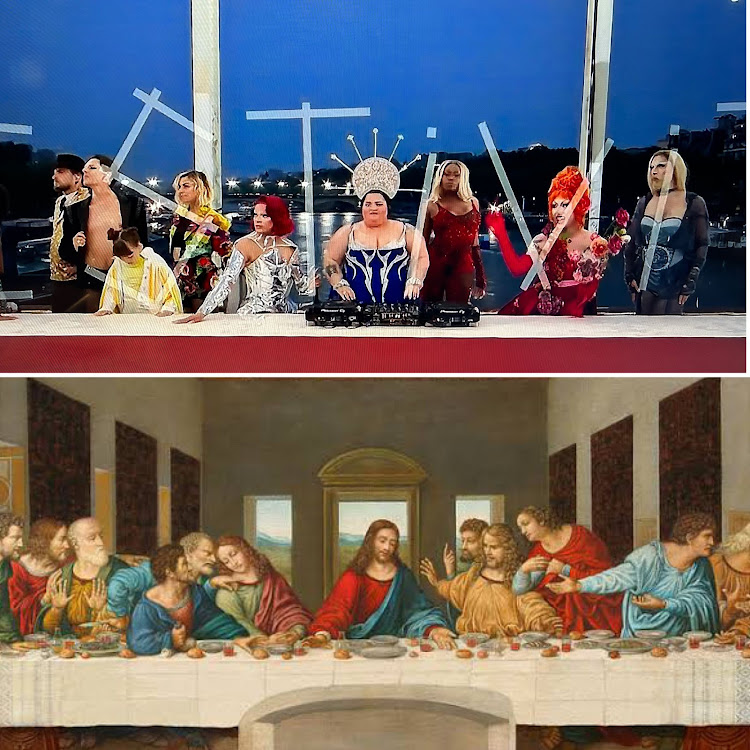
The Olympic Games opening ceremony featured what seemed to have been a parody of the painting from Leonardo da Vinci’s Last Supper; only the members of the supper were represented by drag performers. And, in case you live under a rock or are one of those blissful souls who are not on any social media, the reaction to this has not been positive. The organizers gave a somewhat half-hearted apology, but again the reaction to that has also not been positive.
There is something about all this that feels like the internet just being the internet. Did you know that the Christmas Starbucks Cup is now only green and red? Did you know there is an ice cream store called “Sweet Jesus”? Did you know someone somewhere changed the words to a Christmas song? Excuse me while I yawn and keep scrolling. However, there is something about reacting this way to things in the name of faith that is a whole lot more disconcerting to me.
To put it one way, I think the offense at the offense is worse than the original offense. I remember seeing the display of the Last Supper and thinking, “That’s odd and a bit in poor taste, but if they want to do that, oh well,” and then I pulled up that day’s Wordle to crack (I admit, yes, I still play Wordle). Then I watched post after post of people losing their minds over this, shaming everything from the entire Olympics to the whole country of France to pronouncing God’s judgment over every non-Christian everywhere that wasn’t offended at this. To that, I don’t know what to say to that. In internet-speak: Insert meme where Jean Luc-Picard face palms here.
Perhaps in the grand scheme of things, I just believe there are so many more important things to be upset about. Perhaps, in my old age, I have grown desensitized to internet hoopla. Perhaps, I am the one that isn’t normal. Perhaps, I am okay with that. But if you are reading this thinking, “Yes, Spencer, there is something wrong with you; you as a Christian need to be upset about this,” let me suggest that, perhaps, getting upset makes its own unintended offenses.
Speaking of being upset, I want to take this time to point out an irony that I so often see. I watch right-wing folk complain about how “woke” the left is, how it is always offended at things, and how this portrays a lack of emotional stability or something like that. Well, sometimes, the thing we hate in another is what we embody ourselves, and we just can’t see it. Pause and reflect on that one.
Now, indulge me for a second if you are a Christian. We live in a secular culture. We live in a culture where Christianity has taken on layers of negative connotations based on its past, a past typified by exclusion and violence against various minor groups. Polls suggest that in the minds of the average Westerner, Christianity is associated with words like “homophobic” and “anti-science” more often than “love” or even “Jesus.” Now, you see a display where drag queens replace the figures of a Di Vinci painting of the Last Supper (if that is what is going on here—that is debated), and your first impulse is to say to yourself, “What will further Christianity in a world that no longer sees the value of faith anymore? I know—I have an ace up my sleeve—I’ll rant about it on Facebook!” Let’s pause and reflect on that one.
Is that really a strategy to defend the Christian faith? The organizers gave a half-hearted apology, but even if they somehow convincing gave some sort of “we are really, sincerely, sorry” routine, trying to close the proverbial barn door after all the animals ran out, I really don’t believe this would be a win for the Christian faith. Crying offense often only works when there is a loud outcry, and that means that attempts to shame the culture into respecting the Christian faith can still very much be a Constantinian strategy of power and privilege.
While we are at it, let’s think about who might be on your social media. Are there gay people on your social media? Trans folk? Queer folk? Perhaps not. Perhaps they don’t share that information. Ask yourself why? Can you ask yourself: What do you think they saw? They probably saw the fact that there are numerous other portrays of Jesus in our culture—the blasphemous portrays of Jesus by evangelical leaders in order to support Donald Trump, the rhetoric of “blessing Israel” invoked by some to justify the genocidal actions of the Israeli army in Gaza or just the myriad of other portrayals of the Last Supper in popular art—literally by almost every major TV series—that for some reason does not get people of faith worked up. Yet, Christians got upset over the one that had sexual minorities in it. What does that say? It says, implicitly, that it is not alternative depictions of Jesus that offend me; those people do. Let’s again pause and think about that.
Why did the artistic director of the Olympic ceremony do this? By his own intention, the director did not think he was trying to directly offend Christians. He says he was not even alluded to the Last Supper at all (which may just be an attempt to save face). It does seem that he was trying to portray something of the Greek mythic backgrounds of the Olympic, as well as what current French art is about: its capacity to be over the top, parody previous art pieces, making statements about inclusivity, etc. To that, I would say that if you designed a public portrayal of any religious figure in an unconventional way and did not think it would offend people (or if you really thought arranging the table that way with a centre figure like that would not be taken as an allusion to the Last Supper), you clearly did not think that through. If that is the case, as I said, I thought the display was in poor taste: Surely there could have been better—smarter—ways to celebrate French art and inclusion in a venue like the Olympics.
However, there is something profoundly indicative of our cultural situation where a classic Christian work of art is portrayed with members of a community Christians have often excluded as an act that says, as a culture, “we value inclusivity.” There is also something profoundly ironic about Christians getting angry at an art piece as an “attack” on their faith that fuels the very secularizing impulse that protects these displays in the name of inclusion and free speech. Let’s remember that the very reason, historically, that Europe started secularizing was because, after brutal religious wars, faith was no longer trusted as a discourse to build public flourishing upon. Again, let’s pause and think about this.
How should we defend the Christian faith? Let me suggest that it does not need “defending” at all. Such language implies Jesus needs to be defended, that the ones doing this are our “enemy,” etc. Is that kind of militancy the path forward? I have to ask: How did that go for Peter? What did Jesus do to the very person Peter tried to defend him from? If someone feels that there is a group of people that are the enemies of Christianity, the Christ-like response is to find a way to do good to them. Perhaps, in the name of defending Jesus we have inflicted our own wounds on others Jesus wants us to heal. That should be our reaction. If we are offended at someone representing drag queens at the Last Supper, perhaps the best “defense” is to ask ourselves, “What would it take for these people to feel safe enough, loved enough, understood enough, to be at our table?” Maybe then we will see what the Last Supper was actually trying to depict.
Questions about Communion

Is not the cup of thanksgiving for which we give thanks a participation in the blood of Christ? And is not the bread that we break a participation in the body of Christ? Because there is one loaf, we, who are many, are one body, for we all share the one loaf. – 1 Cor. 10:16-17
What is happening in the bread and wine when it is called the “body” and “blood”?
Some call communion a “sacrament” (a means of grace) and others call it a “ordinance” (a command). I don’t think there is a zero sum game here. God’s presence and grace should be expected when we obediently gather for worship. The grace is intimacy with Christ, which should be expected when we draw close to him in remembrance.
Roman Catholics have taken a rather literalistic view that states that the bread and the wine becomes the body and blood of Jesus. This is called, “transubstantiation” and it has an interesting development. Christianity has always held that Christ is real in communion, and thus, the language of “this is my body/blood” has always been used unabashedly. However, it was only later that Roman Catholics used Aristotelian philosophy to talk about the substance of the bread and wine changing while remaining bread and wine in its accidents: “trans-substance.” This causes an obsession about the material bread and wine that is unhelpful.
This breeds all sorts of weird concerns. What if we spill the wine? Are we spilling Jesus? What if there is bread left over? Are we wasting Jesus?
Protestants, sadly, go to another extreme. The Reformers resisted transubstantiation and talked about Christ being spiritually present in the bread and wine, called “consubstantiation.” This commits a kind of dualism where Christ is spiritually but not physically present, as if the physical is not where he is found.
Further reformers got increasingly more extreme in their anti-Catholic prejudice. They started saying communion is strictly a memorial to the point of saying Christ is not in communion at all. It is just a remembrance. That is too far. How could we not expect Christ to be with us in the fullest real sense when we worship him?
Now, let me go on record and say that I don’t like any of these schemes of thought. I think obsessing about what is going on in the bread and the wine is foreign to Scripture’s concern. We need to just remember Christ, thank him for what he has done for us, enjoy his presence, and commit to living it out. Yet, 1 Cor. 11:16 uses the term “participation in the body of Christ.” Christ is very real in communion, but saying “this is my body” is merely a way of affirming Christ is with us in this entire act.
Why do I say this? While, think about it this way: “For where two or three gather in my name, there I am with them,” says Matt. 18:20. If we gather to worship Christ in his name, we are already the body of Christ. That is why the metaphor cannot be stretched too far.
The entire act has to be taking into account for an understanding of his presence that is not an abuse. Christ shows up always in his surprising grace, but that can never allow us to eat refusing to thank him, remember him, and commit to living out the new covenant. Any theology of communion that allows us to be at one with the cross without having to take up our own crosses (Matt. 16:24) is a perversion.
Also, the language here is important, “one loaf, we, who are many, are one body” (1 Cor. 10:17). Eating is an act of unity. To eat and drink in the time of the fractured church, the time like ours in which we are profoundly aware that there are authentic believers found in churches not of our own, is to eat and drink, hopefully in a way that does not further add to division. So, this leads me to the next question…
How is it practiced?
Well, we should distinguish this question from “How was it practiced?” I say that because the original way the church practiced communion was part of the meal of the “love feast.” Acts 2:42 states that, “They devoted themselves to the apostles’ teaching and to fellowship, to the breaking of bread and to prayer.” Meanwhile, 2 Peter 2:13 and Jude 12 allude to the agape meals. 1 Cor. 11 has the abuse of the Lord’s Supper. The reason it is abused is because it is a love feast. The believers in the church are gobbling up all the food and even getting drunk off the wine, all while the poor, who have not arrived yet, go hungry. Communion was originally practiced as a meal, but the church today has ritualized it
It should be insisted, however, that because communion was a meal, that basic act of eating together, fellowshipping as a church, should be considered spiritual. God means us in the midst of life, and that means acts like eating, especially in the community of the church, should be a place where we see God.
Today there are all sorts of modern ways to practice communion. Some use one load and one cup, still with wine rather than juice, to maintain symbolism; others use pieces of break and individual cups. Some give just the bread in lieu of both; others insist on dipping the bread into the wine, rather than having a cup. Some use a priest figure that dispenses the sacrament; others do so without an official person presiding. The point is not the precise “how.” Whatever way we practice it, it must be loving and conducive to remembering the Gospel.
Baptists tend to avoid hierarchical displays. He hold to the priesthood of all believers (1 Peter 2:5). So, while the pastor typically presides, the emphasis is on the equality of all believers to encounter God together.
Who can take it?
Our church is constituted that “All who confess Christ is Lord may eat.” We do this for a few reasons. First, we are careful to say that communion is the Lord’s Supper not the church’s supper, much less the baptist supper. The Eucharist is the symbol of unity in the church, and if we were to exclude other followers from Christ from it, we would be celebrating it in the sin of division.
Second, because it is “open communion” this means the unbaptized individuals may eat. This is important as to keep in the unity intended in the first reason. If Baptists are the only ones that baptize adults by immersion, and we see this as the only true baptism, it would be getting exclusion in the back door. It would be rather hypocritical to say, “Come, all Christian are invited to the table!” but then say in the fine print, “By the way, we believe that only we are the true Christians!”
This creates some interesting and messy situations where you don’t know who is coming up and where they are coming from. We leave that up to God and that person, but we also hope that as the worship with us we will get to know all our family members better in the church. It should be stressed that communion can only best be appreciated by a disciple, who has committed to walking with Christ, and thus, has been baptized, but again, the age of a fractured church simply does not allow us to vet individuals as the partake. The table is not a place for vetting who should properly be there, it is a place of welcoming the misfits that don’t have a proper place.
There are some who, like John Wesley, that would even allow communion to be the given as an evangelistic opportunity: come and eat and accept Christ. So, for him, it is not just Christ-followers, but those that are accepting Christ in that moment. I think this possibility is valid. It might not have been the normative practice of the church through the years, but we are not bound to tradition in that way when we see opportunities in the Spirit.
After all, the prefigures of communion in Jesus’ teaching are him eating with tax collectors and sinners as well as feeding the crowd of 5000. These prefigure communion because communion represents God’s love to sinners and our vocation to feed the hungry. So, with that in mind, we can never be too regimented in who is in and who is not.
So, all who confess Christ may eat, and perhaps, some will need to “taste and see that the Lord is good,” (Ps. 34:8) accepting Christ as they are invited to eat.
Can you eat of it when you are in sin?
Many Christians practice communion stating that you cannot “eat in an unworthy manner” (1 Cor. 11:27). They take this to mean that no one with an active sin in their lives may eat of communion.
The problem with this theology is legion. First, everyone has sin in his or her lives. We are all imperfect this side of eternity. All believers are waiting the day when God fully restores us. If you remove all the sinners from church, you would not have a church. Learning to have grace on each other as sinners is apart of the grace of the fellowship of the church.
Second, this warning was a communal warning. The passage leading up to this was Paul noting that the Corinthians were eating and getting drunk before the poor could arrive and be fed. This was despicable because communion was meant to be a sign of God’s love to the poor, not an act of exclusion. Paul reminds them that they should soberly examine themselves, then eat. He is referring, however, to the way the church eats together, not the individual sins of the people.
A contemporary example would be the instances where the Catholic Church barred a church from communion. One church during the civil rights debates, in their racist ignorance, barred black people from taking communion. The Catholic church, rightly I think according to their polity, removed their power to serve communion because of the unloving manner their racism caused. Baptists don’t have a hierarchical authority that revokes the power of communion, but I think the sentiment is correct.
Third, all that considered, we should use communion to examine ourselves personally. We cannot do otherwise when coming into the presence of God and remembering what he has done for us. However, notice what is being done there. When I eat at communion, I come to the table, not because I am perfect, but because I seek Christ’s perfection for my life. I do not refuse to eat until I am healed as a sinner, I am invited by Christ as a sinner to come to his table and be healed. The notion that we need to fix ourselves in order to be in God’s holy presence is extremely contrary to the way of the Cross, where God in Christ, in all his holiness, became sin to offer us new righteousness and life (2 Cor. 5:21).
If you ever feel like you are unworthy of eating the bread and the wine, that is probably a good indication that God welcomes you all the more to his table.
 Spencer Boersma