
Tagged: Mercy
Laying Down the Stones: God’s Mercy and John 8
Preached at Billtown Baptist Church, Sunday March 22, 2026.
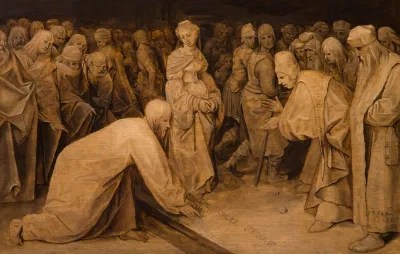
1 while Jesus went to the Mount of Olives. 2 Early in the morning he came again to the temple. All the people came to him, and he sat down and began to teach them. 3 The scribes and the Pharisees brought a woman who had been caught in adultery, and, making her stand before all of them, 4 they said to him, “Teacher, this woman was caught in the very act of committing adultery. 5 Now in the law Moses commanded us to stone such women. Now what do you say?” 6 They said this to test him, so that they might have some charge to bring against him. Jesus bent down and wrote with his finger on the ground. 7 When they kept on questioning him, he straightened up and said to them, “Let anyone among you who is without sin be the first to throw a stone at her.” 8 And once again he bent down and wrote on the ground. 9 When they heard it, they went away, one by one, beginning with the elders, and Jesus was left alone with the woman standing before him. 10 Jesus straightened up and said to her, “Woman, where are they? Has no one condemned you?” 11 She said, “No one, lord.” And Jesus said, “Neither do I condemn you. Go your way, and from now on do not sin again.” (John 8:1-11, NRSV)
So, Pastor Angela asked me to speak on the next sermon in this series on the rocks of the biblical narrative. When she told me that the next passage was going to be John 8, I was excited but also a bit nervous. John 8 is one of those passages that is powerful but also perplexing.
Let me put it this way. When I was in college, I took a course on the Gospel of John my freshman year. I loved it. As preparation for the course, the professor made us read the whole of the Gospel of John in its entirety twice before we began. I had never done that before, and when you read the Gospel of John all at once in one sitting from start to finish, you start to realize just how poetic, beautiful, emotionally charged, even thrilling, the Gospel of John is. If you have never done that, I would encourage you to.
And if you do that, you will find as I did, there are so many cherished passages: John 3:16, Jesus washing the disciples’ feet, Jesus giving his disciples the new command of love, or the promise of the Holy Spirit. But one of my favourite passages is this one right here: Jesus defending this woman caught in adultery.
The course dove into the book chapter by chapter, and so, the week came around that this passage was next. I was eagerly looking into my textbook to learn more. What was Jesus writing in the dirt after all? But I noticed in my textbook, which was a commentary, this section was not treated. The commentary began at verse 12 and simply offered this explanation: “This passage is not in the originals so it doesn’t belong in the Bible. Therefore it will not be treated as such here.” Oh. The commentator, a respected conservative evangelical New Testament scholar, dismissed it and moved on. “What?!” I thought, “Are you telling me this beloved passage actually isn’t part of the Bible?” As you can imagine, I was a bit thrown off (and maybe you are too—maybe you feel a little bit like the rug has been pulled out from under you as I did). Ever since then, I have pondered this passage and researching it, wondering about it.
Now, before we even get to what God might be telling us in this passage (which I do believe God very much has say something to us through this), we must ask the difficult questions of this passage: Where did it come from? Does it actually belong in the Bible?
For those of you who think I or my textbook have suggested something farfetched or even blasphemous, you can look at any Bible like the ones in our pews (I checked before the service). All of them will say in the little footnotes in the bottom, something like, “not in the earliest manuscripts.” So, don’t shoot the messenger.
I admit I felt tempted to just skip over this issue and pretend it was not there. Most of us would be none the wiser. However, I feel like we owe it to ourselves to be honest with this. Woe to the version of Christianity where you cannot talk about the tough parts of the Bible! Perhaps you have seen that line in the footnotes and wondered. I remember seeing that line in the footnotes in my NIV Bible when I was in high school, when I first read through my Bible. I asked my pastor about it, and he more or less just struggled it off as nothing important and said all we need to do is keep believing. That answer did not really satisfy me and I can’t imagine it satisfying you either.
So, when it says that this passage is not in the earliest manuscripts, what does that mean? One thing that is fascinating to study is the history of the transmission of the manuscripts of the New Testament from the earliest times to now. If you do that kind of study (which I admit some of my colleague are much better studied on this subject then I am), it overwhelming shows just how meticulous and faithful the copies have been preserved from generation to generation.
But I have to admit this instance is one of those head scratchers: This passage first appears in the copies of the Gospel of John in the third century. Why did this passage all of a sudden get tacked on at the bottom of a manuscript of John’s Gospel in the third century? If this is the case, why is it still in our Bible despite Bible translators knowing about this?
Does this mean the Bible has been corrupted and we, modern folk, are just cluing into the conspiracy? Is this like something out of a Dan Brown novel, where the truth has been hidden for centuries by some evil secret order of the church? That is where our mind goes because we live in a culture that is deeply sceptical about institutions and claims to authority.
Well, the reality is actually less exciting. It seems that the Bible copyist in the third century tacked this passage on because he really did feel this was an authentic account of Jesus’ life. It was meant, it seems, like some kind of appendix to the Gospel of John, noting there is another memory of Jesus’ life that the copyist wanted to preserve. Over time, later copyists simply copied it into the main text of the Gospel of John.
But later copyists wondered about this passage, and they would often copy it with the rest of the Gospel of John but put a note around it, flagging that they were not sure if it was original. Copyists have been doing that since the third century to the modern day.
Well, those are the facts. As I said, that is not as exciting as Tom Hanks uncovering a conspiracy as the illuminati chase him, but there it is. That is the non-sugar-coated truth about this passage. So, why did this copyist, two centuries after the events of the New Testament think this passage was an authentic story of Jesus’ life? What gave him the gall to tack it on to the end?
Well, the only reason I see as to “why?” is that there was a common understanding that this was a short memory of Jesus. In fact, there are writings from just after the time of the Apostles where their students and successors talked about what they had been taught. One of these people is a man name Papias, who lived from 60 AD to 130 AD. So, he was a young man when the Apostles were old. Papias was a church leader and, in his writings, he talks about how the Gospels were written by the eyewitnesses of these events and that is why they are trustworthy.
But, of course, there were many more eyewitnesses of Jesus’ life and deeds than just the writers of the New Testament. What is also interesting is that Papias also talks about a story about how Jesus intervened when a woman was caught in adultery. So, it seems like this is a story of Jesus’ life that the early church knew about.
It seems that this cherished story was passed along from generation to generation until it was finally tacked on to a manuscript of John’s Gospel in the third century.
This passage may have been written by an apostle or at the least may trace its origins to an eyewitness to Jesus’ life, who that was, we don’t know.
This passage does not seem to have been added out of any deceitful intention. It looks like the copyist really did think this was legit and wanted to preserve it.
Well, what do you do with that? As I said, my textbook in seminary insisted it should be taken out of the Bible. Perhaps, you feel the same. If that is the case, this sermon could have been much shorter.
On the other hand, one New Testament scholar, far from wanting to take it out of the New Testament, has argued it should be left in and we should recognize it as something like a very short “fifth Gospel.”
Others think that maybe God was up to something in having this story come into the New Testament. Perhaps the whole thing was providential rather than scandalous.
I will leave you to ponder that, but for me, perhaps the most interesting argument for seeing this as part of the New Testament is not in my mind the level of certainty I have about where it came from. It is what it says.
When it comes to what is says, we can at least recognize, as whoever it was that copied it down centuries ago, that this story really does sound like the Jesus of the rest of the New Testament. This story sounds like something Jesus would do.
On that note, I think we can continue to ponder all the perplexities of where this story came from, how it got into the New Testament, and what that means for how we understand the nature of the Bible as inspired and things like that. Those are all interesting questions that I continue to ponder and think about—and I continue to ponder them because, I would hope to impress on you that God very much wants us to ponder these questions; God is not threatened by us asking difficult, honest questions, nor do I believe that the central truths of the Bible are harmed by the existence of a difficult passage like this. We can continue to ponder and think about these questions, but as we do, we can also ask God, “What are you trying to say to us with this passage?”
When we ask that question, there is little wonder then that the church, even Christians that knew about these complications about its origin, have nevertheless cherished this as a story that profoundly speaks about who Jesus is. Jesus challenges hypocracy and condemnation with mercy. That sounds like who Jesus is from Matthew to Revelation.
As one Canadian Baptist writer, Stanley Grenz, once put it, the “Bible is the book the Spirit uses.” This story, despite all the questions we might have of it, is a text that the church has heard something from the Spirit for the last 1700 years.
What is the Spirit saying? This story challenges us with Jesus’ prophetic mercy and justice.
A woman, who is caught in adultery is brought to Jesus while he is teaching and a crowd has gathered. Jesus is stealing the show from the religious leaders, so they try to do something about it. She is brought to him in order to test him, to try to trap him. They try to do this in other instances. Think of them coming to ask Jesus about taxes, seeing if he will say something against Roman taxation that will get him in trouble, but Jesus brilliantly says to them after getting them to point out that Caesar’s image is on the money they love so much, “Render unto Ceasar what is Caesars, and what is God’s onto God’s.” Jesus outsmarts them.
Here they try to see if they can pit Jesus’ compassion against his message of justice. Jesus has been eating with tax collectors and sinners, enraging the religious leaders. By included these people, he is robbing the leaders of their status. So here, they try to force his hand: Will he condemned her to death and contradict his practice of showing mercy to the unworthy? Or, if he doesn’t, then they have him explicitly refusing to carry out a command of the Bible.
After all, there is a law in the book of Deuteronomy that said if a couple is caught in adultery, they are to be stoned. If Jesus resists having her stoned, they got him. Or so they think.
Of course, one cannot help but notice how the law says that both the man and the woman who are caught cheating should be stoned. Interestingly enough it is only a woman. Where is the man?
Also, the law stated that witnesses had to be brought forward and a formal trial had to take place. That is not happening here.
This woman—while she by all accounts seems to have the act in question—she is also a victim of sexist injustice. You don’t need to go far today to see this happening today: cover-ups instead of inquiries, sex scandals in the church where the male leadership protects other men while the woman gets scapegoated.
So, are these religious leaders even interested in justice? It seems they are only interested in their own deeply skewed, self-serving version of it. Again, you don’t have to go far to see examples of that today.
It looks like Jesus sees through this. But how does he respond? He does kind of a weird thing: Jesus starts writing in the dirt.
Weird time to start doodling, right? What was Jesus writing in the dirt? We are not really sure, but there is a passage in the prophet Jeremiah that says that God writes the sins of the people in the dirt, and so, some wonder whether Jesus was writing the sins of the religious leaders down in the dirt, and this is one of the things that spooks them, pressuring them to back off as Jesus says, “Let he who is sinless cast the first stone.” Subtext: You’re not, and you need to get off that high horse.
When we look at the laws of the Old Testament, there was nothing in them that said you must be sinless in order to carry out an execution. Yet, for Jesus to declare this, he is in essence challenging the religion of his day to step further into God’s justice, true justice. The laws of the Old Testament where just the beginning of the journey God has us on, teaching us and leading us into deeper and better ways of living.
In the Old Testament, God begins to teach us justice and fairness, that there are consequences to sin that we need to take seriously and avoid. But are the consequences the point?
It should be noted that the early church, while the Old Testament had laws that had the death penalty, based on who they understood Jesus to be, we see that they simply stopped practicing it. Jesus revolutionized how they saw their scriptures.
Abraham Joshua Heschel writes, “Justice dies when dehumanized, no matter how exactly it may be exercised. Justice dies when deified, for beyond all justice is God’s compassion.”
If you think faith is about how right we are and how evil everyone else is, how people deserve punishment and how we are safe, you have missed the point.
It has been said, “If justice is an eye for an eye, the whole world would be blind.”
And the sad reality is that many Christians are blind, and when we are they inevitably give our vices a free pass and judge the vices of others as so much worse and unforgivable.
These folks come to Jesus trying to trap him and they are the ones that end up getting trapped. They come to Jesus trying to get him to contradict his message of love and compassion using the law of God, but in the process, Jesus exposes how they are the ones who fundamentally don’t get what the law of God is about.
Jesus starts writing in the sand, some think he starts recounting their sins, and then he dares them: The one who is without sin, cast the first stone.
The Prophet Micah says, “And what does the Lord require of you? To act justly and to love mercy and to walk humbly with your God.”
Justice, God’s justice, can only happen when we are merciful and when we stop thinking of ourselves as better than others.
So, the leaders are caught, do they come forward to throw the stone, if they do that, they will look really arrogant, and I think they realize that. They are the ones who are caught.
And so, each leader sheepishly drops their stones and slips away, leaving just Jesus and the woman.
Jesus turns and says, “Where did everyone go?” And of course, Jesus, who actually is one who is sinless, he turns to her and simply says, “Well, if they don’t condemn you, I don’t condemn you. You’re free. Go and have a new life.” Jesus frees her from condemnation and frees her for a new life.
This end of this story feels all too familiar for what else we know about Jesus: The woman at the well joyously goes and tells everyone she knowns what Jesus did for her. Zacchaeus the tax collector is so overwhelmed at the hospitality of Jesus, he changes his life, repaying several times over what he has taken from other people. Jesus’ compassion and mercy transforms people.
This is what the message of Jesus does today.
One time a number of years ago, we were doing a community meal with the church I pastored. At this meal one man showed up. He didn’t look too good. He ate his food. I said “Hi.” He proceeded to want to chat. But he started asking questions. You could tell these were really loaded questions.
He turned to me, and asked, “You’re a pastor right?” “Yes, I said.” “You know about God and stuff, right?”
“I try my best, yes.”
He turned to me and asked, “Is it okay to kill in war?”
I stop, and asked, “what does that question mean for you?” He tells me he has seen war.
We did not get to finish our conversation, but a little while later, I hear this man has ended up in the hospital. So, I got to visit him.
I sit down at his bedside, and he we start chatting. He asks me again, “Is it okay to kill in war?”
I ask again, “What happened to you?”
He told me that he served in the military and he was deployed in a war-torn area. The areas was an area that was ruled by a war lord that had recruited child soldiers, and one kid came at him, and he killed him.
He confessed this to he and I quickly realized, this burden of guilt, the trauma, has been consuming him for years. He felt like he had done something truly unforgivable. His life was marked with this sense of being condemned. Drugs and alcohol, I think for him, was self-punishment.
It wasn’t any use trying to convince him that war is tragic and it was self-defence, at the end of the day, he still had this memory that he kept reliving.
So, I prayed with him and I asked him to close his eyes and imagine that Jesus was in the room with us and just rest in that fact. This is an exercise called imaginative prayer. I read a number of scriptures. I can’t remember if this scripture was one of them.
After a bit, I asked him, can you picture that child, but this time, picture him with Jesus. He agreed to. Is he in a good place now? Yes he said. Is that child hurt anymore? He said no, he is with Jesus now.
I asked him, if he was willing to picture his wrongdoing, to picture it like a box in his hands. He agreed. And I asked him, can you give that chest to Jesus? He agreed.
At this point, he turned to me, with his eyes closed, and he said, I see Jesus taking that box from me. Jesus walked over to a well and he through that box down a well so that it was no more.
I was not expecting that.
I don’t pretend to understand everything what that person saw at that very moment, but I do believe this person realized then and there that Jesus did not condemn him and that Jesus was freeing him from the darkness of his past.
He realized for the first time that God is not the exacting judge in the sky, waiting for us to fail, delighting in pronouncing judgment against us when we fail. God is love and mercy and forgiveness.
If God is revealed in Jesus, God has died the penalty of sin—our penalty—at the cross for us, all to show us that God’s will, God’s justice, is mercy.
If that is the case, if God is willing to invest his very life in us, as I got to say to that person that day and what I am here to tell you today, I just don’t believe that God has given up on us.
The only reason we believe God’s grace is limited is because we are limited people and we have such a hard time fathoming that God is truly love.
As I saw vividly that day, whether or not God is gracious and merciful is not an abstract notion: it can literally make the difference between life and death.
God is not up in heaven holding a stone.
God is with and for us and we can trust it. Can you trust that today?
Can you trust it enough to lay down your stones? Cause we all have our stones. The stones we condemn ourselves with; the stones we condemn others with.
Some of us we cling to that because it’s all we know. We cling to it because freedom is frightening; we cling to it because, at the end of the day, we really don’t want to face the reality that the people we condemn are just like us.
But what if God really does not look at us and divide us up into worthy and unworthy, righteous and wicked, allies and enemies—what if God just looks at all of us, every single one of us, and he simply sees his beloved child; he sees all of us as his family, not one more loved than another? That is an unsettling thing to ponder for what means for our laws, our privileges, our status and place in this world.
What if that whole way of thinking is what Jesus is asking us and that woman to be liberated from when he says, “Go and sin no more”? Are we ready to lay down our stones and step into God’s mercy?
Let’s pray…
 Spencer Boersma