How (Not) to be Patriotic (Part 1): Understanding Culture and Faith

Canada_flag_halifax_9_-04

My wife and I, on our honeymoon, did a Mediterranean cruise. We saw Malta, Naples and Pompei, Rome and the Vatican, Florence and Pisa, and finally Cannes, France.

Florence was a gorgeous city. We toured the city’s cathedrals, and through the streets we saw statue after statue, all by walking along very picturesque cobble stone roads.

We came to the city center where the Duomo was. This is a massive cathedral constructed by the same architect that did the St. Peter’s Basilica. The baptismal chapel on the one end of the Duomo has gold gates, called the “Gates of Paradise,” lined with plates of biblical artwork.

I remember thinking, we really don’t have stuff like that in Canada. We don’t have the depth of history like a place like Florence does.

The tour took a break and so I want to the bathroom. As I was washing my hands, one of the other people on the tour started talking to me. Apparently it was acceptable to talk to others in a bathroom in his culture.

“Are you enjoying the tour?”

“Yes, the gates were awesome,” I said.

“You’re an American, yes?” he asked.

Of course, I replied, “No, I’m Canadian.”

To which he replied with one of the most insulting things you could say to a Canadian in that instance: “Oh, same thing!”

If this was hockey, the gloves would have come off!

So, I turn to him and asked, “Your ascent – its Irish, isn’t it?”

“No, I am from London.”

To which I replied, “Oh, same thing!”

Now, since then, that story has caused me to reflect on what it is to be a Canadian. What does it mean to be a Canadian? Are we, as John Wing joked, “Unarmed Americans with healthcare”?

This is not as obvious a question as it sounds. Yes, I was born in the area in between the Pacific, Atlantic, and Arctic Oceans, North of America and South of Greenland, but that does not tell us much about what it means to be a Canadian. That’s geography. However that may tell us something or two.

“Canada [geographically] is like an old cow. The West feeds it. Ontario and Quebec milk it. And you can well imagine what it’s doing in the Maritimes.” – Tommy Douglas

My apologies to all the Maritimers in the room.

Anyways, what I am talking about is being a “true Canadian.” Is there such a thing?

Do Canadians have a particular culture? We love hockey. We love camping. Outdoor sports in general. Everyone in this room knows what it is like to walk out of your house in the winter and breathe in -45 degree Celsius air.

Canadian food: Maple Syrup, bacon, Nanaimo bars, poutine with globs of gravy and cheese curds, beaver tails, etc.

We like to drink unhealthy amounts of coffee, double double. We get our milk in liter plastic bags, not jugs.

Our money is all sorts of goofy colors, and for some reason, the Canadian mint is slowly turning all our bills into progressively larger coins. The 5 and 10 dollar coins are coming, people. What then? I think eventually we will have 20 dollar coins the size of frisbees and eventually 100 coins the size of manhole covers!

We have iconic figures like beavers, moose, the Canada goose. We are apparently really proud of our wildlife!

We sort of go to those kinds of things in order to understand ourselves, but those kinds of things are pretty surface level and outward. That does not tell us a whole lot about us. Hopefully there is more to us than that.

The fact that we have receded into those kinds of cutesy notions of who we are shows what the Canadian media philosopher Marshall McLuhan said decades ago:

“Canada is the only country in the world that knows how to live without an identity.”

McLuhan was the man that stated, “The medium is the message.” Canada had these brilliant culture philosophers like George Grant and Northrop Frye that no one really remembers today. It’s kind of sad.

Anyways, we are a pluralistic, multi-cultural society, not culture but a set of cultures, and that leads us to feel a sense like we don’t have a uniform set of values. We often don’t feel like we know who we are deep down as Canadians.

However, interestingly enough, while many Canadians are unaware of it, there is a bizarre consensus in Canada on values.

In college I read the book, Fire and Ice: Canada, the United States, and the Myth of Converging Values. It was a bit of an eye opener. Canada, according to sociologist Michael Adams, is becoming very different from its American counterparts. We are similar to Americans, but as far as values goes, the presence of America to the South of us as caused us to be increasingly different form them on lots of stuff.

That is one way of saying who we are, isn’t it? Canadians are not Americans. Whoever we are, we ain’t that. We are proudly not that.

We always define ourselves in terms our brothers and sisters to the south. Pierre Trudeau once likened North America to a bed where Canada was a beaver trying to sleep next to a raging Elephant (the US).

And while Americans assume they have a more uniform melting pot kind of culture and Canada has a multi-cultural, diverse culture, Canada is actually far more uniform from sea to sea than the US. That’s ironic.

In values of Authority vs. Individuality and Survival vs. Fulfillment, American regions are very diverse: the Deep South is strongly Authority-Survival, South Atlantic is Individuality-Survival. Some states were closer to Authority-Fulfillment while others closer to Individuality-Fulfillment. Meanwhile, all Canadian provinces fell within the Individuality-Fulfillment quadrant.

What does that mean? Here are some of his statistics: Only 20% of Canadians attend church weekly versus 42% for Americans. Only 18% of Canadians feel that the father must be Master of the house versus 49% for Americans. 71% of Canadians felt that a couple living together were family versus 49% for Americans. Only 25% of Canadians were prepared to take great risks versus 38% of Americans. Only 17% of Canadians feel a widely advertised product is probably good versus 44% of Americans

Adam’s said, and I think this sums it up well: Americans would be more likely to brag about a new car; Canadians more likely to brag about the trip they went on.

Adams feels that “an initially conservative society like Canada has ended up producing an autonomous, inner-directed, flexible, tolerant and socially liberal people. On the other hand, “an initially liberal society like the US has ended up producing a people who are materialistic, outer-directed, intolerant and socially conservative.”

Now, here is the important question for today. Does that make our culture the right one?

According to the news, people from both American and Britain have been googling “How to move to Canada” at record rates, but I think that is short-sighted.

I don’t think anyone of them is necessarily bad or good. I see things like and things I am concerned about in those statistics. Sure there are cultures that have strong education or have less crime or promote religion. However that can all have good aspects and bad aspects.

Of course, if we said that Canada’s culture was the best,  we would be saying that out of bias, and we would also be failing to cultural arrogance, which is not good.

The fact is that you can take your culture in a good way or a bad way. You can’t blame your culture for stuff you know is wrong. Any culture has upsides and downsides. The point is to be aware of it. There will be extremes. Culture is not necessary a thing to be opposed in faith, but is something to be understood critically, placing our faith and discernment first. We need to celebrate the good and work at eliminated the bad.

Christians have usually two dangerous responses to our cultural identities:

(1) Isolation: Churches that Retreat from Culture

This is very common of fundamentalist churches. Our culture is bad, impure, evil, so lets huddle in our faith bunker where it is safe.

Churches that get isolated don’t use the goodness the Spirit of God has planted in the culture to use to communicate the Gospel. Paul knew this when he spoke to the people at Mars Hill.

There is no such thing as a culture-less church. No church is free from culture. God did not intend it that way. The Bible was written within a culture of its own, but the Word of God speaks to all cultures. The church should be working to promote the best of culture. The point is discerning the good from the bad.

It is not weather we will have a Canadian culture within us or not, the question is will we be aware of it and response appropriately.

Canadians are more skeptical about consumerism and war, and more hospitable to immigrants. That’s good. I think Jesus was too!

Canadians are individuals that value strong relationships over institutions and programs. That is something we can work with.

Canadians might be skeptical about religion, but they are open to talking about justice, spirituality, ideals, and values. In a round about way, that sounds religious!

Lots of people want to lament that our culture is becoming less Christian. That is true in one way, but that does not mean the Spirit has stopped working in our culture to make opportunities for the Gospel.

(2) Accommodation: Churches Claim All Culture for their Own

The worst example of this in history is when Emperor Constantine in the third century made Christianity the state religion. To be Roman was to be Christian. To be Christian was to be Roman. Roman law was ordained by God. The church went to war against Rome’s enemies.

We saw horrific examples of this in Nazi Germany where the state church proclaimed Hitler to be chosen by God to bring glory back to Germany.

We see the same in the British Empire. Where the Anglican Church sanctioned colonialism. The British colonized half the world and now complain about immigrants taking their identity!

We see this also in America today, sadly. American wars for oil have become evangelical crusades against Muslims. The American motto of “life, liberty, and the pursuit of happiness” is preached as gospel in some churches.

We Canadians can do the same.

I think ours is a culture of apathy and skepticism. We have allergic reactions to organized anything, except organized sports. We have trouble committing to community. We are terribly afraid of offending people with the truth. We are individualists that don’t know who we are and don’t want you to tell us.

That comes out in our religion.

We say stuff like, “I believe Jesus in my Lord and Saviour, but that is just my personal opinion.” (A joke often made by the ethicist, Stan Hauerwas).

We are multi-cultural, which is great. But also we have allowed tolerance to go a bit too far. There are two kinds of tolerance, by the way. One kind says, “You are different from me, so please help me understand you, and let me make a space for you, so that we can have peace.” That’s good.

There is bad tolerance that says, “I don’t know you, I don’t care, you stay out of my business and I’ll stay out of yours. If we bump into each other at Foodland, lets have a shallow conversation about the weather or local sports team, but not anything meaningful, let along religious.”

We are terribly afraid of speaking truth and very afraid to commit to organization and community. That fear has caused us to shrink back from opportunities to encourage people with the Gospel. We are so afraid of offending people that we miss opportunities to encourage.

When we think about our nationality, we have to be critical. We are called to be “in the world and not of the world”

We need to understand that there is good and bad in our culture. We need discernment to that we do not fall into nationalism. Being Canadian can be a good thing, but not necessarily.

This is why we look to how we are apart of another nation: the kingdom of heaven…

Peeing in Peace: A Sermon on the Transgender Bathroom Laws


bathroom

“I did not even know theologically that these people could exist.”

This is what a pastor told me as we sat chatting at his house for lunch after service several years ago. I spoke at his church and my message was on drawing close to the love of the cross. Recently a friend of mine then had came out to his church and was driven out. He went suicidal, and seeing the whole thing, I was outraged at those Christians. One of my points challenged them to stop their hatred and conditional love of sexual minorities and thus to truly embrace the fact that we are all justified by faith not by works.

I thought this would be a controversial sermon, but it was met with unanimous approval. One lady even came up to me and said, “Pastor, what a fine sermon. One day you will become the next John MacArthur!” I choose to take that as a compliment.

At lunch the pastor turned to me and expressed that he also felt challenged by what I said. He told me that he was doing door-to-door evangelism one day – God bless him! – and a person greeted him and let him come in. As he started talking, the person shared startling information. This person appeared female, but was actually “intersex,” meaning that while she appeared mostly female, she had both male and female genitalia. Neither she nor the pastor I spoke with shared specifics beyond that.

She turned to him and said, “Do you honestly think that if your church knew this about me that I would be welcomed in your church?”

The man sheepishly tried to respond, and as he did he looked around and saw the pictures of her family. She apparently had a lover, who was female, and they had a child.

Overwhelmed, he turned to her and said, “Honestly….nope, my church would freak out.”

So, he thanked her for her time and dejectedly left. And as he turned to me, he uttered a statement indicative of the grand mess the church with its uncritical beliefs has gotten itself into:

“I did not even know theologically that these people could exist.”

For him, he believed that there was male and female and that was it (which is a pretty bad way to read Genesis 1-2). If you don’t fall into those comfortably, it’s your choice, your fault. However, in doing so, his beliefs prevented him from not only reckoning with the basic facts of life: that intersexed people (and this is something different than transgender) exist and they were born with both genitals in some way. It also prevented him and his church from having grace on people it should have been showing grace to. He admitted to me with deep shame that his church was not prepared to love the unloved.

The way we talked about this person was a matter of ministry: is this person loved by God? Is there a place for her in our church? Those are the important questions of us as a church. However, people are talking about this issue in regards to politics…

Once upon a time our laws were blissfully naïve to the existence of the full range of the children of God. Women went to the bathroom that had a person with a dress in it; men to the one with a person in trousers. We are told that trans-people have always been around, and it seems like these people used the bathrooms that best corresponded to how they looked, and the watching world was none the wiser. If they did go to a bathroom that did not correspond to how they looked, they did so at risk of ostracization and even being beaten up.

Lawmakers did one of two things: institute laws that prevented trans people from using bathrooms of their current gender or institute laws that protected them, giving them the right to use the bathroom of their current gender. Either way, people were not happy.

Now, I am going to talk about a sexual topic today, which we have to say always makes people squirmy. Sexuality is a dimension of the human person that is closest to who we are at our most vulnerable. Therefore, we are the most guarded and sensitive about those topics.

Obvious proof of this: how many couples here even go to the bathroom while their spouses are in the bathroom with them? I don’t like to even with my spouse being near me, let alone another man, let alone anyone else. Thank-you very much.

There was an East Side Mario’s in Hamilton. In the men’s washroom, there were urinals. Anyways, I went to the bathroom there, and I found that the urinals were only about a foot apart. No barriers. Another guy came in. He obviously had to go. Came up to the urinal beside me, and started going. Our shoulders were touching. I couldn’t stop. He couldn’t stop. It was very traumatic for the both of us.

All of that is to say, matters like sexuality, we are more sensitive to. People naturally will get upset about these kinds of things no matter what people say. People make knee-jerk reactions based on their sexual-disgust feeling. Evangelicals are particularly susceptible to this. They are ironically “liberal” reading their experience of bodily shame into Christian ethics. Where guilt and shame-based preaching abides, evangelicals fixate on matters of sexual disgust as their core political concern, forgetting far more grievous social sins. I have heard evangelical pastors say really idiotic stuff like, “I am not homophobic; I just think the whole gay thing is disgusting.” Dietrich Bonhoeffer noted this when we visited the U.S. He thought evangelicals resembled gutter journalists, obsessed with what people did with their genitals to the neglect of all other ethics. I think that is more or less true.

So, keep that in mind, and now let me sketch out a timeline of this kerfuffle.

Most people don’t even know that the legal battle in Canada is a done deal. A transgendered person can use any public bathroom that they feel corresponds to their gender.

In Canada, in 2012, the NDP proposed Bill C-27, which amended the criminal code to protect other “gender identities.” If you remember the Conservative party was in power at the time. Over the next few years, it went through various readings, eventually being fully passed in 2013. What is interesting about his (and you can look up all the transcripts of debates and votes on the internet) is that the bill would not have passed if 30 some odd votes were not given by conservative MP’s. On most of the votes that happened on Mar. 20, 2013, the bills were passed by 150 to 130, give or take. The 20-30 votes that were needed to tip the bill into being passed came from the conservative party.

This means the party could have prevented the bill if its leader demanded uniformity (which he often did). This to me smacks of the lip-service conservatism that says it is pro-life but does nothing about it (Harper actually quashed his own MP’s from trying to talk about it), or in this case, says it is against a bill, but lo and behold, supplies just enough to get the bill passed, but not enough for it to look like the conservatives supported it.

I say that because I am very weary of any political party claiming to be the “Christian option” in this day and age. At least as far as I understand the conservative party in Canada, it does not seem like the definite traditional-Christian party anymore. It seems like a house divided at best. This does not mean the liberals are “the Christian” option either, or the NDP. Christians are called to affirm that Christ is King and all other politics authorities are secondary.

I find in politics there is very little integrity. Politicians refuse to admit their faults. They will argue their points, even if they know they are wrong. They will demonize their opponents to win. They often have ulterior motives: making a corporation rich or appealing to a voter base. For that reason, Christians should always keep politics at arms length. Only the kingdom of God will restore society, not a liberal utopia or conservative nostalgia. We are not going to build the kingdom of heaven by who we vote for.

At any rate, the Bill was met with interesting protests from trans individuals. Take for example, Brae Carnes (first picture below), who posted in male bathrooms, exposing the obviously problem of making all transgendered people go into bathrooms that did not match their identities. I don’t think any conservative would want a person that looks like the next two individuals in women’s bathrooms either.

The issue changes when it has a face doesn’t it?

I think intuitively when you see just how far transitioned these people are that it would not be a good idea to force them to go to the bathroom of their birth gender. But there are lots of transgendered people that do not look that much like their transitioned gender. For them, going to any public bathroom will still be dangerous.

Many conservatives did oppose the bill under the notion that it put women and children at risk. Potentially a predator could come into a woman’s bathroom and claim to be a woman, and refuse to leave. There are a handful of examples that show laws the protect transgendered people have been manipulated by sexual predators. For instance, a man claimed to be transgender, and used it to living in a woman’s shelter, committing acts of sexual assault. There are those examples.

Certain places in Canada installed gender-neutral, co-ed bathrooms. I remember using one of these bathrooms at University of Toronto. Apparently these bathrooms were quite unsafe. They certainly were awkward.

Then HB2 hit. While Canadians dealt with this debate rather quietly and civilly, as we often do, for good or for ill, but when things happen in America, it happens like singing a bad campfire song again: “Second verse same as the verse, a little bit louder a little bit worse!”

North Carolina passed the law allowing organizations liberty to enforce that a person ought to go to the bathroom of their birth-gender.

The company, Target, refused. They said, if you are trans-gendered, you can use whatever bathroom you feel meets the gender you feel. Note that they are merely exercising the rights that HB2 gave them.

Conservative family values lobbying organizations protested this and organized a boycott of Target of almost 1.1 million signatures. I think organizing a boycott like that is foolhardy. Even if you are morally outraged at Target, there are so many more immoral companies out there that Christians are not boycotting, so by doing this to Target, this portrays that Christians really have uneven standards.

Also, think about it this way: Would you appreciate a company refusing to sell to you if it knew your religious convictions? Lets say an atheist bakery refused to bake bread for church communion? We would be outraged at the pettiness. Yet this is why I cannot see those conservative Christians they would refuse to bake a cake for a same-sex wedding as anything but petty.

In wake of this, two particularly disappointing things happened:

First is that there is a story of a woman, who had short hair and was athletic, was followed from the woman’s bathroom and harassed by Christians in a public place because they did not believe she was a full woman. Now Christians are the ones straight people need protection from!

Second, the leader of one of these family values political lobbyist groups, Sandy Rios of American Family Association, admitted in an interview that her organization actually sent men into women’s bathrooms to scare women and children into agreeing with her agenda. That is the height of hypocrisy. Her organization claimed to be about protecting women and children from men in their bathroom, yet they are the ones sending men into said bathroom all for the sake of their political agenda. What if one was, as they argued, a woman that was raped? Again, there is this odd necessity to now protect bathroom from Christians.

We should note that if this is true, the American Family Association has very likely put more men in women’s bathrooms than there are instances of sexual predators abusing transgender laws. While there have been instances of sexual predators abusing transgender laws, these instances are very rare. With good reason: How many times do you think a predator can get away with doing that? Predators need absolute secrecy, and it seems like only the really stupid ones would try to do that.

But given the whole debacle, the whole thing is really quite sad. Just plain sad.

Personally, I find the conservative politics the most abhorrent. It is mostly because Christians often back conservative politics, so there should a higher expectation of moral integrity, which is not there. But perhaps it is my own disappointment with the party I was raised to support. While liberalism worships sexual liberty in a problematic way, Christians who support conservative politics routinely come off as condescending and apathetic towards others. Evangelicals routinely ignore basic science on matters of gender. The persistently make one issue about another. Do conservative evangelicals really care about transgender people? Or do they just want their political sensibilities validated and codified?

They sound like they just want the church to flex its muscles and the world to bow down to them and wave fans at them for being so right. That’s probably most sad part.

Personally, I would rather say, “I don’t know but I care,” then be obsessed with have all the right answers, and coming off like I don’t care.

I know Christian pastors that harp on this issue and don’t even know a single transgender person. These pastors are not acting like the priests of Christ but acting like pharisees of the law.

Those that do this forget some very important facts. They read their Bibles, but not the book of nature. This much I do know about the science: There are people – less than 1% but that is still quite a bit – that are born with different configurations of gender. Some are born being physically male but have within them ovaries. Some are born physically female, but have within them testes. They often don’t discover this till years later, and then they understand why they feel “different.” Some are born with both genitals, believe it or not. Some are born physically male or female, but their brains are hardwired to be the opposite. There are all sorts of other examples like this.

When I hear of unique cases like this, I turn to God and reaffirm the strange but blessed diversity of God’s image in humans. He made us all; he loves us all; he claimed us with the dignity that belongs to his children. The more we lovingly draw close to others different from ourselves, the more we see the divine image.

If they are born that way, there is the unsettling truth that I could have been born that way too. So could you. We can’t control the circumstances of our birth.

I could have been born feeling like a female within, and being drawn to “girlie” stuff as my parents looked on with confusion and concern.

I could have had a disappointed father that always made me feel like half of a “true man.”

I could have been the one mocked in gym class change rooms as my peers invented new insults.

I could have been married with kids, trying to live a normal life, but never feeling like “myself” around them, or anyone else for that matter.

I could be the one dying of confusion, despair, and even self-hatred of why I am the way I am.

If this could be any of us, we must follow Christ’s command to “love our neighbor as ourselves.”

How would I want to be treated in public? Hopefully just to be left alone. What kind of world would I hope there be for me? Hopefully a just one. What kind of church would I hope there be for me? Hopefully a compassionate one.

What they go through could be what any of us could be going through, and therefore it is our obligation to care and do something.

I am amazed at how many people don’t get this.

I often ask myself: Why cannot people be more rational? Why can’t Christians particularly have empathy? Or at least discuss things with a least a drop of honesty and integrity. So, let’s try to do that.

Note that there are two major responses to this debate:

(1) Liberals have made it their goal to proclaim that all gender is fairly fluid and that choosing the gender that one feels is the best approach. This usually involves hormone therapy and gender reassignment surgery. How that works, I am not going to get into here.

(2) Conservatives tend to ignore the existence of true intersexed people, and emphasize that there are many others that are plainly gender confused because of the break down of the nuclear family. It is nurture not nature. The person had an unstable childhood, so their gender is unstable. In those cases, recommending gender reassignment surgery is a bad option. It causes more harm to an already unstable person. The best thing a society can doe is get back to the stability of the “good old days.”

Who is right? I don’t think either side has it completely. Let’s admit that. When issues polarize, there is very rarely one perfectly right side.

Christ forbids the notion that there ought to be an “us” versus “them.” Eph. 6 :12 warns, For our struggle is not against flesh and blood, but against the rulers, against the authorities, against the powers of this dark world and against the spiritual forces of evil in the heavenly realms.” I worry about those Christians that excel at making enemies of the people they are called to preach reconciliation to.

At least as far as I have read, gender reassignment surgery has been shown to relive the anguish of some transgender people, but also in many cases create whole new problems. I am not a psychiatrist, so that is all I can say. Whatever a transgendered person is going through, we know it is going to be difficult. We should be honest about that.

Now, bring in politics. What do you do when a person identifies as a woman, but was born a man, and wants to use a woman’s bathroom? Some say, “Let them if it helps them feel some modicum of security and peace.” Others say, “I don’t feel comfortable with a person of the opposite physical gender being in that bathroom. The laws can be abused by predators.” Again, both have a point, but neither side have it all.

There seems to be a bunch of concerns here that all Christians should have:

  1. Transgendered people are valued and should be kept safe from harassment.
  2. We need greater awareness for the existence of transgendered people and what they go through.
  3. However, the concern is also that in doing so, society promotes the notion that our genders are fluid, which could cause physiological harm to some that need more structure.
  4. Women and children could be put at risk by sexual predators abusing transgender laws

You will notice that liberals tend to prioritize (1) and (2) while conservatives prioritize (3) and (4). But, if you can admit that both sides are trying their best to uphold justice some way, I think we can have a better way of thinking about his whole debacle.

We cannot be satisfied with any law that does not protect all vulnerably parties. We don’t get to choose who we defend the dignity of, one way or another. We are called to defend all people’s dignity. All people, not some, not just your kids, not just transgendered people either – all are made in the image of God. Everyone is. We don’t get to choose who to care about. All deserve our love in how we talk, think, feel, and write policies.

So, what should a Christian do? Should we advocate for the laws to stay the same? That did not happen, and there should be a law that protects trans people. Should we advocate for the bathroom laws to pass uncritically that can be abused? No. I think there needs to be further criteria to how the bathrooms are used. Should we advocate new ones that can further allow transgendered people to get beaten up and harmed, protecting the churches prerogative over others? No.

Many say we should move to installing gender-neutral bathrooms that are fully enclosed. That is probably the way things are going to go, but that sounds expensive. I don’t think companies can accommodate every public bathroom being converted that way. There does not seem to be a good answer here.

I think the obvious response for Christians, when the law of the land does not reflect the perfect justice of God is to pray and trust and hope.

I recently read through 2 Peter. Peter is encouraging a congregation with the hope that Christ will return and one day the world will be ruled by God not people. So, he says,

“We are looking forward to a new heaven and a new earth, where righteousness dwells” (2 Peter 3:13)

We are to live like exiles in a strange land, for we are citizens of a different kingdom.

This admits that the current situation does not have a comfortable solution that Christians should be happy about. If any law leaves a vulnerable party unsafe, we should not be happy about it. We need to continue to rethink, listen, and pray.

What does that mean? I don’t know. I don’t know the answers to many things in life. But as I said, I would rather say that I don’t know but care then that I know but come off like I don’t care.

I don’t know if I have a position, but I do know the posture: Christ. I don’t care much for politics, but I do care about the people. That is what we should focus on: the posture of Christ and the people in need of love.

I look at this world, and all I know is to cling to the love of Christ, the love he showed me, and the love I ought to extend. True religion is, according to the prophet Micah 6, “To act justly and to love mercy, and to walk humbly with your God.” The more I befriend people that much different me, the more I see Christ working around me. That is a humbling thing.

I know that politics is not the vehicle of the kingdom of God. The Gospel of our God loving all people, forgiving all sin is. Our world is broken, so we need to walk graciously in Christ, for our sake and others. There are broken people in it, like ourselves. If we are to love our neighbors, we need to listen to them and walk with them.

May you walk in the peace of Christ in this broken world, on this matter and all things.

God’s Empathy, Our Hope: Finding God in Despair (4/4)

Sépulcre_Arc-en-Barrois

I wish there was shorter way of saying that fourth point. However, this is the matter of application where life is not a one-size fits all:

4. God sometimes removes sadness, other times he doesn’t, but either way he does offer empathy, comfort, and hope.

I know some people that have confronted illness that claimed their lives without being phased. I can only say that these are special gifts. They happened. I visited a person in the hospital one time, who had his legs removed from infection. We were worried that his faith could be shaken. But, we walked into to the room and were greeted by a warm smile. “Oh, pastor, I have been praying for you. How are you doing?” His first thought was on me, not his own condition. Nurses in that ward marveled at the obvious grace beaming from him.

However, I also know faithful saints that struggle with depression. You would not know that they do, often. Many learn to manage it. They learn their bodies well. However, the depression never leaves. They just learn to walk in faith with it. It is like Paul when he realized that when he was weak then he was strong.

So, there are others that feel despair and it does not go away. They carry it the rest of their lives.

I know some people that will feel the burden of mourning a loved one the rest of their lives.

I know people that suffer depression or illness, and it gets them down.

I know people who feel wounded in their faith. Their confidence in God has been shaken, and they don’t know what to do with that. They sincerely wish they had more faith, but they do not know what to do.

There are all sorts of examples where people carry these burdens.

We might ask ourselves is this all there is? Did the despair have the final say?

Like I said, some are given beautiful gives in this life of the “peace that passes understanding.” Yet some don’t have their sadness lifted in this life. I don’t have an answer why some get that gift and others don’t. You hear of how good it goes for some people and you cannot help but feel angry about those that got nothing.

Of course, Jesus cared a lot about those that got nothing, and he tells a story about a rich man that did nothing while a man named Lazarus died on his doorstep. If we don’t use our blessing to extend it to others, our “blessings” will be our downfall.

That still does not fix the problem of why some suffer so bad in this life. I am reminded that one author said that the problem of tragedy and evil was not a intellectual problem to be solve but a mystery to be lived.

Still, we might ask ourselves “Does God care about them? Did God forget them in this life?” The answer, the promise against lies in the cross.

Dietrich Bonhoeffer once said, “Only a suffering God can save us.” That sounds counter intuitive. A God who suffers sounds like he is trapped in this world. He sounds weak, not all powerful. But we know a lot of powerful people that do not care at all about those suffering.

So, if God chooses to feel our suffering, then God promises to end our sufferings. Why? Love empathizes. If you have ever empathized with another person, you feel their pain. You love them so much that you would then be moved to do something about it. Love feels the pain of another. Love yearns and hopes for pain to end. Love motivates us to change pain into peace. That is why only a suffering God will save us.

If God feels our pain, do you think God will allow that pain to continue forever? No. God does not change, therefore he loves. God loves, therefore he suffers. God suffers, therefore he promises to end suffering. And since God is powerful love, he will.

Jesus died on the miserable cross to be resurrected on the third day, defeating death. That is our hope: the pain and death of this world does not have the final say. Hope does.

And so, if God did not abandon us, we ought not to abandon each other. Seek out those hurting around us. Be with them, near them. Listen to them, and care for them. Be the body of Christ broken for thus world around you. Be the light shining in the darkness.

And then we will see resurrection.

Amen

Christ in the Darkest Places: Finding God in Despair (3/4)

Sépulcre_Arc-en-Barrois

We move from the liberty to express hurt, understanding that the saints often feel the absence of God. But now we must draw close to God himself.

3. Christ is with us in our darkest places.

When we start to be honest with God, we realize that God is with us through the pain. We know this because of what he showed us in Christ.

God, the God of the universe, came and dwelt in Christ, Immanuel, God with us. He died on a roman execution cross. On the cross he cried out, “My God my God why have you forsaken me?” Which is the lament of the Psalms. Jesus is God with us in our darkness moments.

The cross is a rare kind of anguish. It is the slow death by bleeding out from the torture and nails. Hanging on the nails meant one’s diaphragm would be stressed, causing the person to gasp for air. The subject would hang there starving to death, slowing hallucinating in a delirium of despair as people stand there and mock. Nailed there, few pictures of the atonement render it accurately: few picture the victims unclothed and naked, exposed to desert sun that would blister exposed skin. (Ironically, no crucifix renders Jesus naked – an accurate depiction of the cross is still too scandalous, even Christians!) And the nakedness of exposure was more than physical: hanging there naked, the victim was exposed to the scoffers, jeering, removing whatever dignity remained. Jesus had the added pain and humiliation of a thorn crown pressing into his head and a sign above, mocking his claim to the throne of David.

He did that to show that God is with us even in our darkest moments. When we feel abandoned by God, Christ is actually closer to us all the more.

So we have beautiful Scriptures like Romans 8:

If God is for us, who can be against us? 32 He who did not spare his own Son, but gave him up for us all—how will he not also, along with him, graciously give us all things? 33 Who will bring any charge against those whom God has chosen? It is God who justifies. 34 Who then is the one who condemns? No one. Christ Jesus who died—more than that, who was raised to life—is at the right hand of God and is also interceding for us. 35 Who shall separate us from the love of Christ? Shall trouble or hardship or persecution or famine or nakedness or danger or sword?…

38 For I am convinced that neither death nor life, neither angels nor demons, neither the present nor the future, nor any powers, 39 neither height nor depth, nor anything else in all creation, will be able to separate us from the love of God that is in Christ Jesus our Lord.

So, this is important. Christians can get depressed. Christians can feel terrible anguish in their lives. That does not mean they don’t believe enough or anything like that.

But if you do find yourself in that sense of sadness and you wonder if God actually loves you. Whatever power your mind has, turn it to the cross. Our brains can trick us into feeling extreme worry or sadness. That is clinical, and we need to get ourselves looked at by a doctor when that is the case. But the truth is no matter what we feel, Christ will never ever let us go. He died for us. He feels our sadness with us. He loves us too much to leaves alone.

He gave his life to tell you that you mean the world to him.

Do you think he would give someone up that he paid for with his very life?

Did I Do Something Wrong? Finding God in Despair (2/4)

Sépulcre_Arc-en-Barrois

As we already covered, God wants us to be honest with him. However, many people feel ashamed at how they feel sometimes. So we have to remind ourselves that…

2. Sometimes good people of faith can feel like God is not there

Sometimes we think Christians always have to be happy and have it all figured out. But the example of Scriptures shows that there are great saints that have gone before us have felt pain and anguish, confusion and even anger toward God, and they invite us to express those feelings to God. We miss that in the Bible.

In fact, in the book, The Day Metallica Came to Church, a pastor records how he once quizzed his congregation by giving slides from either the laments of the Psalms and Jeremiah or non-Christian, intentionally sacrilegious rock music. They were quizzed as to who could identify the lyrics of sacrilegious rock music from the Psalms. His congregation couldn’t tell the difference!

We covered some of them in the previous post, but consider also a passage that is often mistranslated in Jeremiah. Jeremiah is sent on his difficult errand to prophesy against his people. He sees his whole world turning from God and God turning to judge it, and he is overcome. He accuses God:

You deceived me, Lord, and I was seduced,
    you overpowered me and prevailed.
I am ridiculed all day long;
    everyone mocks me.
Whenever I speak, I cry out
    proclaiming violence and destruction.
So the word of the Lord has brought me
    insult and reproach all day long.
(Jer. 20:7-8)

It is important to note that “You overpowered me and prevailed” are euphemisms for rape. Jeremiah feels raped by God, seduced into becoming the scorn of a nation.

Can you imagine yourself accusing God of raping you? I have been taught to think that is unthinkable. I would feel like I was blaspheming the sinlessness of God, but then again, it is not like Jeremiah didn’t know that.

We don’t recite these laments. We don’t sing enough lament songs. We feel sometimes like we should only be happy before God and that we can never doubt him or feel disappointed with God. And when we do we feel ashamed, like it is our fault. But the Psalmist are saying these things because they are spiritually immature, are they?

It fact, it is precisely sometimes because they are mature in faith that people experience these things. If is those that walk with God the closest that are reminded the most bitterly that this world displays the absence of God.

Job didn’t do anything wrong…He was doing something right!

In the drama of Job, Job is tested to see if he will truly love God selflessly, whether or not he will love God for no benefit, so Satan destroys all the good in his life, every reason he has to trust God. His livelihood is destroyed, his children die; he is stricken with painful sores. Satan hopes that Job will finally curse God and renounce his faith, but God trusts that his servant Job is a person after his own heart, who loves and trusts for no benefit to himself.

However, before Job is vindicated in the final chapters, Job hits a low point. Job is in such despair, he cries out wishing he had never existed. He is functionally suicidal. Most people don’t read this part in the drama. They only get to about chapter two and stop there, and sing lighthearted songs with lyrics like “you give and take away.” Little do they know that Job said this after. His words are chilling:

“May the day of my birth perish,
    and the night that said, ‘A boy is conceived!’
That day—may it turn to darkness;
    may God above not care about it;
    may no light shine on it.
May gloom and utter darkness claim it once more;
    may a cloud settle over it;
    may blackness overwhelm it.

Or why was I not hidden away in the ground like a stillborn child,
    like an infant who never saw the light of day?

“Why is light given to those in misery,
    and life to the bitter of soul,
21 to those who long for death that does not come,
    who search for it more than for hidden treasure,
22 who are filled with gladness
    and rejoice when they reach the grave?
23 Why is life given to a man
    whose way is hidden,
    whom God has hedged in?
24 For sighing has become my daily food;
    my groans pour out like water.
25 What I feared has come upon me;
    what I dreaded has happened to me.
26 I have no peace, no quietness;
    I have no rest, but only turmoil.”

His friends see this and are so mortified by his condition that they insist Job had to have sinned. Much of the book of Job is Job defending his innocence in the face of their accusations. God appears, and in the final chapters, Job is vindicated. Job in the face of his despair still refuses to curse God, defeating Satan’s accusations against God’s faithful. Satan suspected that Job would only love God insofar as God blessed him. Satan was wrong.  In the moment, Job does not know what is going on, and he is in pain, and he thinks God is against him, but he still refused to curse him.

Dark Night of the Soul

Job did not do anything wrong. In fact, it is because he was righteous that calamity came on him. God used him to overthrow the accusations of Satan. What he is experiencing like other mature saints of the faith is what the Spanish mystic St. John of the Cross calls a “dark night of the soul.”  He realized that there are times when we feel the absence of God and it is not because of our sins. It is actually because we are coming to grips with a deeper more authentic and more mature relationship with him.

Perhaps you are going through a dark night of the soul. Perhaps you wonder why you feel lukewarm yet you try you best to be faithful. This is important. Some of the greatest saints don’t “feel” God’s presence 24/7. Their faith is complex because life is messy.

The best example is Mother Teresa. One of the great saints of the last century often felt like God was not there. She experienced powerful visions early in life, which one day stopped. She turned to self-blame. She felt extreme anguish over not feeling God there.

“Jesus has a very special love for you. [But] as for me–The silence and the emptiness is so great–that I look and do not see,–Listen and do not hear” she wrote. In one of many dark moments she wrote,

If there be God –please forgive me–When I try to raise my thoughts to Heaven–there is such convicting emptiness that those very thoughts return like sharp knives & hurt my very soul.–I am told God loves me–and yet the reality of darkness & coldness & emptiness is so great that nothing touches my soul. Did I make a mistake in surrendering blindly to the Call of the Sacred Heart?

Yet, she continued to pray, to love, to serve the dying on the streets of Calcutta. When we look at her heart, we see the heart of Christ.

We sometimes have the expectation that the true saints have this perfect happiness and spiritual fuzzy feeling of God’s presence all the time, but then what do you do with the fact that one of the most common prayers in the Psalms, the prayer on the lips of God’s prophets, is the feeling like God isn’t there.

Notice something important here. Our culture (even our bad theology) tells us if we don’t feel God here, he must not be here, so give it up. The psalms do the opposite. If the psalmist did not feel God there, this drove them deeper into prayer. Where are you God? Why is this happening? Don’t reject us! How long O lord till you return to set this broken world right again?

What is important is that when we pray these things, something powerful happens. It happened to Job. When we pray wondering where God’s presence is, as faithful members of Christ’s body, the truth is that we are participating in that presence. We don’t feel it, but we do it. As we serve the least of these, as we pray for this broken world, for our brokenness too, as we pray and worship not for what we get out of it, but because we love as God loves in Christ, we are embodying Christ in dark places. Oddly, when we are in anguish wondering where the light is in darkness, caring enough to do something about it, we end up being the light in those dark places. We are like flashlights oblivious to our beam. Or better yet: we are like mirror blind to what we are reflecting.

You might not feel like you have light in your life, but as we walk with Christ, your light shines in the darkness.


God Wants to Hear Your Hurt: Finding God in Despair (1/4):

Sépulcre_Arc-en-Barrois.jpg

Attawapiskat, a reserve up near James bay, had seven teens brought in who have attempted suicide.This was a bad night, but not an uncommon night in Attawapiskat. The small town of 2000 people has a hospital of about 15 beds, but it sees nearly 30 attempted suicides a month. Most of these are kids under the age of 14.

The result is that this has gathered national attention, and something like a state of emergency has been declared.

I don’t know what do say or do about this state in Attawapiskat. I can’t imagine how bad it must be for those kids to be in such a level of despair.

This is not to diagnose the problem with life on reserves. I don’t know enough about it. I can’t judge it. In assuming we know enough has caused non-native Canadians to try to fix the problem, which in turn has made the problem worse.

The government throws millions of dollars trying to fix these situations, but money is not going to do it. But my thought is not about the politics, my thoughts go to the kids. Whatever they are going through, it must be terrible.

But, what is happening to these children is the same thing that happens to all humans that face despair.

According to the Canadian Children’s Rights Counsel:

“Suicide has accounted for about 2% of annual deaths in Canada since the late 1970s. Eighty percent of all suicides reported in 1991 involved men. The male:female ratio for suicide risk was 3.8:1. In both males and females, the greatest increase between 1960 and 1991 occurred in the 15-to-19-year age group, with a four-and-a-half-fold increase for males, and a three-fold increase for females.”

Two in every hundred. That seems steep doesn’t it? I ask myself, why have I never been to a funeral for a person that committed suicide? The answer is I probably have. This kind of thing is kept silent. Or often people who commit suicide have no family. They are buried without a funeral.

This situation reminds us that we are facing a pandemic of despair. Many people feel like life is pointless. Their lives are too painful for them to want to continue. They feel like God, if there is a God, has forsaken them.

More tragically, I know a lot of Christians that face these feelings too.

So, we are going to go through some ways to understand despair and hope in the Christian life.

1. God wants us to be honest about our feelings

There is this inaccurate, stupid, destructive, assumption that if you are a Christian, you have to be happy all the time.

I remember someone actually arguing that if they are sad, they have not actually put their trust in God. You can imagine that guilt that can put on someone who is clinically depressed.

Not only is that unhelpful, it is also biblically inaccurate. The Bible records the laments of the great saints who walked before us. Believers, even and especially the best believers, can feel like God is not there sometimes. In fact, look at the Psalms. Psalms were written by David and other great holy men. It was the hymn and prayer book of Israel. About 50% of all the Psalms (75 out of 150) are sad, lament songs. This is what Walter Brueggemann called the worship in “disorientation.” Often the Psalms cry out, Where are you God? Why is this happening? Have you forsaken me? Let me give you some examples:

Why, Lord, do you stand far off? Why do you hide yourself in times of trouble? (Psalm 10:1)

My God, my God, why have you forsaken me? Why are you so far from saving me, so far from my cries of anguish? (Ps. 22:1)

My tears have been my food day and night, while people say to me all day long, “Where is your God?” (Ps. 42:3)

Why, my soul, are you downcast? (Ps. 42:9)

You are God my stronghold. Why have you rejected me? Why must I go about mourning? (Ps. 43:2)

Why do you hide your face and forget our misery and oppression? (Ps 44:24)

O God, why have you rejected us forever? (Ps. 74:1)

Lord, where is your great love, which in your faithfulness you swore to David? (Ps. 89:49)

Psalm 88 is the low point of the Psalms. It is the Psalm expressing the full lament of the people to God. The people are being sent into exile, their homes have been destroyed, and so, all they can do is weep, feeling God has judged them. Here is a selection:

Lord, you are the God who saves me;
    day and night I cry out to you.
May my prayer come before you;
    turn your ear to my cry.

I am overwhelmed with troubles
    and my life draws near to death.
I am counted among those who go down to the pit;
    I am like one without strength.
I am set apart with the dead,
    like the slain who lie in the grave,
whom you remember no more,
    who are cut off from your care.

You have put me in the lowest pit,
    in the darkest depths…

I am confined and cannot escape;
    my eyes are dim with grief…

13 But I cry to you for help, Lord;
    in the morning my prayer comes before you.
14 Why, Lord, do you reject me
    and hide your face from me?

15 From my youth I have suffered and been close to death;
    I have borne your terrors and am in despair.
16 Your wrath has swept over me;
    your terrors have destroyed me.
17 All day long they surround me like a flood;
    they have completely engulfed me.
18 You have taken from me friend and neighbour—
    darkness is my closest friend.

This is in the worship book of Israel. Can you imagine singing that song on a Sunday morning? It almost sounds blasphemous, doesn’t it.

Then we read a Psalm like this, and we don’t know what to do with it.

It shocks us. Why is this in the Bible? Perhaps God wanted us to know he is listening when we feel hurt, confused, discouraged, even angry at him. He cares so much about us that he will listen to us even when we are angry at him.He wants us to know that we can be honest. That is what love demands.

I am reminded of a time when I was the coordinator of a soup kitchen down in Toronto. I knew a homeless person that came in week after week. In the winter, since he was too messed up to receive shelter, the man would pan handle for enough money to buy really strong alcohol. He would down it before a night where it went down really cold. He learned that if he consumed enough alcohol he would not freeze to death, his blood would be basically anti-freeze, and he would be too drunk to care about how cold he felt as he slept in the streets.

You wonder what brings a person to that low? How much abuse and despair?

I inquired about him to the other drop-in centers. One, a Church ran center, told me that one night they had an open mic, prayer night. Anyone could come up and pray. After a few people, this man, wanted to come up.

He walked up to the microphone, and said, “God if you are there, F*** you, I hate you.” And carried on from there. I was shocked. I asked if they escorted him off the premise for that. The manager of that soup-kitchen said, “No, I realized that he needed to tell God that. He needed to get that off his chest.”

It is odd but true: one of the great gifts I experienced in that ministry was hearing the hurts of others, their hatred for religion and God. I encountered gay people that were badly abused and abandoned by pastors. Women abused by priests. Children assaulted by parents and friends. It seems odd, but one of the greatest gifts was sitting and listening, allowing them to vent their anger at a pastor that cared. Many of these people after they did that started to heal. They stated to heal because a person of faith was Christ to them, a person that listened and recognized their hurt, feeling broken for their brokenness.

That person came to our soup kitchen a few times, as I said, but then I did not see him. I worry the cold got him one night like so many others in Toronto. I have asked God where he was for that person. I have not gotten an answer, but I trust one day I will.

So let me ask you. Is there pain in your past or present?  You might not thankfully be as hurt as this person, but hurt is still hurt. Are you ready to ask God those difficult questions: Where were you? Why did that happen? Did you forget me? It is okay. God wants you to be honest. Love demands honesty. God loves you too much for him to want you to put on a face for him.

If you feel hurt by God or abandoned, tell God that.

Martyr’s Mirror: Living the Cross: Dirk Willems

jmhfr-18-dirk

“For to me, living is Christ and dying is gain.” – Phil. 1:21

Like good Protestants, but bad students of church history, we are going to have to jump 1500 years into the future, to the dawn of the Reformation. In this room here, I imagine we have Christians from different denominational backgrounds like Lutheran, Presbyterian, Reformed, Mennonite, Pentecostal, even some Catholics as well. And some of you even know what those words mean! Those words tend to mean less today not just because we don’t know our church history, but also I think because we have a deeper recognition that we are all one in Christ Jesus, despite minor doctrinal differences in how we interpret our Bibles. It was not always so…

The first Baptists, called by their enemies, the “Anabaptists,” were radical Protestants that saw all the wars of religion, killing between Protestants and Catholics, and the concluded that faith has to be free and voluntary. They were committed to non-violence and refused to let the government legislate religious belief one way or another. This is what Baptist call the separation of church and state – more accurately it is the separation of faith from power.

Again, most Christians now affirm this in one way, shape, or form, but back then, the Baptists who preached freedom of religion and conscience, something we take for granted now as our un-revocable right as a citizen. However, back then, they were deemed enemies of the common good by the established churches and their governments, both Protestant and Roman Catholic. And so, authorities hunted the Anabaptists. This was a dark moment in European history, Catholics killing Protestants, vice versa, Protestants killing Protestants. Christians who all believed in the same Jesus, executing other Christians. What were they killing over?

Baptists held to believer baptism, Reformers and Catholics to infant baptism. In hind sight that is a terrible thing to fight over, let alone kill. It was petty. Yet, where state-religions were strong, so also was the need to control people to get them to believe, and so the Anabaptists, who dissented from this, were chased. Their punishment: they were often dragged to bridges and lakes and flung into the water to drown as a kind of ironic punishment for being re-baptized.

One man was arrested by the Dutch authorities for his Baptist convictions. His name was Dirk Willems, and he was imprisoned purely for saying he no longer believed what other Christians of his day believed. He never hurt anyone. The accounts say that he managed to escape the prison, slipping out of an unbarred window. It was winter time, and so, in order to evade his pursuer, he ran arose a frozen lake neighboring to the prison.

The guard chasing him, being a bigger man, fell through the ice. Dirk was home free. But then he stopped. What would Jesus do? His conscience pricked him, and he was moved with compassion on his persecutor. At great risk to himself, he dragged the man out of the icy water, warming him with his own body heat. Dirk carried the man back to the prison, accepting that if he retuned, he would be re-arrested. Sure enough, some prison guards did not care about his very obvious compassion and bravery, let alone the injustice of his charges to begin with, and sent him back to his cell.

For being a Baptist heretic and because he refused to let his own enemy die rather than escaping, Willems was burned at the stake 16 May 1569.

Can you imagine his thoughts? Turning to save the man that would imprison him, knowing that it mean confronting prison and the death penalty?

It seems difficult to imagine, but that is what Jesus did for us. While we were still sinners [still his enemy], Christ died for us.

Father, we pray for Christian unity, as Jesus prayed “May they be one as we are one.” Empower us to end our petty squabbles and focus more on you. Remind us that the only way we will show the world your son is by having the same reconciling love Willems modeled for his own pursuer. You teach us to love our neighbors as our selves and may we love even our enemies the way Christ loved us, counting their lives more important that our own.

Amen

Martyr’s Mirror: Living the Cross: Polycarp

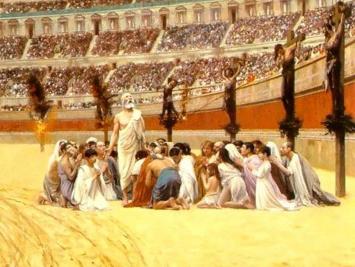
martyrdom-of-polycarp

“For whoever wants to save their life will lose it, but whoever loses their life for me will find it.” Matt. 16:25

The Apostle John died exiled to the island of Patmos, however, he did have a student, a disciple of his own. His name was Polycarp. Polycarp eventually was arrested for his refusal to burn incense to the Roman Emperor, which was the law. This is recorded in the Martyrdom of Polycarp, which this reflection paraphrases. All he had to do was the equivalent of what some of us do in order to freshen a room. It seems like an insignificant act, easy to compromise on. But in Polycarp’s eyes, no act of idolatry is too small.

The soldiers came to arrest him at his home. There he waited, knowing they were coming. It says that he told his friends three days prior that he would die by being burned at the stake. When the soldiers came in, he greeted them, “The Lord’s will be done!” and he sat them down at the table, serving them, requesting only that he be given time to pray before they take him away. They soldiers complied, asking themselves, “Why are we arresting this man?”

The text says, ironically, again, Polycarp was let to the execution stadium on a donkey. They led him into the center of the grand stadium. There a woodpile and stake awaited him, along with the Roman Proconsul. The Proconsul looked at Polycarp and begged him to renounce Christ, appealing to his old age. “Don’t invite harm on yourself. Just swear allegiance to Caesar. Give up Christ, and you are free to live out the rest of your life quietly.”

Polycarp refused, “86 years have I have served him,” Polycarp declared, “and he has done me no wrong. How can I blaspheme my King and my Savior?”

The proconsul pointed to the fire, threatening to burn Polycarp alive. Polycarp replied, “You threaten me with fire which burns for an hour, and is then extinguished, but you know nothing of the fire of the coming judgment and eternal punishment, reserved for the ungodly. Why are you waiting? Bring on whatever you want.”

He was undressed, and placed on the pile. As the fire began to burn up the wood, Polycarp prayed,

“I give you thanks that you count me worthy to be numbered among your martyrs, sharing the cup of Christ and the resurrection to eternal life, both of soul and body, through the immortality of the Holy Spirit. May I be received this day as an acceptable sacrifice, as you, the true God, have predestined, revealed to me, and now fulfilled. I praise you for all these things, I bless you and glorify you, along with the everlasting Jesus Christ, your beloved Son. To you, with him, through the Holy Ghost, be glory both now and forever. Amen.”

His disciples reported as the fire consumed his body, to everyone’s amazement, instead of the smell of burning flesh, they could smell incense, like Polycarp’s body was burned like an offering. As he resisted incense to the emperor, his body was incense to God.

“Therefore, I urge you, brothers and sisters, in view of God’s mercy, to offer your bodies as a living sacrifice, holy and pleasing to God—this is your true and proper worship,” says Romans 12:1.

Father, thank you for Polycarp’s testimony. Thank-you that he refused to compromised under the temptation of comfort and age. Thank-you that he showed us a heart of love not hate, service not vengeance. We pray for his willingness, his courage, as we confront the corruption of our world that has rejected you. May our lives by a sacrifice to you.

Amen.

The Martyr’s Mirror: Living the Cross: Stephen

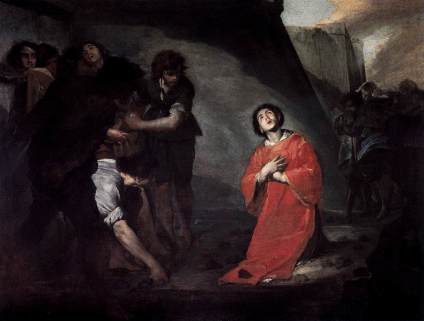
Martyrdom_of_St_Stephen

They will make you outcasts from the synagogue, but an hour is coming for everyone who kills you to think that he is offering service to God. – John 16:2

Let’s rewind now to the first martyr. Acts 6-7 records the account of Stephen. Now the Book of the Acts of the Apostles was written by Luke, the doctor companion of Paul and also the writer of the Gospel that bears his name. He was a trained researcher, and so he knew how to write a judicious historical account (which I find amazing that so many secular scholars ignore when they call into question the Gospel’s history). This witness is trustworthy.

Anyways, when we reads Stephen’s story in Acts, we see that Stephen’s story parallels Jesus’ crucifixion story in the Gospel of Luke. Those that would insist that the cross is not a path we must take, that it is only something God did for us and not something we do as well, have to contend with the fact that Luke intended to show Stephen living out the cross of Christ. Luke intends for us to take up that cross, imitating Christ.

Stephen was chosen by the 12 disciples along with 6 others to be administrators for the growing movement of the Way, (that is one of the names Christianity was called originally). Stephen was known to be a person of outstanding character: “full of faith and spirit,” Luke tells us.

Stephen was known to even perform miraculous signs, gifts of the Spirit working in him just as it did with Jesus. And just like Jesus, when the Pharisees took notice they were offended. They were angry. They felt their power slipping away by a bunch of rag-tag followers of the so-called messiah, Jesus, whom they arranged his execution by deceptive means. But now, his followers were claiming that he rose from the grave. Blasphemous non-sense it was to their darkened minds. Dangerous blasphemous non-sense.

So they arrested Stephen for blasphemy, just like what they did to Jesus. Stephen was brought before the court of the religious teachers, the ones who had Jesus murdered. Stephen, it says, had the Holy Spirit move within him, and he gave a long speech defending how Jesus fulfills everything in the Old Testament.

As he concluded, Stephen turned to call the religious teachers on their corruption: “Do you even realize that you killed the messiah your religious books prophesy about? You obsess about the law, but don’t even realize you killed the one that came as the law-giver! You have the law, but you are so blind you don’t even know it when you are disobeying it completely.”

As one can expect, a counsel of the most rich, powerful personalities of religion did not take that well. Self-righteous religious types have a hard time being told they are the ones who are actually the ones doing the sinning.

So, the counsel dragged Stephen into the streets, growling in rage. They cornered him and picked up stones. The text says, that Stephen looked up and remarked that he saw the heaven’s open to greet him (like a Jesus’ baptism). He could see Jesus, standing with the Father, and he knew he was going home.

Before they threw the stones, Stephen prayed two things, “Lord, receive me spirit,” echoing Jesus’ words, “In your hands I commend my spirit.” And he prayed, “Father, do not hold their sin against them,” again, restating Jesus’ own words, “Father forgive them, they know not what they do.” As Jesus did, so did he.

If someone came against you to kill you, would your first thought be, “Father, forgive them for what they are doing?”

Luke wrote this narrative showing that the cross is something we are to take up. The cross is the ultimate act of obedience to Jesus’ way. It is the ultimate consequence when we live it truthfully to a world that does not want to hear truth. It is also a way that refuses to hold anger and hate.

Stephen’s act of witness was more than a tragedy. It effected change in his persecutors. We know that this love is persuasive in the face of terrible hate: Paul, originally called Saul, was one of the people throwing the stones. As he tells us, he was a zealous Pharisees, hell-bent on eradicating the Jesus heresy. Paul’s heart was hard and violent and bigoted. Some people say that you cannot reason with people like that. However, God is shows that the most awesome power in the world to undo evil is not force, not violence, not even miracles, but sacrificial love in the name of Jesus. Jesus used Stephen’s testimony and then encountered Paul, who soon after encountered Jesus on the road to Damascus; “Paul, why are yo persecuting me?”

Tertullian once said that “The blood of the martyrs is the seed of the church.” The seed of Stephen’s martyrdom flowered with Christ the ever-persisten gardener, transforming Paul.

We live in a world that treats Christians with increasing animosity. Do Christians need to ban together to impose our morals in public legislature? Do we need guns and bombs to suppress Islamic persecution of Christians?

Or do we need to commit ourselves to the way of the cross: Cannot the power of Christ turn hearts?  Just as it was withs the man that murdered Stephen, making him the greatest apostle of the Christian faith, so it may be today.

When

Father, thank you for the testimony of Stephen, how his life and death point back to our Lord. May we always be ready to give account of the hope within us as he was, always ready to speak truth, even when unpopular. Also, fill our hearts with peace in the face of hate. You forgave us, so may we forgive those who wrong us. We commend to you our spirits today. Always uphold us in your hands as you did Stephen.

Amen.

The Martyrs Mirror: Living the Cross (Intro)

takeupcross

In the following meditations, we will go through what our church did for Good Friday this year. In past years, we have celebrated Good Friday with the lit candles being progressively extinguished, symbolizing the fading of Christ’ life on the cross, down to when he breathed his last, “into your hands I commend me spirit.”

This year I have been reading and rereading the Gospel of John. For John the cross is not the darkness of the world extinguishing Jesus.

In him was life, and that life was the light of all mankind. The light shines in the darkness, and the darkness has not overcome it. – John 1:4-5

This was the moment when the darkness could not overwhelm the light.

After Jesus had spoken these words, he looked up to heaven and said, “Father, the hour has come; glorify your Son so that the Son may glorify you…” – John 17:1

This was the moment the Messiah was enthroned as king in all his glory, the glory of perfect love.

So, this year we are going to light candles to show that it was on this night that darkness did not win: Jesus shown in the darkness.

There is more than one way to understand what Jesus did on the cross. In the Bible the cross is understood as Jesus taking the punishment of sin; Jesus paying a ransom to the dark powers, buying us back; Jesus offering himself as a priestly sacrifice; as well as, Jesus conquering the powers of death.

Often when we do that, we see the cross as something God does for us that we cannot live out.

Whoever wants to be my disciple must deny themselves and take up their cross and follow me. – Mark 8:34

Jesus did something for us at the cross that was unique, universal, unrepeatable, an outpouring of his divinity – yes. But he did something as a human, showing us something we must take up. He showed us a way of obedience. He showed us the way of reconciliation and forgiveness with our enemies. He showed us in a very real way what happens when we live fully committed to his will. We take up our cross.

Blessed are those who are persecuted because of righteousness, for theirs is the kingdom of heaven… You are the light of the world. A town built on a hill cannot be hidden. Neither do people light a lamp and put it under a bowl. Instead they put it on its stand, and it gives light to everyone in the house.  In the same way, let your light shine before others, that they may see your good deeds and glorify your Father in heaven. – Matt. 5: 10, 14-16

Sometimes we think that the cross was something Jesus did so that we could never experience something like that. Phew! But that is not what Jesus calls us to.

Those who are called to the light will be despised by those who cannot let go of their darkness.

Those who speak truth will be resented by those who believe their own lies.

Those who seek love will be mocked by those that just want to hate.

Those who seek peace will be attacked by those who love violence.

Those who follow Jesus will be persecuted by those who follow the ways of the world.

It will happen, and when it does, the Scriptures remind us in those moments of confusion – why does the world hate a message of love and peace? – that if we have Christ in our hearts, the world will treat us like they did Jesus.

And the opposite is true: If the world treats us like they did Jesus, those who are persecuted can be assured that Christ is dwelling in their hearts. We are not forgotten by God, we are actually called blessed.

As we trust the cross, we will live out the cross. As we live it out, we will draw near to Christ and Christ to us in profound, even mystical ways. This is what the martyrs have to teach us.

We all do that in our own way, as we are called by God, but some people in our history were called to do so in the most similar manner: they were tested with either denying Jesus or dying for him, and they chose death. They chose their crosses in the face of torture and execution.

Tonight we are going to hear some of those stories. We are going to hear the story of the cross, retraced by the blood of the martyrs.

Let’s open with prayer.

Father, we thank you for the work of the cross that forgave our sins. We come here tonight to remember the sacrifice of your son Jesus Christ. May we be inspired by the stories of your martyrs. May we be reminded in a new way of the cost of salvation you paid to liberate us. If we offer our very lives, our everything to you, we gain infinitely more: the opportunity to follow you, to know the sacrifice of the cross with our bodies, to draw close to you in the way you drew close to us. Guide our meditations and praises to you now, we pray. Amen.