
Tagged: Gospel of john
Longing to be One (Or Alternatively Entitled: Why God is Not an Egg)

Preached at ADC Chapel, January 24, 2024 (some will recognize earlier versions of this sermon from earlier posts on this blog).
In the Gospel of John, John records Jesus on the night of his betrayal, instructing the disciples about many things. He tells them about things like his new command of love and about the coming of the comforter, and here he does something particularly remarkable. Jesus prays for the church.
20 “I ask not only on behalf of these but also on behalf of those who believe in me through their word, 21 that they may all be one. As you, Father, are in me and I am in you, may they also be in us, so that the world may believe that you have sent me. 22 The glory that you have given me I have given them, so that they may be one, as we are one, 23 I in them and you in me, that they may become completely one, so that the world may know that you have sent me and have loved them even as you have loved me. 24 Father, I desire that those also, whom you have given me, may be with me where I am, to see my glory, which you have given me because you loved me before the foundation of the world. 25 “Righteous Father, the world does not know you, but I know you, and these know that you have sent me. 26 I made your name known to them, and I will make it known so that the love with which you have loved me may be in them and I in them.” (John 17:20-26, NRSV)
Here, John uses this language that within God there are two identities (and a third he mentions a few chapters earlier): Father, Son, and the Comforter, Holy Spirit, and these three identities, these persons, these three somethings are one, a mystery the church has puzzled over ever since, speculating on the meaning of person, being, substance, relations, and a whole lot more terminology. Sadly, the Trinity is nothing but terminology for many.
Dorothy Sayers, a Christian novelist and a friend of C. S. Lewis, once joked that she felt like the doctrine of the Trinity was something theologians thought up one day to make life harder for the rest of us. Ya, caught me, Dorothy! While that was a joke, we have to admit that probably most of us at one point have sympathized with Sayer’s feelings on the matter, and for some, that may have been around week 12 of Christian Theology Part One last semester (I don’t know, just a guess). Rest assured; this is not a sermon about why you need to know the historical context of terms like homo-ousia or hypostases, as important as those are. For surely, the Trinity is more than concepts and vocabulary.
Too often, the Trinity is relegated to the equivalent of the appendix: an unnecessary fixture next to our large intestine that some will just eventually have removed. Or worse: Too often, the Trinity is the club to bludgeon the dissenter with rather than a bandage to nurse the sick soul. Most often, when the Trinity is mentioned in some churches, it is to point out just how wrong some people are and how right we are. (And if that is what we think doctrine is meant for, we have missed the point).
Or we try to over-explain. If you grew up in the church, you might have been subjected to quite possibly the most overused theological explanation of all time: “The Trinity is like an _____ (egg!). There is the shell, the yoke, and the white part. Or God is like water because it can be a solid, liquid, or gas.” There you go. Solved it. I don’t know about you, but I just don’t find the idea that God is like an egg all that comforting. And we wonder why Christian beliefs don’t connect with people.
I mean, at least we could have chosen a better food. The Trinity is like waffles: the waffle, the butter, and the syrup poured out like the Holy Spirit. Look, see, there are three, and they are delicious!
The Trinity is like bacon. I can’t think of three aspects of bacon, but if God is like bacon, I want it!
Well, analogies have limits, especially when it comes to mysteries. Dorothy Sayers followed up her joke about the Trinity with a really good piece of advice: if you want to understand the doctrine, you need to look at the drama. If you want to understand our Triune God, look at the story of Scripture. It is here that we encounter the character of God.
To confess Christ is to attest to how we have found ourselves in a story where the Creator of all that is reveals Godself in the history of a people, the Israelites, a people oppressed and enslaved under idolatrous tyranny. This God says God is One, the I am who I am, the living God and this God rescues the Israelites out of bondage to be a chosen people, a nation of priests, to reflect God’s character to the rest of the world, and this One God longs to be one with us.
If you want to know that doctrine, you need to know the drama. And so when we look at the narrative of the Bible, we see this One God revealing who God is in this pursuit of being at one with us in a way that mysteriously takes on—for lack of a better word—different dimensions to God’s self: the God who is beyond all things, infinite, transcendent, and almighty, is also the root of all existence, the breath of life, the presence of beauty, one in whom we live and move and have our being, the movements of love, known as Spirit.
As the narrative shows, these dimensions relate to one another. God sends his messiah, the king, but a king that is more than another human king; he is God’s only begotten Son, yet one with the Father. The Father sends the Son, Jesus Christ, the one who perfectly enfleshes the presence of the God Israel worshiped but also fulfills the longing for righteousness, this reconciling oneness with all things Israel was called to, and Jesus does so through sending the Spirit.
This is probably where it gets confusing for people (and we do not like confusing). What does it mean to be at one? Isn’t all this oneness talk just impractical abstract mystical stuff? Are we right to ask, as modern people, is all this really useful?
Or does it name something we long for? On December 31, 1989, Bono, the lead singer of the band U2, aired the band’s dirty laundry in a radio interview. The band was on tour with an album some regarded as evidence that the band was over the hill. The reality was the band was burning out. Bono had had his first child, and being away from his family was emotionally draining. Another member’s marriage was crumbling. The band was on the verge of breaking up. Meanwhile, members of the band were becoming interested in activism but struggling to make a difference. They were navigating how they could express their religious convictions in music while wrestling with the religious hypocrisy of much of Christianity. When the band got together to write music a few months later, the song “One” came out of a space of brutal honesty about where their lives were and what they longed for. Let me read you a few stanzas of it:
Is it getting better
Or do you feel the same?
Will it make it easier on you, now
You got someone to blame?
You say one love, one life
When it’s one need in the night
One love, we get to share it
Leaves you, baby, if you don’t care for it…
Have you come here for forgiveness?
Have you come to raise the dead?
Have you come here to play Jesus
To the lepers in your head?
Did I ask too much? More than a lot
You gave me nothing, now it’s all I got
We’re one, but we’re not the same
Well, we hurt each other, then we do it again
You say love is a temple, love a higher law
Love is a temple, love the higher law
You ask me to enter, but then you make me crawl
And I can’t be holding on to what you got
When all you got is hurt
One love, one blood
One life, you got to do what you should
One life with each other
Sisters, brothers
One life, but we’re not the same
We get to carry each other, carry each other
Some of you noticed the interconnected themes of love, marriage, justice, religion, responsibility, hurt, blame, differences, and division, all tied to that word Bono keeps singing over and over: “one,” oneness.
Some of you started singing that in your head. Others just sat there wondering why Spencer is quoting old people music. Some might be thinking, “Spencer, isn’t there any recent good music out there you could have quoted to connect with the younger generation?” And the answer is, “No, there isn’t.”
You can fight me on that later, but I hope you all noticed the theme: Oneness. U2, struggling with their marriages and what it means to be one life together, feels like that is one instance of a larger struggle all humanity participates in together. They use the notion in a very similar way to how Jesus uses it in John. In a similar way, my life is bound up with my spouse, how we are one flesh, how we are partners in life, and how we affect each other; God pushes us to see others that way.
“One life, but we’re not the same. We get to carry each other, carry each other.” It is a clue into the very heart and essence of God, just as much as it is an insight into the very essence and longing of our humanity. We are creatures that are connected to each other.
The past few years have continually illustrated the fact that we are connected. I have been thinking about the wildfires we had last year. It was being talked about on the news the other day.
Hundreds of homes were destroyed by a 25,000-hectare fire caused by such dryness that is unheard of for a province that literally has ocean on all sides of it. The weather is getting more and more severe because we are dealing with the effects of climate change that can turn a spark and a few embers into a wildfire the size of a city.
We are realizing that how we treat the environment affects one another. And at the end of the day, all it took was one person to burn some leaves in their backyard, and hundreds of families lost their homes.
We all longed for rain back in June, and then, you know what happened? We got rain, so much rain there was flooding all over the province. Then, a hurricane happened. Now, we are experiencing a strange winter, which is more severe than usual, while the rest of the continent is hit with Arctic winds. Our world is out of balance, and we are disconnected from it and each other.
It is things like a forest fire and flooding that remind us that a city of a million people like Halifax still needs to be a community, depending on one another, needing one another, affected by the choices of one another; that our providences and nation, just like individuals are not self-enclosed, independent, self-reliant units, able to carry one without help or helping others.
We are dependent on the earth and the seas, the fish and the animals, for the very processes of life that sustain us. We are dependent on each other. We are learning the hard way that we are all connected. Where one acts irresponsibly, all are affected, and also, where one suffers, all suffer.
We have been reminded again and again vividly over the last few years that we are all connected.
We are feeling how industrial practices on one side of the world affect farming on the other.
Health practices on one side of the world affect the health of communities on the other.
Wars on one side of the world affect life on the other.
We can’t get away from it. We are profoundly connected, but we continue to ignore this fact, retreating into our little empires of autonomy (some of us even use our Christian convictions to do so).
And yet, our lives are marred with reminders that we are living alienated from nature and each other. We are divided against the very things we need most. We are killing ourselves because we are constantly failing to see ourselves, our fate, and our identity as dependent on others.
We know we need to be one; we long to be at one with each other; we long for unity and harmony where we can all be ourselves, and others can be themselves in peace with the earth, and yet, we are not at one. We have given in to greed and selfishness or just slipped into an easy thoughtlessness, too concerned with the rat race of life.
We find ourselves reliving this story of humanity again and again, which comes to a particular intensity when people rejected Jesus’ invitation to step into the oneness of God. John says at the beginning of his Gospel: “The world came into being through him, yet the world did not know him. He came to what was his own, and his own people did not accept him.” We know how this story goes.
Jesus died on the cross, executed by an instrument of imperial oppression orchestrated by the corrupt religious institution seeking to preserve its own power, but also betrayed by the ones Jesus was closest with, his own disciples his friends. The cross discloses the tragic depth of our tendencies to refuse to be at one with God and others, even when literally God is staring at us face to face.
But it is in these dark moments that God showed us who God is.
For Jesus to die one with sinners, yet one with the Father, reveals God’s loving solidarity with the human form—our plight, no matter how lost or sinful. God chooses to see God’s self in us and with us, never without us. God chooses to bind himself to our fate to say I am not letting you go.
John records Jesus putting it this way: “No one has greater love than this, to lay down one’s life for one’s friends.” And he counts the ones in front of him, the ones who he knew would betray him the worst—he counts them as his friends.
So often, we are tempted to lose heart, to recoil and collapse under the weight of our guilt and shame, when we think about the state of our world, our complicity in things like racism, war, climate change, consumerism, all the toxic squabbles we see on social media, or just our individual apathy to the needs of others we encounter on a daily basis— there is so much that might cause us to shrink back and say we don’t deserve a better world. We deserve what is coming to us.
To be a part of the people of God is to trust in Jesus Christ; it is to remember that in these moments of condemnation, we have been encountered by the presence of the Spirit, a love that invites us to see that we are loved with the same perfect love the Father has for his own only begotten Son. The same love that God has for God in the Trinity, God has for sinners, for you, and for me. God is not going to give up on us. Trust this. Trust this.
God is the God who, throughout history, stands with the undeserving, the least of us, the oppressed, the god-forsaken, the outcasts, the sinners—all humanity—announcing as Jesus did to the unfaithful disciples: “peace to you,” announcing God’s will for us is and has always been eternal life.
When we are suffering and scared, our cross becomes his cross.
When we are lost and hopeless, his resurrection becomes our resurrection.
This God who is God above has come and walked with us in Christ as God beside us and has redeemed us with the Spirit, leading us forward as God within us and through us, a love so undivided and unlimited, it is making all things one.
As John says, “The light shines in the darkness, and the darkness could not overcome it.”
And so, John challenges us to be at one with each other in a similar way to how the Father is at one with the Son: “May they be one as we are one.”
He prays for his disciples. He is praying for the church, which means he is praying for us today. In a world that is broken and divided, be at one with each other. Model the kind of empathy, acceptance, reconciliation, forgiveness, and encouragement that says, “I need you; I can’t be me without you; I cannot succeed unless you succeed; If you are hurting, I am hurting; We are one.”
“One life, but we’re not the same. We get to carry each other, carry each other.”
That is Jesus’ prayer. God knows I could use some prayer on this. I had my family call me from Ontario, wondering if I was safe through all the fires and floods. I tried to explain to them that not all people in Nova Scotia live in Halifax (a point that is routinely lost on them), but I also caught myself saying, “I am okay. This does not affect me.”
I caught myself doing something we all too easily do: since hardship or oppression does not touch my immediate experience, my job, and my family, I conclude I am not affected.
We can do that with so many things. Injustice does not affect me. Poverty does not affect me. Illness does not affect me. War does not affect me. That person’s financial troubles, that person’s health risk, that person’s views: not my problem. It’s theirs, not mine. And so, we choose to forsake the invitation into oneness of love again and again.
One reason the Trinity feels abstract is that we so often use it as just one more way to honor God with our lips (and perhaps our cognitive minds), but the reality is our hearts are far from God.
Two days ago, I was driving into work, and CBC radio mentioned police charged a guy with accidentally starting the fires, as I mentioned before. A 22-year-old decided to burn some dead leaves in his backyard. I remember uttering things to myself about what I hope that guy gets for being so stupid and thoughtless. But then the radio had an interview with a man who had lost his house, his farm, and even his cottage on the other side of the forest fire. The man was asked how he felt about the person charged, and all he could say was, “I can’t blame him. I’ve done a lot of thoughtless stuff over the years. Mine, thankfully, just didn’t have as severe of consequences as his. His mistake could have just as easily been mine.” I remember sitting in my car in the parking lot, just having a moment to take those words and that profound lesson in humility I just experienced. To the one who had caused all this destruction, this man who had every possession of his destroyed in those fires chose to see himself in the other. He chose empathy and mercy. He chose oneness.
Again, folks are so often tempted to see the Trinity as some abstract idea (and we theologians can admit some part in that), but the Trinity flows from our relationship with God and each other. It is an invitation into the movements of worship and prayer, service and sacrifice, solidarity and forgiveness that speaks to the essence of who God is and who we are and the only way we can move forward as people: We are connected; we belong to one another, and in God’s choice to be bound to us, to refuse to let us go, we are awakened to our responsibility to others—more than this: our privilege, our witness, “so that the world may believe that you have sent me.”
May we, daily in choices, grand or small, step into the oneness of God as a college, a community, a church, awaiting the day when God is all in all.
Costly Gifts: A Sermon on the Anointing at Bethany
Palm Sunday, Bethany Memorial Baptist Church, 2021
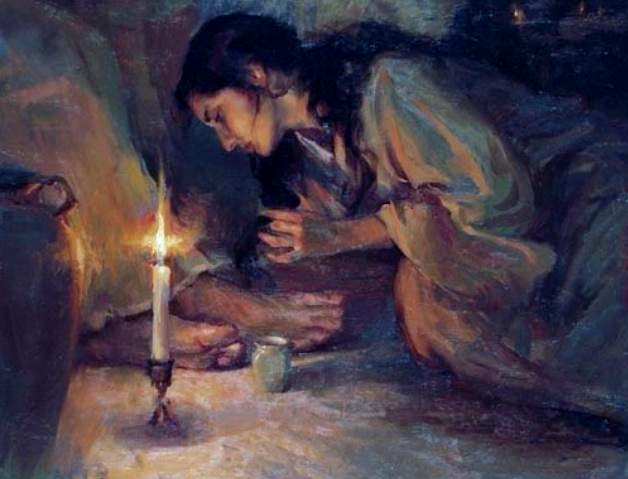
Six days before the Passover Jesus came to Bethany, the home of Lazarus, whom he had raised from the dead. There they gave a dinner for him. Martha served, and Lazarus was one of those at the table with him. Mary took a pound of costly perfume made of pure nard, anointed Jesus’ feet, and wiped them with her hair. The house was filled with the fragrance of the perfume. But Judas Iscariot, one of his disciples (the one who was about to betray him), said, “Why was this perfume not sold for three hundred denarii and the money given to the poor?” (He said this not because he cared about the poor, but because he was a thief; he kept the common purse and used to steal what was put into it.) Jesus said, “Leave her alone. She bought it so that she might keep it for the day of my burial. 8 You always have the poor with you, but you do not always have me.” – John 12:1-8
This week my wife and I woke up to our oldest son making his mommy a gift. Rowan sneaked down to the kitchen and started breakfast for his mom. Rowan has taken to learning cooking and baking, and he is doing a wonderful job. He made chocolate cookies the other day – sorry chocolate-covered peppermint fudge cookies – the other day, and frankly, they were some of the yummiest cookies I have ever had. However, this was not cookies.
This particular morning I came down while Meagan was in the shower, as I usually come down and start the whole process of cereal and toast for all our kids. I came downstairs to find that Rowan and started making eggs on the stove. While I was about to give him the talk about not using the stove when parents aren’t around, I noticed the eggs appeared to have blood in them.
“What is that?” I said. “I put red food coloring in to make it in the shape of a heart for mommy,” my son replied.
“Oh, I see,” I said, “Well, I am sure Mommy is going to be surprised,” I remember looking again at the sight of these eggs, which looked kind of like something died a horrible death in the frying pan, and I recall gagging a bit, even though it was just food coloring.
Of course, Meagan came down and was, in a word, shocked, to say the least. After the shock wore off, she recomposed herself as Rowan said that he wanted to make heart-shaped eggs for her. To which, she happily ate that reddish, pinkish mess of eggs that did not really come out in the shape of a heart at all (Maybe a kidney or possibly a liver shape).
The point is often, parenting, as I have learned, means giving a lot for your kids, and sometimes it means seeing them give gifts in return (one way more than the other for sure). These gifts, while they are not what we expect, are the ways in which our kids show love. In that regard, they are special. I love that my son has taken to cooking and wants to appreciate people with it.
While this notion of gifts, gifts of appreciation, gifts expressed in particular and personal ways, and in the case of this text today, gifts that cost deeply, that is what the life of faith is about.
I found myself reflecting on this account of the triumphal entry, reading the passages leading up to it and the ones coming after it, and as I said to Sarah, I want to just pause and think about the events that happen just before Jesus comes into Jerusalem on a donkey. Jesus is anointed at Bethany before this, and I want to reflect on this beautiful passage as a way of getting to the truth of Palm Sunday this morning.
John’s Gospel is the only one that places the anointing before Jesus comes into Jerusalem. John’s is also the only Gospel who names Mary of Bethany as the woman (not Mary Magdalene – there is a lot of Mary’s in the Gospel accounts, by the way). The reason I bring this up is that ancient history writers like the Gospel writers wrote this history with rich narrative. One of the reasons you see stories told in different ways and in different places in the Gospels is because the Gospel writers place the stories in a certain order to say something.
We sometimes are tempted to think of the Gospels are haphazard catalogues of the events of Jesus’ life, which we listen to in our Bibles section by section, but the reality is the Gospels are beautifully crafted stories, very intentional in how they say what they say.
Narratives mean something on the whole, and we do the Gospel’s a bit of a disservice by chopping them up and reading them in little sections and bites. There is nothing wrong with just enjoying a beautiful verse, but if anyone is a book lover, you know that a good story is a page-turner, and you just want to keep reading to just dwell in the story.
One of the most significant moments of growth in my walk with Christ is when I took a course on the Gospel of John in college. One thing the teacher made us do was to sit down and listen to the whole Gospel from start to finish in one sitting.
I had never bothered to do this before, and it allowed me to experience the Bible in a new way. John’s beautiful storytelling came through. The emotion and tension between Jesus, the people, and the Pharisees, seem so real and palpable. The use of irony and even sarcasm in the text, I saw for the first time. And the sense of climax and culmination as the tension and conflict builds between Jesus and the religious leaders that lead to Jesus’ crucifixion. It all really hit me.
Let’s take time to read the story as it is meant to be read. Again, small passages are good, but you don’t just listen to one line of your favourite song. You listen to the whole thing, from intro to ending.
I am just going to put this out there. I have a pastor friend who, every year for Good Friday, has a get-together at his house, and there they listen to the entire Gospel story, everyone taking a chapter, breaking to eat and talk and pray. Perhaps this is something we could do next year.
But for the time being, maybe sit down this week and listen to the whole of John’s Gospel, and when you do, look at the stories that happen before a passage and after it. Ask yourself, “Why did John place this here? What is John trying to tell us?”
Here, beginning in chapter 11 and into the beginning of chapter 12, just before Jesus marches into Jerusalem, something takes place that is setting this whole final week of Jesus’ life into motion. Jesus gives a very costly gift. He raises Lazarus. And, we see here that Mary, Lazarus’ sister, responds to this with her gift of perfume in adoration. She thanks Jesus with a costly gift. But his disciple Judas scoffs at this. I am going to suggest that that hardness of heart that we all can have will cost us as it did him.
Jesus gave a costly gift; Mary thanked him with a costly gift, but Judas scoffed and it cost him.
1. Jesus gave a costly gift
So, what happens before this story? Well, if we go back to a chapter, we find out that Jesus raises Lazarus from the dead.
If you recall, in this story, people come to tell Jesus that Lazarus has fallen sick and is about to die, and Jesus says he is going to come to Bethany, just outside of Jerusalem, to raise Lazarus. The disciples get really worried about all this. The last time Jesus traveled that close to Jerusalem, a crowd trying to stone him. Jesus has made some very powerful enemies that want him dead.
But Jesus goes anyway, despite the risk. This upsets the disciples. Thomas even says sarcastically, “Fine then, let’s go so we can die as well.”
Jesus goes, and he raises Lazarus, even though Lazarus had been dead for four days, and proclaims, “I am the resurrection and the life.” To raise the dead and to claim that in Jesus is life itself, those are things that God says and does.
You can imagine that news like that does not stay hidden. A word about this gets to the ears of the religious leaders, and they realize Jesus is taking away their followers. Jesus is taking away their power and influence. Jesus is threatening their religion. It is funny how Jesus can do that!
If Jesus is God in the flesh, they are out of a job because they have made a lot of money telling people grace comes with a price. And if a desert Rabbi can do these things and claim these things, the religious teachers are exposed as greedy frauds that they are.
So, the Pharisees put in motion a plot to arrest and kill Jesus if he comes into Jerusalem.
By coming and raising Lazarus, Jesus is a marked man. With raising Lazarus, Jesus’ life story has entered its endgame.
You have to ask, then, why did Jesus do that? Surely, he could have kept on living for many more years, healing many more people, teaching many more things, then come and died on a cross. Why take this risk? Why be wasteful?
The answer is obvious: Jesus loved others, and Jesus was faithful to the plan God the Father set for him. Jesus loved Lazarus to the point of weeping at the news of him passing, even though he knew he was going to raise him up. This was what God the Father set out to show.
Jesus was faithful to his task, which was showing us love at a deep cost. Jesus gave the gift of life back to Lazarus, but it was an action that would cost Jesus his life in the end.
Jesus gives the gift of life, and he gives the gift of his life. The two are one and the same.
Jesus says later at the last supper, “No one has greater love than this: to lay down one’s life for one’s friends” John 15:13.
One writer says this, “The mystery of the Christian faith is that if you have not loved, you have not truly lived, but if you have truly loved, you will end up dying for it.”
The raising of Lazarus is the beginning of the climax of John’s Jesus story, preceding Jesus coming into Jerusalem, Jesus being betrayed, Jesus laying down his life at the cross to “draw all people to himself,” to be a sacrifice for the sins of the whole world, to show us that God has this kind of love for sinners: a love that sacrifices of one’s very self.
All of this is to say to us when the very worst parts of ourselves come out when we feel and know deep down it is like there is nothing good in us, nothing that deserves better, God loves.
God loves us despite the very worst of ourselves.
When we feel like our lives are worthless, like we don’t even deserve to live, God gladly dies our death to offers us his life in the cross.
If we ever are tempted to think that God has forsaken us, has lost hope for us, that we have sinned against God too many times: we just don’t feel what should feel and do what we ought to do, we have to remember that God has revealed himself in Jesus.
John 1:18 makes this plain: “No one has ever seen God. It is God the only Son, who is close to the Father’s heart, who has made him known.” God is like Jesus because Jesus is God and Jesus shows us what God is truly like.
What is God like? God is the God that loves us more than his very life. God is showing us that this love is life, eternal life, the resurrection and the life.
Because Jesus loves with a perfect, self-giving, self-sacrificing, costly love, what he does for Lazarus is merely Jesus being who Jesus has always committed himself to be, for each and every one of us, showing us who God truly is.
This is why he could not stay away. He had to go. He had to love. Its who he is!
But here is the thing: if we know that we are saved by this kind of love. If we know that this is who God is and invites us into this love. We must love the same way: “If you have not loved, you have not truly lived, but if you have truly loved, you will end up dying for it.”
Jesus says a few verses later, “Those who love their life lose it, and those who hate their life in this world will keep it for eternal life. Whoever serves me must follow me, and where I am, there will my servant be also” (John 12:25-26)
The question is, how do we do that? How do we do that in our everyday lives, where we might not have life or death decisions in front of us? And to that, Mary, Lazarus’ sister, gives a bit of a clue:
2. Mary thanked with costly gratitude
The story says that Mary and Martha are the sisters of Lazarus. It also says that the sisters lived with Lazarus. Is it because Mary and Martha are not married? It makes you wonder: Have they been widowed? It seems likely.
If this is the case, Lazarus dying could have spelled poverty and dereliction for these ladies if they had no other family support.
And if they were widows, which is very likely, this says all the more what Lazarus meant for Mary. Lazarus was the brother that cared for her when she lost her husband, the person that sustained her when she had nothing. He seems like the kind of endearing, tender-hearted person that when he died, Jesus himself missed him and wept.
Jesus gave back her big brother. The question is, if you were Mary, what would you do or say to Jesus if Jesus did that for you, and he does this, moreover, knowing that this will cost him this life?
Mary is overcome with gratitude, and so she does something special, even over the top. She goes out and buys an expensive incense. It seems like she had some savings as this incense is supposed to have cost nearly a year’s wage, something that would have cost today tens of thousands of dollars. We don’t know where she got this, but I wonder if she is a widow, if these are her savings leftover from when her husband died.
Has anyone ever done something for you that made you want to give a gift that could cost an entire year’s pay? Think about that for a second, and it gives you the sense of just how moved she felt.
What does she give? The incense is nard, which was the oil from a type of honeysuckle plant that only grew in India and China. It’s expensive because it is imported and very difficult to make. It had a sweet smell, and it was used in medicine: it soothed muscles and cleaned the skin. It is so expensive that you would try to ration it to make it last for as long as possible. However, she buys a whole pint of it and brings it to Jesus and pours it on him.
She comes into the room and anoints Jesus’ feet by pouring this oil on him and adores Jesus to the point of wiping his dirty feet with her beautiful hair. I think the women can appreciate this action more than the men. She is showing her thanks financially with the incense, but also physically and emotionally with her hair.
She also makes a point of using oil that has a double meaning.
First, it is the oil you would anoint a king with. The kings of Israel were anointed by prophets who herald them as coming kings.
God used the great prophets to herald the kings like Saul and David. Here God chooses a lowly but grateful lady, Mary, to anoint the true King. While the disciples seem to scratch their heads, puzzled about who Jesus is, Mary seems to get it.
Jesus is our king; Jesus is her king, but he is the king who is going to give up his life for others because his kingdom is different, and it made a difference for her.
A few days later, at the last supper, Jesus sits his disciples down, takes a towel and, as a servant, washes the disciples’ dirty feet. The disciples are horrified that Jesus would be a servant to them. They still think his kingdom is about having power and status. But here, Mary is already living the way of Jesus for Jesus, anointing his feet. Mary know Jesus is king and she knows what this kingdom is all about.
Second, it is also oil that you would anoint the body of a cherished family member with when they died. Jesus recognizes this. He knows it is for his burial.
The next day, people shout Hosanna to Jesus, greeting him as a messiah, and eager to see what Jesus will do for them: will he overthrow the Romans? Will he re-establish a golden age of prosperity for them?
They never think of what this will cost Jesus. Mary knew. Mary knew Jesus would die.
That is why this gift costs her. It costs her materially and emotionally. She puts herself into it.
She wanted Jesus to know that Jesus was worthy of the very best she had to give.
She wanted Jesus to know that what he did has meant everything to her.
She wanted Jesus to know that she was thankful deep down to the core of her very being.
The crowds the next day hailed Jesus as King, but at his cross, they left him because a dead king is no king at all in their mind.
Mary died the opposite. She anoints Jesus as King because she knows he will die.
Do we understand that this week especially? And if so, how will we show it?
3. Judas mocked at his own cost
There is a powerful saying by the Baptist preacher Charles Spurgeon, “If Jesus is not everything to you, Jesus is nothing to you.”
If we don’t recognize this costly gift Jesus gives, we can’t receive it for all that it truly is.
It seems that there was one person that really failed to understand this in Jesus’ circle, and that was Judas. It seems that all those years of travelling with Jesus, seeing miracles, hearing his teaching didn’t do anything. Judas’s heart had grown hard.
So, when he sees Mary do this for Jesus, he is indignant. What a waste!
You could have given that to the poor! He snarled. But John reminds the reader that Judas did not actually care about the poor; he was greedy and would often help himself to the communal funds. He was skimming off the top.
Judas does something I have seen many times over. We love to cloak our apathy with concerns that sound pious.
How often is racism from our nation’s past protected in the name of preserving “culture and history”?
How often are ignorant and bigoted opinions protected in the name of freedom of speech?
How often do we as Christians excuse ourselves from doing what is good and just by invoking religious freedom?
If we take a good look deep inside ourselves, we know we can put up excuses and fronts that get us off the hook from following Jesus in a costly way.
In fact, in a sad and ironic way, I have heard this very story be used to get out of doing what Jesus teaches us to do.
Judas scoffs at this and says this money could go to the poor, and Jesus says, “the poor you will always have, but you won’t always have me.” I have heard preachers use that phrase to say that, therefore, we should not care about the poor; there will always be poverty, so don’t bother with soup kitchens and benevolence and all that.
That seems to really miss the point of what Jesus is saying on the cusp of his crucifixion, to the person who will betray him.
Mary was not neglecting the poor, she was recognizing the one who had loved her, whose kingdom was for the poor, whose kingdom was for all people, especially the forgotten of this world.
But it goes to show just how often we can mask our apathy, our unwillingness to follow Jesus in those important costly ways, by making very seeming good excuses.
How do we do that? I think of how often I have said, “I wish I could do this or that, but I am just too busy.”
How do we do that as a church? Can we hide behind excuses when we know we need to be going out and serving as Jesus did? We have to ask again this morning:
Will we love Jesus with everything we have?
Will we serve like Jesus even if it costs us everything we have?
It should not escape us that the anointing at Bethany is the namesake of this church. It is a name that recalls us to the power of Jesus is raising Lazarus and the love of Mary in anointing him.
It recalls us to the costly nature of following Jesus. Serving Jesus will cost us. But the cost is worth it!
One great Christ-follower of the last century was a missionary named Jim Elliot, who died in 1956 at age 28 in Ecuador. He was killed by a marauding band that swept through his camp, killing several people, including him.
Why did Jim Elliot go to He felt the Gospel was calling him to share the good news in the most dangerous places on earth. He felt called to share the Gospel to tribes in Ecuador, which was a place irrupting in violence. People pleaded with him: “Don’t’ go, it’s too dangerous.”
Jim Elliot replies with the mentality that I think Christ had, and it is the mentality that we must have: “He is no fool who gives up what he cannot keep, to gain what he cannot lose.”
“He is no fool who gives up what he cannot keep to gain what he cannot lose.”
Brothers and sisters, when we know that Jesus has given us everything, when we see Mary’s example of offering everything, and we see the peril of Judas refusing and losing everything, we must ask ourselves: What are we holding back? What can you entrust to God today?
Is it emotional, or is it financial? Is it time, or is it a task?
What have you got to lose? More importantly, what have we got to gain?
Perhaps, if you are like me, just asking these questions reminds me of all sorts of ways I forget and neglect to make Jesus my everything, every day.
So often, we aspire to be like Mary, giving 100%, but in our day-to-day lives, we feel more like Judas, apathetic and unfaithful, making excuses.
Judas met a terrible end in betraying Jesus. However, so did Peter and his story ends very different. Let me suggest to you that he met this end in part because he simply could not fathom that Jesus could forgive him after what he did. He simply could not surmise that Jesus’ grace really is grace because his mercy really does not have conditions or limits.
So, it is not whether we fail in our Christian walk, we have and will. It is whether we can keep trusting God’s forgiveness in our lives.
In that case, part of the gratitude we are all called to begins with that simple thank-you, saying today and every day in a new way,
God, I know I don’t love you perfectly,
but I know I can trust you again today
that you love us perfectly.
Jesus, I long for your love to renew my heart today,
so I can love you deeper
and love like you.
Amen.
Let’s pray this together before we continue in worship:
 Spencer Boersma