
Despots and Decor Choices: The Throne of God and the Way that Endures
Sermon preached at Lawrencetown United Baptist Church, Sunday, June 21, 2026.
Sermon Scripture Reading: Revelation Chapters 4-5.
When Pastor Andrew invited me to come speak, he pitched it to me that he was going to preach on the Book of Revelation and that I could do the next passage. My immediate thought was, “Boy, you aren’t letting me off easy here.” My next thought was that I am going to have to go re-read some of my books on Revelation. My next thought was, “Andrew is now the one making me have to do my homework!” Maybe Andrew is trying to get back at me for making him read all those books for my classes.
Well, at any rate, I did enjoy revisiting some of these topics as I thought about the sermon for today.
The Context
But make no mistake: The Book of Revelation is one of the easiest books to misinterpret.
For this reason, in the early church, this book was often given something like how movies have a “PG” rating: this book should be read with care.
G. K. Chesterton once said that the Book of Revelation is a book of visions of many strange monsters, but none so wild as some of the book’s interpreters.
I am sure you all know of examples of weird interpretations of the Book of Revelation.
There is a persistent tendency for us to try to read the Book of Revelation as if it were a code to crack, with the events of today clearly providing the cipher.
Some have thought that the number 666 clearly refers to the former Russian President Mikhail Grobechev because—again, clearly—his birthmark on his face was in the shape of three sixes.
Some have thought that the locusts with “tails of scorpions” in Rev. 9 are clearly Apache helicopters.
Some have thought that the mark of the beast is the bar codes on grocery store products. Others think that the mark of the beast is vaccines. I know one person who believes the mark of the beast is credit cards (coincidentally, they have wonderful credit).
In terms of who is the anti-Christ or the false prophet, throughout church history a slew of people have been suggested: in the early church it was the Caesars who persecuted the church, in the middle ages different kings thought enemy kings were the antichrist, others thought the prophet Muhummad was the anti-Christ, during the reformation, Protestants thought the Pope was the anti-Christ, in the 19th and 20th centuries: Napolean Bonaparte, Adolph Hitler, and others. In recent memory, the leader of the UN, the Ayatollah of Iran, Saddam Hussein, Vladimir Putin, every president, and, a personal favourite of mine, Oprah Winfrey (I guess some people really don’t like Oprah). All of these people have all been accused of being—again, clearly—the Anti-Christ.
If Revelation is treated as a secret code to crack, predicting the future in outline, do you notice something of a perennial weakness in this? The problem is that every generation assumes they are the ones in the real end times because their age is so much more frightening than the previous one, and this gives them something like a blank cheque for how they want to interpret it. One pastor, Greg Boyd, once referred to the Book of Revelation as a literary Rorschach test: When you look at it, much like the inkblots therapists used to use, what you see probably says more about you and what you choose to see than what is actually there.
The Book of Revelation is a prophecy, but it isn’t a prophecy that tells us the future in exact detail. The Book of Revelation is less about predicting the future and more about knowing the patterns of history
It is less about prediction and more about patterns.
We can get really wrapped up in the “what?” or “how?” questions (you know: What does that symbol mean? How is that going to take place?), but the book is more about the “Who?” This book is less about the how and more about the who: it is about the character of Jesus, his Spirit, whether his way is the only way.
The books of the Bible that deal with apocalyptic, which, as one Baptist writer once said, are meant to teach us how to see all history through the eyes of God.
It is not trying to give us a detailed picture of what the future will literally be like. They are more like symbolic glimpses God gives to churches at particular times and places to keep them on the way to a future we simply cannot imagine. Revelation is written to seven churches in the first century, visions that intend to steer them back on track. And if we read the book with that kind of care, we too might sense our own course corrections from the Spirit.
For those who have been tracking with Andrew’s previous sermon, the Seer John of Patmos sees Christ, the Ancient of Days, and tells him to send seven letters to seven churches, each with their own challenges and strengths, which the writer mentions. It seems that these seven churches face all kinds of issues, like persecution, but also lackadaisical, lukewarm faith. Each one of the letters to the seven churches encourages them to persevere, promising that those who overcome will receive God’s promises.
In this regard, the message of Revelation is quite simple: God’s way will overcome. Trust it.
So, the Book of Revelation is less about prediction and more about patterns of history.
It is less about the “how” and more about the “who.”
It is not a code to crack or calculate; it is about our everyday character.
The question remains at the end of these seven letters: What does it mean to overcome? How do you do it? And the question throughout the book is simply: Are Rome’s ways of empire, violence, idolatry, and greed the true way or does God have a different way for God’s people?
The Throne
And to answer this, the topic shifts from personalized letters to seven churches to John being ushered up into heaven in the spirit to see a vision of God’s throne. Why this after those very personal letters to seven churches? Why the change in genre? What is the significance of God’s throne?
Why does a God that is beyond all things need a throne? I don’t think a God who is incorporeal needs to sit, but if he does, what other furniture does God have up there? Does he have a couch and a TV? Why a throne? In asking that, the reason is obvious, but we have to remember that these are symbols that God is giving us to help us understand a place that is beyond what we think time and space are. So, again, why a throne?
The most elaborate throne in history was reputed to be “the Peacock Throne.” This was the official throne of the Mughal Emperors, who ruled the entire Indian subcontinent from the 1500s to the 1800s. We tend to think that this was the age when European nations expanded and ascended to global power with the rise of the British, French, and other European colonial-imperial projects, but while Europe was sending out ships to colonize the world, the Mughal Emperors ruled an expansive land with 150 million people. And they were so wealthy, these rulers possessed roughly 25% of the world’s wealth at the time.
And so, as a demonstration of their power and opulence, these emperors commissioned the building of a throne that would truly show off their glory. You can look up artist renderings of this throne. It was not just a chair like the throne that sits in Westminster Abbey, for the King of England is called St. Edward’s throne. The peacock throne was not just a chair, but rather more like a gazebo or roofed platform that could be carried, carried, mind you, by a small army of servants. It was a golden platform large enough to hold a company of people, with pillars supporting a roof, all of it in gold. The throne weighed 3,000 pounds (those poor servants!).
The throne was adorned with elaborate textiles and decorated with golden peacock sculptures and real peacock feathers. One witness reports that there were close to 27 000 gemstones embedded in the gold of the throne, one of which was among the largest diamonds in the world.
The peacock throne said something about the emperors who sit on it. Thrones say something about the ruler.
Just think of what this attempted to say to people who came near: This person is so important that they don’t need to walk (they have servants for that), they are surrounded by gold and jewels (just to sit on), and their throne is adorned with sacred birds like the peacock, which symbolizes immortality and prosperity.
World rulers always find a way to symbolize their power in the objects around them, whether it is thrones, crowns, or golden wall décor that is actually just a painting moulding from Home Depot.
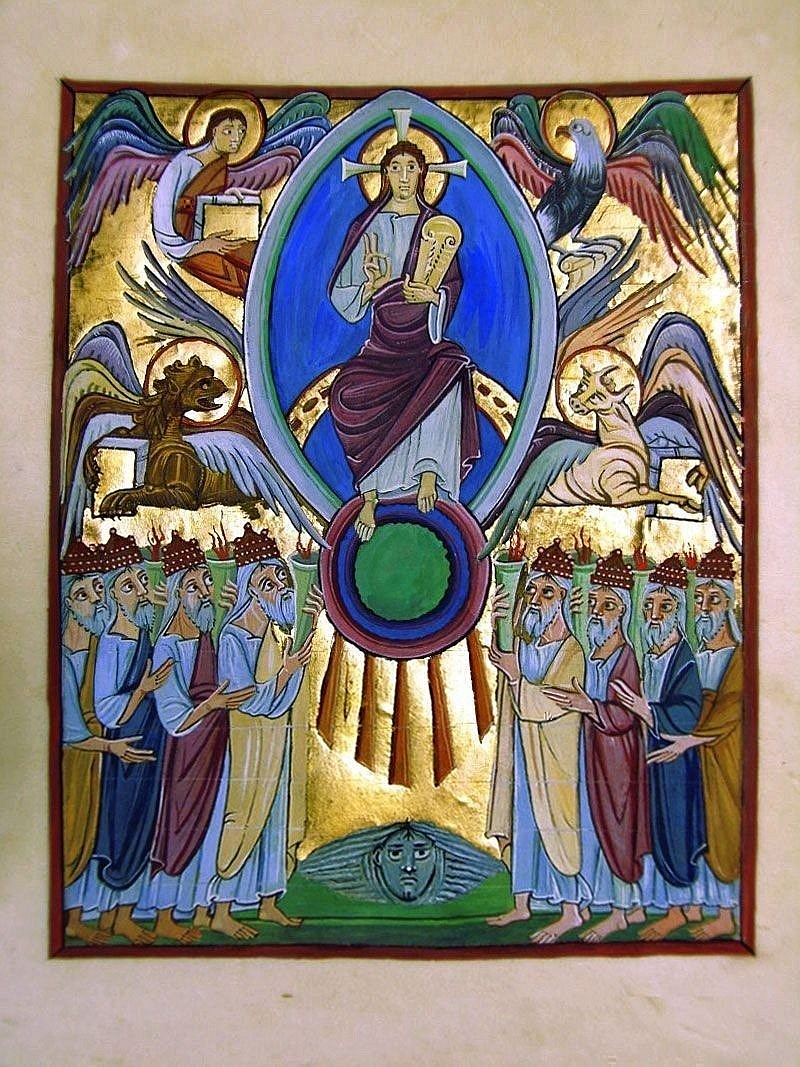
Here in Revelation, God shows this fantastic, symbolic vision of his throne, and we have to ask, What is this throne communicating about this ruler?
God’s throne is not only encased in gemstones and has the very rainbow itself encircling it.
God’s throne has cracks of lightning around it. It rests on a sea of crystal.
It is surrounded by 24 elders, presumably representing the 12 tribes of Israel and the 12 apostles, both worship Jesus in unison.
And there are these otherworldly cherubim circling around, each with a different animal head.
A simple reading might say that while emperors of the world try to show off their thrones, their power, their wealth, their opulence, God turns and says, “You think that is something, eh? Take a look at mine!”
But God’s throne and God’s kingdom are more than just a bigger and better version of a worldly throne. God is not like a human king, only scarier. God is not an opulent tyrant in the sky. God is trying to tell us that God’s rule is fundamentally different.
Remember that the throne has rainbows, and while rainbows are beautiful and sublime, they are also a sign of God’s promise never to destroy the world again. This ruler’s throne suggests not opulence but mercy.
Or, notice that the cracks of lightning and rolls of thunder are the same description of what happened at Mount Sinai, when Moses received the commandments. This God is powerful, but God is holy, just, and good.
Or notice that there are 24 elders who worship God, suggesting that while the church is being attacked by members of the synagogue, Jesus is still the fulfillment of all Israel longs for. God is still faithful to his people.
God, the ruler of the cosmos, is different.
In fact, that is what these other-worldly creatures cry out: Day and night without ceasing they sing, “Holy, holy, holy, the Lord God the Almighty, who was and is and is to come.”
This God’s reign is eternal, this God’s power is ultimate, but this God is holy, pure, good, and therefore different, different from all the rulers of the world.
And so, John gets a vision of the throne of God. This is not the first time in scripture that this happens. When King Uzziah dies, and the country is thrown into turmoil, Isaiah has a vision of God in his heavenly temple, seated on the throne, and the train of his robe fills the temple, and his throne is surrounded by angelic seraphim that cry, “Holy, Holy, Holy,”
The second time in the Bible is when the prophet Ezekiel sees the corruption of the temple and knows that God’s presence is no longer there and that dark days of exile are coming, but then he sees God’s throne coming down surrounded again by strange angelic creatures. This time, Ezekiel sees that on the throne there is one like the son of man, the “Son of Man” is Jesus’ most common title in the Gospels.
It seems that when we are going through turmoil, when things look the bleakest, when the world is quaking from the corruption of its leaders, it is in these times that God gives his prophets visions of his throne and says, “Look to me. Look to the one who rules this world, this cosmos. They are not in control, they are not all-powerful, their rules are not eternal, their lives are not infinite, their ways are not perfect. Mine is.”
“I am the one who was and is and is to come.”
I don’t know if you caught this, but the peacock throne is no more. A Persian army successfully attacked the Mughal Empire and carried off the throne as a trophy, but the general was assassinated, and the throne was pillaged.
It is ironic that the throne that symbolized immortality was melted down and broken into pieces, and the dynasty that ruled on it is all but forgotten.
In the time of the churches of Revelation, Rome proclaimed itself the Eternal City and its rule immortal. John sees a vision of God’s throne, heavenly and surreal, and it forces his readers, then as well as us now, to ask: What thrones, what powers do we trust in? What rule do we really think is going to outlast, a human’s or God’s? Which path dies and which path endures?
The Scroll
And if you trust Jesus’ rule, how does that change how you live? As we go through the Book of Revelation, you will notice that it is not merely an apocalyptic book but a book about worship: the angels are worshipping God here, and benedictions are placed throughout the book. It is trying to get us to realize that who we have our allegiance to is who we worship.
The people of the seven churches are being persecuted. Some of them are being martyred for not worshiping Caesar as Lord. Many felt tempted to give in, go along with the Empire, with its idolatry and its devotion to violent subjugation.
You can imagine them asking: But shouldn’t I support the Roman army? I meant, have you seen the economy? Have you seen the price of gas and groceries these days? Don’t worry about the people our country harms and oppresses; you need to take care of yourself. Don’t question the system. It can’t change. Just go along with it.
Their temptation was different from ours, but not all that different.
And that is why this vision says something to us today: When we see the heavenly throne of God, we are forced to ask: whose kingdom has our allegiance? Who is our true king?
John’s vision goes on to see a scroll, and an angel asks, “Who is worthy to open the scroll and break its seals?”
What is this scroll? Well, if this is a throne room of a king, a scroll is a royal decree. Edicts were sealed scrolls that rulers opened and read.
The scroll is no mystery. The Book of Revelation is not God giving Christians the winning lottery numbers before the lottery is called, so we can effectively hedge our bets. Some think the scroll is predicting the next set of events, but that is not quite what it is.
The scroll is justice. Who is worthy of executing the justice of God? And who will this justice vindicate in the end, the martyrs or the oppressors?
At this John weeps because he believes there is no one worthy in all creation to open the scroll, but then he is corrected: No, there is one. The one on the throne, this Jesus is not just a man, he is Lord and God.
He is the Lion of Judah. He is the king. He has conquered.
It makes you think of King David, the great warrior king with his armour and shield and sword, slaying thousands upon thousands.
Maybe that is what we need! All we need is a warrior to round up all the evil doers and get rid of them. We need another King Cyrus. We need another Constantine. We need another Richard the Lionheart. We need to fight fire with fire.
Is that how we solve evil? We certainly think that way.
But wait, look at what it says. John turns, looking for the Lion of Judah, but who does he see on the throne?
He sees the Lamb that was slain. The Lamb is the Lion. The slain lamb is on the throne, and the slain lamb has conquered, victorious.
Power does not have the final say in this world, suffering love does. Ironically, power is not truly powerful; love is true power.
In the Gospel of John, we could say that there is the third vision of God’s throne: the cross. Jesus tells Pilate that he is a king, just that his kingdom is not of this world. Jesus refers to the cross as his exaltation, his glory. John makes a point of saying Jesus was given a crown, a crown of thorns; he was adorned in royal clothes, the purple robe the Roman guards stripped him of and gambled away; he was lifted up, not with a golden chair, but with nails in his flesh. The sign above him on the cross says, mockingly but ironically, here is Jesus, King of the Jews.
While the Book of Revelation gives us this powerful symbolic vision of the glorious throne of God, we must never forget the throne that redeems us is the one that is made out of two rough planks of wood.
And if this is the case, how does God execute his justice? He does so by serving, by solidarity, by suffering with, and these are what eternal life is about.
Salvation came not by God destroying his enemies, but by dying for them. While we were still his enemies, Christ died for us.
“Take heart,” Jesus says, “In this world you will have trouble. But take heart! I have overcome the world” (John 16:33).
And so, Christ challenges us: Do you want the fullness of life? Do you want the life that lasts? Take up your cross.
When the ways of empire and idolatry want us to go their way of pride, complacency, dishonesty, self-preservation, greed, violence, the Book of Revelation says to us, look to the king, look at the one who has conquered sin, death, and the devil, look at the one who suffered and died and rose again.
Again, whose reign dies and whose reign endures?
Whose kingdom will you follow?
Jesus says to the church in Ephesus, “To the one who is victorious, I will give the right to eat from the tree of life, which is in the paradise of God”
And yet, when we admit that so often we stumble and fail, I am reminded that Romans chapter 8 simply says, “In all these things we are more than conquerors,” not by our own power, for it says, but rather, “through him who loved us.”
May trusting the mercy of God daily renew us deeper into the image of Christ, the Lamb. Amen.

