
Tagged: Apocalypse
Despots and Decor Choices: The Throne of God and the Way that Endures
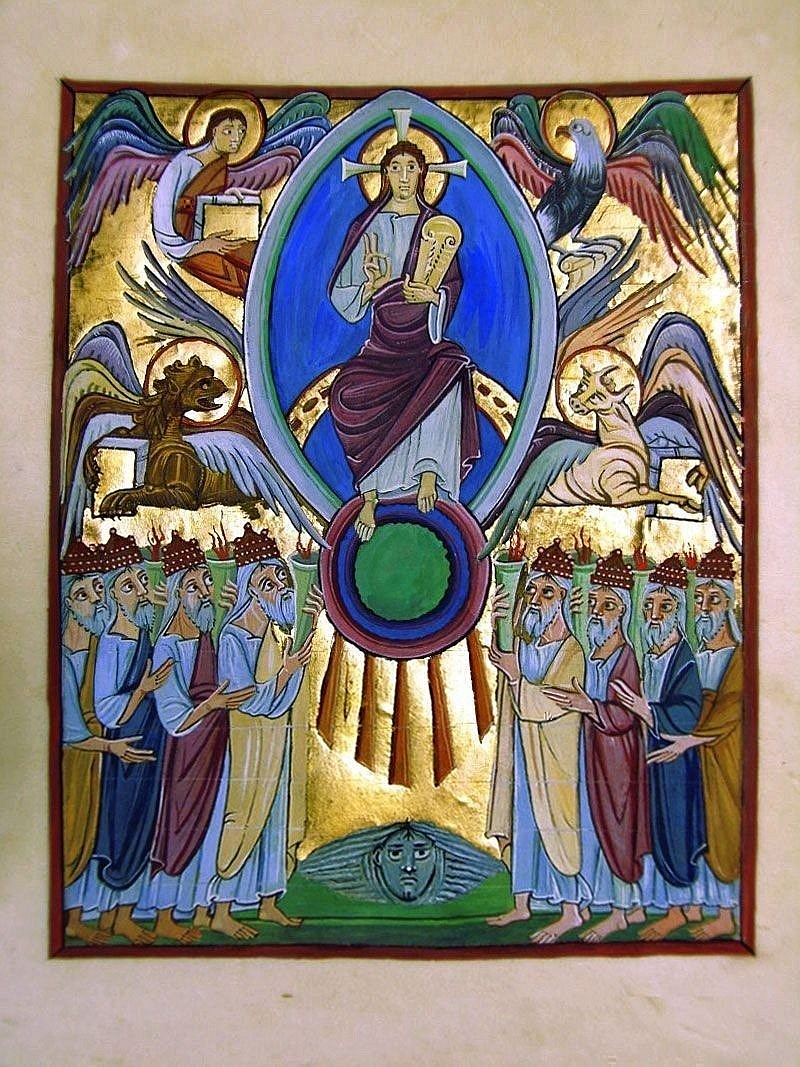
Sermon preached at Lawrencetown United Baptist Church, Sunday, June 21, 2026.
Sermon Scripture Reading: Revelation Chapters 4-5.
When Pastor Andrew invited me to come speak, he pitched it to me that he was going to preach on the Book of Revelation and that I could do the next passage. My immediate thought was, “Boy, you aren’t letting me off easy here.” My next thought was that I am going to have to go re-read some of my books on Revelation. My next thought was, “Andrew is now the one making me have to do my homework!” Maybe Andrew is trying to get back at me for making him read all those books for my classes.
Well, at any rate, I did enjoy revisiting some of these topics as I thought about the sermon for today.
The Context
But make no mistake: The Book of Revelation is one of the easiest books to misinterpret.
For this reason, in the early church, this book was often given something like how movies have a “PG” rating: this book should be read with care.
G. K. Chesterton once said that the Book of Revelation is a book of visions of many strange monsters, but none so wild as some of the book’s interpreters.
I am sure you all know of examples of weird interpretations of the Book of Revelation.
There is a persistent tendency for us to try to read the Book of Revelation as if it were a code to crack, with the events of today clearly providing the cipher.
Some have thought that the number 666 clearly refers to the former Russian President Mikhail Grobechev because—again, clearly—his birthmark on his face was in the shape of three sixes.
Some have thought that the locusts with “tails of scorpions” in Rev. 9 are clearly Apache helicopters.
Some have thought that the mark of the beast is the bar codes on grocery store products. Others think that the mark of the beast is vaccines. I know one person who believes the mark of the beast is credit cards (coincidentally, they have wonderful credit).
In terms of who is the anti-Christ or the false prophet, throughout church history a slew of people have been suggested: in the early church it was the Caesars who persecuted the church, in the middle ages different kings thought enemy kings were the antichrist, others thought the prophet Muhummad was the anti-Christ, during the reformation, Protestants thought the Pope was the anti-Christ, in the 19th and 20th centuries: Napolean Bonaparte, Adolph Hitler, and others. In recent memory, the leader of the UN, the Ayatollah of Iran, Saddam Hussein, Vladimir Putin, every president, and, a personal favourite of mine, Oprah Winfrey (I guess some people really don’t like Oprah). All of these people have all been accused of being—again, clearly—the Anti-Christ.
If Revelation is treated as a secret code to crack, predicting the future in outline, do you notice something of a perennial weakness in this? The problem is that every generation assumes they are the ones in the real end times because their age is so much more frightening than the previous one, and this gives them something like a blank cheque for how they want to interpret it. One pastor, Greg Boyd, once referred to the Book of Revelation as a literary Rorschach test: When you look at it, much like the inkblots therapists used to use, what you see probably says more about you and what you choose to see than what is actually there.
The Book of Revelation is a prophecy, but it isn’t a prophecy that tells us the future in exact detail. The Book of Revelation is less about predicting the future and more about knowing the patterns of history
It is less about prediction and more about patterns.
We can get really wrapped up in the “what?” or “how?” questions (you know: What does that symbol mean? How is that going to take place?), but the book is more about the “Who?” This book is less about the how and more about the who: it is about the character of Jesus, his Spirit, whether his way is the only way.
The books of the Bible that deal with apocalyptic, which, as one Baptist writer once said, are meant to teach us how to see all history through the eyes of God.
It is not trying to give us a detailed picture of what the future will literally be like. They are more like symbolic glimpses God gives to churches at particular times and places to keep them on the way to a future we simply cannot imagine. Revelation is written to seven churches in the first century, visions that intend to steer them back on track. And if we read the book with that kind of care, we too might sense our own course corrections from the Spirit.
For those who have been tracking with Andrew’s previous sermon, the Seer John of Patmos sees Christ, the Ancient of Days, and tells him to send seven letters to seven churches, each with their own challenges and strengths, which the writer mentions. It seems that these seven churches face all kinds of issues, like persecution, but also lackadaisical, lukewarm faith. Each one of the letters to the seven churches encourages them to persevere, promising that those who overcome will receive God’s promises.
In this regard, the message of Revelation is quite simple: God’s way will overcome. Trust it.
So, the Book of Revelation is less about prediction and more about patterns of history.
It is less about the “how” and more about the “who.”
It is not a code to crack or calculate; it is about our everyday character.
The question remains at the end of these seven letters: What does it mean to overcome? How do you do it? And the question throughout the book is simply: Are Rome’s ways of empire, violence, idolatry, and greed the true way or does God have a different way for God’s people?
The Throne
And to answer this, the topic shifts from personalized letters to seven churches to John being ushered up into heaven in the spirit to see a vision of God’s throne. Why this after those very personal letters to seven churches? Why the change in genre? What is the significance of God’s throne?
Why does a God that is beyond all things need a throne? I don’t think a God who is incorporeal needs to sit, but if he does, what other furniture does God have up there? Does he have a couch and a TV? Why a throne? In asking that, the reason is obvious, but we have to remember that these are symbols that God is giving us to help us understand a place that is beyond what we think time and space are. So, again, why a throne?
The most elaborate throne in history was reputed to be “the Peacock Throne.” This was the official throne of the Mughal Emperors, who ruled the entire Indian subcontinent from the 1500s to the 1800s. We tend to think that this was the age when European nations expanded and ascended to global power with the rise of the British, French, and other European colonial-imperial projects, but while Europe was sending out ships to colonize the world, the Mughal Emperors ruled an expansive land with 150 million people. And they were so wealthy, these rulers possessed roughly 25% of the world’s wealth at the time.
And so, as a demonstration of their power and opulence, these emperors commissioned the building of a throne that would truly show off their glory. You can look up artist renderings of this throne. It was not just a chair like the throne that sits in Westminster Abbey, for the King of England is called St. Edward’s throne. The peacock throne was not just a chair, but rather more like a gazebo or roofed platform that could be carried, carried, mind you, by a small army of servants. It was a golden platform large enough to hold a company of people, with pillars supporting a roof, all of it in gold. The throne weighed 3,000 pounds (those poor servants!).
The throne was adorned with elaborate textiles and decorated with golden peacock sculptures and real peacock feathers. One witness reports that there were close to 27 000 gemstones embedded in the gold of the throne, one of which was among the largest diamonds in the world.
The peacock throne said something about the emperors who sit on it. Thrones say something about the ruler.
Just think of what this attempted to say to people who came near: This person is so important that they don’t need to walk (they have servants for that), they are surrounded by gold and jewels (just to sit on), and their throne is adorned with sacred birds like the peacock, which symbolizes immortality and prosperity.
World rulers always find a way to symbolize their power in the objects around them, whether it is thrones, crowns, or golden wall décor that is actually just a painting moulding from Home Depot.
Here in Revelation, God shows this fantastic, symbolic vision of his throne, and we have to ask, What is this throne communicating about this ruler?
God’s throne is not only encased in gemstones and has the very rainbow itself encircling it.
God’s throne has cracks of lightning around it. It rests on a sea of crystal.
It is surrounded by 24 elders, presumably representing the 12 tribes of Israel and the 12 apostles, both worship Jesus in unison.
And there are these otherworldly cherubim circling around, each with a different animal head.
A simple reading might say that while emperors of the world try to show off their thrones, their power, their wealth, their opulence, God turns and says, “You think that is something, eh? Take a look at mine!”
But God’s throne and God’s kingdom are more than just a bigger and better version of a worldly throne. God is not like a human king, only scarier. God is not an opulent tyrant in the sky. God is trying to tell us that God’s rule is fundamentally different.
Remember that the throne has rainbows, and while rainbows are beautiful and sublime, they are also a sign of God’s promise never to destroy the world again. This ruler’s throne suggests not opulence but mercy.
Or, notice that the cracks of lightning and rolls of thunder are the same description of what happened at Mount Sinai, when Moses received the commandments. This God is powerful, but God is holy, just, and good.
Or notice that there are 24 elders who worship God, suggesting that while the church is being attacked by members of the synagogue, Jesus is still the fulfillment of all Israel longs for. God is still faithful to his people.
God, the ruler of the cosmos, is different.
In fact, that is what these other-worldly creatures cry out: Day and night without ceasing they sing, “Holy, holy, holy, the Lord God the Almighty, who was and is and is to come.”
This God’s reign is eternal, this God’s power is ultimate, but this God is holy, pure, good, and therefore different, different from all the rulers of the world.
And so, John gets a vision of the throne of God. This is not the first time in scripture that this happens. When King Uzziah dies, and the country is thrown into turmoil, Isaiah has a vision of God in his heavenly temple, seated on the throne, and the train of his robe fills the temple, and his throne is surrounded by angelic seraphim that cry, “Holy, Holy, Holy,”
The second time in the Bible is when the prophet Ezekiel sees the corruption of the temple and knows that God’s presence is no longer there and that dark days of exile are coming, but then he sees God’s throne coming down surrounded again by strange angelic creatures. This time, Ezekiel sees that on the throne there is one like the son of man, the “Son of Man” is Jesus’ most common title in the Gospels.
It seems that when we are going through turmoil, when things look the bleakest, when the world is quaking from the corruption of its leaders, it is in these times that God gives his prophets visions of his throne and says, “Look to me. Look to the one who rules this world, this cosmos. They are not in control, they are not all-powerful, their rules are not eternal, their lives are not infinite, their ways are not perfect. Mine is.”
“I am the one who was and is and is to come.”
I don’t know if you caught this, but the peacock throne is no more. A Persian army successfully attacked the Mughal Empire and carried off the throne as a trophy, but the general was assassinated, and the throne was pillaged.
It is ironic that the throne that symbolized immortality was melted down and broken into pieces, and the dynasty that ruled on it is all but forgotten.
In the time of the churches of Revelation, Rome proclaimed itself the Eternal City and its rule immortal. John sees a vision of God’s throne, heavenly and surreal, and it forces his readers, then as well as us now, to ask: What thrones, what powers do we trust in? What rule do we really think is going to outlast, a human’s or God’s? Which path dies and which path endures?
The Scroll
And if you trust Jesus’ rule, how does that change how you live? As we go through the Book of Revelation, you will notice that it is not merely an apocalyptic book but a book about worship: the angels are worshipping God here, and benedictions are placed throughout the book. It is trying to get us to realize that who we have our allegiance to is who we worship.
The people of the seven churches are being persecuted. Some of them are being martyred for not worshiping Caesar as Lord. Many felt tempted to give in, go along with the Empire, with its idolatry and its devotion to violent subjugation.
You can imagine them asking: But shouldn’t I support the Roman army? I meant, have you seen the economy? Have you seen the price of gas and groceries these days? Don’t worry about the people our country harms and oppresses; you need to take care of yourself. Don’t question the system. It can’t change. Just go along with it.
Their temptation was different from ours, but not all that different.
And that is why this vision says something to us today: When we see the heavenly throne of God, we are forced to ask: whose kingdom has our allegiance? Who is our true king?
John’s vision goes on to see a scroll, and an angel asks, “Who is worthy to open the scroll and break its seals?”
What is this scroll? Well, if this is a throne room of a king, a scroll is a royal decree. Edicts were sealed scrolls that rulers opened and read.
The scroll is no mystery. The Book of Revelation is not God giving Christians the winning lottery numbers before the lottery is called, so we can effectively hedge our bets. Some think the scroll is predicting the next set of events, but that is not quite what it is.
The scroll is justice. Who is worthy of executing the justice of God? And who will this justice vindicate in the end, the martyrs or the oppressors?
At this John weeps because he believes there is no one worthy in all creation to open the scroll, but then he is corrected: No, there is one. The one on the throne, this Jesus is not just a man, he is Lord and God.
He is the Lion of Judah. He is the king. He has conquered.
It makes you think of King David, the great warrior king with his armour and shield and sword, slaying thousands upon thousands.
Maybe that is what we need! All we need is a warrior to round up all the evil doers and get rid of them. We need another King Cyrus. We need another Constantine. We need another Richard the Lionheart. We need to fight fire with fire.
Is that how we solve evil? We certainly think that way.
But wait, look at what it says. John turns, looking for the Lion of Judah, but who does he see on the throne?
He sees the Lamb that was slain. The Lamb is the Lion. The slain lamb is on the throne, and the slain lamb has conquered, victorious.
Power does not have the final say in this world, suffering love does. Ironically, power is not truly powerful; love is true power.
In the Gospel of John, we could say that there is the third vision of God’s throne: the cross. Jesus tells Pilate that he is a king, just that his kingdom is not of this world. Jesus refers to the cross as his exaltation, his glory. John makes a point of saying Jesus was given a crown, a crown of thorns; he was adorned in royal clothes, the purple robe the Roman guards stripped him of and gambled away; he was lifted up, not with a golden chair, but with nails in his flesh. The sign above him on the cross says, mockingly but ironically, here is Jesus, King of the Jews.
While the Book of Revelation gives us this powerful symbolic vision of the glorious throne of God, we must never forget the throne that redeems us is the one that is made out of two rough planks of wood.
And if this is the case, how does God execute his justice? He does so by serving, by solidarity, by suffering with, and these are what eternal life is about.
Salvation came not by God destroying his enemies, but by dying for them. While we were still his enemies, Christ died for us.
“Take heart,” Jesus says, “In this world you will have trouble. But take heart! I have overcome the world” (John 16:33).
And so, Christ challenges us: Do you want the fullness of life? Do you want the life that lasts? Take up your cross.
When the ways of empire and idolatry want us to go their way of pride, complacency, dishonesty, self-preservation, greed, violence, the Book of Revelation says to us, look to the king, look at the one who has conquered sin, death, and the devil, look at the one who suffered and died and rose again.
Again, whose reign dies and whose reign endures?
Whose kingdom will you follow?
Jesus says to the church in Ephesus, “To the one who is victorious, I will give the right to eat from the tree of life, which is in the paradise of God”
And yet, when we admit that so often we stumble and fail, I am reminded that Romans chapter 8 simply says, “In all these things we are more than conquerors,” not by our own power, for it says, but rather, “through him who loved us.”
May trusting the mercy of God daily renew us deeper into the image of Christ, the Lamb. Amen.
When Will It End? A Different Kind of Apocalypse
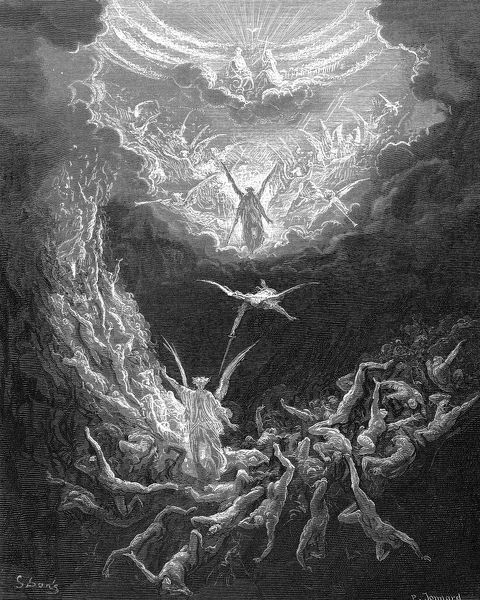
So, Phase Five of the reopening plan in Nova Scotia has been delayed until October. I don’t know about you, but when I read that, while I think it is the right decision, I just groaned with that sound a drain makes when I try to pour soup down it: ugh. When will this be over?
Believe it or not, the people in Zachariah’s day were asking a similar question: When will the end come?
Zechariah is a prophet that writes at the time of the return from exile (this is 520 years before Jesus, in case you are wondering), but we need a bit more background to understand what is being said in our passage today before I read it. You see, the nation of Israel after King David and his son, King Solomon, split into two halves: The Northern Kingdom and the Southern Kingdom, and this was due to the idolatry of King Solomon and the foolishness of his son, Rehoboam. While the Southern kingdom continued on for about two hundred more years, it was defeated by the Babylonians. Jerusalem was burned and levelled, and its people were carried off into exile in Babylon.
This destruction was prophesied by the prophet Jeremiah. Jeremiah also prophesied that God would restore Israel after the exile. He says,
For thus says the Lord: Only when Babylon’s seventy years are completed will I visit you, and I will fulfill to you my promise and bring you back to this place. For surely I know the plans I have for you, says the Lord, plans for your welfare and not for harm, to give you a future with hope. (Jeremiah 29:10-11)
How many of us have had that Scripture read lately? We like that part of Jeremiah, don’t we?
After 70 years, God would fulfill his promises for Israel. These promises include God bringing about the kingdom of God. If you are already doing the math and thinking to yourself, “Wait a minute, Jesus came 520 years later,” hold that thought.
So, when the Babylonians were defeated by the Persians, and the Persian kings ordered the return of the Jewish exiles back to their home, the Jews got back, and they started rebuilding, hoping for the imminent coming of God’s kingdom. They did not want the past to repeat itself, so they did the good religious thing, and they started fasting regularly. But beneath the piety, they had not actually changed.
God sends Zachariah, and Zachariah tells the people he has had visions in dreams. Chapters 1-6 record them, eight in total, each one perplexing and fantastic in its symbolism, and the first four and last four seem to mirror each other.
Zachariah dreams of four powerful angelic horsemen returning to Jerusalem, but then in his eighth dream, they are going out on patrol on standby. What is happening there?
He dreams of the horns of the oppressive nations being dismantled. But then he dreams of a woman being carried off in a led basket by angels to Babylon, where a permanent dwelling awaits her.
He dreams of measuring a new Jerusalem, where God dwells and protects his people. But then he dreams of a flying scroll going out into the land and finding anyone who has dealt with another falsely and cursing them.
He dreams of the high priest of his day, a man named Joshua, being accused in heaven by the Adversary, and God coming to his defense, taking his filthy, soiled clothes, and giving him a beautiful new priestly robe to serve the people.
Then he dreams of a golden lamp stand with a bowl with seven lamps standing beside olive trees. This, an angel explains, is the governor Zerubbabel. This is what he can be for his people if he trusts not his own strength but trusts in the Spirit.
Reading these, one cannot help but ask: When is this going to happen? Did it already happen or is it yet to happen? How are they going to happen? It does not exactly fit into a neat timeline (more on that in just a minute). Then the dreams close with God saying something strange in Chapter 6:15: “This will happen if you diligently obey the voice of the Lord.”
If? That’s weird. That can’t be right. The future is set and determined. The translator probably got that waw wrong. Or did they? Well, this brings us to our text today:
7 In the fourth year of King Darius, the word of the Lord came to Zechariah on the fourth day of the ninth month, which is Chislev. 2 Now the people of Bethel had sent Sharezer and Regem-melech and their men, to entreat the favour of the Lord, 3 and to ask the priests of the house of the Lord of hosts and the prophets, “Should I mourn and practice abstinence in the fifth month, as I have done for so many years?” 4 Then the word of the Lord of hosts came to me: 5 Say to all the people of the land and the priests: When you fasted and lamented in the fifth month and in the seventh, for these seventy years, was it for me that you fasted? 6 And when you eat and when you drink, do you not eat and drink only for yourselves? 7 Were not these the words that the Lord proclaimed by the former prophets, when Jerusalem was inhabited and in prosperity, along with the towns around it, and when the Negeb and the Shephelah were inhabited? 8 The word of the Lord came to Zechariah, saying: 9 Thus says the Lord of hosts: Render true judgments, show kindness and mercy to one another; 10 do not oppress the widow, the orphan, the foreigner, or the poor; and do not devise evil in your hearts against one another. 11 But they refused to listen, and turned a stubborn shoulder, and stopped their ears in order not to hear. 12 They made their hearts adamant in order not to hear the law and the words that the Lord of hosts had sent by his spirit through the former prophets. Therefore great wrath came from the Lord of hosts. 13 Just as, when I called, they would not hear, so, when they called, I would not hear, says the Lord of hosts, 14 and I scattered them with a whirlwind among all the nations that they had not known. Thus, the land they left was desolate, so that no one went to and fro, and a pleasant land was made desolate. (Zechariah 7:1-14, NRSV)
1. We want to know when all this will be over.
So…After the book recounts these dreams, it says that a delegation comes to Zechariah, and they say, “Hey, it’s been 70 years of exile since Jeremiah said God would come and restore us and fulfill all his promises. The clock is ticking. We are back, but life is terrible!” Let’s just say it was worse than a life of zoom calls and mask-wearing. So they say, “When is God going to come? When and how are all these dreams going to take place? When is God’s kingdom going to be here?”
Jeremiah’s prophecy looms in the background, and so the prophet brings it up. They want to know, when is it all going to end? When is a golden age going to dawn? You might say that they want to know if they are living in the end times.
I grew up in a religious tradition that was almost singularly obsessed with this question of the end times. As a person that has always loved reading, in my early years, I read book after book on predictions for the end times. As a young person, I felt deep down that things were not the way they were supposed to be. The world was becoming a darker place, not better, and when you read through a book like the Book of Revelation, it is very easy to draw the conclusion that the end is certainly near.
On Dec. 31st, 1999, my family was vacationing in Florida at my Grandparents’ condo over Christmas. Everyone was worked up about Y2K. Could this be the end? Will there be a mass computer failure, resetting civilization? Will the armies of the middle east rise up against the Western powers like what we saw in the Gulf war? Will the European Union become the new Babylon? Some of the preachers I read said it would. It’s 2000 years from the life of Christ. It makes sense. Two thousand years from Abraham to Jesus, the beginning of the covenant, so logically 2000 years from Jesus to the second coming.
I remember asking my dad about this, and part of him was skeptical. The other part was scared and felt anxious.
We watched the countdown: 3, 2, 1, Happy New Year! The ball dropped in New York, and people sang silly Irish songs. And as people out in the pool house of the condo ran around blowing their horns and noisemakers, my dad and I looked at the TV screen: reports came in that everything was fine. Nothing happened.
The end did not come.
I wish I could tell you that I learned a lot from that experience, but through high school, I really just went on to another prediction, figuring that the Y2K prediction was the right approach with the wrong conclusion.
Another event happened in my young adult life: 9/11. I watched from the big TV in the corner of our classroom in high school the planes flying into the World Trade Centre Towers. Then the war on terror was launched, then the Iraq war. The books I read suggested that these are the real prophesied enemies, Gog and Magog, and now, not Y2K, was the real beginning of the end. It felt like it.
But already, as a young person, this approach became dissatisfying to me, and perhaps you have felt this too (if you have any clue about what I am talking about). It seemed like those most certain that this politician or that terrorist attack was clearly this man on a horse in the Book of Revelation or that seal or bowl or trumpet or beast – whatever it was – it seemed that these preachers had been making these predictions for decades.
Protestant Christians have been habitually predicting the end since Martin Luther, who was convinced that the beasts in Revelation were Roman Catholicism. For 500 years, Christians have been treating apocalyptic literature as a code to crack and that we are now living in the definitive age that has provided the cipher, all to be proven wrong time and time again. Anna said last week: We have been living in the end times for 2000 years.
A few months ago, I was driving to work. I took a different way than I normally do. As I drove, I admired the farms and trees and all the beauty of the Annapolis Valley. Of course, I passed by churches. One church in particular (which will remain nameless) struck me. It had a sign on the front. It was a quotation from the Book of Revelation. It indicated that COVID-19 is one of the plagues from the Book of Revelation, revealing that we are in the definitive end times. Oh, and by the way, service is online at 10; all welcome.
A piece of me really wanted to deface that sign. Adorn a ski mask and spray paint something on that sign in the middle of the night. I don’t know what I would spray paint it with. Maybe Matt. 25:13: “You don’t know the time or hour!” I don’t know. I decided that probably was not the best idea.
I was tempted to call that church up and lecture them about how you can catch more flies with honey than with vinegar. I can’t imagine that going well.
But the other part of me had to say: Aside from the sign being in bad taste, it is a question people are asking: Is the world ending? Cause it kinda feels like it is. If not, when will it end? How will it end?
So, to give these folk some credit, all our hearts feel the same thing: the foundations of our world are shaking, and our social fabric is tearing, and that has led so many of us to pray: How long, O Lord? When will your promises be fulfilled? When will your kingdom come and will be done? Because our world today feels like it is on the precipice to oblivion.
2. What does the end reveal about us now?
As I reflect on it, that sign probably revealed just as much about me as it did about that church. Apparently, I have tendencies towards vandalism, and I get really bothered by other people’s bad theology (It is an occupational hazard).
Something similar, however, is true of the visions of Zechariah.
An apocalypse is an unveiling, a revealing, that is what the word in Greek means, but it is not God giving believers a spoiler video clip of the conclusion of his own movie before the movie comes out.
It is prophetic poetry that uses fantastic and frightening symbols: of fire and flying scrolls, beasts and bowls of wrath, angels and dragons – and if we read it as literal, something will happen exactly like this or that, or we dismiss it as vague mythology of a by-gone era, something modern science with its laws of the conservation of energy has disproven, we miss that these figures are trying to unveil something in us, something in front of us.
Books like Zechariah or Revelation are not maps to the future. They work more like postcards and compasses because we so often lose our way on the journey of faith.
Sometimes we are tempted to go our own way, take history into our hands, and think that now we can make God’s kingdom come here. All we need to do is lie here, cheat there, or kill those getting in the way.
Other times we are tempted to be so certain Jesus is coming we sit back and do nothing and watch idly as the world becomes a darker place as we wait to escape it. We think the end is about fleeing earth to get to heaven, rather than living a way on earth as it is in heaven.
Other times we fall to despair and say God isn’t coming, there is no hope, and we recede into ourselves, caring only about our little slice of the world we can control, and we try to distract ourselves with life’s few fleeting moments of pleasure and peace.
Which have you been most tempted to do during this pandemic? Have you spent the pandemic angry at others? Or just waiting for it all to be over because you’re just done? Or have you just stopped caring?
These visions give us something more like a collage of pictures and mirrors: pictures that point to God’s end for all things, yes, but also mirrors that reflect these figures on ourselves, allowing us to see what is going on in our selves at a particular time so that we can get back on the right path to God’s end.
These are the things these visions are trying to truly unveil. Notice the move Zechariah makes, and it is a move that Jesus makes as well when the disciples ask him about the end in Acts 1. The people ask: when is it going to end? Zechariah responds with a challenge:
“Thus says the Lord of hosts: Render true judgments, show kindness and mercy to one another; do not oppress the widow, the orphan, the foreigner, or the poor; and do not devise evil in your hearts against one another.”
3. The End is an Invitation
Walter Rauschenbusch, the Baptist pastor and theologian, once said, “It is for us to see the Kingdom of God as always coming, always pressing in on the present, always big with possibility, and always inviting immediate action.”
We want God to come. But then God opens a door and says: ok, step through. The future is an invitation, the future is a choice, and it is being presented to us every moment of every day. In this way, we are living in the end.
Embrace God’s future, live in line with the restoration of all things, or hold on to your past and the ways of this world and live in line with the road that leads to Gehenna’s destruction. The choice is before us, and it is a call we so often ignore.
We want to know what is true in this world, seeing it as it truly is, but we cling to easy answers and protect ourselves with lies.
We want a world of justice, but we cling to our privilege and complain about the sacrifice it calls for to set right what has gone wrong.
We want a world of love, but we don’t want to forgive or empathize with those we disagree with.
We ask God when will all this be pandemic stuff be over? When are you going to bless us and fulfill your promises?
God replies: Be honest; start being kind to one another; stop oppressing the marginalized of society; stop hating others. It is simple, but we keep refusing to listen.
During this pandemic, have we learned just how important it is, to be honest, to pursue sound truth and follow good common sense?
Have we learned through this pandemic just how interconnected we all are, just how much our actions affect those around us? That our health is connected to the health of others, that we are only as protected as those least protected.
Have we learned how we are connected to the earth and to each other and how the only way we can succeed as a society is by using our rights and resources to lift each other up?
Have we learned to be kind to those with whom we disagree? Have we learned that people have more worth in them than their opinions and that no opinion can make them worth any less?
Have we learned to care more about the vulnerable of society: our seniors, those that live in long-term care facilities, front-line and minimum wage workers, those who face eviction, homelessness, unemployment, mental illness, and disability, those that face hardship through no fault of their own?
Have we learned that money cannot dictate morality? Have we learned the real thing that has kept society together has been individuals coming together and giving their time and service to the common good?
If we have not learned these things, this might sound apocalyptic, but will society survive another pandemic? Can we even survive the next few years or even months?
When will all this be over? Scripture flips this question around on us and simply asks: What will you choose now?
But the answer to that is predictably dim and disappointing. Zachariah says that the people refused to listen, and here we are 2500 years later, and we still don’t want to listen. Have we learned that much from the pandemic about how to live in the way God wants us? I don’t think we have.
And so, Zachariah, like many of the other prophets, calls us to repentance and justice, and he offers us words of warning and even wrath, but then also ends with hope, hope that does not depend on us, although it constantly invites us into it.
He proclaims in chapter 9: “Rejoice O Daughter Zion, your king will come to you. Triumphant and victorious is he, humble and riding on a donkey.” Then God says, “Because of the blood of my covenant with you, I will set your prisoners free… I will restore you.”
It is the hope that the God that made this world and has spoken promises through prophets has come into the world in Jesus Christ, his Son. God became a man, and this man died on a cross because of our failure to embrace goodness and truth when God has proclaimed it. But the forces of death, disobedience, destruction, and despair did not have the final say.
In this, we trust and hope today, despite our own selfishness and stubbornness, that God desires the resurrection for everyone and everything so that the force that emptied the tomb will fill every corner of this world, every heart and mind, beginning with us.
And so, we ask: When will all this end? The church knows it will and simply prays: Come, Lord Jesus Come. We are ready to step into your kingdom!
Let’s pray.
Lord, God, Alpha and Omega, beginning and the end, you are Lord of history because you have taken on the darkness of history and bore it in your very flesh, then you rose from the dead into a future of hope, forgiveness, and joy.
Lord, we long for this pandemic to end. But may this be the end of our selfishness and hatred; put an end to our deceit and ignorance; may this be the final day we tolerate injustice and division.
Let a dawn of resurrection righteousness shine in our hearts, in our relationships, and our communities. May we see something new among us, in us, and through us, by the power of your Spirit.
Come, Lord Jesus, Come. Amen.

