
The Sabbath and Jesus’s Way of Following Scripture
Preached at Billtown Baptist Church, Sunday, August 23rd, 2026.
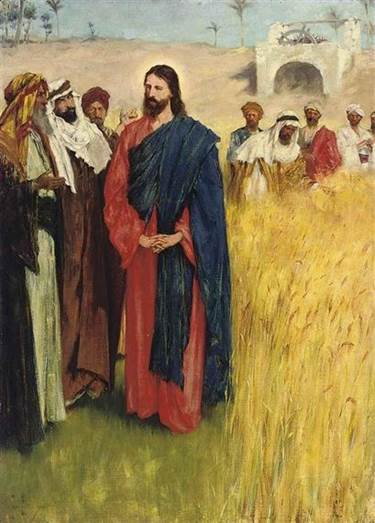
23 One Sabbath Jesus was going through the grainfields, and as his disciples walked along, they began to pick some heads of grain. 24 The Pharisees said to him, “Look, why are they doing what is unlawful on the Sabbath?”25 He answered, “Have you never read what David did when he and his companions were hungry and in need? 26 In the days of Abiathar the high priest, he entered the house of God and ate the consecrated bread, which is lawful only for priests to eat. And he also gave some to his companions.” 27 Then he said to them, “The Sabbath was made for humanity, not humanity for the Sabbath. 28 So the Son of Man is Lord even of the Sabbath.” (Mark 2:23-28, NRSV)
As an experiment, the journalist AJ Jacobs set out to live out every command in the Bible as literally as possible for one year. He talks about this in his book, A Year of Living Biblically. Jacobs admits he is not a religious person. He is ethnically Jewish, or as he puts is, he is about as Jewish as the Olive Garden is an Italian restaurant. He has, nevertheless, always felt deeply fascinated by religion and tried it on as an experiment.
And so, he set out to tally and then implement all the commands he could. Some ones we know well: to love your neighbour as yourself. Don’t eat pork (so he had to give up bacon for a year—see that would have been a deal breaker for me). But there are also a lot of others: Don’t wear clothes of mixed fabric, don’t shave your beard. So, he had to put away a lot of his clothes and grow his beard out. I see there are a lot of men who are ritually unclean in the room this morning.
As you can imagine, some of these rules got him in some tense situations. He tells of having a conversation with a man he met walking in Central Park. As they talked, the man wondered about his experiment, given that Jacobs was starting to look more Moses-like, shall we say. When Jacobs asked about the man’s life, the man casually mentioned he was living with his girlfriend. To which Jacob’s stopped and informed him, “Sir, I wish you had not told me that, because there is a law in the Bible about stoning adulterers, so, now I am obligated to stone you.”
“Are you serious?” The man said. Jacobs, obviously not willing to fully go through with that particular command for obvious legal reasons, but still wanting to fulfill it in some literal sense, took a handful of gravel from the side pouch that he had saved for just such an occasion and tossed it at the guy and ran away.
Jacobs’s experiment, as he tells in his book, is full of quirky predicaments. But the book is more than a piece of entertainment. As Jacobs tries his best to commit himself to living fully obedient to the laws of the Bible, he, as an agnostic, comes to appreciate the concern for living rightly and having a sense of awe and gratitude about the world that many of the religious people in his life have. He finds there is something deeply centring about religious rituals (even if you don’t believe in them).
But more to the point, he realized, trying to keep every single law (he calculated 700 laws, by the way) in modern-day Manhattan was impossible. Throughout the book, he talks with Ultra-Orthodox Jews, Christian fundamentalists, and many other religious folk who claim that they attempt to follow all the plain commands of their scriptures, and lo and behold, he concludes that everyone he talked to made certain exceptions that were not explicit in their scriptures for certain particularly odd or burdensome commands. Every single person he talked to did this in some way.
He concludes that no one is a true absolute literalist when it comes to the Bible. Everyone, whether they admit it or not or are aware of it or not, has some kind of set of criteria for when a rule should apply and when it doesn’t, based on context and things like that. You can either be consistent about it or not.
Another discovery he made, perhaps an all too obvious point, is that following many commands of the Bible strictly according to their letter, actually, ironically, goes counter to the very values and principles the Bible holds as central.
If you don’t keep what is central about the Bible at the centre, you can actually do a lot of damage. (Just ask the guy who had gravel thrown at him).
It does not take you long to see Christians near and far using the Bible to harm rather than to heal. Or even more ironically, Christians using the Bible to not follow Jesus.
This problem is not new. It is one that Jesus specifically came to correct. We just have been very good at listening.
I sat there thinking about what I wanted to preach on this week, and I simply had this scripture placed on my heart. This topic: how does Jesus want us to follow what is in the Bible? If Jesus is the centre, how does he show us how to live out scripture fully and most faithfully? This simply is something we all need.
That brings us to Mark chapter 2. Jesus clearly wanted us to know this as well. In Mark’s Gospel, Mark starts introducing us to Jesus, and one of the first stories he tells us, one of the first acts Jesus performs when he begins his ministry, is this.
Remember Mark is the earliest Gospel. While we sometimes don’t give Mark his due since it is also the shortest Gospel, scholars have pointed out that in many ways, Mark is also the most edgy.
This is the first written account of Jesus’ life, introducing us to Jesus, and as far as Mark is concerned, we are just starting to learn about this mysterious person named Jesus who has been baptized and called the “Son of God” by a voice from heaven and has healed folk like Peter’s own mother and things like that. It seems that one of the opening stories Mark wants us to know about who Jesus is involves Jesus and his disciples walking along, and they get accused of breaking Sabbath law. That is an odd story to begin with if you want to show how Jesus fulfills the law, isn’t it?
So, what happens here? The disciples get hungry, and so they break off heads of grain and chew them as they walk (which apparently you can do to the grain when it is green but not when it is dried out and, technically, ripe—or at least that is what Google’s AI told me when I asked it). I was thinking about that since we passed a wheat field on the way here. I am not going to do that; I’m just saying you could.
That seems innocent enough. My family went hiking while we were on PEI, and the trail we walked on had wild raspberries, so as we talked, some of my kids picked some of the berries and ate them. I am pretty sure the one bush might not have been raspberries at all, but they ate them before I could say no, and they are still alive, so all ended up well. (That’s where I am in my parenting, by the way—when you only have one kid, you are so concerned about every hiccup. You get to five, your parenting rule becomes, “Well, they’re still alive, so I guess it’s fine”).
Not so for the disciples. Why? Because it was the Sabbath. You’re not supposed to do anything like work on the Sabbath: not pick grain, not even prepare after-church sandwiches or coffee (so, some of us are in big trouble).
In fact, there is a passage in Exodus 31:14-15 that reads as follows: “Observe the Sabbath, because it is holy to you. Anyone who desecrates it is to be put to death; those who do any work on that day must be cut off from their people. For six days work is to be done, but the seventh day is a day of sabbath rest, holy to the Lord. Whoever does any work on the Sabbath day is to be put to death.”
You could have the death penalty for working on the Sabbath. That sounds drastic. Why would there be a command like that back in the Old Testament? Can you imagine there being a law like that in Canada? Imagine it being a crime to work on the long weekend?
Why did they have a law like that in the first place? Well, if you think about this along with laws like the punishment for idol worship and things like that, it seems like the people of that time, being rescued from slavery in Egypt, where they worked day in and day out—and this was the way of life they were used to, along with thinking about God through idols—they had a really hard time breaking away from this way of thinking and living. These laws were created wanting to reject that kind of way of life in the strongest possible terms, putting that kind of deterrent on going back to the economically and religiously oppressive ways of Egypt. Now, I am not saying that to make them sound just by today’s standards, but by the standards of the ancient world, this is what they were trying to do. The penalty, as severe was it was, was a way of saying, “this is really important.”
But like so many of the laws, these laws were intended for a very specific purpose that got forgotten. And there is something of an irony that, in creating laws with such strict penalties as a way of rejecting oppressive ways of life, it actually creates its own oppressive way of life. I am sure it does not take much to think about what other commands Christians take in a similar way today.
Well, Jesus and his disciples are walking along; they get hungry, and the disciples pick grain heads off as they walk and eat them. Some Pharisees see them.
Who are these Pharisees? The Pharisees were religious leaders who held to a school of thought that developed about a century and a half or so prior to Jesus showing up. Their name means the “separate ones,” and they put strong emphasis on strict personal adherence to the laws of the Bible, and they developed a whole body of writings on how to do this.
However, along the way, just like how AJ Jacobs points out with fundamentalist Christians, the Pharisees find all sorts of ways of saying “we obey all the commands” while actually making exceptions for the ones that might cost them the most.
They found ways of selectively applying the commands of the Bible in ways that pointed the finger at people outside their group and interpreted other laws in ways that were beneficial to them. This is what Jesus confronts in the Sermon on the Mount.
Again, it does not take much to see examples of this today.
Well, Jesus and the Pharisees have already picked a fight, and so it looks like they were already watching for something to accuse him of. You can imagine them coming up to Jesus, fingers waving: “What do you think you are doing, picking grain on the Sabbath? That’s against the rules!”
And Jesus turns to them—and I love this—he says, “Umm, haven’t you read that…” as if to say, “Oh, I’m sorry, perhaps you don’t know the scriptures very well, let me remind you.” In other words, I think Jesus is actually being a little bit cheeky here.
And more importantly, Jesus essentially out-thumps the Bible-thumpers.
And he says, “Don’t you know that in the Bible, David, when his men were hungry, ate consecrated bread right from the Temple?” They were hungry, and it did not matter that it was holy bread, reserved for God. It appears that God did not mind. It is kind of like making sure people do not go hungry is more important.
Then he gives this profound principle: The sabbath was made for humanity, not humanity for the sabbath.
Now, when you think about this, we who are living 2000 years after Jesus, it seems all too obvious to us what Jesus is saying. We take this story to mean something like this: Following God’s commands are important, but don’t get too persnickety about it or something like that. But put yourself back in their shoes. It’s more radical than that.
At least at first glance, the Sabbath was a command about worshipping God. If anything, it should be absolute because what could be more important than God?
If anything, the line should have read, “Humanity was made for the Sabbath because the sabbath is about God and humans were made for God.” It’s one of the Ten Commandments. If there is going to be an absolute law in the Old Testament, this is it. This fits the bill.
But, this whole notion of having a Sabbath day, in Jesus’ estimate, was to help people. God does not need us to worship him. We need to worship him. We don’t practice a day off from working because the Sabbath is so important. We take a day off from working because people are so important. And if you are so obsessed with following the laws of the Sabbath that you refuse to help people, you have missed the point.
Again, this all might sound obvious to us. Some of us don’t bat an eye about answering emails on Sunday or picking up a shift. If anything, most of us could be a bit more strict about having a day where we refuse work and rest.
But again that is not the radical point being made here: if the Sabbath stood at the heart of Jewish religion (which it did), this is how it might have been heard: Humanity was not made for church, but church for humanity.
Or hear it this way: Humanity was not made for Christianity, but Christianity for humanity.
Putting it that way might give us a clue as to just how revolutionary and provocative Jesus’ statement would have been to those hearing it. And it might also give us a clue as to how much we have ignored Jesus’ own radical way of living out the Bible.
I don’t know about you, but I have literally heard this passage preached to me growing up as “See, because of Jesus, I can mow my lawn this afternoon and not feel bad. That’s grace.” Now, don’t get me wrong. I am going to mow my lawn this afternoon (if the rain lets up), but if that is all we think this passage is about, we have really missed the point.
But it goes much deeper than that: Jesus claims that he is Lord of the Sabbath, if he is the centre of what the Bible is about, and because he is Lord, because the Sabbath is about him, then he actually approves of his disciples of NOT following this command to its letter, which is again, one of the most important commands in the whole Old Testament—so important and absolute you could get the death penalty for violating it. And yet, Jesus says, if it does not actually help people, don’t follow it.
Jesus, here and throughout the New Testament is trying to re-teach the people of God what it means to follow the Bible and what it means to follow God.
Jesus is asked later in the Gospel of Mark what is the greatest commandment, what is the commandment that summarizes all other commandments? Jesus simply says that it is to love God with your entire being and love your neighbour as yourself. Then Jesus says, this is the most important commandment. Notice the language there? Love God and love others is not two commands but a single command.
More radically, if you look at the Gospel of John, which is the latest Gospel, John does not include any specific teachings of Jesus. It’s interesting. John does not pass on the Sermon on the Mount as Matthew does, or parables as Luke does. John has Jesus say this: I’m giving you a new commandment: that you love one another. That’s it. That is what believing in Jesus looks like. Love.
John even has a moment when Jesus says to the religious teachers: You search the scriptures, but if you are doing this without looking at me, you are going to miss eternal life.
This law of love shows up in every Gospel and in all the major writers of the New Testament. The Apostle James calls it the “royal law.” Paul teaches it to the Galatians, a congregation of non-Jewish folk that were being told that if you don’t follow all the rules you can’t be a part of God’s people. But He says, if you trust what the Spirit has done in you, you’re justified, and from there, what rules should you follow? Follow the rule of love, following the fruit of the Spirit. He says, “love, joy, peace, forbearance, kindness, goodness, faithfulness, gentleness and self-control. Against such things there is no law. “
This leads me to ask: What if we believe in the Bible the way Jesus did? What if we did this consistently with all the commands we can think of?
Because you know what we often do? We seem to get it well enough that there are those strange laws in the Old Testament that intuitively don’t seem like they apply today.
But do we do this with the commands of the New Testament? Or do we turn around and make the New Testament into the second Old Testament?
Do we take our theologies and say, because we have backed them with Bible verses, we use them as excuses to not be more loving?
Do we actually use the Bible to prevent us from loving others more?
Do we actually use the Bible to get out of following the way of Jesus?
What are the consequences of that? Personally and globally?
Again, it does not take you much to see how this is having disastrous results in the world.
If you want, you can look in the Bible and kinds ancient laws that were intended for a very different time than our own, and cite them, and you can do some pretty terrible things.
One author, Jordan Harrell, put it this way (I paraphrase):
Genocide is biblical; loving your enemy is biblical. [That is, there are commands in different parts of the Bible that suggest both]. But only one is Christlike. [Only one is actually lived and modelled by Jesus]
Slavery is biblical [it’s in the Bible]; Chainbreaking [liberation] is biblical. But only one is Christlike. [Only one is preached as central by Jesus]
Patriarchy is biblical; Counter-culture elevation of women is biblical. But only one is Christlike.
Retributive violence is biblical; Grace-filled restoration is biblical. But only one is Christlike.
Segregation is biblical; Unity is biblical. But only one is Christlike.
And you can go on from there.
That, of course, is not saying that the Bible is bad or that we need to get rid of it. Far from.
What he does mean is that if we don’t keep Jesus central, if we don’t follow the Bible Jesus’ way, we can turn even something as beautiful and true and good as the Bible into something idolatrous and destructive.
There are so many widespread implications to this that we do not have time to get into, so let me limit myself and close with this story:
Like many churches, we have communion once a month. When I was pastoring in Sudbury, we had a communion Sunday very similar to here at Billtown: the same way the deacons pray and the elements are distributed. One Sunday my worship leader invited a family to come to church. She was a single mother with three kids, one of whom had autism. She arrived late, just before we served communion. She kind of sheepishly snuck in the back. Well, when I started going over the communion words, something set the poor kid off, and he began running back and forth at the back of the sanctuary. Then he ran up to me, grabbed the communion cup, and ran off with it.
What would you do if that happened? I stood there stunned a bit, but I got a little nudge from the Spirit, I believe. It occurred to me that if we got really wrapped up with what we were doing with the bread and the wine, we could actually be missing the point of what communion was about, and that was, for this morning, welcoming a family with Christ’s love. That is communion.
Without any prompting, some of the older women came and sat down next to the lady and simply said that they were glad she was here. Of course, a ritual purist might insist that communion is about remembering Jesus and making sure the elements are taken respectfully. But could we say, “Communion was made for humanity, not humanity for communion”?
Again, do we so often miss the radical way Jesus is showing us?

