
Category: Uncategorized
Eden: Physical Place or Spiritual State?

The truth of Genesis two, the truth of Eden is that we are all the man and the woman of this passage. We are all born into a state of innocence, and we all have the choice before us: to live life with God, eating of the tree of life, or to be our own god, eating of the tree of knowledge of good and evil. One means death; the other means eternal life.
It is amazing how this simple truth gets obscured by loony assertions about the geographic nature of Eden, attempts to find it, and the requirement to have it as a historical place or else the whole Bible is worthless. Consider the following a therapy to return us to a more spiritual simplicity. This may take some explaining of some complex fine points, but, like I said, it actually returns us to the simple truth of the text.
In this post and those subsequent we will look at Genesis two and point out obvious literary contours that suggest its character is often just as spiritual or poetic as it is historical, and so, its truth is its theology not necessarily its geography or history.
Myth or History?
Are the early chapters of Genesis history or myth? Well, technically both and neither. The either/or notion of history or myth is a modern invention. In fact, conservatives that attempt to force these passages to be history in the modern sense, ironically accommodate the Bible to a system of thinking very foreign to Genesis. While the Gospels are eyewitness accounts and memoirs, Genesis is not. While the whole Genesis narrative is enveloped in features of historicity – being written in a genealogical account with a rough chronology, it is simply not history in the precise modern sense. Ancient story tellers passed along their accounts orally, embedding them with rich poetic detail from the surrounding culture and its mythology. The stories were a set of oral traditions, passed along in a tradition of story telling and they retain that flavor. God was pleased to have it that way. Eventually the stories were written down hundreds of years later. God was pleased to do it that way.
Note what this process looks like: they were passed along without any fact checking (or worry of factually) and they were passed along because of their ongoing theological truth as told and retold in a community who understood themselves as being a people in covenant with God. The notion of writing history from primary sources and eyewitness reports, critically fact checking them is really a method of historiography that is only a few centuries old, developed in the Enlightenment. So, the narrative intends history, but its form is more complex than that. It intends historicity but is not bound to its historicity. Whether or not the passage happened is just not a worry of the ancient world. Thus, for us, we need to have a similar mentality. The value of the narrative is not in the history behind it, but in the story retold. These narratives are God’s word, using the means the people of the day had to communicate salvation truths today. As the baptist theologian James McClendon reminded, “The Bible is the story of God, retold in the way God was pleased to tell it.” God was pleased to use the ancient discourses just as much as he is pleased to have the present imperfect church as his body.
This poetic aspect has its own theological weight to it, as we will see, since literary devises suggest theological truths beyond historical references. While Genesis two is written to be an event occurring in the ball park of 4000 B.C. and Eden is in some way described like it is a physical place, there is also signs that the Eden is an ongoing spiritual reality fitted into this history-like account.
As we will get into, putting even all arguments about evolution aside, humans have been on this earth for a lot longer than 6000 years. The standard estimate is somewhere around 200 000 years. Young earth creationists, who, as we say in the previous post on Genesis one, bring an uneven literalism to the Genesis text, making up arguments to make their interpretations work such as Carbon dating is completely inaccurate or that before the flood the rays of the sun somehow made fossils look older. This is a far-fetched theory. It still does not reconcile why no human fossil is older than, for instance, dinosaur fossils, let alone how there are human fossils still that are dated around 6000 years, while others are far older, mostly found in Africa, not Mesopotamia. While most forms of carbon dating start to get less precise after about 50 000 years (which is determined based on the half-life of forms of carbon, after which point the carbon traces become minuscule), within that span of 50 000 years, it is reasonably accurate. If humans have only been on this earth for 6000 years, why are we finding perfectly persevered 10 000 year old totem polls in bogs in Russia, bogs where neither light nor air touch? Why are we finding cave paintings, sealed and protected in hundreds of feet of rock, that date 30-40 000 years (such as the Cave of El Castillo in Spain or the Chauvet Cave in France)?
Given that Scripture is true because it witnesses to Christ and shows us salvation truths to live righteously (2 Tim 3:15-17) and not because it gets every historical detail correct, we can apply what Baptist interpreters call the “form/substance” distinction. This moves the meaning of the passage from what the passage said to what it is saying. The ancient form of this passage is an origin story, assuming a 6000 year old earth and that humanity is relatively new. Yet, these are incidental. The enduring message of this text is that all humanity as well as the whole world was born into innocence and that all humans have a moral choice between obedience and life or disobedience and death. That is as true now as it ever was, with or without science.
So, in this post, we will look at (1) how Eden is talked about through the Bible, which applies to how Eden in Genesis is understood. This is in a way working and reading backwards. (2) We will look at features within Genesis two that corroborate a spiritual-poetic meaning. Note that this post only addresses Eden as a place. We will cover the nature of Adam and Eve, the Serpent, death and the curse, etc. in another post.
1. Eden throughout the Bible
In Genesis two, we see this particularly with how the geography is set up. As God forms the man the text mentions that “the Lord God planted a garden in Eden in the east.” Eden is a place existing before anything else, and then the garden is planted in it. This begs the question what was Eden before there were no people or plants? Hmmm…
The passage continues to mention that in the garden there is two trees and “a river flows out of Eden to water the garden” (2:10). Out of Eden proper to water the garden. Eden is still talked about as somewhat distinct from the garden. These should give us clues that, as Rabbinical commentators thought, what is being talked about here is a garden participating with the celestial Eden. I know that sounds bizarre, but treat it as a hypothesis that we will continue to test and explore.
a. Ezekiel
Eden in Ezekiel is spoken of as a spiritual reality. Eden is the garden; it is also mount Zion, where salvation will come to earth; it is heaven above, and oddly it is all of these simultaneously. It is deeply mystical. In chapter 28, the king of Tyre is understood to be “in Eden” like he is a fallen cherub, a glorious being with jewels like those on the priest’s breastplate (Ex. 28:17-20). This is metaphorical, but it is also spiritual. The passage reads as follows:
Mortal, raise a lamentation over the king of Tyre, and say to him, Thus says the Lord God:
You were the signet of perfection,
full of wisdom and perfect in beauty.
You were in Eden, the garden of God;
every precious stone was your covering,
carnelian, chrysolite, and moonstone,
beryl, onyx, and jasper,
sapphire, turquoise, and emerald;
and worked in gold were your settings
and your engravings.
On the day that you were created
they were prepared.
With an anointed cherub as guardian I placed you;
you were on the holy mountain of God;
you walked among the stones of fire.
You were blameless in your ways
from the day that you were created,
until iniquity was found in you…
Your heart was proud because of your beauty;
you corrupted your wisdom for the sake of your splendor.
I cast you to the ground (Ez. 28: 12-15, 17)
Again, while the king of Tyre is being metaphorically compared to a fallen cherub at the time of creation, notice how Eden is being talked about. The cherub is in the “garden of God,” which is also the “mountain of God” (Sinai and/or Zion in Jerusalem); it has the “stones of fire,” which may be referring to how God often appears as a pillar of fire, particularly as he did to Moses at Sinai. The pride of this person was so great that God threw him “to the ground” from above, either from the holy mountain or from heaven. The complexity of reference here simply does not work if Eden is a physical place in the past. It only works if Eden is a spiritual reality, interconnected in the past, present and future, paradise, Zion, and heaven.
What is interesting about this passage is that it is referring to creation and the fall, but it is not to a creation and fall strictly at the beginning of history. After all, Eden somehow also has the mountain of God in it, Zion. Eden is a present reality. It is talking about the king of Tyre’s creation and fall in the present. Eden is referring to the king’s former innocence and un-corrupted beauty. If Ezekiel had a doctrine of original sin, much less an idea that the fall was one historic point in the past, then he would not be able to talk about a pagan king being formerly “blameless” and “perfect” then being corrupted by pride iniquity. Instead of Eden and the fall being a moment and place in the past, it was a spiritual figure, a spiritual pattern we all participate in, rediscovered and relived in every person’s life as they moved from innocence to responsibility to fall.
Continue on in Ezekiel and we find a stronger example of Eden being a present spiritual figure. Chapter 31 has Pharaoh identified as a tree in Eden. Ezekiel 31:2-4, 8-9 reads,
Mortal, say to Pharaoh king of Egypt and to his hordes:
Whom are you like in your greatness?
Consider Assyria, a cedar of Lebanon,
with fair branches and forest shade,
and of great height,
its top among the clouds.
The waters nourished it,
the deep made it grow tall,
making its rivers flow
around the place it was planted,
sending forth its streams
to all the trees of the field…
The cedars in the garden of God could not rival it,
nor the fir trees equal its boughs;
the plane trees were as nothing
compared with its branches;
no tree in the garden of God
was like it in beauty.
I made it beautiful
with its mass of branches,
the envy of all the trees of Eden
that were in the garden of God.
 Here we have an interesting set of metaphors describing spiritual realities. Assyria is metaphorically described as a “cedar of Lebanon” that rises to the clouds with the “deep” beneath it and streams flowing out of it. It is spoken as in the garden of God such that the cedars of the garden are envious. Assyrian mythology, like many other mythologies, believed in the tree of life as a “world tree,” a tree whose canopy supported the heavens and roots formed the pillars of the underworld. This mythology is mixed with the Hebrew understanding of the garden to talk about the splendor of Assyria. Notice then that this is not a mere metaphor. This passage and Assyrian mythology talk about the garden of God and the world-tree as a present reality. Eden as a spiritual reality means the past is alive in the present and the present participates in the past. Eden is again a spiritual reality here, forsaking the restrictions of time and space.
b. New Testament
Now, the passages in Ezekiel are a bit difficult, but this only primes us for the move obvious examples that bring the point home in the New Testament. Jesus promised to the Good Thief on the cross that he will be with Jesus in “paradise” after his death (Luke 23:43). Similarly, Paul said that in a vision he was called up into “paradise,” which was the “third heaven” (2 Corinthians 12:1-4). Far from being lost in the flood, a distant memory of the past, Eden is heaven. Paradise, the Greek way of referring to the garden of Eden, is heaven. Revelation 2:7 says to the believers in Ephesus, “To everyone who perseveres, I will give permission to eat from the trees of life that is in the paradise of God.” This paradise, as well as the tree, is not a place of distant memory, it is a future spiritual reality connected to heaven and salvation. This corroborates everything said so far. Eden is a spiritual reality.
c. Eden as Destination
In this way, going back to the Old Testament, the prophets are adamant in using Eden imagery to talk about future salvation. For example, consider Isaiah,
For the Lord will comfort Zion;
he will comfort all her waste places,
and will make her wilderness like Eden,
her desert like the garden of the Lord;
joy and gladness will be found in her,
thanksgiving and the voice of song. (Isa. 51:3)
Eden, Zion, and the whole world ends up being connected in the promise for future restoration. In prophetic longing, Eden is referred to as something coming, not something lost. Isaiah 11:6-9 longs for the day when the “wolf shall dwell with the lamb.” This becomes important as while we know that humans have actually be on the earth for some time as well as physical death in the animal and plant world millions of years before that, this should not bother us. The spiritual figures of Eden is not about getting back to an event or place that may or may not have historically existed, but God using these poetic images to talk about the future he is bringing humans into.
Thus, Eden is a spiritual and symbolic reality, symbolizing our innocence, our original goodness, but also heaven, Zion, as well as our future salvation, and thus, it goes from a past image to a present and future reality.
2. Eden in Genesis Two
Does Genesis talk the same way about Eden as does Ezekiel and the writers of the New Testament? The rivers suggest the answer is yes. The rivers and trees are deliberately portrayed in symbolic and spiritual ways.
Genesis two opens up quite differently from Genesis one with no vegetation growing yet. One central stream rises from the ground to water the whole earth. This is the river of life (Rev. 22:1). God forms the man as if by molding him out of clay from the stream and breathing life into him. From there God plants a garden in Eden. Eden is already existing and now there is a garden in it. As we said, rabbinical commentators have noted that Eden is semi-celestial with the earthly garden participating in it.
a. East
The text mentions that this garden is “in the east,” which is an interesting detail. It may merely be the direction, but it may also be a literary devise. If the historical garden was at the top of where the Tigris and the Euphrates begin as some literalists suggest (which is modern day southeastern turkey), this is hardly in the east from the standpoint of where the Israelites lived. It is actually directly north. We will get to the identity of the rivers, but we must note the repetition of the use of “east.”
The east, however, was a spiritual way of saying a few things. It was similar to how the direction north connotes strength and leadership due to its function on a compass. In Genesis, Lot went east to Sodom (Gen. 13:11-12). Ishmael went east (Gen. 25:5-6). Jacob was tested by going out east (Gen. 29:1). Unsurprisingly it is repeated several times to describe the garden of Eden (2:8), one of its rivers (2:14). It is also the direction of Adam and Cain’s exile (3:23; 4:16). East connotes a place of mystery, testing, and exile. This is a minor point, but when we enter into the patterns of ancient story telling, even things like direction can be used to communicate deeper meaning. It was similar to how a person today might say, “I feel a million miles away from you.” Spatial distance has emotional connotation.
b. The Rivers
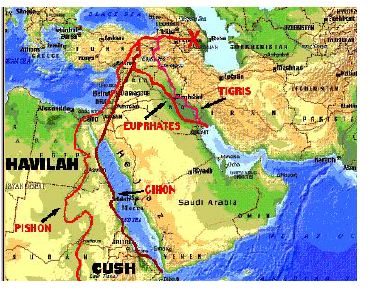 Search the internet and you will find gobs of suggestions and goofy maps of where Eden was by trying to identify its four rivers. As the above graphic attests, many have attempted to find the four rivers in Mesopotamia (note that in the above graphic Havilah is in the wrong place, which we will discuss shortly). However, there is only geological evidence of the Tigris and the Euphrates (the Hiddekel and the Pherat are their names in the Hebrew) existing there. Ignoring this fact, some have said that Eden must have been where the Tigris and Euphrates meet at the Persian Gulf. However, they also ignore that the Tigris and the Euphrates flow into one delta, not from the delta into two rivers as Genesis describes. The Tigris and the Euphrates flow the opposite way this interpretation suggests.
The more likely place is in the north (not east) where the two rivers begin (modern day eastern Turkey). This still leaves, however, the problem of the location of the other two rivers, both of which have explicit lands mentioned in their location. The Pishon is described as being near Havilah, where there is gold, bdellium and onyx (also translated as other precious stones). Genesis 25:18 mentioned Havilah as “east of Egypt on its way to Assyria.” Havilah could be two possibilities, Genesis 10 mentions two men named Havilah, one a descendant of Ham, whose lands are southeasterly of Canaan, the other, a descendant of Shem, settled in Mesha (modern day Mecca) all the way to Sephar (modern day Yemen). First Samuel 15:7 helps clarify the location, “Then Saul slaughtered the Amalekites from Havilah all the way to Shur, east of Egypt.” All these descriptions place Havilah southeasterly of Israel all the way to modern day Yemen, which is the land east of Eden on the other side of the Red Sea. Geological work done in the area shows no sign of an ancient river and if there was one, it is in no way connected to the Tigris and the Euphrates. Some have suggested that the Red Sea is this river, which is not particularly helpful for a physical description of Eden.
The second river, the Gihon, again is quite troublesome to physically identify. Cush is consistently understood in the Bible to be modern day Ethiopia. This would make the Nile the most obvious choice. However, there are two problems with this. First is the Nile does not “flow around” Cush; it flows through it. Second, if it is the Nile, this again is nowhere near the Tigris and the Euphrates.
While the text mentions all four rivers being connected by a common source river from the garden, ancient commentators thought that the four rivers were the Tigris, Euphrates, and possibly the Ganges, Nile, Red Sea or Jordan – two of those four, the most likely possibilities we have already discussed. The problem with any discussion after this of possible rivers is that any river in the entire ancient near east becomes a possible river of Eden, ipso facto.
If the four rivers are, for instance, the Tigris, Euphrates, Ganges and the Nile, there is an obvious implication. These four rivers are not in anyway connected and every reader would have known that. The river feeding them would be spiritual (as we already discussed), being a symbolic way of say the innocence of the garden permeated all life like blood flowing from a heart through all the major arteries. Moreover, the four rivers suggest an obvious poetic device, the four rivers indicating something like when one said “from sea to sea” or “from North, East, South, and West.” The four rivers are a symbolic way of saying the whole world was in a state of innocence.
Adam and Eve’s exile from the Garden is interesting to think about because if the author is talking about four rivers as enveloping the whole known world, then exile would be physically impossible. The exile then would be spiritual. Similarly, Cain, when he sins, he settles in the land of Nod. Nod literally means “wandering,” so Cain’s exile of “settling in the land wandering” is again more of a spiritual state that he is left in than a actually physical place he goes to. Plus, we already covered how “east” is less a direction and more a connotation of mystery and exile.
If you interpret the rivers as merely physical rivers, like interpreting Genesis one as purely historical, you end up with an unsustainable interpretation. The burden of proof is on the Young Earth Creationist to explain these details of the rivers, and of course, they cook up a lot of fancy reasons to get around the obvious: these are unconnected rivers that suggest something more than mere geographical detail.
c. The Trees
Finally, we come to the trees, which really get at the substance of the passage. God makes two of them: the tree of life and the other the tree of the knowledge of good and evil. Eating of one means death (the nature of this death we will look at later as it does not straight forwardly mean physical death). As the trees are talked about through the Bible, the trees represent spiritual realities and present choices.
What is odd about this is that God’s ultimate test for humanity to be obedient or not is whether the man and the woman will or will not eat a fruit. This alone does not suggest that the trees are symbolic, but trees do seem to present two choices. The idea that it is just fruit might suggest that even seemingly banal disobedience has cosmic consequences.
However, knowing that in the surrounding cultures there were myths about the food of the gods bestowing divinity, the forbidden fruit makes cultural sense. Interestingly, the story of Eden shows the opposite. While demi-gods sought a way to cheat death and become gods by finding and eating the food of the gods, here the quest for self-divinity ends in death and exile. God even closes the tree of life off from Adam and Eve out of compassion in order to prevent people from being eternally trapped in sin. There is a stark polemical contrast. True life is obedience to God, not rebellion against the gods. The rest of the world sought self-divinity to beat death; Genesis two teaches that to seek divinity is death. By blocking the passage to the tree, God makes mortality in part a remedy to the presence of sin. It ensures that sin is as finite as the sinner.
We have already seen from Revelation that the tree of life is thought of as a ongoing spiritual reality that exists at the end of time, a symbol for the end gift of eternal life for perseverant saints. However, Proverbs also constantly alludes to the tree being a symbol for walking wisely with God. Proverbs 3:16-18: “Length of days is in her [lady Wisdom’s] right hand…She is a tree of life to them that lay hold upon her.” Again, Prov. 11:30 reads, “The fruit of the righteous is a tree of life” and Prov. 13:12 reads, “Hope deferred makes the heart sick; but when the desire comes, it is a tree of life.” In Prov. 14: 4 it is said, “A wholesome tongue is a tree of life.” So, the tree of life becomes an ongoing spiritual reality symbolizing our walk with God and our final destination, eternal life.
If you interpret the trees as merely existing 6000 years ago, you actually shortchange the Bible’s richness in understanding them ongoing typological realities in our walk with Christ.
Conclusion
Again, the ancient form of communicating at story meant that this story does assume Eden as a physical place, the world as 6000 years, Adam and Eve as the first original human pair, etc. but the message of this text, a suggested by its poetic crafting is much more: that the world has an underlying innocence to it, that we all face the decision to obey or disobey, to choose exile form harmony and death or obedience, life with God, and that means heaven and eternal life.
Kim Davis: The Difference Between Support and Affirmation

Kim Davis has been getting a lot of air time. Back when her original incarceration occurred, I thought the whole thing was fairly inconsequential. To be honest, Davis gives me the same vibe as people who have bumper stickers that depict a Jesus fish eating a Darwin fish or say “Are you following Jesus this close?” It is not that they aren’t well intentioned people. It is just that I would never hold them up as poster children of Christian witness. Well, tell that to the internet.
Now, tell that to the Pope, who recently met with her, prayed with her, and congratulated her for her courage and her stand for religious freedom. To be honest, the Pope is a classy guy. So, I’m just surprised he dignified this situation with a response like that. Good on him. But is what Kim Davis did really an appropriate way to stand for religious liberty?
So, I will briefly weigh in on the issues around Kim Davis. I admit, I am probably writing about this for the same reason I watch The Bachelor. There is virtually no substance to the story, but I am a big sucker for hoopla, but anyway, here it goes.
So, should a conservative Christian clerk issue same-sex marriage licenses? And while we are at it: Could a conservative Christian bake a cake for a same-sex wedding? Oh for the sake of historical-consciences, media amnesia be damned: Should the conservative Christian CEO promote gay employees (I’m referring to the Chic-Fil-A debacle)?
Notice that I am saying “conservative Christian.” I say this because I know just as many passionate liberal Christ followers that have a different interpretation and notion of biblical authority from my own. We all need to make our peace with the diversity the Spirit has chosen for Christ’s body. But if you are a liberal, I am asking you to step into the mind of the conservative. Attempt to understand it as you would want conservatives to understand you (I’ll say more about empathy later). From the perspective that homosexuality is against God’s design and that same-sex marriage is not a biblical practice, I would hope that any liberal understands that there are well-intended, open-minded conservative Christians without a drop of homophobia in them. Conservative Christians are just trying to be faithful to what God is showing them.
So, assume this with me, whether you agree with it or not. Now I ask myself, if I was Kim Davis, what would I do? Please don’t make any bracelets. It is purely hypothetical. It means what would I do in her employed position, so I am not saying literally her – although I will admit to staring at myself in the mirror and wondering: what would it be like to have Kim Davis’ hair?…Anyhow, I digress. What would I do?
I would frankly resign or ask to be laid off. That I think would be the appropriate response if I was in a line of work I did not morally agree with. You cannot be a pacifist and a soldier and just refuse to fire your gun. You cannot be a doctor and work at Planned Parenthood and expect to be paid but never do an abortion. You cannot be a Jehovah’s Witness and be a nurse at a blood donor clinic, refusing to take anyone’s blood. If you do not morally agree with the line of work, don’t do it, much less expect to be paid for doing less work than others.
If you feel obliged not to bake a cake for a gay couple, then you have chosen not to get any money from them. That’s fair. That’s religious liberty and its consequences. We all have the right to act as our conscience dictates. Unless you are Maria Antoinette, withholding cake is not oppressive. However, let’s remember that Kim Davis did not get imprisoned for having an opinion. This is not about religious liberty or free speech in many ways. She got in trouble with the law because she refused to do the legal duty she was hired for. If you don’t believe in the power of the State as something legitimate yet separate from the church, then do what the Mennonites did. Don’t be selective. Demanding the same pay for less work is turning religious rights and freedoms into religious privileges. Again, if you don’t agree with the line of work, the better witness is to resign.
But whether it is issuing a marriage license, baking a cake, or promoting a employee, I fear there is a persistent hypocrisy on the part of these Christians. Licenses were undoubtedly issued, cakes were unwittingly baked, and promotions blindly awarded for heterosexual adulterers of far worse sorts. Where was the integrity of conscience there? Theses events show that conservatives don’t just let us all be sinners equally, but unevenly see LGTBQ individuals as the worse form of sinner. Many conservatives Christians I know don’t just see homosexuality as sin like it is a sin to smoke or work on Sundays. Gay people disgust them. They are a political threat. They are the scapegoat of the church’s dwindling power. It is so much so that far more than all the other sin and injustices out there (including and especially injustices done by the faithful), these Christians see that their professions, in their minds, must be made into soapboxes of condemnation. Hypocrites full of condemnation…Jesus had a few choice words for people like that.
But back the truck up. I have gotten a head of myself. Allow me to compose myself again…
There is an overlooked question here. We have missed something. It is this: can I support without morally affirming? That is the question. It is the distinction that was never made. Kim Davis thought that issuing same-sex licenses means she is 100% agreeing theologically with same-sex marriage. Is that really the case?
By that same logic countless gay youth have been pushed out onto the streets because their conservative parents, in their mind, have been lead to believe that if they materially support their openly gay child they are actually affirming something their convictions condemn. Of course, they continue to delude themselves when they think that if they abandon them, a gay child will obviously then see the love of Jesus. Somehow they think these things logically follow.
Same with the person that refuses to bake a cake or a business that refuse promotions.
The next question is the shocker: Does the Bible actually offer a pattern where support is possible without affirmation? Like many debates in evangelicalism, authentic biblical zeal is dangerously mixed with biblical illiteracy, concocting a cocktail of well-intended bigotry. As the Baptist theologian James McClendon used to say, the problem with fundamentalism is that it is not fundamental enough.
Let us look at the example of men serving unethical governments.
(1) Joseph served the self-proclaimed god, Pharaoh, enabling Egypt to become even more of an idolatrous superpower.
(2) David served the pagan king Achish, providing military support for an enemy to Israel.
(3) Daniel served the oppressor of his people, Nebuchadnezzar (who also claimed deity for himself). It is not that he lacked conviction. When told not to pray, he still did. When his friends were told to bow down to a statue, they did not.
Let’s move on to Jesus…
(4) Jesus performed a miracles for a centurion’s household, healing his servant boy (moreover, some suggest the boy may have been his pederast). He could have told the centurion, “Well that is what you get for occupying land that is not yours. Go home!” He could have inquired into whether there was a pederast relationship between him and the boy. Whether that is the most obvious interpretation or not, the point is Jesus did not ask. He served.
(5) Jesus miraculously made more wine even when people were getting well sauced at a wedding. While the point of that sign is not promotion of drinking (it was the arrival of the “new wine” of the new covenant), Jesus nevertheless made a great bartender.
In each of these examples, the person could have been seen as complicit in helping someone do something sinful: helping the political enemy of the people of God, not to mention enabling idolatry, or worse, even using drunkenness as a grand stand for a kingdom sign. Yet for various purposes, they did so. Joseph and Daniel out of virtue; David out of necessity; Jesus out of compassion and prophesy, etc. All these examples are, of course, dissimilar from the present one in various ways, but I think the point remains:
Christians should have the freedom not to support what they think is sinful. However they are called to serve sinners and service need not be seen as affirmation. Serving others is an act of good witness.
The public sphere is not the church. The fight for political rights are not the same as Christian witness. They overlap some, but they are not the same. Christians would be wise to remember that.
The public sphere is a place where not all agree, and it is the job of the government to regulate relationships to promote common good and common well-being.
Would a Christian want an atheist business to refuse promotions under the notion that they can’t promote someone they thing is deluded? How would a church feel if a company refused to sell them communion cups? Or an atheist government clerk refusing to send charitable status paperwork or ordination papers out of their defiled conscience?
In a world exploding with differences, Christians can have a faithful political witness by merely promoting empathy, honesty, and fairness: something that will work fair better at creating a bottom line of common good and decency than any Constantinian strategy will ever do.
I am going to preach to you now. God’s Word addresses us today afresh as it has for thousands of years:
“The only thing that counts is faith expressing itself through love…You, my brothers and sisters, were called to be free. But do not use your freedom to indulge the flesh; rather, serve one another humbly in love. For the entire law is fulfilled in keeping this one command: ‘Love your neighbor as yourself.’ If you bite and devour each other, watch out or you will be destroyed by each other.“ (Galatians 5:6, 13-15).
Why Genesis One Does Not Teach Creationism

“One does not read in the Gospel that the Lord said: I will send you the Holy Spirit who will teach you about the course of the sun and moon. For He willed to make them Christians, not astronomers.”
– Saint Augustine, regarding Genesis chapter one
Many of my fellow believers are creationists, who hold that Genesis chapter one should be read as teaching a doctrine of how the world was scientifically made. While I respect the sincere faith of these believers, some are even in my church, I also see many Christians, myself included, encountering significant faith crises, because of the assumptions of that perspective. Many creationists see it as the opposite: that evolution will erode and destroy one’s faith. For me and many other Christ-followers, it simply hasn’t. For me, it is mostly because I found that Genesis one should not be made to comment on the scientific composition of the universe. Here is a reflection on why I think Genesis one is best understood as offering a theological narrative: timeless truths about God and creation delivered in a culturally bound way.
There are some very good reasons not to take Genesis one as offering a scientific description of the creation of the world. Not doing so, I think, is the most consistent way to interpret it. This is because there are pre-modern notions about the cosmos that these text assumes. In fact, I will go so far as to say that if we do take it as a historical description of the material origins of us and the cosmos, if we make that the truth of this text, we force the text to contradict itself, reducing a literalistic strategy to absurdity.
So, the following eight exegetical points attempt to point out the problems of a creationist approach. Because the text assumes a geo-centric cosmology, it cannot be used to support creationism which does not hold to these details. I am doing this without offering a full positive doctrine of creation (which is another argument that I will give later). However, trust me, I do think Genesis one is God’s Word and that the universe is God’s creation. But it is God’s Word in proper literary context, understanding the cultural climate it was written in. I believe in creation. I believe that Genesis one teaches us about creation. I just don’t believe in “creationism” as an idea that tries to extract science into this narrative or things all of the aspects of these narrative are applicable today.
As I said, my argument is an reducio ad absurdum. Creationism, by its own uneven exegesis (or more accurately is consistent neglect of what the text literally says), is an interpretation that collapses into self-contradiction necessitating a different interpretation, a reconsideration of interpretive principles. So here are the eight interconnected arguments or features:
Creation from Water?
The opening verses describe the heavens and earth as “formless and void” yet the spirit of God hovers over the waters of the deep. Before everything else is created, there is water. Before there is time, planets, stars, there is water. That seems odd. Why is that? Is water the eternal, primal sub-atomic substance in which all things were constructed? Does this passage, as some suggest, contradict creation ex nihilo, the notion that God created the world out of nothing? No.
Water was a symbol of nothingness. The Mediterranean Sea was thought to be an “abyss.” Why? If a sailor sank into the depths of the sea, they would disappear into what would seem like bottomless black nothingness, a void. Beginning with water is a metaphorical way of saying the world was “formless” and “void,” and so, God created the world out of nothing.
Notice right off the bat then that choosing to see metaphor rather than concrete descriptions makes the images in the text make way more sense. It makes them much more meaningful. It has a better interpretive fit.
Earth then Universe?
Next we see that the creation of the earth precedes the creation of the very universe it is supposed to be situated in. This should tip us off that this is not a scientific description. In fact, we commit violence to the text by reading out modern assumptions into it. By all accounts the Sun is older than the earth, and the earth (as well as the moon) all formed because they were in orbit around the Sun.
A creationist might retort and say that God held these things in place until the solar system was created, but then natural history is being portrayed as intentionally deceptive. However, the text does not say anything about such a process nor would it even be suggesting it as it is speaking to a non-scientific world. Often I find creationists doing these kinds of ad hoc interpretations in order to save their theology. What ends up happening is that creationist invent miracles that the text does not describe to make the simple narrative make sense by their interpretive assumptions. A good rule of thumb is that if you have to invent miracles in order for interpretations to make sense, you are probably reading into the text with the wrong approach.
Light/Day before Sun?
Light and darkness as well as night and day are placed before the sun and moon, by which light, time and day are generated and measured. Even the ancient people understood that light only comes from the sun and moon (remember, they did not have electricity). Yet the sun was often worshiped, so we see the sun’s importance relegated to a later day in creation. It is no longer the primary act of creation or its pinnacle. Light, the source of all the earth’s nourishment, the symbol of moral goodness, comes directly from God. Time and day, the forces that structure reality, again, are not controlled by a solar deity, but proceed directly from God. The sun, not even named, is demoted to merely being a sign for the seasons. The “seasons” are the times of the worship festivals. So, instead of being a god, it is merely a sign for the people of God to know when to worship the true God! Thus, we see that the creation days are most meaningful when we see them as a rhetorical strategy for countering pagan mythology.
Blue Sky Made of Water?
God divides the waters above to form the sky and the waters below to form the seas. The sky is described as being made out of water in the text. Again, I am amazed that creationists skip right over this. We know that the sky is not made out of water, but rather it is blue due to the fact that light rays going through the atmosphere show up blue, and the sea is blue because it reflects the blue of the sky. The sky is not blue because it is made of water. Again, this is a pre-modern description of the universe, not a scientific one.
I have heard some creations say that before the flood there was an expanse of water above the clouds that came down for the flood, since the text says it had not rained until then. There are problems with this. The biggest problem is that the “expanse” of water is not described as coming down at this time. In fact, the author that wrote at the time of Psalm 148:4 implores the “waters above the skies” to worship God. So, it is still there. Also, the expanse is not merely water held in the sky. It is literally thought to be a hard dome, which we will see in the next point…
Sky is a Hard Dome?
The sky is thought to be a hard “dome” (also translated “vault” or “expanse” or “firmament”). In the ancient cosmology the sky was made of water, separated by a dome-like wall. Creations oddly dismiss this detail, saying that it is no longer there because the waters came down in the flood. However, this neglects firstly that the dome is still around in Psalm 150:1 when the people of God are invited to praise him in this dome. The dome is a permanent fixture of the cosmos in the ancient mindset. Second, what is being described here is literally a hard dome, not a miraculously held up expanse of water. This dome has “flood gates” by which waters flood down (cf. Gen. 7:11). This dome is hard enough for God to “stretch out the heavens like a tent” over top and lay “the beams of his upper chambers on their waters” (Ps. 104:2-3). Isaiah 40:22 describes the heavens not like a spherical atmosphere, but as a “canopy” or “tent” on the flat earth. The flat earth rests on pillars. “When the earth totters, with all its inhabitants, it is I who keep its pillars steady” says God in Ps. 75:3. One cannot escape that the ancient people thought of the world like a building, with a dome over top and pillars below (cf. Ps. 104:5). For all their talk about reading the Bible plainly, creationist ironically read these passages as figurative.
Creation is a Building?
Expanding the last point, the sun and moon are described as embedded in this dome like lamps in a ceiling, “lights in the dome…God set them in the dome of the sky” (Gen. 1:1, 17). Experientially, we can look up and see that the sun and moon appear to be in front of the blue of the sky and it is no surprise that the ancient people literally thought this. They thought that the sun and moon were embedded in the dome of the sky, like lamps in a ceiling.
Instead of the earth moving around the sun, the ancient people saw the earth as a flat immovable building. Earth is described like a flat “circle,” not a sphere (Isaiah 40:22). God in Psalm 104:5 “set the earth on its foundations; it can never be moved.” Job 9:6 says God “shakes the earth…its pillars tremble.”
The sun and moon are described as revolving around earth’s building, not the earth around the sun. Ecclesiastes poetically describes this: “The sun rises and the sun sets, and hurries back to where it rises” (Ecc. 1:8).
A creationist might respond by saying these are merely a metaphor. To which, I would say that is an ironic strategy for defending an otherwise literalistic interpretation! In other words, that’s my point! Bracketing parts of the text as metaphor to preserve reading the rest of the passage as a scientific description is a sad, self-defeating strategy. Why not be consistent and read the whole description as pre-modern poetic description? That makes more sense.
Dragons Existing?
The fifth day mentions the creation of the great “sea monsters” (v. 21). This is often glossed as something less offensive to our modern ears, reading something like “sea creatures.” However the word in Hebrew is tannim, which literally means “dragons” or “monsters.” The Bible was written in a time when people assumed these things existed. For instance the Book of Job reports the Leviathan and Behemoth as massive mythological forces of evil and chaos, but assumes they are real: “as I made you [Job] I made it [Behemoth]” (Job 40: 15). Isaiah 27:1 refers to Leviathan as the “dragon of the Sea.” Psalm 74:14 mentions that Leviathan has many heads like a hydra. Creationists have tried to say that these refer to the dinosaurs before the flood. Dinosaurs certainly do resemble dragons, but these passages refer to these beasts as presently existing at the time of writing, well after the time that the flood supposedly wiped out the dinosaurs.
The Bible also mentions creatures like Rahab (Job 9:13; also called Lilith, cf. Isa. 34:13), not to be confused by the prostitute that helped the spies in Canaan. Rahab is described as a dragon-like enemy of God that God defeats: “Was it not you who cut Rahab in pieces, who pierced the dragon?” (Isa. 51:9). Rabbinic commentators describe her as a vampire-like woman. Job 26:12 describes God striker her down like he rebukes the Sea, the Sea (capital “S”) being a symbol for cosmic forces of chaos and nothingness in Job. Similarly, Psalm 89:9-10 refers to God conquering the chaos of the Sea, slaying Rahab and the enemies of God, Rahab being a kind of symbol for chaos and evil.
Why does the Bible include this stuff? It is because the ancient people thought they were real and the Bible is trying to comfort them by entering their cultural standpoint, assuring that God is more powerful than any evil they can imagine. What is more comforting? If the Bible said, “Those things don’t exist, silly” or “Whatever evil you can imagine, God is greater than that.” The Bible tends to choose the later strategy.
Different Creation Order from Genesis Two?
Notice in comparison to Genesis two that Genesis one reports the order and events of creation differently. Thus, if they are read as strictly historical accounts rather than literary-theological accounts, they are contradictory. It seems like Israel has two creation accounts that were quite different that the writer of Genesis knowingly put next to each other because both story’s teachings are true. They are both inspired stories. First, while in chapter one creation occurred in a week-long process, in chapter two it is in a day: “In the day that the Lord God made the earth and the heavens” (2:4). Now, “in the day” can mean a period of time, but in this context it does not seem to. This refers to Genesis two, where, as we will see, a new creation story is being presented, which does not use a creation week. Its events are presented undifferentiated by days. Thus, it seems that “day” could mean a week-long period, there are no creation days in Genesis two for it to correspond to.
Second, there is a different creation mode. Genesis one creates by divine word alone. Genesis two uses the imagery of a fountain (perhaps the river of life alluded to Rev. 22:1-2) springing forth and covering the earth (decidedly different from water being the beginning substance that is pushed back in chapter one). From there, God “formed out the ground” man, plants, animals, and birds. Chapter two describes creation not by word instantaneously but like a potter forming clay, then breathing life into it. In Genesis one God is a poet; in Genesis two, God is an artisan.
Third, there is a different order to the two creation stories. In chapter one, the order of creation goes birds and fish on day five, then on day six animals first and then male and female created simultaneously that same day. Day five: birds fish; day six: animals then humans, male and female. In chapter two the order goes as follows: the man, then vegetation comes up (v. 9 – where it is already made in the first account), then animals and birds are formed (v. 19), then the woman from Adam’s rib. It is an often neglected detail that in the second creation account God creates the man first, and it is only after he states that it is not good for the man to be alone that he then creates animals and birds, who are not suited for him, and only after that realization, the woman is formed.
Verse 19 sees the creation of every animal as a consequent act to realize Adam is alone: “So then out of the ground the Lord God formed every animal of the field and every bird of the air…” Creationists inject alternative meanings to say that God had already made the animals and birds, but the passage describes a subsequent and consecutive event. In fact, it is similar to most verses in this chapter that begins with what is called a waw consecutive (the Hebrew word for “and then”), which is the engine of Hebrew narrative (literally every sentence in a narrative will begin with a waw, “and then,” but most translations edit them out).
Again, if you read them as historical accounts, you force the passages to contradict themselves. If you try to use the passage to support creationism, you are glossing over a lot of details to make it work. If you read them like they intend to be read, as theological narratives, something closer to a parable, then you will have no problem seeing these different orders as incidental to the enduring theological truth of the passage.
What should we do with this? Is Genesis a Myth?
Is Genesis a myth or is it history? The Bible never uses the term myth to describes its contents. In fact 2 Peter 1:16 is quite condemning of the category. So, many are troubled to hear that the creation myths around and before Israel had similarities to Genesis one. In Genesis chapter one, we see what can best be described as an “inspired story” or a “counter-myth.” This is a story that resembles myths that proceeded it, told using the form of story that ancient people used to explain their world, but uses that medium to present truth that counters pagan ways of thinking about God.
Is it purely fictional then? Didn’t ancient Israelites think it was factually true? Creationists are right to think that the writer of Genesis one probably did think the universe was created in six 24 hour periods 6000 years ago. However, it assumes the geo-centric cosmology of culture as well. The text does assume a cultural history that the ancient people assumed, but is crafted through the covenant relationship with God to present us with redemptive truths that speak beyond the ancient assumptions.
The idea that Genesis one has pre-modern qualities or assumes a history that we do not hold to today, does not disprove its enduring theological worth. Far from, it shows its incarnational beauty. God worked from within the ancient culture. We as responsible interpreters need to be discerning about what is cultural and what is timeless. We do this by discerning the context of the text in its historical context and as it has been reflected upon by Christians for 2000 years.
Are we condemned to disbelief about God as a creator, creating the world out of nothing because of these prescientific descriptions? No. It should be no scandal that God used people where they were at to communicate his Word. The notion that God was trying to teach physics and astronomy to a pre-scientific people implies that that Bible is true because it is a science text book and not a book about a God that comes into our world. In fact, people who want to read the Bible as offering a culture-less statement of timeless principles often have a very docetic view: a Word from God without human flesh. It makes way more sense that, just as Jesus stepped into human (Jewish!) flesh, God stepped into a world that thought in terms of story to offer redemptive truth using the media of the culture. Just as Jesus assumes that the mustard seed is the smallest seed (which was the ancient assumption) to teach as about the power of faith, so also Genesis assumes a geocentric universe to communicate God. The meaning of faith is not damaged by the mustard seed not actually being the smallest seed nor is creation disproved by astronomy. So, the fact that God used ancient means of communicating theology should not bother us. In fact, it is a comfort: God uses imperfect authors to write his perfect Word just as he uses us imperfect people to be his Body. He uses our cultural thoughts to communicate his perfect thoughts.
This passage is offered in the form or medium of a nonscientific counter-myth or origin story (which is how the ancient people thought), yet its enduring message or substance is that God is creator and nothing else is, the creation is good, life-giving ordered, and beautiful, and humans are made in God’s image, designed to inherent dignity and to find themselves in his love, etc.
What we have to keep in mind is that God has communicated something enduring in something culturally-bound. This is called the form/substance distinction that Baptist interpreters (such as E. Y. Mullins and Walter Connor) have suggested for over a century. Does the Bible assume a hard domed universe? Yes. Does it assume a 6000 year old cosmos? Yes. Does it assume a geo-centric universe? Yes. Does it assume the existence of dragons? Yes. Does the Bible implore us to believe these things now in order to believe God is a creator? No. Those things are incidental.
We might also call this the medium/message distinction. The form or medium of this passage is prescientific counter-myth, an event of creation that is dated somewhere around 4004 B.C. involving a domed universe and all that, which are details that the ancient people assumed to be true. However, the substance or enduring message of the text is more than that. It is teaching the following:
- God is creator of all that exists, creates out of nothing, and therefore, is greater than all the forces of chaos in our world.
- God is beyond creation, and so, nothing in creation is to be treated as god, and therefore, humans ought not to be enslaved to the worship of finite things.
- Creation is made by divine decree, and therefore is ordered, good and life-giving.
- Creation is designed for peace, worship and Sabbath.
- All humans, not just kings, high priests, or warlords but all people, male and female, rich and poor, are made in God’s image, deserving the dignity and rights God’s children deserve.
- All humans are designed to act like God, emulating his “likeness” of goodness and love.
- People have a responsibility to be stewards of the environment, not to destroy it or waste the precious gift we have been given, but to care for it.
- Reading Scripture through the entire canon, we know that Genesis one is true because it points to Christ. Christ is the logos of God, bringing creation into being (John 1). Christ is the truth of creation, and the truth of creation points forward not backward: Christ is the light shining in the darkness and is ushering a new creation in our midst. The power of Genesis one has not merely happened but is happening as we look to the transformation that Gospel is enacting.
All of that is still true and simply does not depend on whether a creation event happened six thousand years ago.
There are, of course, more truths in the text, and these can be discerned with wisdom, in the community of the faithful, gathered to listen to how the Spirit will use the Scriptures to speak to us.
You can hold to evolution and that universe is billions of years old and that Genesis is God’s Word. Why? For the same reason we trust the Gospel today: God has meet us where we are at.
Why God did not stop the Charleston shootings

Charleston, South Carolina. June 17th. 9:05 p.m. Twelve congregants gather for prayer and the reading of God’s Word at Emanuel Methodist Episcopal Church. A 21 year old, white, sandy-blond haired man walks in, sits down, and begins to speak with Rev. Clementa Pinckney. They begin to argue, and he stands up pulling out a .45 cal. pistol, aiming it at 87 year-old Susie Jackson. Jackson’s nephew, 26-year-old Tywanza Sanders, tries to calm him down. The man replies, “I have to do it. You rape our women and you’re taking over our country. And you have to go.” Sanders moves in front to protect his aunt, heroically acting as a human shield. He is shot first and drops to the ground. “Y’all want something to pray about? I’ll give you something to pray about,” the gunman cries, shouting racial slurs. He proceeds to pump dozens of rounds into people there. He has to reload five times to continue the premeditated carnage.
The suspect is Dylan Roof, a deranged racist hell-bent on starting a new civil war. This is evil of the most chaotic and unnecessary sort.
Why did God allow this senseless killing? Why did he not intervene?
Why did he not show up to protect his children as a white bigot gunned them down in a house of prayer?
This question was posed to me by a friend, but we ask this question not just for these people but for all who came before them, the greatest victims of history: the martyrs.
While the world cries out for vengeance, we, the spiritual family of the victims, must lament this loss in a different way. We know that the way of Christ necessitates the most costly sacrifice. This makes our laments as bitter as it is beautiful. Every Christian when they are pulled up from the waters of baptism should know that they have committed themselves to a non-violent witness in the face of the powers and principalities of hate and violence in this world. We cannot give into the same hate the fueled this massacre, and we are oddly moved towards thanks for the martyrs are have shown us so great a witness.
We have a resolve to refuse a heart of vengeance that is predicated on the sobering realization that to long for the punishment of sin, egregious sin, against others is to condemn the sin we excuse in ourselves. However, to answer the question, “Why did God allow this?” I just don’t think the question gets answered with this reminder.
A classical apologist would appeal to how we have free will or that suffering is pedagogical. However, I am of the opinion that human freedom is neither this absolute to the divine prerogative nor this desire for our own.
I am of also of the opinion that tragedies and the question of “why?” do not get answered in Scripture with reason as we commonly understand it. Reason and logic are parts of the good order of creation. Rationalizing evil is to assign it some of the goodness of reason. However, evil must be understood as an absurdity. It has no reason. It ought not to have a reason. An inexplicable tragedy should probably be left as such: unexplained.
We can say that Christ is with those that suffered. We can say God’s faithful are always prepared to take up their own non-violent crosses as Satan bares his teeth. We know that the way of the cross will prevail, and we pray that the martyrs’ lives will work a witness to effect the redemption of those lost in the darkness of hate similar to that of the perpetrator. We know that there will be a day of judgment and restoration as God loves even the perpetrator. We know this because he loved us while we were his enemy. This disarms our hate, pushing us towards the compassion needed to perhaps bring a bit of that much longed for restoration here in our midst today. However, not all suffering is remedial. An omniscient God does not need to test his subjects for he already knows the answer. God does not require suffering, evil, and tragedy to accomplish his will. All things can be used by divine providence to bring about good, and we sincerely hope that good comes out of this evil, despite this evil. However, if God caused the felix culpa, our original fall or this one, in order to enact our redemption, no matter how spectacular, God is immeasurably wasteful.
To ask “why did God not intervene?” (we circle around this vexing question) is not to occasion a place for atheism either. Atheism is too easy. If God does not exist, the brutality of this life is inconsolably permanent. The only response, no matter how undesirable, will ultimately be a paralysis of acceptance. All condemnation of it is rendered as vacuous as any hope beyond it. If God is dead, the stench of the problem of evil still lingers.
But Scripture never sees moments like this, moments where God seems absent, to be a basis for intellectual disbelief. It is a cause for faithful lament. The words of Scripture offer vocabulary to name the groanings of our saddened souls. It compels and allows us to ask similar questions to what reverberates constantly through the Psalms: “How long O Lord?” or as Christ’s cry on the cross, echoing Psalm 22: “Why have you forsaken me?” Interestingly enough, not even Christ, not even his prayer, was answered during his life. An inexplicable tragedy remained as such: unexplained. Only sin required the solution that meant Christ willingly died for us.
God responded three days later with the resurrection, and we wait on that promise. The Christian philosopher Gabriel Marcel once said that the problem of evil and tragedy is not an intellectual problem to be solved so much as a mystery to be lived. How is it lived? The only way, the only respond to our original question might be to say that we pray, we mourn, we resolve live differently. We commit to solidarity, to compassion, to lament, to justice, to reconciliation, and to hope. May we not be paralyzed with apathy or hate or despair.
We live awaiting the restoration of all things. We live trusting the promise of the resurrection. We live waiting on the crucified God as the Apostle of the persecuted churches of Revelation cried out, “Come Lord Jesus Come!”
We dare not dishonor the victims by speaking easy answers or blaspheme our God by ascribing to him the authorship of evil or condemn ourselves to a broken and brutal reality that is beyond hope of repair. And so, we do not give an answer, we cup our hands to our mouths in the face of divine mystery and tragedy as Job did. And after this we give a response.
We live this response in the lament-filled space of compassion and prayer.
How long O Lord? How long?
The Figure of Empathy: The Good Samaritan
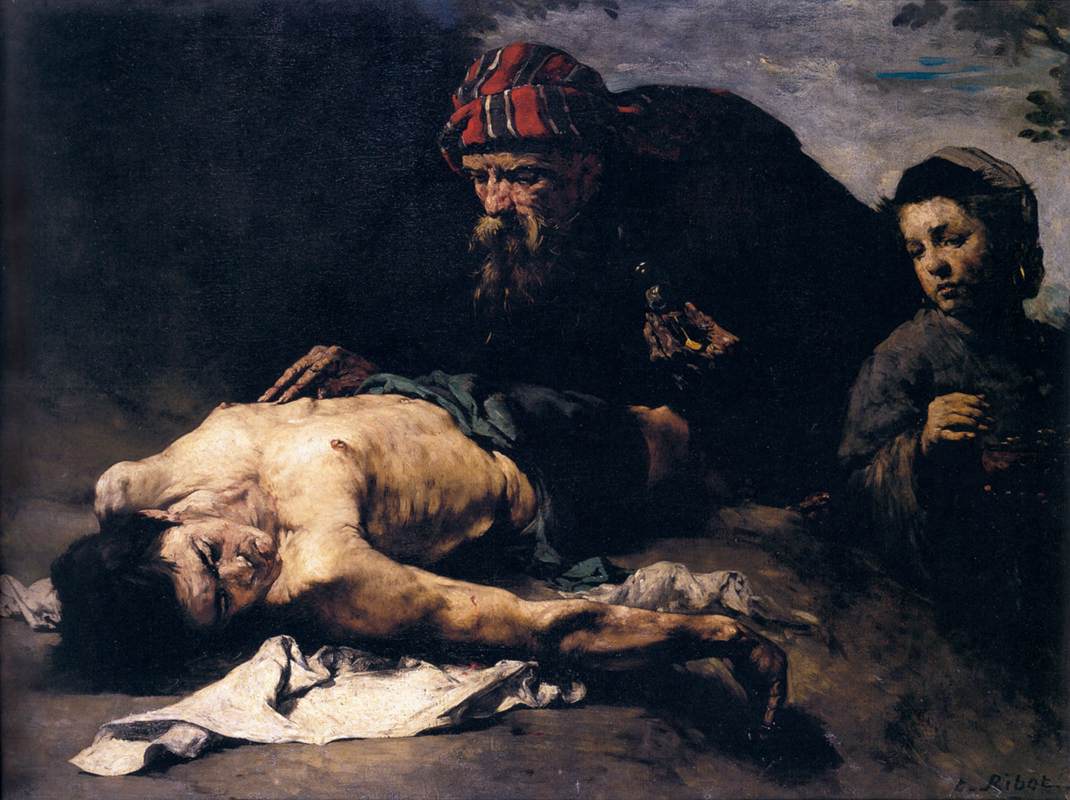
Just then a lawyer stood up to test Jesus. “Teacher,” he said, “what must I do to inherit eternal life?” He said to him, “What is written in the law? What do you read there?” He answered, “You shall love the Lord your God with all your heart, and with all your soul, and with all your strength, and with all your mind; and your neighbor as yourself.” And he said to him, “You have given the right answer; do this, and you will live.” But wanting to justify himself, he asked Jesus, “And who is my neighbor?” Jesus replied, “A man was going down from Jerusalem to Jericho, and fell into the hands of robbers, who stripped him, beat him, and went away, leaving him half dead. Now by chance a priest was going down that road; and when he saw him, he passed by on the other side. So likewise a Levite, when he came to the place and saw him, passed by on the other side. But a Samaritan while traveling came near him; and when he saw him, he was moved with pity. He went to him and bandaged his wounds, having poured oil and wine on them. Then he put him on his own animal, brought him to an inn, and took care of him. The next day he took out two denarii, gave them to the innkeeper, and said, ‘Take care of him; and when I come back, I will repay you whatever more you spend.’ Which of these three, do you think, was a neighbor to the man who fell into the hands of the robbers?” He said, “The one who showed him mercy.” Jesus said to him, “Go and do likewise.” (Luke 10:25-37)
First to understand this beautiful passage, we must recognize it is a parable. We ascertain this as a hermeneutic judgment upon the text. Indulge me for a second. Understanding the passage on the Good Samaritan literally would not be to fret about whether historically there really was a man who got beaten up, left for dead, passed by a Levite and Priest, and then finally, a man from Samaria rescued him. Jesus responds to the lawyers’ question, “Who is my neighbor?” with this story. It references real places and it seems plausible. He never says whether it is a parable. Why would we doubt it to be anything but history? Many so-called literalists worry about texts of Scripture like whether the origin stories of Genesis, the story of Jonah, or the drama of Job are historical and if they are not they are worthless. They would feel obliged to see it necessarily this way because they must read it “literally.” But literal reading of Scripture merely means to read the passage they way it – the letters on the page – intend to be read. To read any passage of the Bible literally might mean reading it as poetry, parable, metaphor, or some complex mixture of the above.
This parable reminds us of these often forgotten hermeneutic considerations. We all intuitively recognize that Jesus is not reporting a historical account and if this story did not historically happen, its truth would be no worse off for it. The parable does this without having any historical reality behind its statements. The story is doing something quite beautiful by displaying a set of figures, patterns of action, mentalities and convictions that transcend times and culture. Jesus is here dismantling the arrogance of the lawyer, who “was seeking to justify himself.” The lawyer wanted a way of excusing himself of his obligation to his neighbors, whom he did not want to care for. We all do this in our broken world of sweatshops, oil sands, racial killings, ISIS and drone strikes. We look for ways to say to those who we do not want to feel obliged to that “You are not my responsibility. You do not deserve my compassion. I don’t have to care about what you think.”
Thus, the lawyer asks “who is my neighbor?” implying that he wants criteria that will absolve him of his responsibility to certain neighbors (like his enemies) and Jesus answers with a story about a generic man from Jerusalem who got robbed (a situation that the lawyer easily could himself in). Because he was near death (which would make him ritually unclean according to strict reading of the Law), a Levite and a priest pass him by. Yet a man, a Samaritan, who by his ethnicity would be an enemy, had compassion. This implicitly forces the lawyer to ask of himself, “If I was in dire need, who would I want to be a neighbor to me?” Jesus forces him by the figures in the parable to say that he would want all people, including his enemies, to be a help him.
Jesus continues and says “Who do you think was a neighbor to the man who fell into trouble?” The man is again rhetorically compelled to recognize that a neighborliness is not an object to be identified – “Who is really is my neighbor?” – but a mentality to embody, a posture of compassion towards anyone we cross paths with in this messy world: “A neighbor was the one who showed him mercy.”
Jesus responds, “Go and do likewise,” which implores the actions of the Samaritan figure to the (non-Samaritan) lawyer, inducing him to think of himself not as the man going from Jerusalem but now as the man going about showing mercy.
Because this is a parable, it transcends its cultural time frame. Because it is the inspired word of God, we know that it does happen in places of need in this world. It is a figure alive before us that we are to live and embody. This parable is real. It is happening now, calling a different world, a different kingdom into our midst. This kingdom transcends the opposed identities that are further the wounds of this world – rich/poor, male/female, black/white, citizen/immigrant, gay/straight, Christian/Muslim, Western/Eastern, cop/criminal, so on and so forth. This figure obliges God’s chosen ones to be agents of reconciliation and empathy.
This story could be about Muslims lining up to protect Christian churches in Egypt.
It could be about a bigoted cake maker in Indiana who was financially supported by a gay person.
Those stories actually happened.
May we all come to terms with how we can all act like the lawyer.
But may we live the Good Samaritan in compassion and grace.
May we go and do likewise.
All People are God’s Children

Fundamental to our understanding of God is that he is a loving Father to all people with a special and purposeful relationship with those that follow his Son, Jesus Christ. This is that heart of evangelistic faith: that God loves all people as his children, seeks to save all, and in Christ has died for all.
Yet, often the universal parenthood of God is dismissed as a liberal idea in, especially, Reformed-Baptist circles. As I have investigated this interpretation, I have found that it was largely due to the battles between liberal and conservative Baptists in North America. The argument is older than that, but here it took on a particular intensity. Social Gospel Baptists emphasized our common humanity to support a political ethic of rights and responsibilities. We see good examples of this in Walter Rauschenbusch’s classic, The Social Principles of Jesus. While their hearts were in the right place, like many progressives, their hearts exceeded what their exegesis could demonstrate. Moreover, while there are many beautiful elements of the Social Gospel, it too often over-emphasized the political dimensions of sin and salvation and undermined the personal. When they did demonstrate their doctrines with exegesis, they used strongly historical critical methods of interpretation, unafraid to point out inaccuracies in traditional views on certain passages, which offended the conservatives.
In response, the conservatives in turn offered polemics against liberalism, who conservatives worried dissolved the particularity of the church. J. Gresham Machen, for example, dismissed the doctrine of God’s universal fatherhood in his Christianity and Liberalism. However, while the Reformed-Baptists appealed to adoption texts in Paul and John, which does apply childhood relationship only to Christians, this essentially neglected a large sum of Biblical material that did speak of all people as God’s children, glossing the Bible with their own Calvinism. In doing so, the dangerous implication could be that God does not love all people, or if he does, it is certainly in an arbitrary, uneven, and preferential way, saving the elect while damning everyone else.
While Scripture, particularly John (John 8:42-44; 1 John 3: 7-10) and Paul (Rom. 8:14-21; Gal. 4:4-7; Eph. 1:3-6) use the notion of God as Father in a way that only speaks of Christians as God’s adopted children in a very specific way (they will receive the Holy Spirit, conformed to Christ, and will be gloried), this is simply not the only way the Bible, nor even Paul and John use these terms.
For example, Paul does not exclusively see sonship and adoption as pertaining to Christians. In fact in Romans we see adoption used to speak in terms of Israel, who has abandoned Christ, much to Paul’s lament. He writes,
For I could wish that I myself were cursed and cut off from Christ for the sake of my people, those of my own race, the people of Israel. Theirs is the adoption to sonship; theirs the divine glory, the covenants, the receiving of the law, the temple worship and the promises. Theirs are the patriarchs, and from them is traced the human ancestry of the Messiah, who is God over all, forever praised! Amen. (Romans 9:3-5)
Thus, God’s parenthood remains despite disobedience that would disqualify them from fellowship in the church.
Parenthood of Israel, Obedient as well as Disobedient
As we just saw with Paul, this is where the standard paradigm that only believers are God’s children gets more complex. Israel is understood to be God’s children. Israel is the elected “firstborn” of the family of God (Ex. 4:11). Yet, Israel is understood to be the children of God even in their disobedience. Thus we see this in Deuteronomy, Jeremiah, Isaiah and Hosea.
(a) Deuteronomy: the Deuteronomist pleads with the people to turn back to God and remember him. “Is this the way you repay the Lord, O foolish and unwise people? Is he not your Father, your Creator, who made you and formed you?” (Deut. 32:6). Here in Deuteronomy, God is speaking of the creation of the nation of Israel. Creation, election and Fatherhood are connected here in an overlapping metaphor.
(b) Isaiah: This is made particularly explicit in the later part of Isaiah that disobedient Israel is still God’s children:
Where are your zeal and your might? Your tenderness and compassion are withheld from us. But you are our Father, though Abraham does not know us or Israel acknowledge us; you, O Lord, are our Father, our Redeemer from of old is your name. Why, O Lord, do you make us wander from your ways and harden our hearts so we do not revere you? Return for the sake of your servants, the tribes that are your inheritance. (Isa. 63:15-17)
No one calls on your name or strives to lay hold of you; for you have hidden your face from us and made us waste away because of our sins. Yet, O Lord, you are our Father. We are the clay, you are the potter; we are all the work of your hand. Do not be angry beyond measure, O Lord; do not remember our sins forever. (Isa. 64:7-9)
In John, those who rebel are understood as children of the devil (John 8:44; 1 John 3:10), but this is not the case here in Isaiah. There are different usages based on different theological and rhetorical purposes.
In John, the best interpretation, suggested by the context, is that Jesus is denouncing the character of the Pharisees: They are children of the devil because, like him, they are lying and seeking to murder (John 8:44). Calling someone the “child of the devil” was not to describe their eternal nature (thus making any call to repentance useless) but rather was a way of denouncing their actions (which the Pharisees were self-deceived into thinking were good). Thus, John writes, “This is how we know who the children of God are and who the children of the devil are: Anyone who does not do what is right is not God’s child, nor is anyone who does not love their brother and sister” (1 John 3:10). This does not mean anyone who is unloving is actually demonic in nature (for that would mean all people before they repented are that, and that would make asking any unloving person to repent as useless). It describes one’s actions now, so that, hopefully, people will change and act more like the character of God the Father, who is loving and righteous.
What is most interesting about Isaiah 63, in contradistinction to John’s more conditional notion of fatherhood, is that Isaiah actually sees the fatherhood of God as so unconditional, despite disobedience, that it is a cause to question God. If God is sovereign, why did he not empower his children to obey? In fact, Isaiah 63 goes so far as to beg God to “return” (which is implicit repentance language) to his compassion. Isaiah 64 acknowledges that if God’s children are disobedient, God is in control and will reform their character like a potter over the clay.
(c) Jeremiah: One of Jeremiah’s usages seem similar to how John uses it. God displays his disdain for how Israel in this time, not unlike Jesus’ context, claimed God as Father but did not obey (Jer. 3:4). God longs to treat Israel as his children, but their disobedience prevents him, which deeply hurts God:
How gladly would I treat you like my children and give you a pleasant land, the most beautiful inheritance of any nation. I thought you would call me ‘Father’ and not turn away from following me (Jer. 3:19)
God wants to treat them with the full inheritance his child would have, but is prevented by their actions. However, there is more than one usage in Jeremiah. Similar to Isaiah, sonship seems unconditional despite disobedience and is the basis of hope of restoration later in Jeremiah:
They will come with weeping; they will pray as I bring them back. I will lead them beside streams of water on a level path where they will not stumble, because I am Israel’s father, and Ephraim is my firstborn son. (Jer. 31:9)
Disobedient Israel will be led back to restoration because God is their Father.
(d) Hosea: This prophet provides another moving example where God speaks of his nurturing care for Israel, which inevitably causes God’s heart to recoil in mercy despite Israel’s wrongdoing:
When Israel was a child, I loved him, and out of Egypt I called my son…It was I who taught Ephraim to walk, taking them by the arms; but they did not realize it was I who healed them. I led them with cords of human kindness, with ties of love. To them I was like one who lifts a little child to the cheek, and I bent down to feed them…. How can I give you up, Ephraim? How can I hand you over, Israel?… My heart is changed within me; all my compassion is aroused. I will not carry out my fierce anger, nor will I devastate Ephraim again. For I am God, and not a man—the Holy One among you. I will not come against their cities. (Hosea 11:1, 3-4, 8-9)
The parental love of God here problematizes the standard account of holiness of God. God is portrayed as unable to look upon sin due to his purity or holiness (Hab. 1:13), yet, this image does not prevent, for instance, Christ from “becoming sin” for God’s salvific purposes (2 Cor. 5:21). Here in Hosea, the tender mercy of God is the true display of his holiness despite the sin of the people, who now expect wrath. God comes into their midst, despite their sin, because of his parental love. Wrath is eclipsed by mercy in God’s holiness for Hosea, which seems to be the more accurate depiction of God’s holiness in Christ’s atonement for our sins. God is holy because God is merciful in ways completely separate from our notions of divinity.
The parenthood of God is a cause for both chastisement and comfort for the prophets. Israel is God’s child. Israel should know better, yet the people have acted sinfully. God will punish them, yet because he is a father, he will also restore them.
Universal Parenthood in the Bible
So, while God’s people are understood as God’s children, whether the church or Israel, obedient or disobedient, even these are not the exclusive ways the Bible speaks about his subject. The Bible is not a systemized tractatus of statements. Rather it is a rich anthology that has layers and contours of meaning. The Bible offers different theological usages that are different and distinct but not contradictory. If we read only one contour, which is distinct onto itself, we miss the other ways the Bible speaks on a certain subject. The universal fatherhood of God, in these passages, forms the basis for the inherent dignity humans have as God’s children. So, we will see universal parenthood upheld through several contours: the imago Dei, the sonship of Adam, God’s fatherhood over all families, and God’s role as creator founded on his parental nature. All these contours will be reconciled by fitting them into Christ’ Parable of the Prodigal Son.
(a) Imago Dei: The first and foremost reference to this universal fatherhood is in Genesis chapter one. Many miss it. To be made in the “image and likeness of God” (Genesis 1:27) is an ancient way of saying “These are my children” as Adam uses that same language to talk about his son (i.e. Seth in Gen. 5:3). Much ink has been spilled and wasted trying to discern the nature of the imago Dei, when its meaning is displayed four chapters later. It is a very typical way of identifying parenthood. It is the same as a person today looking at your child and saying, “Wow, your baby looks just like you.” It is a statement of parental identification.
This notion of image as a parental-child relationship cannot be dismissed as it is appropriated by Paul to describe how Christ is the son of God: “The Son is the image of the invisible God, the firstborn over all creation” (Col. 1:15). Jesus is the “Son” and “firstborn” as he is the “image” of the invisible God, the three imply eachother. Similarly Hebrews draws this close connection between sonship and image: “The Son is the radiance of God’s glory and the exact representation of his being” (Heb. 1:3). Only children are in the image of their parents.
(b) Adam as Son of God: Adam is God’s child and in Scripture the parental relationship extends to his offspring in the same way a patriarch is the father over those that would technically be grandchildren. All humans are from Adam and Adam is the “son of God” despite his fall (Luke 3:38 – this passage is a genealogy). All humans are in God’s family as all humans are children of Adam, the son of God. If the fall extends to all people so does this parental relationship.
This becomes vitally important as the Bible communicates that God is “our Savior, who wants all people to be saved and to come to a knowledge of the truth” (1 Tim. 2:3-4). This is corroborated with the fact that Adam in his curse received also the promise, what some call the “proto-evangelion” (the first gospel), where God promises to crush the head of the serpent (the power and effects of Satan) with the seed of the woman (prophetically seen as Israel and Christ) (Gen. 3:15). The commands not to eat of the Tree of the Knowledge of Good and Evil along with the curse and this promise are bound together as a kind of covenant, which Hosea 6:7 implies. Thus through Adam, all people have a covenant with God and, more importantly, the promise of restoration. If all people are fallen in Adam, all have the promise of hope in him too.
(c) God as Patriarch of all Families: Thus, Paul says that all families are a part of God’s. “I kneel before the Father, from whom every family in heaven and on earth derives its name” (Eph. 3:14). All families exist like subsidiaries under the auspices of his parental authority much like how a patriarch is leader of a clan of families all related to each other. Thus, Paul in Acts 17:28-29, sees all the people he is talking to (who are pagans) as “God’s offspring.” We will treat this passage in the next section, but some have raised the objection to this passage as Paul is quoting a pagan poet as a polemic, dismissing the statement. This however does not dismiss the fact that Paul sees the statement by the poet as true. Paul goes further to posit our next point that God’s parental relationship is synonymous with his providential work as creator. Paul says in the same passage (thus implying connection), “For in him we live and move and have our being.”
(d) Creator as Parent: Now, Genesis’ imago Dei and Paul’s notion of God as patriarch both are a bit removed from our culture. We need not cite passages that difficult. In the Old Testament, God is a Father purely because God is the creator of everything. God speaks out of the whirlwind in Job and states that all creation is constituted through a parental relationship: “Who fathers the drops of dew? From whose womb comes the ice? Who gives birth to the frost from the heavens…?” (Job 38:28-9). The implication in all these questions in this chapter is that only God does. All creation is brought forth out of God’s parental love.
We have already noted the overlapping metaphor that in Deut. 32:6 where God as Father is also God as elector and creator. Israel saw creation as an ongoing act in redemption. For example, Isaiah 51 seems to speak of return from exile as an act similar to God splitting the sea in the Exodus for the faithful to walk over, but also, interestingly enough, as an event similar to God defeating Rahab and conquering the primordial choas of the sea as in creation. Return is exodus which is also creation. So also, God is a Father because God procreates or generates all creation as his offspring out of his love as creator.
(e) Prodigal Son as Paradigm: How do we understand this contour in line with the adoption contours in Paul and John? Again different contours need not be seen as contradictory. Jesus offers a good way of understanding universal childhood and adoption in his parable of the prodigal son (Luke 15). Here the son takes his inheritance, functionally disowning himself from his father, leaving his household and squanders it. He begins to suffer from the consequences of his decision and so he realized his stupidity. He returns back to the father, thinking at best he could be his servant. The father greets him with open arms, placing a ring (indicating position) on his finger. The father, in a sense, re-adopts him after the son disowned himself from his father. The father re-adopts him even though, from the father’s standpoint, the son was always still his son.
All humans are God’s children. All humans have rebelled against God, revoking their own rights as children. However, God still loves them as a parent. In salvation, God “adopts” them back into right relationship.
Universal Parenthood as Basis of Ethics and Evangelization
So, why is this point especially important? Here we see the ethical and evangelistic application as God’s Fatherhood over all creation and all people creates an important foundation for both right action and repentance from sin.
(a) Image of God as Basis for Ethics: Foundational to the entire ethic of the Old Testament is the fairness of lex talionis: “eye for eye, tooth for tooth” (Ex. 21:24). What you do to another is the measure justly done back. Now, the Bible eventually moves towards restitution and restorative justice, but the oldest parts use this. This principle assumes the equal value of all human beings. Ideally, to steal from a foreigner warrants the same punishment as if the same amount was stolen from the king since the two are of equal value and the same degree of harm was done. While we see redemptive movement that slowly realizes this ideal with increasingly better justice for slaves, women, foreigners, etc., this progressive movement is predicated on the basis of the image of God. The ethical treatment of humans as in the image of God appear in passages like after the flood account: “Whoever sheds human blood, by humans shall their blood be shed; for in the image of God has God made mankind” (Gen. 9:6). Because all people are in this image, all people are God’s children, and thus, all people deserve dignity such that no one can be, at the very least, murdered due to their lack of value to another and the murder get away with it. The notion that all people are God’s children, in his image, forms the moral bottom line of the Old Testament ethic.
(b) The Mission and Witness of the Firstborn: Adoption in Paul is not for the preferential treatment of the elect, but rather a call to be the “firstborn” or prototypes that all creation will benefit from. This has his roots in the call of Abraham and the nation Israel. Election takes paradigmatic meaning from Abraham’s call. Abraham is blessed so that “all the families of the world will be blessed through you” (Gen. 12:3). Election is not merely election to salvation. It is election of the work of bringing salvation to the rest of creation. Thus, election is not preferential as it entails the possibility of self-denial and crucifixion in order to see the enemies of God reconciled. The children of God exist like Christ, sacrificing themselves to save others.
Coming back to Abraham, Abraham’s descendants competed for the definitive blessing: Isaac and Ishmael, Jacob and Esau, Israel’s twelve sons, etc. While the blessing was a privilege, the blessing carried the duty of care for the rest of the family in the ancient culture. The firstborn, who regularly received the larger blessing, received it in order to be the protector and provider of the family. Now, import this metaphor into the understanding of Israel: Israel is the elected “firstborn” of the family of God (Ex. 4:11), which seems to indicate that God is using Israel as an instrument to guide and bless the rest of his family (i.e. the other nations). As the nations see how God blesses Israel due to their obedience to God’s redeemed way of life, the nations should naturally seek to come to Zion to learn the ways of the Lord (we see this theme constantly through Isaiah). Through Israel as firstborn, the nations should see the character of God as their Father.
Thus, Israel’s firstborn nature is synonymous with his priestly vocation. In the ancient world, the patriarch (usually the firstborn of the family) was also the priest in residence of the family, the spiritual leader of the household. God appointed Israel to be a “kingdom of priests” (Ex. 19:6). A priest represents others to God and God to others, mediating the relationship. In this way, God’s people were meant to mediate God’s love to the nations as if the nations were the full extend of God’s congregation. Thus, the temple was to be a “house of prayer for all nations” not just for Israel (Isa. 56:7). Israel was called to bring other nations into the worship of God.
It is an arrogant mentality of superiority where Jews tried to use their blessing to extort money from foreigners, assuming that God loves his chosen people more than the rest of the nations. Jesus zealously clears the temple over this (Matt. 21: 12-13). Thus, many have used doctrines of election, whether in Judaism or Christianity, to form a notion that God loves his people more and therefore they can feel entitled over and against those that are not God’s people. Jesus strongly denounces this.
It is this priestly dynamic that forms a crucial structure of the Old Testament witness. Israel’s witness was how God treated them, saving them from oppression, blessing them, offering them a redeemed way of life in the law, but also chastising them when they did wrong. This paradigm was the basis of witness to the other nations. As God has treated his firstborn, so Israel knows the character of God in order to proclaim hope to the nations. God will save because Israel knows God to be a savor. God does not judge without mercy, since Israel has seen the fire of his intense disciplinary wrath as a refiners fire (cf. Isaiah 48:9-11; Mal. 3:2; 1. Cor. 3:10). Thus, based on Israel’s witness, the nations are called to trust God, submitting to his authority, judgment, but also love and liberating power.
Today, similarly, the church proclaims salvation to sinners because, as sinners, the church has experienced unmerited grace. Because a believer testifies that God has treated them with saving love, so they proclaim and hope for this love for all other sinners.
This confidence and witness is rendered problematic in a narrowly predestinarian view. If God’s children are only the elect and not all humans, the Church cannot truthfully proclaim to anyone “God loves you and wants to save you.” If a person is not of the elect, that statement is simply not true. A more true statement would be hyper-Calvinistic: “If you are one of the elect, then God will save you. If not, you are unfortunately damned. All I know is God loves me, and possibly may love you.”
(c) The Scope of Restoration Through God’s Adopted: Thus, the Church through Christ is the fulfillment of this mission and calling to all people and all creation. Christ is the fulfillment of Israel and is the true firstborn (Rom. 8:29). We see here the notion of adoption in Romans coalesce with the other uses.
The Spirit himself testifies with our spirit that we are God’s children. Now if we are children, then we are heirs—heirs of God and co-heirs with Christ, if indeed we share in his sufferings in order that we may also share in his glory… For the creation waits in eager expectation for the children of God to be revealed. For the creation was subjected to frustration, not by its own choice, but by the will of the one who subjected it, in hope that the creation itself will be liberated from its bondage to decay and brought into the freedom and glory of the children of God. We know that the whole creation has been groaning as in the pains of childbirth right up to the present time. Not only so, but we ourselves, who have the firstfruits of the Spirit, groan inwardly as we wait eagerly for our adoption to sonship, the redemption of our bodies (Romans 8:14-23)
A holistic cosmic redemption of all creation is connected to the redemption found in the glorification of the adopted children of God, the elect. Believers are the “firstfruits,” or to use a modern notion: believers are prototypes. Through the work in the children of God, all creation will be restored. Thus, 1 Cor. 15 offers a comprehensive process through these “firstfruits” for restoring all that has been lost:
Christ has indeed been raised from the dead, the firstfruits of those who have fallen asleep. For since death came through a man, the resurrection of the dead comes also through a man. For as in Adam all die, so in Christ all will be made alive. But each in turn: Christ, the firstfruits; then, when he comes, those who belong to him. Then the end will come, when he hands over the kingdom to God the Father after he has destroyed all dominion, authority and power (1 Cor. 15:20-24)
While this strand has to be read coupled with the judgment strands that warn that to reject Christ and to refuse to follow him entails “eternal punishment” or “eternal separation” (Matt. 25:46; 2 Thes. 1:9), again, these contours need not be read as contradictory despite them sounding different. The end conclusion is this however: God is seeking to restore all creation and all people (his children) through Christ and his church (those children that have fully realized God is their Father).
(d) Basis for Evangelization: Thus, we see instances in the New Testament where all humans are regarded as God’s “offspring” and this forms the basis for a general call to repentance for everyone. Paul says to the Athenians,
As some of your own poets have said, ‘We are his offspring.’ Therefore since we are God’s offspring, we should not think that the divine being is like gold or silver or stone—an image made by human design and skill. In the past God overlooked such ignorance, but now he commands all people everywhere to repent. (Acts 17:28-30)
As we have said, while some have attempted to write this instance off as Paul merely quoting a pagan poet for his polemic, this quotation is the crux argument of Paul’s for Athenians to renounce their paganism. Paul is saying, “You are God’s children, don’t debase yourselves worshiping idols. You were meant for more!” If this is the case, the certainty that all people are God’s children forms the foundation of the prophetic call the church gives for all people to renounce idolatry, repent, and follow him. That all people are God’s children is the very foundation of the possibility of Gospel proclamation to people.
Conclusion
Therefore, all people are, from God’s loving standpoint, children of God, deserving dignity and hopefully will realize their place in God’s family, yet it is only Christians that have fully realized that God is their Father in a special way such that they have been adopted into the life of knowing and living God’s plan and character. This plan is a calling to act like Christ, giving up one’s life for others so that all may be blessed. The end result is that all creation will be restored through God’s elect.
The Motherly Love of God: Theological Reflections on Mother’s Day

A mother held her new baby and very slowly rocked him back and forth, back and forth, back and forth. And while she held him, she sang:
I’ll love you forever,
I’ll like you for always,
As long as I’m living
my baby you’ll be.
This is from the story by Robert Munsch. It is very dear to me because my mom would read it to me. She read it to me to remind me that she loved me no matter what, that one day she won’t be around, so she wanted me to remember how much she loved me and how I should pass on that love.
That sounds a lot like the love of God, don’t it?
Today we are going to reflect on mothers. We are going to reflect on the significance of the gift of our mothers, and how the love of our mothers remind us of God’s love.
First I’ll tackle the tough stuff of metaphors we used to understand God: Is God a he or a she, a father or a mother? Or neither and both? Second, with that ground work laid, we will survey the rich images of motherly love in the Bible.
Understanding God as Father to understand God as Mother
First, we need to understand what God as Father means. Why in the Bible does God refer to himself as a “father,” or at least as a “he” rather than a “she” or both? I have often wondered that.
God in the Bible is almost always referred to as “he.” Jesus teaches us to pray to God as “Our Father.” Some people get offended at that. They think that is sexist. Some Christians have advocated modifying liturgical documents, editing out male references on that basis. I think that misunderstands why male references are used. Changing, for instance, the prayer, “Our Father” to “Our Mother” misses why it is the way it is.
Nevertheless, many conservative Christians don’t understand why God is portayed this way. One feminist objector to the faith, Mary Daly said, “If God is male the male becomes God,” and sadly, a lot of Christians think that. And so, church history has seen the Bible used to value men more than women under the notion that men are closer to God than women because God is male and not female. Their concern is not without warrant. Some Christians have argued on theological grounds that women were not in the image of God (based on a misreading of 1 Cor. 11) or that women are less human then men (which followed the Greek philosophical traditions of Plato and Aristotle that saw women as “defective” males). However, this is not why God refers to himself as a father. The abuse does not necessarily invalidate the use, but it does reiterate that to call God “Father” begs questions about why we are saying it. If you are calling God “Father” because you think these things, your notion of God has been reduced to something idolatrous. God is not male because God is not a thing.
Why does God get communicated as a father in the Bible?
First off, God in beyond gender, but God communicates with us personally, so he takes on gender. God is the “I am that I am” (Ex. 3:14) indicating freedom of existence, but God is not an “it.” So the use of the personal pronoun, “he,” is not to insist God is male so much as to prevent God from being abstracted. God is beyond creation and therefore beyond gender and sexuality. God is beyond everything. Yet he reveals himself to us using the good things around us. God allows himself to be imaged in order to have relationship.
God uses many images, not just gendered ones. Anything that is good can be used to communicate God’s goodness to us. God is a shepherd, a warrior, a king, a servant, a midwife, an artist, rock, light, fire, etc. This includes fatherhood as well as motherhood, because these roles are intrinsically good. While the Bible uses “he,” God is not more a he than a she. God is these things to get to the inherent goodness of himself that his created order shares from him.
God is understood as a “he” and a “father’ in the Bible for a very good reason. We, just like in the world of the Bible, have many absent fathers. God constantly communicates himself as a father, because there are so many people out there that, while they have a good mom, they don’t have a father. God communicates himself to us as a father, primarily because that is the love that most of us our missing, the love of a father. God seeks to be a father to the fatherless. God is a loving father in a way that says to absent fathers, true fathers do not do this. God communicates himself primarily as a father not because of patriarchy but to counter its abuse.
In fact, one of the first displays of God as a father in the Bible is the blessing and protection of Abram. God acts like a father to him as Abram leaves his father’s household. Abram is left fatherless, leaving his father’s idolatry for God’s call of obedience, and here God promises to be his father, protecting and blessing him. God is a father to the fatherless.
God is a father and the Holy Spirit is a “he” as well, particularly in the New Testament to reiterate the closeness of relationship they have to Jesus.
So, God primarily communicates to us that he is a loving father, the Father of Jesus Christ. However, many people neglect that God often does in the Bible speak of himself as a mother, loving us like a mother. This only makes sense:
God’s love is good.
Our mother’s love is good.
All that is good is of God.
Therefore, our mother’s love shows us God’s love.
Or, God’s love is good like a mother’s love.
Specifically, God loves like a mother.
Now this is important. While the Bible only uses the pronoun “he” for the reasons sketched out. To call God a “mother” or even to provocatively say “she,” is not actually against Biblical faith. Jesus does refer to the figure of Lady Wisdom, a figure that is divine in the inter-testamental books he seems to be alluding to, and Jesus says that “Wisdom is vindicated by her children” (Luke 7:35). Other than this, while God is not primarily referred to in the Bible as a “she” there is no reason to say God is more a “he” than a “she” or that masculinity is closer to God than femininity.
To use the term “she” to refer to God is similar to referring to God as a “Trinity.” No where in the Bible is the word “Trinity” used. Nowhere is the language of “three-in-one” used. While they are not explicitly found in the Bible, they are compatible with its logic. In fact, the trinity makes sense of its logic, helping us to image the God of the New Testament. If God is good and motherliness/femininity is good, then their goodness can be used to communicate God.
Think of a similar example. In the Chronicles of Narnia, God is portrayed as a lion: majestic and powerful. One could just as easily use a dog to represent God. Any dog lover will understand this simile: God is loyal, a companion, a protector, a friend. Yet God is not a lion or a dog.
Scripture goes further to use non-living objects to communicate God. God is a rock, connoting secure firmness. God is a fire, indicating warmth, power, the capacity to purify and even to destroy.
Now, like I said, when we understand why Scripture uses “he” and “father” we know that it is not in a sexist or patriarchal way, although some abuse them for that purpose. We don’t need to jettison that language, nor do we need to have such a fuss about conceptualizing God as feminine. All the goodness of creation communicates God, not least of which is motherly love.
So, this is what we are going to mediate upon today. God’s love is like the procreative, unconditional, sacrificial, protective love of a mother. Our mother’s love points us to the love of God, and this will allow us to appreciate both God and our mothers today.
1. We come from God like how a mom gives birth to us
“You have forgotten the Rock who bore you and put out of mind the God who gave you birth.” (Deut. 32:18)
Deuteronomy warns don’t forget that you came from God. God is your creator like how a mom gave birth to you. Don’t forget that you owe who you are and what you are because God created you like a mother.
My earliest memory was when I was a little over three. I remember the day we moved into our house that I grew up in in Stoney Creek. I don’t remember anything of the house before that. I don’t remember anything of what my parents had to do for me before that. At three I was walking and talking.
That means for three years before that, I don’t remember how much my mom had to work to feed me, clothe me, bath me, brush my teeth, change my diaper, put me down for naps, comfort me when I was upset.
My mom told me that I cried incessantly for months after I was born. My mom brought me to the doctor, concerned about how much crying I did. The doctor told my mom that it was nothing, and she was just being crazy. After several times insisting to the doctors that she was not crazy. They ran some tests to find that I had a herniated stomach from birth. It took six months for them to finally get around to diagnosing it and operating on it.
My mom told me that the operation happened late December, and on Christmas morning, my mom woke up in a panic. I did not wake her up in the night, so she, like most mothers naturally do, assumed I had died and ran to my bedroom. She found me waking up smiling. My mom, until that day, had not slept a full nights rest in six months up until that point. You can imagine the patience, the perseverance, the devotion that takes? That is the same patience, perseverance, and devotion God has for us.
Deuteronomy warns don’t forget God who bore you; don’t forget the God who gave you birth. You are not a self-made person. You exist because someone cared for you while you could not care for yourself.
God here feels forgotten and under-appreciated like a mom!
I admit that I am a man. Red Green has taught me the important mantra “I am a man; I can change; if I have to; I guess.” Nevertheless, I forget special occasions often. I am also a human. There is something about me that causes me to be very forgetful of God some days.
In the times that I have forgotten Mother’s Day, I don’t think my mom was mad at me or disappointed because she missed out on her reward for all her good work in my life. Moms don’t do what they do for any recognition. Saying “thank you” to your mom on Mother’s Day is not rewarding her because she needs a reward, right? But every parent wants to know that they have raised their kid right. That means they have come to recognize goodness done to them when they see it, whoever is doing it, and they respond appropriately: with gratitude and appreciation.
The same goes with God. God wants to see us mature in his goodness, and that includes learning to have gratitude towards him and responsibility towards others. This is why praising God in church is so necessary. It is not necessary to God. God does not need us to sing to him. We need to sing to God. We need to be constantly thankful so that we can dwell deeper in the awareness of all that is good.
Thus God reminds us: Don’t forget the one who bore you, says Deuteronomy. Don’t forget.
2. God protects us like a mother bird
God guides Israel like a mother bird teaching her young to fly:
“Like an eagle that stirs up its nest, that flutters over its young, spreading out its wings, catching them, bearing them on its pinions, the Lord alone guided him” (Deut. 32:11-12)
This is a fascinating picture of God’s providence:
How often do we refuse to trust God in order to guide us?
How often do we think God is making us fall when actually he is helping us fly?
God, in the Bible, is often described as a mother bird protecting her young.
Be merciful to me, O God, be merciful to me, or in you my soul takes refuge; in the shadow of your wings I will take refuge, until the destroying storms pass by. (Ps. 57:1)
Jesus even looks at Jerusalem and longs to protect them like a mother bird in Matthew 23: 37-38:
“Jerusalem, Jerusalem!.. How many times I wanted to put my arms around all your people, just as a hen gathers her chicks under her wings, but you would not let me! And so your Temple will be abandoned and empty.”
Paul, similarly, guides the church not as a father but as “a mother caring for her little children” (1. Thess. 2:7). Both examples, taken to their ultimate conclusion, poses the possibility that gender identity is porous with regards to roles and abilities, roles like be an apostle or a pastor not necessarily being “patriarchal” or innately “fatherly” roles.
Again, God is often described as male, as a father, as a king in the Old Testament to draw on the cultural experiences of men as protectors of the home. However, have you ever seen a female bird defend its nest? You can see what even Jesus prefers a motherly metaphor here, particularly, that of a mother bird.
Hawks have the ferocity to beat up bears if their nest is disturbed. Think about that. A 4 pound bird has the ability to send a 400 pound bear running for its life. Go ahead and look it up on the internet. It’s amazing. When a bear disturbs the tree where a hawk nest is, the mother hawk in a protective frenzy swoops down and claws the bears back. The bear runs yelping as the hawk continues to fly down, dive-bombing it. It’s incredible. The hawk beats up an animal 100 times its size in order to protect it’s young.
How confident that God will fight for you when you are in trouble?
How often to you think the things that are attacking your life are too big?
How often do we forget that God will fight for the death for us?
Believe it or not, God is fighting for you right now. The terrible thing about some of our sins – some of the dark things we are trapped in – is that we don’t know what trouble we are in. We don’t worry about all trouble we could be in.
Two things I look forward to seeing when I get to heaven. The first is all the moments God protected me in life that I did not realize. I imagine we will get to see the play by play of our lives in heaven, sort of like on sports channels. When that happens we will see all the moments God was there for us, saving us, protecting us, providing for us, and we did not even know it.
The second thing I look forward to seeing is all the prayers my mom prayed for me. How many times I went out and goofed around with my friends late at night and my mom could not sleep because she was waiting, worrying, and praying for me.
Moms fight for their kids, physically and spiritually. Moms want to protect their children with every ounce of their being. God is fighting for us right now and always. Do you realize it?
3. God also is wrathful like a mother
God’s wrath is often attributed to male metaphors, emphasizing power and patriarchal authority. However this appeal is not uniform. God is also seen as wrathful in a special way that only a mother can be.
“I will fall upon them [disobedient Israel] like a bear robbed of her cubs” (Hosea 13:8)
Notice that while God does not directly get the pronoun “she,” here the simile employs the feminine pronoun “her” to speak of God. God is wrathful like the awesome ferociousness of a mother bear whose cubs are in jeopardy.
Similarly, the salvific wrath of God is likened to a woman angrily in labor:
“For a long time I have kept silent, I have been quiet and held myself back. But now, like a woman in childbirth, I cry out, I gasp and pant…I will lay waste the mountains and hills and dry up all their vegetation…I will lead the blind by ways they have not known, along unfamiliar paths I will guide them; I will turn the darkness into light before them and make the rough places smooth. These are the things I will do; I will not forsake them.” (Isa. 42:14-16)
I remember when my wife was in labor with our second son. Labor came on so quickly by the time we figured out that she had gone into full labor and got to the hospital (this happened in about three hours) our son was born within minutes of her arriving.
I will never forget on the way to the hospital seeing my wife in pain. She furiously tried to hit the wall of the van. I grabbed her hand trying to stop her, so that she would not damage a knuckle. She looked me with a killer look in her eye and lunged at me to bite my hand like Bilbo when Frodo did let him see the ring. That was a whole other level of wrath I had never seen before. I have never felt that angry.
Understanding God’s wrath as motherly helps to understand it rightly. God has wrath not because God has stopped loving us but because God loves us passionately. When I have done wrong, my mom was angry at me because she knew I was capable of better and would do anything to help me be the best I can be. That is God’s wrath. It is a loving wrath that wants to help us not hurt us.
4. God as motherly by professional role
There are other uses of feminine language that employs cultural language that refers to typically female roles. God is portrayed as a midwife attending a birth in Psalm 22:9-10, 71:6, and Isaiah 66:8-9.
“‘Yet no sooner is Zion in labor than she gives birth to her children. Do I bring to the moment of birth and not give delivery?’ says the Lord. ‘Do I close up the womb when I bring to delivery?’ says your God” (Isa. 66:8-9)
Paralleling God as shepherd (male) in the parables, God and his kingdom is described as being like a woman working leaven into bread (Lk. 13:18-21) and a woman seeking a lost coin (Lk. 15:8-10), both chores of Galilean peasants woman. Jesus identifies God in these parables as women.
This again reiterates that if something is good it can communicate the divine. If a role is good, it can in some way, metaphorically communicate God’s goodness.
5. God refuses to let us go like a mother
“Listen to me, descendants of Jacob, all who are left of my people.
I have cared for you from the time you were born. I am your God and will take care of you until you are old and your hair is gray. I made you and will care for you; I will give you help and rescue you.” (Isa. 46:3-4)
God here is described as a mother, who bares her child Jacob, but continues on for the rest of our lives, providing, caring, rescuing. What wouldn’t a mom do to rescue their child?
Fire broke out in Harrison, Arkansas of January 7th of this year. Police and firefighters worked to search the homes of a burning multiplex to evacuate anyone inside. One of the homes was engulfed in flames on all sides. The firefighters sprayed through and ran in the home to check it. In the upstairs bathroom they found a woman, Katherine Benefiel, 41, heavily burned, arms wrapped around her five year old son, covering him from the flames. Both were rushed to hospital, but the mom succumbed to her burns. The son, while badly burned himself, remained in critical care, but lived. The story continues to mention that the pastor of the nearby church stepped in to help the family.
Katherine Benefiel with her last strength, when it was apparent that there was no way out, used her self as a shield to protect her son.
What wouldn’t a mother do to rescue her children? She would give her very life. Is it any wonder why Scripture uses the metaphor of the love of a mother to teach us about God’s love for us? Isn’t that exactly what God did for us in Jesus Christ on the cross? God loved us so much that God would die to save God’s children. God died so that we could have life, eternal life.
So, it goes much further than that. God’s motherly love goes beyond any earthly motherly love. Creation is limited. God is infinite. Thus, the love of a mother is similar, but also infinitely dissimilar.
“But God’s people say, ‘The Lord has forsaken me, the Lord has forgotten me.’ Can a mother forget the baby she is nursing, and have no compassion on the child she has borne? Though she may forget, I will not forget you!” (Isa 49:14-15)
Here Isaiah in his poetry enacts a similar move to the apophatic traditions of Christianity where God is ineffably more than all created things. God’s love is unspeakable better than any metaphor we use to talk about it. God reminds us that even the beautiful love of our mothers, while it points to his love, while God uses it to illustrate his love for us, it is inadequate at fully representing the perfection of love God has for us.
God bore us like a mother to physical life, but even more than that. God causes us to be born again of his Spirit to receive everlasting life.
God protects us like a mamma bird, but more than that, God protects us perfectly.
God has wrath like a mother, but perfectly, never doing so abusively.
God refuses to let us go like a mother, only God has laid down his life for us so that we can not only live this life, but for ever and ever in heaven afterwards.
This mothers day I am deeply reminded of this. My grandmother passed away this year. This means this year I do not have any of my families mother’s life alive. This week is a particular bizarre week. This week marks the anniversary of the passing of my grandmother (my Dad’s mother 16 years ago and the passing of my Dad from pancreatic cancer 8 years ago. My mom passed away 5 and a half years ago. That means, like I said, I don’t have any of the mothers directly related to me left.
Yesterday was also my wife and I’s six anniversary. We have been married for 6 years. It makes this time odd. It means I go out to celebrate the gift of having Meagan in my life, but it also reminds my that I don’t have my mother or grandmothers left to celebrate.
I do have a wonderful step-mom and mother-in-law, but of course, the can never replace my mom.
God, as I have been saying from Deuteronomy, says don’t forget where we came from; don’t forget who cared for us; don’t forget who gave us birth. He is urging us never to forget him, the author redeemer, sustainer of life, but to truly understand what God is communicating to us in these metaphors, we cannot take for granted the love we get from our mothers. Sadly, we won’t have them forever. I learned that the hard way.
May you cherish your earthly mothers as a gift from God that points us to his perfectly love.
May you know that God loves you like the perfect mother, who cares for you, protects you, even disciplines you when you are have strayed.
May you know that God in motherly love has died your death and given you life in Jesus Christ.
***
For those interested, my book The Father and the Feminine: Exploring the Grammar of God and Gender, is forth coming, hopefully by the fall of 2024. This blog post was the first attempt to put my thoughts down on the matter. Since then I have written several scholarly articles, the most succinct of which is published with Council for Biblical Equality’s academic Journal, Priscilla Papers, also entitled “The Father and the Feminine,” and the link for that article online is here.
“Where the Spirit is, There is Freedom”: Women Leaders in the Bible

The Gospel is good news for women. Scripture opens up liberty for all people, particularly women, and particularly with a liberty to follow God’s calling in the world. The church is to be the site where women are most heard and most valued, and thus should also be given opportunity to lead, not being held back. Here we will go through all the women leaders of the Bible. The amount may surprise you.
Often those that would restrict the Spirit will cite a handful of proof texts in the New Testament as universal commands and patterns for gender in the church, rather than situation-specific commands to promote order in disorderly churches. As we go through all these examples, we begin to see an inductive necessity for seeing those proof texts as contextual. The narrative of Scripture simply does not conform to rigid gender patterns.
Deborah
Judges 4:4: Now Deborah, a prophet, the wife of Lappidoth, was judge over Israel at this time. She held court under the Palm of Deborah between Ramah and Bethel in the hill country of Ephraim, and the Israelites went up to her to have their disputes decided.
Notice a few things: Debroah is a prophet, a true prophet. You can only become a prophet if God picks you. A prophet is someone, if they are authentic, who communicates messages from God to the people. This might be something more intuitive like how a pastor can preach prophetically from God’s Word yet has not heard the direct audible voice of God. Martin Luther King, Jr. was in many ways a contemporary prophet in that regard. However in its most common form in the Old Testament, a prophet hears directly from God. Jeremiah describes hearing God and penning what he heard (Jer. 36:2). While authentic prophecy has to be discerned by God’s people (1 Cor. 14:26-33), a prophet is the highest religious authority for God’s people, higher than elders, higher than priests, higher than the king. As we will see, there were a lot of female prophets.
Deborah was a judge. She held court over all Israel. She was a judicial-political figure over all of Israel, all the people of God, and they were okay with that. What is even more interesting about that is that the qualifications of judges, given in Exodus 18, states that judges must be “men who fear God.” Apparently God and God’s people saw the description of “men” to be generic and inclusive. They did not have a problem with a women leading God’s people, provided she had the calling and ability. It was less common, yes, but it was not forbidden, even in a patriarchal culture. Fast forward to the New Testament and we see something analogous: in 1 Tim 3:2 and Titus 1:7 an overseer or bishop is described as a being male, using only masculine pronouns. These function as the New Testament equivalent of judges for the community. So, if the qualifications of judges in the Old Testament uses male pronouns as does the New Testament office, yet in the Old Testament there is a judge installed that is female and this is permissible, it stands to reason that the male description in the New Testament is inclusive also. The Bible, in its culture, had not problem saying a woman is the right “man” for the job.
Deborah was also a military leader. This story in Judges continues on to describe how an evil warlord Sisera attacks Israel. Barak, a male judge, refuses to fight Sisera unless Deborah comes with him. While he places a lot of confidence in her, Barak is also being a big coward. Deborah agrees to come and fight (despite war not being a female gender role of the time) and she prophetically declares that God will use a woman to shame and defeat Sisera. While Deborah commands the army and defeats Sisera, Sisera runs and hides in a tent where a woman named Jael kills him by stabbing him with a tent peg while he was sleeping, which is a very humiliating way to die. The story of Deborah shows that God can choose women to lead God’s people in all areas (military, religious, and government) and in fact, God chooses women to shame the brutality of some men. After all, he chooses the (supposedly) weak to shame the (supposedly) strong (1 Cor. 1:27).
Huldah
II Kings 22: 14-20 (cf. II Chr. 34: 22-28): Hilkiah the priest, Ahikam, Akbor, Shaphan and Asaiah went to speak to the prophet Huldah, who was the wife of Shallum son of Tikvah, the son of Harhas, keeper of the wardrobe. She lived in Jerusalem, in the New Quarter. She said to them, “This is what the Lord, the God of Israel, says: Tell the man who sent you to me, ‘This is what the Lord says: I am going to bring disaster on this place and its people, according to everything written in the book the king of Judah has read. Because they have forsaken me and burned incense to other gods and aroused my anger by all the idols their hands have made, my anger will burn against this place and will not be quenched.’ Tell the king of Judah, who sent you to inquire of the Lord, ‘This is what the Lord, the God of Israel, says concerning the words you heard: Because your heart was responsive and you humbled yourself before the Lord when you heard what I have spoken against this place and its people—that they would become a curse and be laid waste—and because you tore your robes and wept in my presence, I also have heard you, declares the Lord. Therefore I will gather you to your ancestors, and you will be buried in peace. Your eyes will not see all the disaster I am going to bring on this place.’ So they took her answer back to the king.
While there is other accounts of women prophets such as Miriam (Ex. 15:20-21), Isaiah’s wife (Isa. 8:3), Noadiah (Neh. 6:14), or Anna (Luke 2:36), these are mentioned in passing. Huldah provides an interesting case. Here Josiah, a good king, discovers the Book of the Law, forgotten in the temple. He sends his officials to Huldah to see if this will prevent the immanent judgment of God against Jerusalem (2 Kings 22:1-13). They go to Huldah, while Huldah comforts Josiah (she says the judgment will not occur during his life) she also blasts him, rather irreverently: “Tell that man who sent you this…” Why so feisty? Rabbinical commentators point out that Jeremiah was around prophesying coming judgment, it would have made more sense to talk to him. However, the king is going to a female prophet, perhaps to push or manipulate her into saying something for his benefit. Huldah has none of it, and she definitely takes him down a notch.
So notice what is going on here: This indicates that a women, by her religious calling, has more authority than God’s anointed king. King Josiah goes to her to get approval, and Huldah rebukes him. Huldah was a sharp, feisty, and formidable prophet of God.
This is what the empowering Word of God does.
Now, onto the New Testament…
Philip’s Daughters
Acts 21:8-9: On the next day we departed and came to Caesarea, and we entered the house of Philip the evangelist, who was one of the seven, and stayed with him. He had four unmarried daughters, who prophesied.
The Book of Acts begins with Peter excited that a new age is here, prophesied by Joel: “In the last days it will be, God declares, that I will pour out my Spirit upon all flesh, and your son and daughters will prophesy” (Acts 2:17 cf. Joel 2:28). As evidence of this, mentioned in passing, Acts records an evangelist named Philip, who has four daughters who prophesy. Again, while true prophesy had to be discerned, prophets were the highest religious authority in the church next to the apostles, but above teachers: “God has appointed in the church first apostles, second prophets, third teachers…” (1 Cor. 12:29, cf. Eph. 2:20; 4:11).
This is important. Prophets are listed by Paul as higher ranking than teachers. Yet, in 1 Tim. 2, he bars women from teaching, and in 1 Cor. 14, the interpolation there prevents women from speaking (probably during a very specific time in service). This should be a red flag notifying us that 1 Tim. 2 and 1 Cor. 14 are situational, not universal. Prophets were teachers and they taught in the assembly. Moses gave the law as a prophet and teacher, the two being one and the same. You cannot prophecy without teaching, but you can teach without prophesy. Prophesy is similar but superior.
Prophesy was done in the church by women. How do we know? Look at the context of one of the most infamous “headship” passages, 1 Cor. 11, which actually insists on head coverings to show authority when women prophesy. The head covering seems to be a cultural expression that Paul is using to maintain some sense of decorum, as indicated by the often mistranslated statement at the end: if anyone is contentious on this “it is only a custom” v. 16). But make no mistake: whatever one’s view of the male-female relationship and the coverings of 1 Cor. 11, this passage shows that the covering actually shows the authority of a woman (not the submission!) when she prophecies in a church (v. 10)! All things considered, there is no reason why a woman cannot give the sermon on a Sunday. Preaching is not a action restricted to an office. It is the gift of the Spirit.
Philip’s daughters may have been his back-up preaching team in his evangelistic work. Whatever this means, you know that guy was a proud parent. The text makes a point of saying that they are unmarried, which means they very likely are young women also. Perhaps this was Luke’s (the author of Acts) way of saying “and fellas, they are single,” or it reiterates that these women were good at what they did, despite their youth. They were not discriminated against because of their gender, demeaned as too delicate for ministry.
Priscilla with her Husband, Aquila
Acts 18: 24-26: Now there came to Ephesus a Jew named Apollos, a native of Alexandria. He was an eloquent man, well-versed in the scriptures. He had been instructed in the Way of the Lord; and he spoke with burning enthusiasm and taught accurately the things concerning Jesus, though he knew only the baptism of John. He began to speak boldly in the synagogue; but when Priscilla and Aquila heard him, they took him aside and explained the Way of God to him more accurately.
Aquila was a Jewish Christian and exile from Italy (Acts 18:1-2). He and his wife are mentioned several times (Rom. 16:3-4; 1 Cor. 16:19; 2 Tim. 4:19). This indicates that this couple got around, and they did a lot of work for the Gospel. They were very likely traveling apostles. Here in Acts 18, we see this husband and wife team instructing a gifted teacher named Apollos, who apparently was discipled under John, knew Jesus, but was missing a few things. At any rate, the text makes a point that both Aquila and Priscilla took aside him and taught him. This should not be assumed to be just a quick chat, but rather hours of reasoning through Scriptures. It also should not be assumed that Priscilla sat there quietly leaving the men to talk. The text makes a point that both of them taught Apollos seemingly as equals.
Chloe
1 Cor. 1:11: For it has been reported to me by Chloe’s people that there are quarrels among you, my brothers and sisters.
This is an implicit example, but strongly suggestive nevertheless. Who is Chloe? Some want to write her off as just a concerned congregant, and she may be. However, Chloe has people under her. They report to her, and in turn, she has sent these people to report to Paul, regarding the spiritual affairs of the church of Corinth. She is apparently well known to the church as she needs no introduction like “Chloe, the wife of [someone more important that you know].” So we know that she is well known to the church, has people under her, and reports to Paul regarding the religious matters of the church. This sounds like a pastor or even a bishop/overseer of sorts.
Nympha
Colossians 4:15: Give my greetings to the brothers and sisters in Laodicea, and to Nympha and the church in her house.
The early church had not formal buildings to meet in. So, often people would meet in homes. It was the norm that the person that owed the house usually was the leader of that house church. This is similar to small groups and house churches today. Thus, Nympha very likely was a sort of house church pastor.
Phoebe
Romans 16: 1: I commend to you our sister Phoebe, a deacon of the church in Cenchreae. I ask you to receive her in the Lord in a way worthy of his people and to give her any help she may need from you, for she has been the benefactor of many people, including me.
Some translations will say, “Phoebe, a servant of the church of…” in the sense of a beloved volunteer. That is possible, but unlikely. The word “deacon” is male, and just as Huldah and Deborah were described as “prophets” not “prophetesses,” the use of the male word was done to imply title and authority. Also, Paul uses the word “deacon” to describe his own ministry (1 Cor 3:5; 2 Cor. 3:6, 6:4, 11:23; Eph 3:7; Col 1:23, 25), which may indicate the importance of Phoebe’s work. The fact that she is of another church coming here also speaks to her having representative authority. She has been called in as a specialist to help the church in Rome.
Paul tells the church to “give her any help she may need from you” which means he is giving her authority that the church needs to follow. Paul offers a reason why and it is because she has been the “benefactor of many.” Notice something that is often missed: “benefactor” is a bad translation. The Greek word is prostatis. The prostatis may have been a title used in the early church for those who lead worship and communion in a church service, or a general position of leadership in the church. In fact, the verb form of prostatis, proistēmi, is used to describe the act of church leadership (Rom 12:8; 1 Thess 5:12; 1 Tim 5:17) and household management (1 Tim 3:4, 5, 12), most notably used to describe the gift of leadership in Romans. 12:8, the home context where Phoebe is mentioned: “We have gifts that differ according to the grace given to us: prophecy, in proportion to faith; ministry, in ministering; the teacher, in teaching; the exhorter, in exhortation; the giver, in generosity; the leader, in diligence; the compassionate, in cheerfulness.” So, Paul states something like this, “Listen to Phoebe, she has lead ministry for many, including me. She good at what she does. Do what she tells you to do.”
Junia
Romans 16:7: Greet Andronicus and Junia, my fellow Jews who have been in prison with me. They are outstanding among the apostles, and they were in Christ before I was.
I have seen a lot of prejudiced translations intentionally mistranslate this passage to downplay Junia. For instance some translations say, “Junias… famous to the apostles.” However, there a lots of reasons why that translation does not work. First the oldest manuscripts we have say “Junia.” The manuscript that renders this word “Junias” has been demonstrated to be flawed. As scholars looked at the rest of the manuscript, it shows that it accidentally records several other female names as male. However, the biggest problem with this is that “Junias” is not a name in the Greco-Roman world. The root word for “Junia” means something feminine, so there are no known male versions known in the Roman world to corroborate and warrant it being translated as a male name.
Also, the translation “famous to the apostles” is grammatically less sound than “among.” “Among” in this case is usually used to indicate that something is apart of something, like saying, “This hockey player is respected among his or her team mates.” Practically speaking, mentioning that Junia is merely famous to other apostles other than Paul does not rhetorically make much sense. Why would Paul bother pointing out how famous two people are among other apostles other than himself? It does not make much sense. It makes more sense that he is speaking of them as excellent apostles.
Others have tried to render them as famous “messengers” (which is what “apostle” meant in Greek), however, Paul seems to reserve the word for a person who has similar authority and role to himself (although not as important as the 12 Apostles). Junia is not the first century version of a FedEx girl. For Paul, apostles, when mentioned, are never messengers, as seen in the case of Epaphroditus in Phil. 2:25: “I think it necessary to send to you Epaphroditus – my brother, co-worker, fellow soldier, your messenger/apostle and minister to my need.” Paul says Junia and Andronicus both endured prison with him. This means they – both of them – were doing similar work to him. So, the more likely translation is that these two people – probably an apostolic couple like Aquila and his wife, Priscilla – were prominent among the apostles, who are their colleagues. Junia, as far as we can infer then, was an apostle, having authority to proclaim the gospel, teach disciples, start churches, etc., all for which she was imprisoned, and so, apparently she was outstanding at what she did.
Euodia and Syntyche
Phil. 4:2-3: I plead with Euodia and I plead with Syntyche to be of the same mind in the Lord. Yes, and I ask you, my true companion, help these women since they have contended at my side in the cause of the gospel, along with Clement and the rest of my co-workers, whose names are in the book of life.
Euodia and Syntyche are apparently having an argument and Paul wants them to resolve their differences for the sake of church ministry. They are described as Paul’s “co-workers,” at his “side” (connoting equality). Paul refers to Epaphroditus as a fellow “co-worker,” and he is also described as an “apostle” (Phil. 2:25). “Co-worker” is a description Paul uses to describe his fellow apostles often: Timothy (1 Thes. 3:2), Titus (2 Cor. 8:23), Justus (Col. 4:11), Priscilla and Aquila (Rom. 16:3), Urbanus (Rom. 16:9), and in general (cf. 1 Cor. 3:9; 2 Cor. 6:1). Euodia and Synteche are listed here along with a man named Clement for the “cause of the Gospel.” We know that Clement may have been the same Clement that went on to become overseer of the church in Rome, so these women are being described as being among an important group: the apostles.
Conclusion
Many people cite, for example, 1 Timothy 2:11-12 as a command that limits women in the church today: “Let a woman learn in silence with full submission. I permit no woman to teach or to have authority over a man; she is to keep silent.” They take this to be a unilateral teaching that Paul applied in all his churches, representing the universal position for the church today. However, a good question to ask is why are these particular women in Ephesus so forcefully being barred from teaching? There are good reasons for that. We should also ask whether this lines up with what we see elsewhere in Scripture. Paul obviously would have been aware of Deborah and her position. When we see many other instances where women did in fact exercise high degrees of authority in the biblical narrative, we should do the work of good interpretation and consider that contextual factors might be in play in what Paul teaches. What Paul did to establish order in the church that Timothy oversaw might not be suitable today to further the ministry of the gospel.
While much good can be said about traditional gender roles, marriages, families, etc., my sense of the matter is that we cannot turn gender roles into gender limits, much less gender stereotypes. While we must respect our differences as men and women, these are to be done within the framework of equal worth, equal opportunity, equal distribution of work, all in order to love each other better and to follow God’s calling for each of our lives.
So, does the Bible have women leaders in it? Yep. It explicitly has apostles, judges, prophets, deacons, and while not mentioned by title, it also has teachers, pastors, and possibly, bishops. “Where the Spirit of the Lord is, there is freedom” (2 Cor. 3:17), and as Peter describes it in Acts, this is evidence that a new age is dawning, where the Spirit is being poured out on “all flesh” (cf. Joel 2:28), where the curse of patriarchy upon the daughters of Eve is being lifted (Gen. 3:16), where a new age of equality is here in which there is no longer “Jew or Gentile, male or female, slave or free, for all are one in Christ Jesus” (Gal. 3:28).
I’m back
After taking a break from blogging for a year or so in order to concentrate more on church administration and my dissertation, I am back at blogging. I was encouraged back to doing so mostly because I get so many questions about different bible passages and topics that a web resource like this is a lot more efficient. So, I hope to publish my bible study, sermon, and academic notes on this site for other people (pastors and lay people) to be encouraged by.
 Spencer Boersma