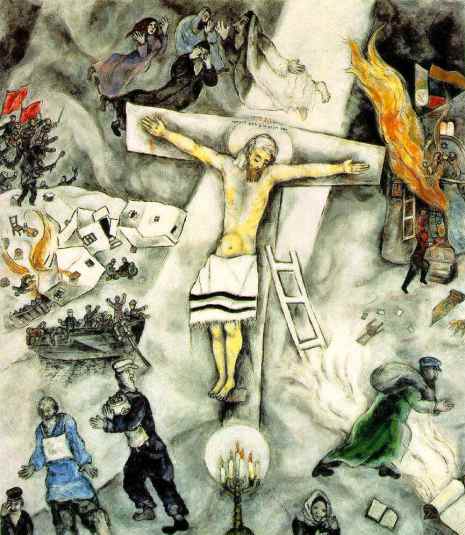
Seven Final Words: Into Your Hands

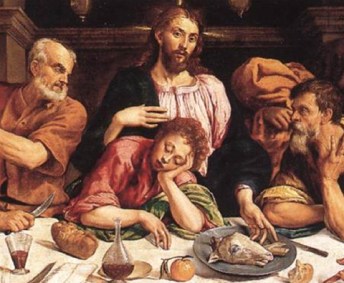
holbein

“Father, into your hands I commend my spirit” Luke 23:46

Jesus at the cross began by praying; here he also ends by praying.

These are often words spoken on people’s deathbeds and at funerals. They are profoundly comforting words. They comfort because they remind us of the sobering but reassuring truth. One day, whether unexpectedly or at the end of a long life, we will die. Our physical lives will end. All that we are, had, and hold on to will cease.

This is sobering because we realize the truth that we cannot save ourselves. We cannot preserve ourselves. We cannot control the very foundation of our lives. Millionaires have died in car accidents and cancer just like the rest of us.

We cannot take this world with us. Celebrities pass away and their fame eventually with them. You can be buried with your money, if that is your will, but that is not you anymore in that casket anymore than that money is useful. What we are and have, ultimately and finally, is not up to us. It is up to whatever or more importantly whoever lies thereafter.

This is why it is reassuring, even liberating. It reminds us that at the end of the day, whoever we are, it is all in God’s hands.

Here, God in Jesus Christ is modeling for us the very essence of faithfulness: trusting God in the last moment of life, at uncertain threshold of eternity.

One way or another our lives are in God’s hands, the question is what will God do with us?

As Jesus said these words, we was dying on a Roman execution cross for the crime of blasphemy, while sinless, he made himself a sacrifice for sin. He gave himself up for us. I would emphasize that he did so, completely. We do not have to fear death because Jesus faced that fear for us.

He had the promise that God is in him and the Father will resurrect him, however Jesus was fully divine and fully human: prone to doubt, prone to uncertainty, prone to anxiety and fear. You can imagine the question is his human, all too human, head: Will my Father be faithful? Will he come through? We have already meditating on his cry feeling forsaken.

So, the comfort of these words must also be kept side by side with the pain of the cross, the willingness of the cross. It is a willingness that seems to admit that Jesus was willing to not only die trusting the Father but also embrace the possibility of the ice-cold silence and darkness of death and hell.

Understanding this fear perhaps explains why he pleaded that this cup may pass, sweating out drops of blood. “But not my will but yours be done,” he prayed. And so again, into your hands, I commend my spirit, as into your hands, all our spirits. It is always in God’s hands, not ours.

Just as he says this, Jesus breathes his last. Jesus dies. The Son of God died. God was found in death. God bound himself to the fate of death. God of infinite joy and life came into the finite space of wretched mortality.

When we think we are sinful and unclean, when we suspect that in our final breath we will disappear in judgment before an exacting God of judgment, we must remember that God died our death penalty. God entered our mortality. God became a rotten corpse, the very object of the consequences of sin, the very object of uncleanliness according to the law. The incarnation was complete, completed in the act of perfect atonement.

No piece of artwork shows this better than Holbein’s the Body of Dead Christ in the Tomb from 1520. Holbein depicts the remnants of the crucifixion on Jesus’ boy: the mangled, pieced, blacked hands, the stretched tortured body, the limp and lifeless face.

At the cross that mission was accomplished. Sin, death, corruption was defeated, but it was through Christ’ willingness to die.

Luke’s gospel reads, “Having said that, he breathed his last. When the centurion saw what had taken place, he praised God and said, ‘Certainly this man was innocent.’ And when all the crowds who had gathered there or this spectacle had saw what had happened, the returned home and lamented.”

Matthew records that at that very moment, the curtain of the temple, the divide between God and man, was torn asunder.

If God is in Jesus Christ, he will not leave Christ to rot in the grave. And the Father didn’t. He rose to new life on the third day. God is love and hope and healing. As we are in Christ, we have the hope that, as everything is in God’s hands, one way or another, we can rest assured they are in good hands, the hands that are mighty to save us.

Final prayer:

Father, we pray recognizing the cost of the cross. We pray trying to understand its pain and shame. We will never understand its full weight, but give us enough understanding to receive it into our hearts. We pray that we would not just hear about the work Christ did, but receive it. We pray would not just look upon the cross, but take it up ourselves. That is taking up the life the cross demands of us, the love it embodies, the truth is sacrificed for. Do not let us leave this place without our heart changed with a new commitment to living out the way of our Lord Christ. Thank-you for your justice, mercy, and love. Thank-you that your cross comes with the promise of the resurrection. Amen.

Seven Final Words: Finished

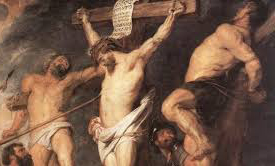
cross

“It is finished” John 19:30

Imagine watching a hockey game, a pivotal match in the pay-offs, where the refs oddly announce before the game that this game would be judged a bit differently than others, but did not say how.

You continue to watch the game. One team, more physical and underhanded, begin bashing the other team. No penalties are being called. This must be what the refs alluded to. In the process, they take a commanding lead and the other team gets pounded.

The other team refuses to sink to the others’ level, even after players get taken off the ice with injuries. “Why aren’t they fighting back?” you wonder. “This is getting pathetic. They should just call the game quits at this point.”

Finally, it comes down to the last few seconds. Time is up and the buzzer sounds. It is finished. The less physical team has lost by quite a number of points. They are finished.

But then, the refs come to the center of the ice, and announce that they other team, the team with fewer goals, actually won. How? You see, the new criteria for which team would win was which team harmed the other team the least.

The more violent team did not take the refs instructions seriously. Now that the game is finished, they are finished too.

When Jesus says, “It is finished.” It is like saying that the game clock has run out. The game is over. However, it does not mean “We’re finished; I am done for; it’s over.” It is that dark moment at the cross that Jesus appears defeated, broken and dying, that actually his mission is accomplished. He is actually victorious.

Jesus is a servant king and he rules a kingdom where those who are great are the ones who make themselves least. He taught things like blessed are the spiritually poor not the spiritually rich, those mourning and broken not the tranquil happy-go-lucky types, the meek not the assertive, the thirsty not the satisfied, the merciful not the exacting, the pure not the political, the peacemakers not the warlords, the persecuted prophets not the powerful potentates. Jesus’ rules for winning flip the game of reality upside down, declaring the losers to be the true winners. And it is at this moment that Jesus demonstrates that his kingdom has come: it has come in him by his faithfulness even onto death.

Saying, “it is finished,” is a victory statement: the kingdoms of evil and darkness have not won. The time is up for them not Jesus. They have been beaten, but not with more evil but with goodness; not with violence but with peace; not with compromise but with integrity; not with wrath but with mercy; not with comfort but with sacrifice.

Within the context of the Gospel of John, this statement – “It is accomplished” – co-insides with Jesus’ prayer of exaltation and glory. Consider John 17: 1-5:

After Jesus had spoken these words, he looked up to heaven and said, “Father, the hour has come; glorify your Son so that the Son may glorify you, since you have given him authority over all people, to give eternal life to all whom you have given him. And this is eternal life, that they may know you, the only true God, and Jesus Christ whom you have sent. I glorified you on earth by finishing the work that you gave me to do. So now, Father, glorify me in your own presence with the glory that I had in your presence before the world existed.

Crucifixion was the most brutal and disgusting way to die in the ancient world, but Jesus has turned it into a way of healing.

No one has ascended into heaven except the one who descended from heaven, the Son of Man. And just as Moses lifted up the serpent in the wilderness, so must the Son of Man be lifted up, that whoever believes in him may have eternal life. For God so loved the world that he gave his only Son, so that everyone who believes in him may not perish but may have eternal life. Indeed, God did not send the Son into the world to condemn the world, but in order that the world might be saved through him. (John 3:13-17)

Jesus tells Nicodemus that he will be “lifted up” in the same way the bronze snake was by Moses in order to heal the people and, simultaneously, he will ascend to heaven. Jesus tells Nicodemus this, and Nicodemus, like many others, really does not get it.

Jesus states later that, “When you have lifted up the Son of Man, then you will realize that I am he” (John 8:28).  The cross is the fulfillment of Daniel 7: the Son of Man is on his thrown, the nations are his. The end of the age happened at this cry as the way of the kingdom is perfectly displayed in Christ’s obedience. It is at the cross that Jesus will be fully realized to be who he says he is, like a cosmic buzzer ringing out, “Ding, ding, ding ding!” Jesus here is announced to be the Son of Man and Son of God, the true King, the Messiah, the world’s Savior.

For years, as I read these passages (specifically John 17), I thought the cross got in the way of Jesus’ glorification or that the glorification was actually after the cross in the resurrection. Not so. Jesus’ hour has indeed come, not despite the cross, but through it.

The cross is kingdom come. The cross is the victory of God. The cross is eschaton. The cross is life, paradise, salvation, heaven.

The cross is where Jesus is truly king,  in glory and majesty –  not in a glory and majesty we expect, but in the kind that displays what kind of king God is: a king of suffering love. The Father has given his glory to Christ (cf. John 17), not despite the cross but through it. THe only thing that is truly defeated that day was the ways of this corrupt world. All who look at the cross know that that the disciples of Christ, those who take up their crosses to follow him, will reign with him.

Seven Last Words: Thirst

watercross

“I thirst” (John 19:28)

In the beginning as Genesis two tells us, there was a stream that bubbled up and watered the earth. From the clay of this stream the first man was molded, from its water Eden was irrigated, and from there, the text says, out of the garden the stream became four great rivers. Here is the archetypal river of life, fountain of salvation.

The human body is about 50-80% water, and doctors recommend that a person drink about 2 litres of water a day to be healthy. It is no stretch of the imagination that we can say that water is life.

Not surprisingly, there is a persistent image of water in Scripture as a source of cleansing, purifying, and revitalizing.

John, a master story-teller, makes use of the theme of water and thirst throughout his Gospel. Disciples are baptized in water. Those entering the kingdom of heaven are born of “water and spirit” (Jn. 3:5). Jesus poured out water to wash the disciples feet, the quintessential act of servanthood.

One instance is particularly applicable. Near the beginning, a woman comes to the well in Samaria, who has been married five times and is living with a man not her husband. Jesus meets her there, and asks her for a drink. She protests, saying the well is deep. Jesus uses this to tell her that there is water that will make her thirsty again, and than there is living water form which she will never be thirsty again. While naïve and uninitiated, she tells Jesus that whatever this is, she wants this water.

She does not understand what this water is, but she is thirsty for it. She is thirsty for water that is more than water. She is thirsty for compassion, for love, for forgiveness, for truth.

Of course, this water is eternal life, and this water is found in Jesus.

The Samaritan woman is, as we all are, thirsty for salvation.

Psalm 42:1: “As the deer pants for streams of water, so my soul pants for you, my God.”

Yet, here on the cross, Jesus, the God-man, the one who is life, who is living water, is now thirsty. In this beautiful use of irony, water does not mean water, and thirst does not merely mean thirst: Thirst is the thirst of the soul. Jesus becomes thirsty.

As Jesus cried out in thirst, they gave him sour wine. The offering was not a malicious gesture as sour wine was considered better for quenching thirst, often used by soldiers like modern-day Gatorade. But Jesus’ thirst here is more than just thirst.

Psalm 63:1: “God, are my God, earnestly I seek you; I thirst for you, my whole being longs for you, in a dry and parched land where there is no water.”

The Scriptures say, “Christ redeemed us from the curse of the Law, having become a curse for us” (Gal. 3:13). “God made him who had no sin to be sin for us.” (2 Cor. 5:21). Christ, the son of God, the son of man, died representing all humanity before God and representing God to all sinners. He died in our place. He took on our pain. He took on our thirst.

His parched throat mirrors the desert wasteland of our souls.

In John’s gospel, as he died, after crying out “I am thirsty,” a soldier pieced Jesus’ side and it says water flowed out. Here we see another allusion to Psalm 22: “I am poured out like water.” Water flowed out of the one whom was thirsty. Through Jesus’ death, water flows. Through Jesus taking our place, God dying as a sinner, our souls will one day drink of the river of life.

So the vision in Revelation 22:1-3 says,

Then the angel showed me the river of the water of life, as clear as crystal, flowing from the throne of God and of the Lamb down the middle of the great street of the city. On each side of the river stood the tree of life, bearing twelve crops of fruit, yielding its fruit every month. And the leaves of the tree are for the healing of the nations. No longer will there be any curse…

In this passage thirst, water, and the overcoming of the curse are intimately connected. We are all thirsty. We thirst for Jesus. Jesus is that water that restores us to vitality perfectly. We know this because Christ bore our curse. Jesus is the only thing that refreshes our parched, dry souls.

Jesus said in the Sermon on the Mount, “Blessed are those that hunger and thirst for righteousness, for they will be filled.” Jesus made this promise, and here on the cross, he cries out thirsting for justice himself, dying from the oppression of a corrupt religious and political system. Yet his thirst was not for vengeance, but for the healing of sick, sinful souls. So Revelation depicts a day here water flows from the New Jerusalem “for the healing of the nations.”

Jesus is righteousness. Jesus is truth. Jesus is forgiveness. Jesus is living water.

And because of the cross, because Jesus chose to be at one with the thirsty, to thirst in our place, we are free to drink of the water of life; We are free to drink of the resurrection reconciliation.

So Revelation 22:17 says, “The Spirit and the bride say, “Come!” And let the one who hears say, “Come!” Let the one who is thirsty come; and let the one who wishes take the free gift of the water of life.”

Father,

We realize that we thirst for you.

We may think that we thirst for other things – money, safety, popularity, health – but it is you that we ultimately thirst for.

Thank you for becoming thirsty, taking on our thirst.

May we drink of the water of the river of life that flows from Christ who died in our place.

May the day come quickly that we see all nations gathered to be healed by the water of the river of life.

Let all who are thirsty come to you, Lord Jesus.

Amen.

Seven Last Words: Forsaken

holocaustjesus.jpg

“My God, my God, why have you forsaken me?” (Mark 15:34)

In his book, Night, Elie Weisel gives his bitter account of the Holocaust, an event so horrifically evil it unsettled the very core of his Jewish faith. He was only a boy when he saw  the execution of an innocent man, starved, emaciated, beaten, broken – broken of his very humanity. He was robbed of his dignity by people devoid of their own humanity, the Nazis.

This man was hanged in front of all the other prisoners: the poor man was made into a spectacle of the Nazi’s brutality as the audience was made to watch, feeling the full measure of their own powerlessness. Weisel, a boy, was made to watch.

As this happened, someone called out, “Where is God?” That man had had enough, the injustice caused him to cry out at the risk of his own execution. “Where is God?!” As if to say: How can he not be here? How could he not intervene in a moment like this? The crowd could give no answer as he indicted God in a crime of cosmic proportions.

“Where is God?” the voice rang out again, again and again.

Elie Weisel, a young man at the time, felt in his heart the only possible explanation: Where is God? God is dead. He died there in those gallows.

Weisel saw this admission as the very moment his faith collapsed into a bitter semi-atheism. His hope in God was shaken.

But as Weisel reports, he did not lose faith, for while he felt hurt by God, the prospect that there was no God at all rendered the events of the Holocaust even more tragic: no God to denounce the evil as fundamentally wrong, no God to command compassion rather than indifference, no God to offer the promise of restoration.

Weisel’s shaken faith, I think, is an honest faith. Faith calls for nothing less than honesty about ourselves and our world, and that honestly about our world calls for nothing less than the honesty of being deeply upset over the tragic injustices of this life.

But to have that honesty in faith means addressing that frustration and lament before God as Jesus did: “My God, my God why have you forsaken us?”

This phrase comes from Psalm 22, a psalm written by David, who was a righteous man that was attacked by his king, his friends, and later, even his own family. He spent much of his life on the run, hunted like an animal.

One way to understand the cross – perhaps the most basic way – is to understand that Christ died, “according to the Scriptures” (cf. 1 Cor. 15:3-4). Jesus embodies the story of Scripture. He is the word of God.

He is the suffering servant of Isaiah 53: “But he was pierced for our transgressions, he was crushed for our iniquities; the punishment that brought us peace was on him, and by his wounds we are healed.” He is the “stone that was rejected that is now the corner stone” (Psalm 118:22 cf. 1 Peter 2:7). He is the perfect Passover lamb, slain as a sin offering for us, etc.

Jesus fulfills this scripture as the rest of the psalm shows:

Dogs surround me,

    a pack of villains encircles me;

    they pierce my hands and my feet.

All my bones are on display;

    people stare and gloat over me.

They divide my clothes among them

         and cast lots for my garment. (vv. 16-18)

In claiming these words as his own, he is not merely fulfilling the Scriptures. He is showing God’s solidarity, his oneness, with all the forgotten of this world. Jesus in crying out in forsakenness, embodying the cry of the oppressed, the abused, the victimized, the neglected, the humiliated – all who feel that God was not there when they needed him. Listen to the rest of the Psalm:

My God, my God, why have you forsaken me?

    Why are you so far from saving me,

    so far from my cries of anguish?

My God, I cry out by day, but you do not answer,

    by night, but I find no rest (vv. 1-2)

But I am a worm and not a man,

    scorned by everyone, despised by the people.

All who see me mock me;

    they hurl insults, shaking their heads.

“He trusts in the Lord,” they say,

    “let the Lord rescue him. (vv. 6-8)

I am poured out like water,

    and all my bones are out of joint.

My heart has turned to wax;

    it has melted within me. (v. 14)

This is the lament song of a soul in despair. This is also the words of God in Christ.

In Christ, God knows what it is like to be abandoned, betrayed, tortured, humiliated, blamed, and executed.

Jesus, in his trial and crucifixion, was the subject of personal betrayal: his best friends and students ran, denied him, and even received money to betray him.

Jesus, in his trial and crucifixion, was the victim of religious corruption and abuse. He was accused of blasphemy for his message of forgiveness: that God is with us, sinners. He was tried falsely by corrupt priests who didn’t want their sins exposed or their power taken away. As John 8 tells us, Caiaphas, the high priest, ironically saw Jesus as his sacrifice to save their religion.

Jesus, in his trial and crucifixion, was the target of political oppression. He was brought before the magistrate, Pilate, who ultimately cared only for order at any cost. So, he gave Jesus over to his psychotic soldiers for torture, humiliation, and finally execution by the slow death of the cross.

The cross is a rare kind of anguish. It is the slow death by bleeding out from the torture and nails. Hanging on the nails meant one’s diaphragm would be stressed, causing the person to gasp for air. The subject would hang there starving to death, slowing hallucinating in a delirium of despair as people stand there and mock. Nailed there, few pictures of the atonement render it accurately: few picture the victims unclothed and naked, exposed to desert sun that would blister exposed skin. (Ironically, no crucifix renders Jesus naked – an accurate depiction of the cross is still too scandalous, even Christians!) And the nakedness of exposure was more than physical: hanging there naked, the victim was exposed to the scoffers, jeering, removing whatever dignity remained. Jesus had the added pain and humiliation of a thorn crown pressing into his head and a sign above, mocking his claim to the throne of David.

How could God let this happen to Jesus? How could he have forsaken him? Where is God?

The answer is right there. God was right there. God was in the man who was godforsaken. God revealed that he is with those who feel forsaken by God.

Jesus, Immanuel, “God is with us,” is here as God bound to our fate, our death, our despair, our pain, our sense of the absence of God. He loves us so much he stands with us in our darkest moments.

This does not make sense by our worldly logic, but this is the logic of God. Dietrich Bonhoeffer put it well when he said, “Only a suffering God can save us.” Only love that is willing to suffer with a victim, feeling their pain, willing to take their pain as his own, can disarm the anguish of suffering.

Jesus cried out, “My God why have you forsaken me?”

Jesus deserved justice’s vindication, but he gave it up to live in solidarity with those whom justice has forgotten.

Jesus deserved the throne room of heaven, but chose a crown of thorns.

Jesus deserved to inhabit heaven, but instead he chose to harrow hell.

So, we return to our Holocaust anecdote: Where was God as an innocent man died in the gallows of the Holocaust?

God was with that dying man. He was in that dying man. He was dying for that dying man. God is that dying man, “slain before the foundation of the world” (Rev. 13:8).

God did die that day, but not in the sense that would lead us to atheism.

God did die that day, because he is love; he is suffering love; he is a God that refuses be far away from those who feel forsaken.

God refused to stand far off as his beloved children suffered. It is that same refusal of a God that chooses to suffer with us that refuses to leave suffering forever forsaken in our broken world. If God suffers with us, we know that God did not cause our suffering. If God suffers with us, we also know that he would not will this suffering to be without end. A God of love is a God of hope for us.

We know this because three days after the cross, Christ rose from the grave. Suffering will stop because the cross leads to resurrection.

So the Psalmist affirms in his suffering that one day…

The poor [i.e. the oppressed, the abused, the abandoned] will eat and be satisfied;

    those who seek the Lord will praise him—

    may your hearts live forever!

All the ends of the earth

    will remember and turn to the Lord,

and all the families of the nations

    will bow down before him,

for dominion belongs to the Lord

    and he rules over the nations. (vv. 26-28)

There will be a day when suffering stops, when tears are wiped away, when hunger is satisfied, when wounds are healed, when pain turns to praise, when repentance and reconciliation reigns.

There will be a day of perfect justice, perfect mercy, and perfect peace.

That day is coming because the God who died on the cross, rose from the grave. Death could not change the impassible character of a God who is boundless life.

The cry of the cross was answered with the triumphant joy of resurrection. Let’s pray…

Father,

We ask with Jesus sometimes, “Why have you forsaken us? Why all the injustice? Why all the destruction? Where are you?”

God, remind our broken souls that you were with us in the times that seems like you were absent. Help us to look to Jesus and trust that you are not far off. You are with us. You are for us. You bear our pain.

You did not abandon us as you did not abandon Christ. Soften our hearts to let go of that pain and anguish, knowing that you have already taken on that pain in the cross.

Lord, allow the wounds of our past to heal in the same way the cries of Golgotha were answered with the resurrection.

Allow the cross and resurrection to inspire us. Give us the grace to live out what your promises demands. Convict us of the courage to confront the injustice of life with Jesus’ innocence. Convict us of the empathy to confront the suffering of this world with Jesus’ solidarity. We pledge to act in trust, compassion, and hope, knowing that you will restore all things.

Amen.

Seven Last Words: Mother Mary, Brother John


disciplejesus

“Woman, behold your son” … “Behold, your mother!”  (John 19:26)

While it is easy to see this passage of Christ looking to his mother, Mary, and instructing her to embrace John, the beloved disciple, and John vice versa, as a simply provision undertaken by our Lord to ensure his mother is cared for, these passages offers us glimpses of something deeper. Let’s look at both John and Mary here.

Why is Mary told to refer to John as a “son” and John to refer to Mary as his “mother”? The provisions of care do not necessitate this, yet Jesus insisted. He could have just said, “John, take care of her.”

Some have seen this as Jesus recommending a relationship between Mary and the disciples.In Christ, there is a new family, a global family, of the redeemed that all began at the cross. Mark 3:35 says, “Whoever does the will of God is my brother and sister and mother.” Here we see the constitution of that family, gathered around the crucified Jesus, listening to his instructions, and so, compelled to treat one another as family.

But it surely meant more than that for John. Mary and John are among the few that actually stayed close to Jesus. They did not flee like the rest of the disciples. John was allowed near the crucifixion site, perhaps because he was so young.  We know this because only boys too young to serve in the military could come near the execution site for fear of uprising to save the crucified.

This helps us understand why John sometimes refers to himself as the “beloved disciple,” who “reclined at Jesus’ side.” Peter would have been much older, the eldest of the disciples, possibly. It is also possible that John was the youngest. He was only a boy, small enough to need hugs from Jesus. He may have seen Jesus has a father figure.

Jesus taught us to call God, “Abba” (Daddy). John may well have called Jesus, “Abba.”

John is standing there, watching his father figure die. So, this was more than provision of care to Mary, it was recognition of mutual support. They would need each other. You can understand Jesus’ words now as commissioning the young John. “It is time to be a man, now John, take care of Mary, treat her like your mother.”

As we see John’s writings through the New Testament, particularly in his epistles, John took up this commission well. He was an apostles of family and love through and through. He constantly refers to his congregation as his “little children,” not unlike what he was when he learned his essential instructions from his master.

We know from church tradition that John’s dying words to his church was, “Little children, love one another!” Love shun through John’s writings at all points, especially in passages like 1 John 4:7-12:

Beloved, let us love one another, because love is from God; everyone who loves is born of God and knows God. Whoever does not love does not know God, for God is love. God’s love was revealed among us in this way: God sent his only Son into the world so that we might live through him. In this is love, not that we loved God but that he loved us and sent his Son to be the atoning sacrifice for our sins. Beloved, since God loved us so much, we also ought to love one another. No one has ever seen God; if we love one another, God lives in us, and his love is perfected in us.

His church was his family, and love was his ministry because Jesus was his hero.

Can we look to Jesus like John did?

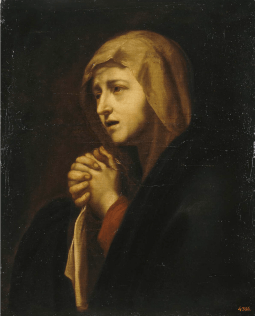
mary

Now, Mary: Protestants have often forgotten the importance of Mary. We have done this out of understandable reasons: it is out of discomfort with how high Mary is elevated in Catholicism. But as Catholicism raise Mary too high; Protestants are guilty of not raising her high enough.

In church history, veneration of Mary began because of how Mary pointed to a proper understand of Jesus. Jesus died in the flesh (contra some who denied his humanity) because Jesus was born to a human mother: Mary was the guardian of Jesus’ humanity, the theotokos, “God-bearer” in Greek.

But, sadly, Mary was elevated to a kind of co-operator with Christ in some Catholic theology, which Protestants simply feel makes her into an idol. But we should ask is how do we properly adorn Jesus’ mother so that she once again safeguards her son’s high place? We might phrase this better by asking, how does respecting Mary as a mother – us looking to her motherly qualities – how does that bring us deeper into appreciation of Jesus? Or, how does understanding Mary as mother deepen our understanding of Jesus as our brother?

The picture displayed above renders this clearly: eyes too sorrowful to see clearly, but too concerned to look away; hands, clenched praying perhaps both that her son would be faithful to the onerous task she bore him for, but because she bore him, praying pleading with God to relent of the suffering her son is feeling.

To look to Mary as our mother is to look at Jesus’ hanging on the cross, not as an abstract idea, a stale doctrine, a historic account, or an expression of our own sentiments, it is an attempt to see the cross for what it is, and not bypassing it too quickly.

Seeing the cross as our salvation can too readily jump from its tragedy to the benefit we get out of it. We can easily see Christ as suffering on our behalf and we can say, “thanks,” and continue on our merry way. We can selfishly forget the cost of the cross. We can easily look at the cross for what we get out of it, not what God put into it.

When we look to Mary as the mother of Christ, we also look at the cross through the eyes of a mother. Someone’s son died on that cross. Someone’s little boy, her pride and joy, everything she lived for, is being murdered mercilessly, dying that miserable death.

And do you not think that it may have occurred to her that while she knew Jesus was dying for her sins, she would have gladly died in her sons place just to save him from the pain? Don’t you think even that she would have gladly refused her own salvation if it meant saving her little boy’s life?

It is only when we look at the cross through Mary’s eyes do we appreciate the cost of the cross for us. It is the cost of a life more precious than our own.

It is only when we lament the cross through Mary’s tears are we ready to say thank-you to a God that gave so much we will never understand.

It is only through the love of Mary for her Son that we ready to love the world as Jesus loved it.

Lord,

May we love as John loved. May we look to you as our daddy, our father figure. So close to us that we can “recline at your side.” Help us to remember that we are beloved disciples, not just disciples. Draw us closer into the family of God. May we treat your sons and daughters as brothers and sisters. Give us opportunities to be big brothers and sisters to others.

May we mourn for you as Mary mourned. And in our mourning, let us remember the provision that Jesus gave at that very moment, the only true provision against the tragedy of this age: You gave us the church, the family of God. Help us to take care of one another. Help us to love one another.

Amen.

Seven Last Words: Paradise

goodthief

“Truly, I tell you, today, you will be with me in Paradise” (Luke 23:43)

Our world is a world that has closed itself off from the transcendent. We have bought into the discourses of science that tells us the immediately tangible is all there is, everything else is suspected as superstition.

Do not get me wrong, science has earned its place in the world, and many need to listen to its voice more. Science has offered enormous explanatory power for our worldview. In the great feuds between scriptural literalism and science, science will usually win. We have found the sun does not revolve around the earth, that the earth is much older than chronicled, that rain comes from weather systems, illness from poor hygiene, etc.

The world has pushed God out of its purview. God has been viewed as too burdensome a notion to trust.

The events of the primordial church fade into the distance of history. History, itself, seems to crocked a path to see providence. Divine intervention seems like misconstrued co-incidence. Many of the great political advances have been done despite religious influences.

We immerse ourselves in the comforting hum of media noise. Talk of God becomes as rare as genuine conversation itself. Hearing from God becomes as rare as genuine listening itself. An atheism falls over us because we feel the blunt force of divine absence.

Our daily lives, even for many Christians, are often practically atheist. Church becomes an cumbersome ritual. Work is more important than worship. Singing praise to God does not feed a family. Prayer and Scripture reading get sidelined to more relaxing practices: Television, sports, etc. So, we say to ourselves, why bother believe?

However, we deceive ourselves into thinking the modern world was the first to discover doubt, as if doubt was an invention by the same brilliance that discovered flight, electricity, or the theory of relativity. Yet, doubt is not a modern novelty.

The cross was a scary time for Jesus and his followers. The cosmos, let alone their little band of disciples, hung in the balance. The circumstances had become so chancy that most of the disciples deserted Jesus: belief in this man as the messiah was simply too insecure at that moment. Peter initially drew his weapon to defend his lord, but upon realization that violence was not going to resolve the conflict between Christ and the priests, upon seeing his master taken rather than fighting back, unleashing the kingdom of power that he was expecting him to unleash, Peter himself turned to deny Christ, three times in fact. Other disciples deserted him far sooner, unfortunately.

Thus, there Christ hung, condemned, and by all accounts at that very moment, defeated and disproved. Jesus as messiah was no longer a tenable conviction anymore. He did not seem to be bringing in a new kingdom, as prophesied. He did not defeat the Roman occupation, as prophesied. Far from! There he was pathetic, disheveled, beaten into irrevocable submission to the powers he should have pulverized with legions of the faithful, perhaps having even angel armies come to assist. Thus, Pilate, either out of mockery to the Jewish people or out of some deep seated pious guilt over killing a truly innocent man, wrote “King of the Jews” and hung it over Jesus’ head.

If one was to look for a reason to believe in Christ at that moment, one would have looked in vain. The man on the cross was exposed many times over as just a man, flesh and blood, ashes and dust, rejected by his people, betrayed by his closest followers and friends, accused of blasphemy by his own religion’s authorities, tortured and in the midst of his execution by his people’s most hated enemies, the most idolatrous power in existence, hanging there, slowly bleeding out, slowly succumbing to his wounds, to thirst, and to death.

Atheism’s objections pale in comparison to the scandal of Good Friday.

As onlookers mocked and jeered, even a man, a wretched thief, dying the same death as Christ next to him, felt no solidarity with the co-condemned, no compassion for his neighbor in this death, only cynicism and despair. Even the thief on Jesus’ one side mocked him.

At this moment, there seems to be no good reason to trust Jesus. Jesus hung there, discredited.

Would you have believed that Jesus was the messiah then? I know I probably would not have. Sadly, that is because I am a “reasonable” person.

More sadly, is that the only reasonable people in this story are monsters: Judas, who calculates how to profit from Jesus’ arrest; the Pharisees, who have the foresight to plan against possible agitators; the Romans, who brilliantly invented means of rebellion suppression.

And yet, in this moment of darkness and doubt, despair and destruction, one person believed! One person dared to see something more. One person had faith. The other thief, what tradition refers to as the “penitent thief,” dying at Jesus’ side. He believed. He had nothing left to hold back. He could have mocked like the other thief, but he didn’t.

We know next to nothing about this person. The Gospels left him unnamed. Having no hope left in this world, he still says to the other thief, “Do you not fear God? You are under the same punishment.” He admits that his punishment is just, yet Christ’s is not. Christ is innocent and he is not.

At the very end of his life, he is moved with humility and honesty.

But his confession is more radical than that. If one was worried about self-preservation, they would have petitioned far more prestigious powers than a dying messiah.

When no one else believed in Jesus, this man did. And so he simply requests that Jesus would remember him when he comes into his kingdom. He, in the darkness moment of his life, in the darkness moment in history, chose to trust the kingdom is still coming.

This man had perhaps the greatest faith in all history, and yet we do not know his name! But God does. God is not dead because God did not stay dead.

Jesus did promise to remember him. In fact, this man, in his final moments of life, was given the most definitive assurance anyone had before the resurrection: Jesus turned to the man and said, “Today, I truly tell you, you will be with me in paradise.”

Sadly, it is only when we realize that our lives stand on the edge of oblivion that we can feel assured that our lives are in the hands of something more absolute than what this world offers.

Father,

Help us to have even just a fraction of the faith this man had.

We complain about our lot in life, yet we are unwilling to admit our faults.

We so often mock and mistrust your salvation. When we do that, we must acknowledge that our punishment, like his is just.

But we must also cling to the hope of your kingdom of forgiveness.

Remember us Lord Jesus, as you remembered him.

May your kingdom come.

Amen

Seven Last Words: Forgive Them

forgive

“Father, forgive them, for they know not what they do” (Luke 23:34)

The world is exploding with differences.

In the news, we see the clash of classes, civilizations, races, religions, and sexes. We, as Westerners, are taught to fear the Muslim world, buying into a narrative of a war between the way of liberty and enlightenment versus bigotry and terrorism.

Yet, in on our own soil we see wars of other kinds: white versus black, citizens versus immigrants, straight versus LGTBQ, Christian versus  secularization, Republican versus Democrat, right versus left, so on and so forth.

The church, particularly conservative churches, has been particularly productive at reinforcing these differences. Christians have been taught to fear the scientific establishment because of evolution, to be militant against same-sex marriage as it is perceived as a threat to the lives of our children, against Muslims for terrorist actions against the West, against Democrats/liberals for insisting on secularized human rights, so on and so forth. We are quick to cast blame for our dwindling cultural power.

The binaries are endless, and there is a less than obvious reason why: we tell ourselves we are unique. I am special, therefore I am different. I am special, therefore I take priority over another. In a world that preaches the gospel of individualism, everything becomes the war of differences: us versus them.

I am more important than you. If you don’t agree, you have done me violence. If I don’t act against this, I do violence to my own uniqueness.

In this scheme the world is at war, not always with guns, but with ideologies. This is a great feud over not necessarily land, but identities, places of privilege of any sort, from political power to hold the presidency to merely having the right to have a cake made for your wedding.

There is a reason why we begin contemplating through the cross by beginning with these words. It is because if we don’t come to the cross realizing it is God showing us that he is forgiving them, not remembering sins against them, that he is reconciliation itself, that he is doing everything possible to tangibly show them this, then we get it all wrong.

We often come to the cross with the same us versus them mentality, only God is the “us” and we are the “them”: God is against us, and we are filled with fear at the prospect of an enemy who is more special than us, more powerful than us. If God is primarily wrath, and  we are firstly filled with fear in the thought of him. In some accounts the cross becomes the product of a wrathful God, fixing his wrath in order for God to now love sinners. This does not really help the binary: a holy God cannot stand to be with sinners. God remains this God and we remain sinners.

Of course, if God is infinite liberty, however, God could have just waved his hand and forgave all humanity from Adam to the end of time right there in the garden. There is no necessity in God for him to have to die at the cross in order to forgive us. The very fact that he wanted to go to the cross shows his mind was made up, that his first intention towards sinners was forgiveness and love. His holy power could have been demonstrated by saying, as Jesus did to the paralyzed man, “Your sins are forgiven” (Mark 2:9) at the first sin, but he didn’t.  Jesus through the cross wanted to show us forgiveness, not merely tell us we were forgiven.

Here Jesus is suffering the cross because of the hard-heartedness of people. Jesus was God’s representative. Jesus was the embodiment of God, the Son of God. What Jesus says, God says. What you do to Jesus, you do to God. And so by crucifying Jesus, the people are committing the worst act in all history: they are executing the Son of God, God himself, for coming and preaching that God was now with us.

God did not set us the binary “us versus them.” We did.

Such an unthinkable evil demands the most exacting punishment. Or one would think. But here we see God’s representation request something: Christ said, “Forgive them, they know not what they do.” At the most unthinkable evil in the world, we see God’s unimaginable grace. Jesus praying for his oppressors as they murder him.

Of course, we might ask, “them, who?” Who did he mean? I cannot be us, for our own instinct of self-justification causes us to excuses ourselves from something the seems obviously unbecoming of our natural goodness. It must obviously be the disciples that betrayed and abandoned him. Or did he mean the Pharisees that sat there mocking, saying, “If you are the King of the Jews, save yourself”? Or the Romans in their innovative yet senseless brutality? Or is it the mindless masses that gave up on him?

These are all good answers, and we would like to think that these are it. We would like to think that we are like Pilate who thought he could wash his hands of the blood he was about to unjustly spill, but to be a son of Adam or a daughter of Eve is to know that we all could have participated and did perpetrate the crime of the cross. All humanity stands condemned with the “them.”

We have the same weak and corruptible hearts that shouted “Crucify! Crucify!” so shortly after proclaiming “Hosanna! Hosanna!”

We have the same mocking voices that question that if he was the messiah, why didn’t he get off that cross?

We have the same cowardliness that caused Peter to deny his Lord three times, where he previously pledged to die for him.

We have same cruel minds in our heads that devised terrible forms of execution like the cross.  The same heart that beats in human chests hammers the nails into Jesus’ hands.

We are them.

In all the wars of differences, in this first and foremost paradigmatic instance, we are the them; we are no different.

We set up the differences and we causes the hurt, or we claim someone else did it and someone else did the crime, who, nevertheless, is just like us. We claim superiority, which in turn leads to violence of other kinds. In the long run, whatever claim to moral superiority we might set up, sooner or later, we will forsake that standard. If we create a binary of us (good) versus them (evil) we will find ourselves sooner or later implicated in our own hypocrisy.

To be human is to be implicated in the great fall into ignorance, exclusion, and violence that characterizes our present existence.

We know this every time we see a poor person on the street, who is there purely because he was born into a place of abuse, where we to stable homes.

We know this every second we look at the TV screen, condemning the actions of terrors by saying, “I hope they blow them all away.”

We know this every time we see a starving family in the third world, and ignore them to go home to warm homes with satellite TV, smart phones, designer clothes, etc.

We know this every time we take more than what we need, say more than what we should, or care less than what we could.

We, especially as Westerners, exist because of a violent oppressive system we and generations before us, created and perpetuate, refusing to dismantle because of the fear of loosing our modern comforts.

We could keep Christ on the cross if it meant keeping our IPhones. We know this because we starve innocent children for our clothes, kill middle-easterners for our oil, oppress and scapegoat minorities to protect our SUV’s.

We are the “them.” Ours is a depravity of omission, negligence, and decadence.

And yet we encounter not just the depravity of our hearts at the moments of the cross, but more importantly, the heart of Jesus, true heart of God, the heart of forgiveness. “Father,” he prayed, “forgive them, they know not what they do.”

Whoever the “them” is, he forgives: an all-knowing God, knows that they did not know. A God capable of infinite wrath, chooses to expend empathy in the moments of human apathy.

It seems obvious that the people did know that they were committing a terrible crime, but the heart of God is one not of exacting judgment, but gracious benefit.

We so often come to church assuming God is our enemy. We assume he is our enemy because we tell ourselves we have done unthinkable evil, wrong choices the we cannot even believe we have done ourselves. We are limited, so we assume God’s grace is limited. And yet when we look at the cross, we see a God with a heart full of understanding and compassion, a God so unthinkably good that while we do the worst, he is always trying to offer us better.

If we have the humility to accept his goodness, he calls us to the freedom to forgive those around us that have done us wrong.

Father,

As we come here, we recognize our continual need for forgiveness.

We recognize we are the “them,” all of us, everywhere, citizens of a world in darkness that showed its vicious hostility to the light.

Yet you prayed for us, when we were still your enemy.

You prayed for the salvation of every person whose heart was in darkness.

And so the Light came into the Darkness and the Darkness could not overcome, Hatred could not overpower Forgiveness.

So, we also confess that we know that you taught us that it is by forgiving they we are forgiven, that we are in the light to bring the light to all darkness.

Lord, you showed us the essence of humility and selflessness as you prayed for your enemies while hanging there dying.

Jesus, teach us to pray for our enemies, for all the “them’s” we encounter.

Amen.

Seven Last Words: Lent Reflection Introduction

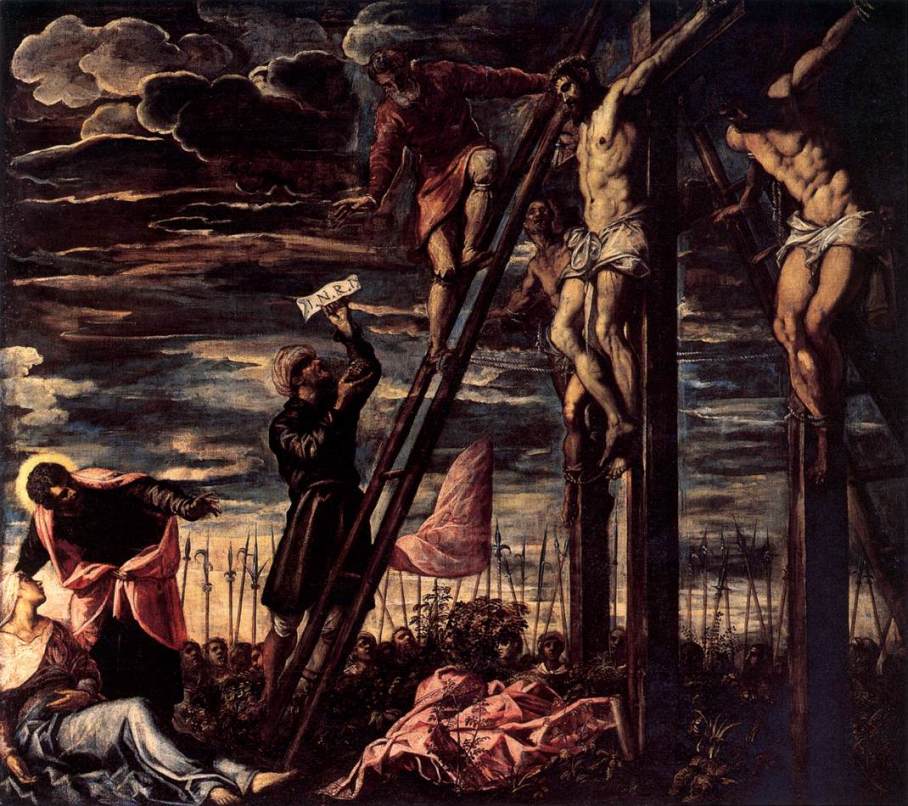
Jacopo_Tintoretto_-_The_Crucifixion_of_Christ_-_WGA22477.jpg

What follows, each week leading up to Good Friday is a meditation on one of the seven final statements of our Lord.

Lent is commonly not observed by many Protestants, but it is often because the practice is misunderstood. Lent is an ancient practice of the church mentioned by St. Irenaeus, a second-century Christian, where fasting was regularly practiced in various ways leading up to Good Friday and Easter. He mentioned that this practice was being done before he was born, so that places Lent within a generation of the Apostles. Eventually the practiced solidified into 40 days of fasting, coinciding with 40 days of fasting the Jesus and Moses did. Lent typically involves a fast to draw the person closer to Christ in empathizing with his sacrifice and using the fast to intensify prayer. Christ himself expected his followers to fast, so all the elements of Lent, while Lent is not mentioned in the New Testament, is nevertheless biblical. As a general rule of thumb, any tradition that helps bring a person closer to Christ need not be viewed with suspicion.

Lent is designed to focus us on the cross. The event of the cross was the greatest event in human history. It shattered all notions of the universe, God, what it means to be human, right and wrong – everything. This is why we fast and meditate: in order to draw closer to just how profound and important the cross is.

The Scriptures record the disciples’ memoirs of the event and their reflections trying to understand its meaning. Some saw Jesus as paying a ransom to buy back humanity from the darkness that had enslaved it. Others saw Jesus as our substitution, our priestly sacrifice showing God’s peace to us, cleansing from sin. Some saw Jesus as providing a way to confront death and evil in resolute non-violent righteousness. Others saw his death as taking on our cursedness, removing the separation between God and people. Still, others saw the cross with the resurrection as a kind of military victory over death and darkness.

Whatever way we understand the cross – and there are several ways Christians have read its meaning – we come to the point of admitting something: the meaning of the Cross is beyond words. Its capturing power renders us speechless.

So, over the next few weeks of Lent, we are going to meditate on the cross using the words Christ spoke as he hung there. We are going to leave talk of atonement theories behind and talk about the atonement person: Jesus.

We will cling to the words Jesus used because we admit our words fail to capture the full meaning of the Cross. As we cling to his words, we enter his presence, his anguish, his love.

May these reflections bless you as draw close to Christ this lent season.


Why Christian Patriarchy Cannot Prevent Abuse

abuse

Here I will further demonstrate with an analytic argument that patriarchy in theory is incoherent and cannot prevent abuse.

Patriarchy, as I have previously argued, is the denial of the gift of the Spirit for all who are one in Christ (which I have argued elsewhere in regards to Galatians 3:28). Under this basis, patriarchy is the denial that a woman could have the gift of the Spirit in leadership (apostolic or general), teaching, prophesy, etc. whether in the church, society, or marriage.

Patriarchy is the position that holds to an inherent hierarchy within the male-female relationship where men have a position of authority or leadership by the merit of their gender, which usually is applied to a marriage (where the man has the power of decision in some way) and church leadership (where men only can be pastors), but also to other aspects of society in general (some argue against women holding any position of authority). However, for purposes of this paper, the marriage example will be used as the normative referent, since it is the male-female relationship at is most basic (where a congregation of pastor-congregants involve relationships not just of a man and women) and it is abuse in marriage that is most distressing.

I find this term is a pretty muddy term because some will argue that Christian marriage and church leadership is by the gift of the Spirit, therefore a man leads, either as husband or pastor/elder, by that gift where a secular marriage or institution does not have this grace. Christian patriarchy is in theory something that only good Christians can do. In other arguments, since gender is apart of the creational design, in principle all marriages and all institutions should naturally work best under this scheme. In this account Christian patriarchy is something that is natural and therefore should work for all. However, Galatians 3:28, forbids the idea that a man would get a gift the Spirit (i.e. leadership) that a woman could not. This leaves the basis of leadership and authority in the realm of the natural. This should grant us some level of demystification. If it is based on natural and rational order, it should be accountable to natural principles of reason.

Thus, I will now argue that Christian patriarchy is incoherent by the fact that it cannot offer an accurate description of its own criteria of success. I will also then argue that it is condemnable by the fact of its inability in principle to restrain oppression and abuse of women. That sounds strong. After all there are so many good husbands, fathers, marriages, pastors, churches, etc. that hold to this. That is fine. This is why we should qualified this and say its inability in principle not reality. In reality there are lots of good marriages that display patriarchy, however, we are analyzing the natural logic of that conviction. To this we will return to the second assertion that argues patriarchy examples of success do not offer the criteria necessary to understand that success. What I mean by that is that patriarchy in successful Christian marriage, is one where there is a practiced intimacy, equality, and mutual accountability, which actually implies the opposite of any hard version of patriarchy.

1. The Incoherence of Patriarchy

Christian patriarchy cannot sustain the assertion that it is good that a man can have a role by the merit of him merely being a man over a woman. It has to argue this assertion by saying he has to be a good man and a capable leader, but cannot sustain that every man is good and capable. This slides the criterion of authority and leadership from a criterion of gender essentialism to pragmatism: a man does not have authority because he is a man, but because has the ability to do so and the character to do so well.

If this is the case, patriarchy has already failed on two fronts. The first is that if a man does not have good leadership and good character he should therefore be disqualified from leadership on principle. There is no basis by which a woman must listen to a man of incompetent judgment, unsound mind, or questionable character (as we will see, the insistence otherwise, therefore, creates the inability for patriarchy to prevent abuse).

The second is that if it is actually on the basis of skill and character (or the gift of the Spirit) that leadership is based, then if a woman manifests these qualities (as we have argued previously in regards to Gal. 3:28), there is no objection in principle that she could in fact lead and the man should in fact submit.

A patriarchalist is then left with three very uncomfortable options: (1) Resort back to arguing that leadership is in fact based on gender without character and ability. This option is incapably of offering criteria that could prevent abuse. (2) Deny that any woman does have naturally the skill and character capable of leading. This option leads the patriarchialist into bigotry. Good female leaders, whether in the church, marriage, or society are ignored, or worse, explained as if they are abnormal women. This option is left explaining away any good preacher, politician, business owner, or administrator that is a woman. As I said, nothing short of calling this bigotry will do because the vast amount of life data one has to explain away virtually makes this position on par with insisting that the earth is flat. So, we come to the final option: (3) Admit that a patriarchalist holds a double standard, either principled inequality or even intentional repression. Inequality is seen in either allowing a man to do something that a woman could do, and overt repression is seen in any act of actively preventing a woman to do something a man is privileged with. If it is the third option, they are left with having to deal with Galatians 3:28 again: the Spirit does not discriminate in regards to the gift of the Spirit on the basis of gender, ethnicity, or wealth. Therefore, theological patriarchialism is left without foundation. Fideism offers no shield to the accusation of the double standard. If a woman is in fact capable of leading there is no position of these three that does not result in a type of authoritarianism (the wrong use of power) or ignorance (refusal to be informed).

Again those are strong words, and I shall qualify: the traditional marriages that we know and respect are ones where the man has the character and skill in leadership, which the woman is content to trust. In other words, while it is undeniable that our gender does affect our relationships and positions, the notion that masculinity as such is the prime criterion of leadership has been exposed as inaccurate. A male leader will inevitably lead in some kind of “male” way, but that is nothing more than a tautology. A female leader will inevitably lead in a “female” way as well. We express ourselves with gender, but gender is not the deciding factor. If woman can in fact possess the qualities of leadership and skill in using authority, gender is incidental.

The opposite scenario (authority without character) offers the falsification criterion required to prove my original point: If we can agree that the logic of even patriarchy of good character is incoherent, (it always requires the ability and character to lead, which is not restricted to gender on the basis of experience or theology) it attests to the fact that patriarchy as such is potentially abusive. The potential outcome is why a logic of egalitarianism is the preferable and in fact necessary one for any successful display of Christian leadership.

Authority can be defined as the power to make decisions, give direction, or have control over something, and to control something is to exert force to direct or restrain. If a man, empowered by the ideology of patriarchy, is set up as an authority in a marriage or an institution, there is now the potential that power can be utilized without a moral or even rational criterion. As we already established, if male-authority is based on skill and character, then that is not patriarchy, it has pragmatic criteria. If authority is actually based on skill and character, than a woman can lead if she displays these skills and character. In fact, as we just demonstrated, with regards to the gift of the Spirit, there is no basis for discrimination.

However, if authority is wielded on the basis of male gender (thus, truly patriarchial) the decision need therefore not be a good decision; the direction need not be a good direction; and the exertion of power need not be a good exertion of power. The obliged response by the female is submission, trusting that any decision by virtue none other than it was a decision by a male is worthy of trust.

This makes things complicated. I have heard some patriarchal Christian valorize this kind of blind submission, and in fact, many resort to this defends in order to dismiss the existence of good female leaders (option 2 above). They would resort to a fideism of trusting in the order of male-authority/female-submission despite the perceived impracticality of it and examples to the contrary. Again, this option fails by its lack of theological basis (if the Word of God in Galatians has anything to say about it) and is therefore a retreat not into the mystery of faith but into the perpetuation of the irrational.

However, most Christian patriarchialists will oppose this fideist notion and qualify that women have to a degree of liberty to inquire and even challenge an unfit decision by a male authority. This, ironically, falls back into the logic of egalitarianism. The criteria to evaluate the validity of a decision, the right to challenge the validity of a bad decision, and the power to refuse to submit to a decision by an authority once it has been made, all imply that authority and leadership is not validated by positional authority alone, but rather by the degree of skill and character an authority or leader has. Again, the criterion is pragmatic not gender based, and therefore any gender that displays these qualities may lead. Any relationship that permits the freedom to question a decision, the freedom to apply a set of criteria to evaluate a decision rationally (and not accept it on merit of positional authority), and the freedom to even refuse a decision if it is incorrect rather than be compelled to submit to it, implies that the relation operates within the parameters of equality: mutual accountability, mutual submission, not hierarchy. If it claims differently, as many do, the description of the relationship is inaccurate and even disingenuous to the reality of the practiced relationship.

In fact, no successful Christian example can be offered in which a man can wield power and authority, well or not, without the woman also allowing him to, implying she exerts her own power and authority over him, if only to relinquish it and empower him. Authority is reflexive. In a marriage, his exertion of power actually is dependent on his legitimating power of his wife’s consent, approval, and ongoing accountability. This is not patriarchy, however. This is egalitarianism that expresses itself in mutually agreed upon traditional roles. The site of authority is equally in each person together, but the execution and operation of power is entrusted to one on behalf of both. However, as I insist, there can be no defeater offered for what a couple cannot agree for the opposite.

2. Complementarianism and the Possibility of Abuse

Some will note that I have only used the term “patriarchy” which some might found offense to their position because it sounds harsh. They would prefer the term “complementarian.” My intent in using patriarchy is because it is more basis to what I take issue at: gender hierarchy, not the notion of similarities within a gender and differences between genders. Some will insist that they are “complementarians” not patriarchialists offering something similar to the description given in the last paragraph, but less objectionable.

Complimentarianism in this case might be essentially the dual thesis that men, by the merit of their gender, are called and best suited to lead or have authority, and women, by the merit of their gender, are called and best suited to submit. This position insists on the need for men to exercise power and authority well (whether as a husband or a pastor, etc.) and a woman (whether a wife or congregant) to submit well. Both together are understood as forming the basis of a successful male-female relationship.

This is more nuanced than patriarchy, but essentially it is just as incoherent. While it offers a more holistic account of how power is applied (i.e. rarely one-sidedly), the notion that a man must lead well and a woman must submit well does not prevent the slippage from a positional criterion of power to a pragmatic one that we just talked about. A man can lead (and a woman submit) only if he actually has the skill and character to do so, and therefore, if the woman possesses these qualities, there is no reason why a man then in turn should learn to submit to her or pray and ask God for help in doing so.

However, I will argue that complementarianism is just as bad and in some cases actually worse. While complementarianism recognizes the dual notion of the relationship, patriarchy is overt in placing the emphasis on male power and control. In patriarchy then the onus is, typically, on the power yielded by the man. Complementarianism is in many ways identical to patriarchy, but when unsuccessful, creates the possibility of female scapegoats. The marriage failed, so one could complain, due to lack of complementarity, not the deficient use of male-power. In other words, the person that refused to fulfill their role is to blame. While it could be the man in refusing to take responsibility, the possibility is offered that it is in fact the woman’s fault for refusing to submit since that is her role. This could create the situation where that a man in merely asserting power on the basis of his gender is deemed virtuous, even though in other regards he is not a supportive husband, but a woman who defies his orders is deemed immoral for failing to uphold her role. This creates a potentially terrible situation: Her displeasure and defiance to the authoritarian nature of her husband’s authority therefore become her fault, purely because she expresses her displeasure and defiance of it.

What is worse is that if authority implies the application of power, if position is legitimated by gender without character, and if decisions can be implemented apart from the ongoing consent and accountability of an egalitarian logic, the result is something that is indistinguishable from abuse. What happens when a wife refuses to submit to her husband? There are two outcomes. The first collapses positional authority into mutual-accountability: the man explains himself and offers compelling reasons for the decision. This implies the logic of egalitarianism as the execution of leadership is based on the pragmatics of ability and character with accountability and equality.

So, the worse outcome is where patriarchy becomes dangerous, which will serve as my closing cautionary example. If the woman refuses to submit, she is in defiance of the order of the relationship, legitimated purely on the basis of gender. In fact, I would point out that if the relationship does not qualify the criteria of accountability for decision to be challenged, all disagreement could potentially be understood as defiance. Rather than accept negotiation or accountability, the failure to maintain this order could be seen as requiring the application of simply more force.

Here is where the possibility of abuse in patriarchy cannot be prevented in theory and is, in fact, bolstered by bad theological analogies. Obviously this does not mean self-espoused complementarians are all abusive, but I have already accounted for why that is not the case, and it is because the relationship is in fact disingenuous about its own pragmatics. However, I will maintain the potentiality in principle.

If a man can wield power and authority purely on he basis of gender and a woman called to submit, if the power is truly positional then power can be wielded without the legitimation of another, without a woman’s approval or accountability. This implies then that he is at liberty to exercise power against her will.

There is dangerous analogous logic that can reinforce the abusive nature of this power. Power relationships often imply the use of force. After all, bosses can fire bad employees. Police can imprison deviant citizens. A teacher can expel a student. A parent can, in traditional understanding, spank a child.

While it is not our project to exegete 1 Corinthians 11, a misapplication of its logic would be thus: God is head of Christ; Christ is head of man; and man is head of the woman. Apply the logic to divine headship over humanity, as some do, to marriage, and it starts to get scary: a very coherent set of logic in its own right is thus offered for the use of force by a man over a woman for the purpose of carrying out the decision. If God is head over humanity and can exercise power regardless of the consent of people and if the male is the head of the female as God is the head over humanity, then the man can analogously wield power regardless of the opposition of the woman. He may think he can do so even to punish her for her own good as God does to humans. The fact that God is morally perfect and people are not can get ignored. The man, if he thinks he is in the right, is now able to exercise the force of punishment against the woman’s will. It us under these schemes that we see examples of “domestic discipline” and abuse perpetrated by Christian fundamentalists. Patriarchy, if it gravitates to this level of theological analogy, can delude itself into laying claim to God’s infallibility and wrath for its own.

This may all sound very extreme and quite offensive to a complementarian or gentle Christian patriarchialist. Thankfully, most who hold this position out of Christian conviction object strongly to the use of force. However, this is the challenge of convictional consistency:  What restrains the use of force as a virtue that comes from patriarchial values or an unadmitted egalitarian one? If complementarianism promotes power over women, how is force that much different? As I said, many complementarians are in actuality egalitarians first, who together mutually consent to traditional roles. However, if the logic that God is an authority with the capacity to use force is analogous to the male power in the patriarchy, the refusal to use disciplinary force is actually disconnected within the linear implications of the logic. This is why patriarchy, as such, cannot prevent its own abuse.

Conclusion

It is for this reason that Bible believing, Spirit-loving, reason-using, and justice-promoting Christians should seek to reform any form of patriarchy. This does not mean demeaning well-intentioned marriages and churches, but it does mean taking seriously the task of clarifying Christian convictions (as we have done here) and promoting the most coherent theology of authority and gender. The most probable exegesis and the most coherent account of relationships is one that works within the bounds of egalitarianism. Patriarchy, as I have shown, in its purest theoretical form, cannot offer a compelling logic to prevent abuse.

The Galatians Principle: Or, Do Complementarians Deny Justification by Faith?

1024px-Hans_Speckaert_-_Conversion_of_St_Paul_on_the_Road_to_Damascus_-_WGA21655

So in Christ Jesus you are all children of God through faith, for all of you who were baptized into Christ have clothed yourselves with Christ. There is neither Jew nor Gentile, neither slave nor free, nor is there male and female, for you are all one in Christ Jesus. If you belong to Christ, then you are Abraham’s seed, and heirs according to the promise. – Galatians 3:26-29

The other day I was told by a complementarian (a person who upholds that there is a hierarchy between men and women as taught by Scripture) that if I believed that women could be ordained, I no longer believed in the authority of Christ over the church. I supposed by this person’s logic and theology of a chain of authority, if he was correct, this is true. However, I don’t think complementarianism is the best exegetical account of the whole of the Scriptures, and so, here is my gentle push back on what is at stake if complementarians refuse a woman in her ministry gifting. It is my intent, as my deliberately provocative title suggests, to demonstrate that Galatians 3:28, within the context of the argument of Galatians and implicit within the same logic of justification by faith, cannot support patriarchy in the church, especially if leadership is by the gift of the Spirit. As a religious axiom about the gift of the Spirit, it promotes the equalized distribution of all spiritual authority without prejudice. If authority in Christian marriage and church is based on the Spirit, this Scripture supports an egalitarian understanding of both.

Understanding Paul’s Concerns

In doing so, I want to chart a middle ground between what I see as the “civil rights activist Paul” and the “complementarian Paul” readings. Both try to fit a circle into a square hole. Notice also, that this is not “conservative version of Paul” versus the “liberal Paul.” There are biblical conservatives that espouse egalitarianism (such as myself), meanwhile, there are complementarians who are such probably for no other reason than their culture has caused them to read scripture thus.

In the context of Galatians, Paul is not concerned with a modern grammar of woman’s rights. It would be wrong headed to translate his world into ours, making him into a modern feminist. All benefit to society is enacted indirectly through the practices of the church, within its narrative self-understanding, not political advocacy directly through a universal set of principles. He is concerned with making sure all recognize what the Spirit has done. Paul is concerned about emancipation and gender equality, but his way of going about it is focused firstly on life in the Spirit in the church community. He is not a civil rights activist. He is not political. He has very little confidence in the justice of the Roman government. His concern is for equality in the life of the church as a witness to the world. So, Paul is primarily concerned about spiritual equality in the church (as opposed to political equality that bypasses the church), but that in turn has very real practical consequences. For him, there can be no ultimate dichotomy or between spiritual value and practical role and no discrimination of the gifts

In Galatians, Paul is concerned with Judaizers imposing the requirement of circumcision on Gentile Christians in order for them to be considered full members of God’s family (4:5), Abraham’s offspring/heirs (3:7) and recipients of the covenantal blessing/inheritance (3:19). This context, as it applies to gender, implies inequality as Paul is equalizing Jews and Gentiles.

Paul sees those advocating circumcision as acting out of discontinuity with the acts of the Spirit. The expectation does not match what they are seeing. In compelling circumcision and austere obedience to the law (the former being a metonym for the later), Paul worries that this is simply disingenuous to the event of Christ’s grace on all who believe and therefore detrimental to anyone that buys into it. It becomes “another gospel” (1:6) as it falls into a paradigm of meritorious obedience, which is an unsustainable perfectionism (3:11-12): the law cannot produce justification because those who seek justification by the law are obliged to keep all of it for that to work, which obviously no one can.

Also, imposing circumcision on Gentiles seems unloving (5:6), especially if it is unnecessary. You can imagine how the Gentile men would not appreciate having to cut a piece of their genitalia off in order to appease the unnecessary demands of a religious faction! It would be painful, humiliating, and potentially unsafe (although Paul does not explicitly mention these factors). The act of which implies ethnic superiority, and inequality as well as religious hypocrisy in Paul’s mind as it treats Gentiles by a double standard that even Peter did not follow. Gentiles were being treated as inherently impure, warranting the circumcision faction and Peter refusing to sit with the uncircumcised in table fellowship (2:12), and therefore they are expected to “act like Jews” (2:14) in order to be acceptable.

However, the work of Christ undoes the basis of superiority here. Paul argues that Christ, who died on a tree, took on the cursedness of those separated from God, existing outside the law and covenant, and in so doing redeemed those under the curse (3:13-14). Any blessed/curse, clean/impure distinction is therefore absorbed in Christ. Paul’s logic presupposes quite a bit in 3:14, but it implies that Jesus is the Son of God (2:20) as well as the offspring of Abraham par excellence (3:16) and by dying on the cross, the Gentiles now have the inheritance and blessing of Abraham as if they too are his offspring. The inheritance is the gift of the Spirit (3:14). This gift of the Spirit, making possible new relationship, occurs by trusting the work of Christ alone – justification by faith – not by meritorious obedience. Since the Spirit is the Spirit of Christ, God’s Son, those who have the Spirit, are therefore also God’s children, able to cry out as Christ did, “Abba! Father!” (4:6). Paul’s argument then has an experiential base: he has witnessed uncircumcised Gentiles, who do not uphold the entire law, be granted the gift of the Spirit purely because they trusted Jesus, and so, he continues to encourage the Galatians to stick with this paradigm.

This overcoming of cursedness and uncleanliness implies a powerful social revolution in Paul’s thought through the work of Christ. We miss it because we expect him to argue on the basis of civil rights. Women were often restricted because of the uncleaniness associated with their gender. For example, Lev. 12:1-5 states that a woman who has given birth to a boy is ritually unclean for 7 days. If the baby is a girl, the mother is unclean for 14 days. Male babies, therefore the male gender, was considered more clean than then female babies. Women had to go into seclusion during their menstruation cycle, because they were unclean (Lev. 15). Thus, women were restricted in worship. Second Chronicles 36:23 states that women were not allowed in the sacred space of the temple as they has their own space, considered the least sacred.

Thus, given that women were treated as as less pure in the ancient world, the notion that Christ bore the curse of the law and that true impurity is wrong doing (Matt. 15:11) would have opened up unprecedented liberty in Jewish culture.

Pneumatic Equality

Some might press the notion that Galatians is only about spiritual equality, so let’s explore it further. Here we see that all are given the Spirit through faith in Christ, which has very practical consequences. Paul is advocating what we might call “pneumatic equality.” Paul does not mention what the nature of the gift of the Spirit does beyond causing adoption and spiritual fruit. Nevertheless, Gal. 3:28 insists that whatever the gift of the Spirit is, the gift is given indiscriminate of ethnicity, economic status, or gender. Whatever the gift of the Spirit entails, it is applied indiscriminately for “you are all one in Christ Jesus.” This is the argument for equality that this passage implies. If one had something or another could not have something on these premises, the result is inequality.

To be clear, Paul only talks about the gift of the Spirit in general principle, but the principle is strictly egalitarian. Complementarians can only at best downplay the importance of the principle, silencing it with other scriptures that sound more complementarian. Thus, if the gift of the Spirit implies all the gifts listed elsewhere in Paul’s writings (cf. Rom. 12:6-8; 1 Cor. 12:8-10; 1 Cor. 12:28; Eph. 4:11, which include the gift of apostles, prophets/prophecy, teachers/teaching, leadership, administration, etc.), the criteria of their distribution should be, by this principle here, indiscriminate of gender as it would be of race and income inequality. It implies that if a Jew can speak in tongues so can a Gentile, if a free person can be a prophet, so can a slave, if a man can have apostolic gifting, so can a woman. Anything less amounts to the denial of the promised inheritance for some.

Thus, it should not surprise us that the Spirit has been so indiscriminate, even in the Old Testament. There we see Deborah, a prophet and judge over all Israel, despite the qualifications a judge in Exodus 18 stating “men who…” (which would form the paradigm of reading the elder descriptions that refer to “a man who…” in 1 Tim 3:2 and Titus 1:7 as generic, inclusive, or non-absolute). Also we see the formidable prophetess Huldah (2 Kings 22: 14-20), who has the God-given authority to rebuke the king himself. We see Philip’s daughters, who are prophetesses (Acts. 21:8-9). There is also Priscilla, who seems to be an apostolic co-worker with Paul along with her husband (cf. Acts 18: 24-26; Rom. 16:3-4; 1 Cor. 16:19; 2 Tim. 4:19); Chloe, whoever she is, seems to have authority in the church of Corinth such that her people report to Paul (1 Cor. 1:11); Phoebe, who seems to be a deacon of Cenchreae (Rom. 16:1) come to give the church in Rome direction; Nympha, who has a church meeting in her house, which strongly insinuates she lead that church (Col. 4:15); Junia, “prominent among the apostles,” which suggests that she is an apostle in the fullest sense of the word (Rom. 16:7); and finally, Euodia and Syntyche, who are listed as leaders along side Clement, which again, suggests apostolic authority (Phil. 4:2-3). If the implications of these passages are correct, this further corroborates the notion that the Spirit does not show favoritism if bestowing the gifts.

Does Justification By Faith Imply Egalitarianism?

Indeed, anything less than an egalitarian application of the gifts of the Spirit would imply legalism. Gentiles, by faith in Christ, are not obliged to follow rules that no longer function, that detract from the work of Christ (which circumcision did), that do not fulfill the law of love (5:6; 5:14) or do not manifest the fruit of the Spirit (5:22). Where there is the fruit of the Spirit, “there is no law against these” (5:23). Conforming to any laws, whether biblical or not, that do not meet these criteria is problematic. If the Gentile believer took on circumcision, such an act would be an act of inequality, reinforcing the superiority of the Jewish ethnicity before God that God has abolished in Christ. Jews and Gentiles have the same access and unity to Christ. Similarly, denying a slave or a woman the Spirit’s gift to preach or to teach, would be in some way saying that they have less of Christ in them than in a free male, implying almost that their submission and slavery was meritorious obedience. Is a complementarian comfortable saying that not all are truly “one” in Christ by faith? This is what the logic implies.

In fact, to take up circumcision as a meritorious action, functionally becoming a Jew in order to be an heir of the covenant, this action seems to imply slavery: “We are children, not of a slave but of a free woman. For freedom Christ has set us free. Stand firm, therefore, and do not submit again to the yoke of slavery” (4:31-5:1). Gentiles, who have the Spirit by faith, have everything the Jewish believers have. Gentiles are able to relate to God unburdened by their previous estrangement from God; they are given the same status, namely, children of God and they are given the same inheritance, namely, the Spirit.

Interestingly enough, that argument could be made, albeit provocatively, that since justification by faith and the gift of the Spirit is linked in Galatians and the gift of the Spirit is for Jew and Gentile, male and female, slave or free, if a person imposed laws of gender on a woman that denied her what the Spirit gave to her through her faith in Christ, that person can be understood to be implicitly denying justification by faith in the same way a Judaizer would be denying justification by faith in imposing circumcision on a Gentile. All are one in Christ.

The Preference of Liberty

This sets an applicable pattern: liberty is preferable to slavery, yet liberty is not to be valorized outside the work of the gospel. This has a very real application for gender. Submission is not virtuous if it does not function, and such submission, especially imposed submission by other Christians, implies inequality in Christ’s unity with humans. It implies slavery. Laws that do not function, should not be followed if they are not loving, do not produce spiritual fruit, or promote the notion that the Spirit is prejudiced. Under these principles, gender and economic equality becomes a secondary concern of all who seek the Holy Spirit to be made more evident in creation.

This does not mean a person who is not given the gift of teaching, for instance, should feel that God is unfair in giving another that gift. What this is saying is that on principle these gifts are given indiscriminate of race, economic status, or gender, and so, not withheld on that basis. There are different roles in marriage, society, and church, the point is that the distribution of these roles cannot be on the basis just described. While we all may be called to serve and submit on mission for Christ, refusing Spirit-given liberty for another, imposing submission, is slavery. Men can be leaders if they have the character, but then again, so can women. A man can be called to be a pastor, if he has the qualities, but then again, so can a woman, if she is qualified. In principle then, a woman could be given any gift of the Spirit just as much as a man could (or Jew, Gentile, slave or free person), but that does not mean every person gets that gift. Men will be called to listen and submit to their wives (“submit one to another out of reverence to Christ” Eph. 5:21), a man must submit to a gifted female teacher as in the case of Huldah and the King (2 Kings 22: 14-20) or Apollos and Priscilla (Acts 18:28). Thus, we see no basis in Gal. 3:28 that any gift of the Spirit is restricted to a gender. To be clear, this does not take offense at the notion that some are called to have authority while others are called merely to submit and trust that authority. The problem lies with any attempt, especially by Christians, to restrict a gift the Spirit sees as open to all, particularly on the basis of ethnicity, gender, or economic status. It does not take offense at the call of some to be enslaved, but see the unnecessary imposition of submission on another.

This clarifies the rhetoric often used by the complementarian that women are spiritually equal, but functionally different. There is no problem in stating some are called to different things, while others are not. Some are called to more difficult lives than others. A person, who feels that it is there vocation to be an accountant for God, will be functionally very different than the person called to be a missionary in the undeveloped world. However, if we used the example of slavery and segregation in the United States, the problem is then the church limits the liberty of others, imposing a supposedly God-sanctioned social order that prevents some to pursue a Spirit-given vocation to a position of authority.

Is Slavery a Defeater?

One could object that if Paul did not abolish slavery, the application of the spiritual equality that equalized Jew and Gentile, removing the requirement of circumcision, cannot be fully applied to gender equality.

What the Gospel in Galatians does imply is the notion that all people are God’s children, thus able to cry out “Abba, Father” (Gal 4:6-7) and are heirs of the inheritance. This in a very practical sense meant the elimination of social separation between Jews and Gentiles in table fellowship (Gal. 2:11-14), but also in 1 Cor. 11:17-34 mean the equalization of access to food at the Lord’s Supper. This equality was lived out in the community of goods, where believers sold all individual property and live as if a single household (Acts 4:32). It was a scandal if a member of a church had much and another was in need.

With regards to slaves, while Paul did not seek a full and potentially destructive and violent emancipation, he did insist that all members of a church, whether slave or free, were considered family. If a slave was considered the family of a master, the implication is that freedom would be sought for the slave along with all other facets of general well being. It would be despicable that a person would own a family member as a slave. Thus, we see in Philemon, Paul plead (not force, we should note) that Philemon free Onesimus as the runaway slave (a criminal offense) is “no longer a slave, but better than a slave, as a dear brother” (Philemon 16).

Some are called to endure suffering and subjection for the sake of the Gospel, including wives (1 Peter 3:1-6) and slaves (1 Cor. 7:21), however, this subjection is for the purpose of witness vocation. Slaves in Christ are free, and the free in Christ are slaves (1 Cor. 7:22). In the case of a slave, Paul recommends not being obsessed with emancipation, continuing on in the state that the person is in. However, Paul clearly expresses the preference that a person must not become enslaved: “You were bought with a price; do not become slaves of human masters.” Again, witness is more important than emancipation for Paul, just as martyrdom is a greater witness than a long and comfortable life. Paul does not easily fit the profile of a social revolutionary. He is an evangelist that sees slavery, hardship and even martyrdom as opportunities to show Christ. However, is social inequality of little significance to Paul? No. Freedom was preferable to slavery.

Again, Paul was not a social revolutionary primarily, but the Gospel does imply liberation. The Gospel implies social progress, but the Gospel does not seek self-assertion let alone violent emancipation to cause progress. Social progress is not the Gospel, salvation to sinners by the free gift of forgiveness in Jesus Christ is. However, the social progress and liberation is a byproduct of redemption as it seeks to remove all barriers to authentic vocation and all effects of sin.

As this relates to gender, the notion that Christians would seek to enshrine and perpetuate limits on women in the home, church, and society, would be going against this principle that Paul offers. Again, Paul is not a human rights activist, and we need to draw close to his logic. He is advocating that the Holy Spirit does not discriminate with regards to the spiritual gifts, some of which imply leadership authority. Refusing to recognized that the Spirit could call a woman to lead, for instance, in the church, is tantamount to limiting the work of the Spirit and perpetuating a requirement of submission that falls back into legalism, subjection to the law.

Conclusion

By analyzing the logic of Galatians 3:28 in the context of the epistle, we see that it offers the principle that the Spirit does not discriminate on the basis of ethnicity, economic status, or gender in regards to the Spirit’s gift, the inheritance of Abraham. Justification by faith implies a type of egalitarianism. Refusing a gifted woman preacher in the church is analogous to imposing circumcision on a Gentile. It is a similar type of legalism. Thus, I offer the provocative push back to some complementarian polemics against egalitarianism, where complementarianism denies justification by faith (which I offer not because I actually think complementarians deny justification by faith, but to point out what the logic implies). While I have worked against the notion that Paul can be absorbed into the caricature of a modern civil rights activist, this does not dismiss the fact that Paul would not allow any inequality in his churches. Refusing to recognize that a woman could have a gift of preaching, prophesy, teaching, administration, or even apostolic leadership is to go against the Galatians principle here.