
Tagged: God
A Different Kind of Christmas
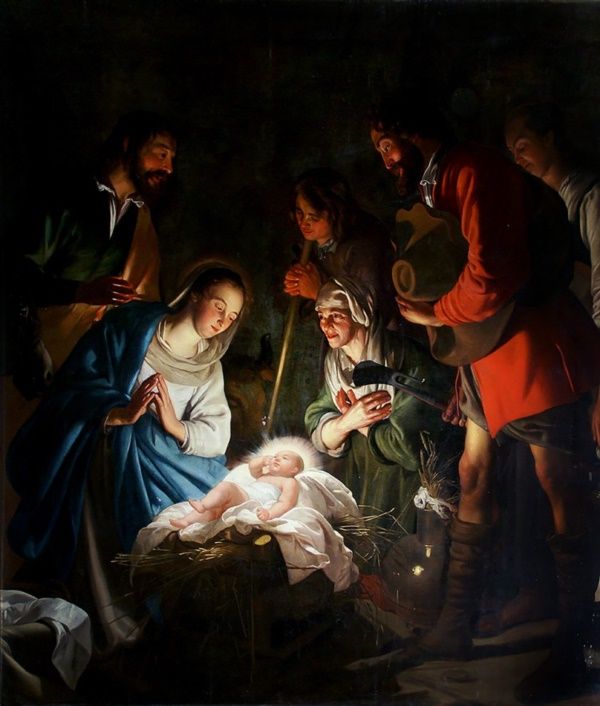
Introduction: Which Jesus?
Scripture Reading: Matthew 2:1-23 and Luke 2:8-20
I am going to say something controversial: I think the movie, Talladega Nights: The Ballad of Ricky Bobby, is Will Farrell’s funniest movie. Ya, Elf is a modern classic at Christmas. Ya, Anchor Man is probably the most quotable. However, Talladega Nights has a moment in the movie that gives one of the most pointed comments on popular cultural Christianity.
Ricky Bobby is a champion Nascar Driver, and there is a scene at the dinner table where he is instructed by his wife to say grace in order for God to continue to bless them with more Nascar victories.
Rick Bobby prays, “Dear Lord Baby Jesus,” and as he proceeds to thank the baby Jesus for all the good things he has, his wife stops him and says, “Sweetie, you know Jesus grew up, right? It’s kinda weird to pray to a baby.” Rick Bobby responds indignant: “I like the Christmas baby Jesus the best. If you say grace, you can pray to whatever Jesus you want: teenage Jesus, bearded Jesus, whatever.”
After which, his friend chimes in and says, “I like to picture Jesus in a tuxedo T-shirt…because it says, like, I wanna be formal…Right. But I’m here to party, too. Because I like to party, so I like my Jesus to party.”
His son pipes up and says, “I like to picture Jesus as a ninja fighting off evil samurai.”
This goes on for a little bit; Ricky Bobby continues to pray: “Dear 8-pound, 6-ounce, newborn infant Jesus… don’t even know a word yet…just a little infant and so cuddly, but still omnipotent… we just thank you for all the races I’ve won and the 21.2 million dollars…Love that money! Amen.”
Now, I hope no one is offended by my quoting this in church, but while this scene is ridiculous and theologically wrong, it also speaks of a kind of culture that has mixed consumerism with popular Christian religion, the cult of prosperity and achievement, health and wealth, with biblical illiteracy: Jesus is who I like him to be.
According to a 2015 survey by the Barna Group (and admittedly, these are American statistics), people believe the following things on average about Jesus: The vast majority of people believe Jesus was a real person. “More than nine out of 10 adults say Jesus Christ was a real person who actually lived.” However, “Younger generations are increasingly less likely to believe Jesus was God…Most adults—not quite six in 10—believe Jesus was God, while about one-quarter say he was only a religious or spiritual leader like Mohammed or the Buddha. The remaining one in six say they aren’t sure….” There is similar confusion about Jesus’ life: “About half agree, either strongly or somewhat, that while he lived on earth, Jesus Christ was human and committed sins like other people.”
That is perhaps somewhat typical given what we assume about living in a post-Christian culture, but one of the surprising statistics found was that the overwhelming majority of Americans say they have made a commitment to Jesus at some point in their lives.
What does this mean? David Kinnaman, President of Barna Group, commented at the end of the study: “This impressive number begs the question of how well this commitment [to Jesus] is expressed…dedication to Jesus is, in most cases, a mile wide and an inch deep.” As I said, these are American statistics, and you can imagine smaller numbers but similar factors going in for us.
It appears that there are lots of people familiar with Jesus in our culture, but not a whole lot that actually want to follow him. Lots of folks agree that Jesus claimed to be God, but that ultimately means they can carry on with their lives no different than those who don’t.
Pastor Chris and I got together for lunch one day, and out of that conversation came the idea of a series going through moments in Jesus’ life, taken from the four Gospels: His incarnation, core teachings, death, and resurrection, unpacking what these mean. So, that is what we are going to be up to leading up to Good Friday and Easter.
We have made Jesus Safe, Sweet, and Sanitized
Again, while Ricky Bobby is a buffoon in a comedy movie, what he says is brilliant satire. Notice how he prefers the Christmas Jesus, which, for him, means that Jesus is warm and cuddly in a golden diaper. I suspect many of us have a depiction of Christmas, as well as the portrayal of Jesus and his teachings, in our heads that is similarly safe, sweet, and sanitized.
Some of our Christmas Carols don’t help. Take “Away in a Manger”: “The cattle are lowing, the poor baby wakes / But little Lord Jesus, no crying He makes.” Why would someone assume that Jesus, as an infant, did not cry, whether hungry for his mother or because he had a dirty diaper? Isn’t Jesus human in all the ways we are human?
Take “Silent Night”: “Son of God, love’s pure light / Radiant beams from Thy holy face.” I love the song “Silent Night,” but I clench my teeth a bit when it depicts Jesus with beams glowing from him.
“All is calm, all is bright…” Why do we assume everything was calm? According to Luke’s Gospel, Mary, and Joseph got into Bethlehem, and it was so crowded and chaotic that she had to give birth in what is probably most accurately the equivalent of an alleyway, where the household animals were kept and were probably dangerous, loud, and dirty. Jesus is laid to rest not on golden, soft hay but in an animal’s feeding trough (some of you folk know full well what that might look like—it probably had bits of slop in it). Jesus was wrapped not in beautiful, bleached linens, but the word in Greek describes the ragged bands of cloth one used during traveling, wind-torn and caked with sand.
Those are details of Luke’s Gospel, and when we come to the events of Epiphany and the visit of the wise men in chapter 2 of Matthew, we have to admit this story has been packaged and sanitized as well.
By the way, I called it Epiphany—did you know that it is called Epiphany? I didn’t know this until literally four years ago when I preached at another church over the Christmas break, and I spoke on an unrelated scripture and was scolded for not upholding the church calendar, which apparently has 12 days of Christmas like the song says (that always puzzled me growing up—why are there 12 days?—also why does a person’s true love give them a bunch of birds?) I get the golden rings but If my true love gave me “eight geese a-laying,” can’t say I would feel very Christmasy about it. I apologize if I have yet again ruined another Christmas song for you.
Well, Epiphany is the last day of Christmas, twelve days after Christmas day that usually celebrates the next event in the Gospels: the dedication of Jesus in Luke, the coming of the wise men in Matthew, and the baptism in Mark and John, who do not have a birth narrative in them. Again, don’t feel bad if you did not know that. My family still puts the Christmas tree away after New Year’s.
However, as further evidence that we have the idea of Christmas so often packaged to us, in a lot of Christmas scenes, you have the shepherds at the manger scene from Luke’s Gospel with the wise men from Matthew’s. But notice what Matthew says: Jesus was a child when the wise men found Mary and Joseph living in a house in Bethlehem. This is a different timeline from Luke’s version.
Matthew tells the story differently and emphasizes certain things he wants his readers to see about Jesus. The churches of Matthew’s day were facing persecution and expulsion from the Jewish Synagogue: Jewish Christians, who seemed to be Matthew’s audience, were being seen as heretics and apostates for following Jesus. This compounded an already tense state of affairs where the people lived under Roman occupation, under the boot of a tyrannical empire, where violence and oppression were already a daily reality.
Again, we so often present the Christmas scene with clean and calm figures, but that is simply not the case for Matthew’s Gospel, which sets the scene for Christmas with a backdrop of tyrants, intrigue, and a bloodshed. That probably would not go as well on someone’s front lawn with lights and bows. Your front lawn would like that guy by Aldershot School that goes way too far in his Halloween decorations. You know who I am talking about, right?
If any of these elements of the story is a surprise to you as it was to me when I learned about them many years into my adult walk with Christ, I think we all have inherited our own pleasant, packaged, safe, and sanitized version of Jesus.
One reason why we like a safe and sanitized version of the Jesus story is that we don’t have to actually contend with what the Gospel demands.
When I was pastoring First Baptist Church of Sudbury, I had a congregant complain after I preached a sermon mentioning the Charleston shooting. This was in 2015. A deranged white nationalist walked into a church in a black community and killed nine people at prayer, hoping to start a race war. I had someone complain that I was mixing politics and religion in the sermon. I was confused by that criticism because that sermon never mentioned politicians, political parties, voting, or anything of the sort.
I soon found this man, a man raised in the church his whole life and even served as an elder in another church, openly espoused that he did not think Jesus ever spoke about racism or justice and even said to me that he did not think racism was sinful. I soon realized that despite his objection, he very much did mix religion and politics. It was just the worst version of both.
His was an extreme case, but we all so often give into a picture of Jesus, sweet, safe, and sanitized, that absolves us from having to do something about it.
1. A Different Jesus: True Moses, True Israel
But Matthew is different. Matthew presents a different Christmas story and a different Jesus. He is barely done mentioning the birth of Jesus when he starts mentioning the politics of Jesus’ day. It says the people were ruled by King Herod. Herod was a tyrant. Herod was not ethnically a Jew, but he claimed to be a faithful Jew for political purposes, nor did he have a royal lineage. His mother was from Arabia, and his father was an Edomite who found favor with Rome because Rome wanted a puppet king over these lands. Herod remained in power because he was very good at squeezing the people for more tax money to fund the imperial war machine, and he was absolutely ruthless at dealing with any threat to his power. In fact, he killed several close relatives who he thought might challenge his power.
Yet, a group of wise men from the east show up at his door wondering where the new king of the Jews is because a certain star sign has risen. Herod’s title was king of the Jews. You can imagine today’s ambassadors showing up to the White House asking the President, “Hey, we are here to honor your country’s new and true President. Where is he?” Yes, the messiah is political, just not in the way earthly politics want him to be.
Herod tries to trick and scheme, then intimidate and murder his way to stay in power, but God whispers in the dreams of the wise men and of Joseph, and both get out of Bethlehem before it is too late.
Matthew says that the holy family fled the massacre to go to Egypt and that they returned home years later when Herod was dead, coming to reside in Nazareth.
By doing this, Matthew’s story makes two subtle references here that tell us who Jesus is.
Who do we know in the Old Testament that had to escape the slaughter of infants? Moses the man who gave the Jewish people the law. In Matthew’s time, Christians are being attacked because their radical way is seen as a betrayal of the Jewish law, yet here, Matthew wants to say that Jesus is not only like Moses, Jesus is the true Moses. Jesus is showing us the true way to be faithful to God. And so, Jesus says in Matthew, “I have not come to abolish the law but to fulfill it.”
Second, who in the Old Testament came out of Egypt? Israel did. God’s people did. Matthew says that these things were done to fulfill what the prophet said, “Out of Egypt I called my son.” That is a scripture from the prophet Hosea, and if you look at it, Hosea is talking about the people of Israel as God’s child, and Matthew sees this as pointing to Jesus. Again, as Jewish Christians in Matthew’s time were persecuted and excommunicated from their families and friends for worshiping Jesus, Matthew says that Jesus is the true Israel. What God was longing to do with his people, a people set to be a redeeming presence to bless the rest of the world, God is fulfilling this first and foremost through Jesus and Jesus’ way. This is what God’s people are meant to be like.
Now, Christians throughout history have looked at passages like this in Matthew and concluded two problematic things: one is that God is done with the Jewish people or, worse, the Jewish people are evil for rejecting Jesus. This has led to some terrible stuff in church history. Others today do the opposite and look at what the modern state of Israel is doing in Palestine and automatically assume that Christians should support this country because this is biblical Israel. Matthew suggests something different.
If Jesus is the True Moses and the True Israel, God has not forsaken the Jewish people. Paul says the promises of God are irrevocable. Jesus is the very sign that God had refused to give up on his people. However, this also comes with the challenge that God’s people are called to follow God’s ways not the ways of this world, and God’s ways are most clearly shown in Jesus.
2. A Different Way: Jesus’ versus Herod’s
Between God and the world, we all have that choice presented to us.
Jesus’ way is different, and it is in brutal contrast to Herod’s.
Herod’s way of ruling involves lying and scheming, deceiving the wise men.
Herod’s way looks to religion to manipulate and maintain his power.
Herod’s way, worst of all, believes that peace and order are maintained by violence, even killing the innocent.
Herod is an especially cruel tyrant—he was a paranoid psychopath—but Herod’s way of ruling is known all too well:
It is the way that sees truth purely as what one wants it to be.
It is the way that puts one’s comforts always ahead of another’s needs.
It is the way that treats others as objects, valuable only if useful and worthless if not.
It is the way that looks at one’s enemies and sees something only to humiliate or annihilate.
It is the way that looks to God and sees religion as a source of power and God as nothing but the idolatrous echo of one’s ego.
Yet, just one chapter later, we see the contrast to Herod’s way as Jesus begins to announce the kingdom of heaven:
A kingdom not for the people who think they are spiritually rich but for the poor in spirit.
A kingdom not for the prideful and powerful but for the humble and humiliated.
A kingdom not for the compromised and the complicit but the pure and the peacemakers.
A kingdom for those willing to sacrifice for the sake of what is true and right, just as the prophets did.
That is Jesus’ way, and it cannot be reconciled with the way of Herod. Jesus is the narrow path that leads to life, whereas Herod’s way is the wide highway that leads to destruction.
3. Different Seekers
Which way are you on? Will you seek Jesus? In Matthew and Luke, it is surprising who does. Jesus has seekers who are different from what we expect.
The wise men seek Jesus in Matthew’s Gospel. Who are these wise men? Tradition gives them names and says there were three of them, one for each gift, but Matthew offers no specifics. Who are wise men? The word in Greek is “magos,” and it is used in the Old Testament for Pharoah’s magicians that oppose Moses in the Book of Exodus and the officiants of the king in the Book of Daniel. These are not particularly positive references: these men are a king’s astrologers and fortune tellers, and often, a king would send officials like them to honor an allied king. In the year 66 AD, magi from an eastern nation beyond the Roman Empire visited the emperor Nero to honor him.
Whoever Matthew’s magi were, they came to recognize Israel’s true king, even though they had no relationship to God’s covenant with Israel, and they are the ones who found Jesus while Herod and the rest of the people in Jerusalem were clueless. Let’s just appreciate this little irony of the story: When God’s people completely miss their messiah being born on their doorstep, a group of pagan fortune tellers travel across the known world led by an ancient horoscope in the sky, a notion Jews would have regarded as false—everything their religion stood against—but the magi did so to find and honor Jesus.
That might lead us to be a bit more humble in how we speak about people of different beliefs than us. For all we know, they may actually be pursuing Jesus—or Jesus is pursuing them—in ways we have fundamentally missed in our own lives.
In Luke’s Gospel, it is the shepherds who seek Jesus. Shepherding was one of the poorest jobs one could have in that society (and not to mention dangerous, out in the wilderness with the elements, wild animals, and bandits). It was a job for outcasts. The shepherds come and find Jesus, and the angels say that you will find your messiah wrapped in ragged cloth and lying in an animal feeding trough, a manger, and these things will be a sign to you of God’s good news for everyone.
If this event were to happen here, today in Kentville, you can imagine Jesus being born by the dumpers in a parking lot at center square, wrapped in someone’s second-hand coat, and the poor, the drug addicts, the folks that work night shift at the gas station or in the warehouse at Walmart realize if this baby is going to be our leader, things are going to get better, but he’s one of us.
A messiah born into poverty rather than power and privilege: This messiah is good news. He gets us. He is on our side because if God is on the side of the least of us, God is for everyone. And so the shepherds search out Jesus. Will we?
This chapter ends with the full display of what Herod is capable of: a massacre of the children in Bethlehem to try to find and eliminate Jesus. Matthew says this speaks of another prophecy from the book of Jeremiah chapter 31, “Rachel weeping for her children / She refused to be consoled because they are no more.”
Scholars have been puzzled about how this passage is actually a prophecy. It does not actually predict anything specific. It just speaks poetically of Rachel, one of the matriarchs of Israel, weeping over the casualties of the fall of Jerusalem several hundred years before Jesus. These were people slaughtered by the invading Babylonian army, who then carried off the survivors into exile. It speaks of the despair the survivors expressed as they mourned their deceased, walking off into slavery with nothing but ash and rumble behind them. Matthew cites it and by doing so connects their pain with the pain of the victims of tyranny in his day. And by doing so, anyone who read this and knew that scripture would also know what that passage promises to those who have suffered tragedy. The verses before and after proclaim hope. They say,
The Lord will ransom you…
I will turn your mourning into joy;
I will comfort you and give you gladness for sorrow…
There is hope for your future, says the Lord…
I will surely have mercy…
I will satisfy the weary,
And all who are faint I will replenish.
To the victims of tyranny and tragedy, Matthew is saying there is hope. Through Mary and Joseph, through wise men and shepherds, Luke and Matthew have been giving us unlikely examples as signs that if God is with these kinds of people, God is with us all.
To the victims of the violence in the Middle East, to those who have lost so much to the war in Ukraine, to those in Japan sifting through the remnants hit by the earthquake, to the broken and the hurting, the starving and the scared, God is with you. God is for you. God will ransom you. God will restore you. God will have mercy. There is hope.
God’s kingdom is here, and this is good news.
Jesus’ way is different because Jesus isn’t like how the world operates. He does not conform to our assumptions and expectations.
God cannot be bought, boxed in, owned, or sold off. God has come as the gift of grace, unlimited as it is undeserved.
Trust it. Let it sustain you in tough times. Let it transform you. Let it flow through you to transform others.
Let’s pray.
Loving and gracious God revealed in Jesus Christ.
You are God, Immanuel. God with us, God for us.
You lead as the true Moses; you teach us what it means to be Israel.
God, we repent for all the ways we honor you with our lips, but our hearts and our actions are far from you and your ways.
Forgive us and guide us by the leading of your Spirit on the way of Jesus.
We pray for these things in your name, amen.
The More Lost, The More Loved

Are you the kind of person who loses their car keys all the time? Full confession: I am. My wife is giving me that look like, “Oh yes, he is, and it drives me nuts.”
“Honey, where are the car keys?” She has asked.
To which I respond, “Well, they are either on the key hook, or on my dresser, or on my desk, or in my coat pocket, or in my pants pocket from the previous day. It’s a simple list of options, Meagan.” To which she looks at me like that.
It is amazing how important a set of keys can be at the right moment. The other day, I was doing work on our vehicle, and I went into the house. I was in there for a bit, and I realized I had to go somewhere. Where are my keys? Where did I leave them? When I came back out, thinking I might have left them in the vehicle, there they were. I could see them through the glass, but—and you know where I am going with this—the door—I realized out of habit, I locked the door and closed it.
This was a holiday, and so I figured CAA would either not be around or charge an arm and a leg to come or take forever to come. So, I tried to get in the car with a coat hanger and something I was using to wedge the door forward a bit. I came so close to getting the hook on the door handle to open it. So close. I have never wanted to get those keys so bad in my life.
In the end we called CAA. They came pretty quickly. They had a special tool that got the door open in about three seconds.
Anyways, you don’t realize just how important something is until it is lost.
So, as I said last week, Pastor Chris slotted me in for two weeks during his vacation way back when. It was when he was going through his series on the parable of the Prodigal Son, and my thought was to go into some of the parables, particularly the two that occur before the Prodigal Son in Luke chapter 15: the Parables of the Lost Sheep and the Lost Coin. These are two parables that I keep coming back to, reflecting on. They go like this:
15 Now all the tax collectors and sinners were coming near to listen to him. 2 And the Pharisees and the scribes were grumbling and saying, “This fellow welcomes sinners and eats with them.” 3 So he told them this parable: 4 “Which one of you, having a hundred sheep and losing one of them, does not leave the ninety-nine in the wilderness and go after the one that is lost until he finds it? 5 And when he has found it, he lays it on his shoulders and rejoices. 6 And when he comes home, he calls together his friends and neighbours, saying to them, ‘Rejoice with me, for I have found my lost sheep.’ 7 Just so, I tell you, there will be more joy in heaven over one sinner who repents than over ninety-nine righteous persons who need no repentance. 8 “Or what woman having ten silver coins, if she loses one of them, does not light a lamp, sweep the house, and search carefully until she finds it? 9 And when she has found it, she calls together her friends and neighbors, saying, ‘Rejoice with me, for I have found the coin that I had lost.’ 10 Just so I tell you, there is joy in the presence of the angels of God over one sinner who repents.”
Gospel of Luke 15:1-10, NRSV
I have been enjoying reading a collection of sermons on the parables as I reflect on these passages. It is a book by Howard Thurman. Thurman was a mentor to Martin Luther King, Jr., and his books have been as beautiful as they are challenging for my faith. In his sermon on these parables, he suggests something profound: Sometimes, we take the parables as stories merely about how to get saved, which is an important topic, of course. But let me suggest to you that if you read these parables asking, “What do I do?” You have fundamentally misunderstood it. Thurman pointed out to me that these parables are whole accounts of God’s character in miniature. They are here to tell us what God is like and what God does.
So, the parable asks this question: What is God like? In these parables, Jesus gives us two surprising metaphors that answer this question.
What is God like? God is like a Shepherd
The first might seem obvious or old hat to some of us who have been around the church for a while, but it is surprising because it is loaded with implications. If you look at certain passages in the Old Testament, God is the shepherd of Israel.
But notice something: Jesus is scolded by religious teachers because he is the one eating with the riff-raff of the town. Sinners and tax collectors are coming to him, finding the grace they have never experienced, and religious folk are indignant. To this, Jesus says that God is like a shepherd who goes out and rescues a lost sheep and that heaven rejoices each time one lost sheep is brought home. Who is this heavenly shepherd in this parable, then? Its Jesus. Jesus just gave us a clue about who he is here. Jesus is God Immanuel, God with us.
But notice something further: What is God like if God is like Jesus? Is God the kind of God that loves only his flock? Does God only love the ones that stay in the flock, who are smart enough and competent enough and loyal enough to keep themselves out of trouble? Is that what God is like? Is that what Jesus is like? Hold that thought for a moment.
What is God like? God is like a Poor Woman
The second metaphor is even more surprising. God is a woman who has lost a coin.
I know what you must be thinking: “You mean God isn’t an old white guy with a long white beard up in heaven?” Believe it or not, while Jesus certainly uses the analogy that God is like a Father for very important reasons, there are other passages that say God is like a mother who comforts her children, or God is Lady Wisdom who guides Israel, or God is a mother bird protecting her young. Look them up. They are worth a Google. The Bible speaks about God in a number of ways to communicate God’s love, and here, Jesus uses the analogy that God is like a woman searching for a coin.
Now, who is this woman? We are given some clues: She has ten coins. A silver coin was a day’s wage. Angela suggested last week that ten silver coins could have been her dowry (the money her father set aside to pay for a wedding); sometimes, the ten coins were laced together onto a headdress for unmarried women to wear. Either that or it could be her life savings. Whatever the case, it suggests she is very poor. If it is her dowry, in a culture where women had very little, marriage was the means of provision and stability. This coin was her future. Or, if it was her life savings, as you can imagine, having only ten days’ worth of savings is not much, and losing even a little would cause panic and desperation. This could be money for her next meal.
It also says she lives in a home that apparently does not have windows (she needs to light a lamp in order to see). In other words, her home is not large and not that nice. This is a person that lives on the brink of destitution.
Desperate and destitute—let’s just let this sink in for a second: God is like a poor, desperate peasant woman looking for the money that she desperately needs to sustain her well-being. If you did not know it was Jesus telling this parable, you might feel like this is an irreverent idea. God is like a woman? God is like a poor woman? God needs the lost desperately?
It begs the question: Do we matter to God? Do the lost matter to God? If so, how much? Is God the kind of God that is unaffected by whether we are saved or not? Or is God like a poor woman desperately trying to find her lost coin?
I was raised with a certain belief about God that said God is the kind of God that chooses some to be saved, some to be God’s elect, and the others, God in his sovereignty, chooses to leave them in the judgment of their sin that they rightly deserve. Perhaps you were raised with that belief, or perhaps you are looking at me thinking, “What! There are Christians that believe that?” Yes, a lot of them, actually (particularly in the United States for some reason), and they find lots of interesting verses in the Bible to support this idea. But then again, you can cobble together a verse here or there in the Bible to justify almost anything.
Now, if you were raised with an idea like that, you probably were also taught that this was a very good and biblical idea because no one deserves to be saved (which is true), but God, in his grace, has chosen certain ones to be saved, and thank goodness, you are one of them.
Many Christians get by immensely comforted by this notion, but to me, as a young man, it caused profound distress. How could God love some with a saving love and not others? How could God love anything with a less-than-perfect and powerful love?
This became particularly disturbing when a person started coming to the church I attended with my family. He came to faith from a completely non-religious background. I remember him being so passionate about God, and, of course, the church rejoiced. He was the evidence that we were reaching the lost. In fact, I remember, right around that time, a sermon on this very parable, praising how this church was seeing the lost sheep come home.
However, as I learned, this young man had a lot of difficult stuff in his life, and one Sunday, I noticed he just stopped coming to church. When contacted, the guy just said he wasn’t interested in all this religious stuff anymore. It wasn’t helping him with whatever he was going through (which, to this day, I don’t know what that was).
This created a dilemma for me because I was raised with the notion that God chooses some for salvation, and for those he does choose, we would say the phrase, “once saved, always saved.” And so, I had to ask my pastor: Is this person still saved? And if so, how could he just walk away from his faith like that? My pastor thought about this and said, with a bit of ire in his voice, “Obviously, he just wasn’t saved to begin with then.” He thought this was a satisfactory answer to my question.
I did not think so. You see, if a person that at one point confesses Jesus is passionate for him as this person clearly was, but then gives up their faith—if this person was never saved, to begin with, how can anyone really know whether they are saved? If eternal security works like that, how can anyone feel, well, secure? I didn’t.
I can tell you that many times in my younger years, I worried whether or not I was saved. Because if God is the kind of God that has only chosen some people to be saved and others not, and there is a whole bunch that think they are saved but actually aren’t, I needed to know for certain that I am one of those chosen, and the only way I could know, I reasoned, is that I believe the right things, I do the right things, or I feel close to God, all of which confirm in some way that God chose me.
The problem with that is that if we believe we know God chose us for salvation because we have the right doctrine, anytime we question our beliefs, we end up feeling uncertain about our salvation. Or if we believe we are saved because we have done something right or keep doing what is right, then anytime we fail, we can feel our salvation is in jeopardy. Or if we think we are saved because of how we feel, there will be times of grief, dryness or loneliness that might make us feel God is far away. Now, all of these things have their place in the Christian life—beliefs, actions, and feelings (a deeper relationship with God involves believing what is true, doing what is right, and being sincere, sensing God’s presence)—but anytime they are used as the sole indicator for whether God loves us, they get distorted. They get used to something they were not meant for. I talked a bit last week about how we can do that.
The reality is the only way we know whether we are saved is not in anything we are or do or have. It simply comes down to this question: Who is God when we realize we are lost?
What is God like? That is what these parables tell us.
God is the God who loves the lost.
God is the God who sees the lost as essential to God’s self.
God is desperate for us, frantic for us, persistent for us.
God is the God who seeks out and finds the lost.
God is the kind of God that brings the lost home when we don’t know how to get home.
God is the kind of God whose deepest joy is seeing the lost realize they are found.
Why? Why is God like that? The only answer possible at the end of the day is simply that is who God is.
What does God Do? God Finds the Lost
Now, there is another question here: What does God do?
God is like a shepherd that goes out and finds and brings home lost sheep. God is like a poor woman who lights a lamp and searches till her coin is found. God is the active agent here. This once again confronts a distortion we so often have in our faith about God.
Sometimes, I think we conceive of God as the person on the other end of a help phone line, which is to say, is not super helpful usually.
My wife and I tried to apply for a grant to get our house off of oil and onto heat pumps. There is an initiative by the government to help homes become more energy efficient that we learned about and decided to go for. I don’t know if you noticed, but the price of oil has increased a wee bit lately.
Now, what seems like a simple thing—install heat pumps and get a grant—is not so simple. You have to have an inspection on the heat usage of the home. You have to send in that report. You have to use government-certified products and certain government-certified companies to install the heat pumps. They have to do a report to the government; you have to submit papers; you have to have another heat usage inspection; you need to submit papers from the bank, etc.
At some point, we had to call the government helpline. I am sure you all know how delightful this can be. You call, and you get that automated voice that gives you a list of options, which really none of them fits what you want, so you kind of guess. It keeps giving you prompts to enter information on the number pad, but in the back of your head, you keep saying, “Please, I just want to talk to a human.” Finally, the automated secretary sends you to a representative.
Somehow, if the stars align, if you are able to provide every piece of meticulous paperwork, you are put on hold listening to that terrible elevator music for what seems like an eternity, and then finally, the representative presses the magic button they must have on their desk to do what you were hoping they would do.
Like I said, I think some people think God is like that. If you come to God, and you have your proverbial paperwork together, then God is helpful.
I knew someone very dear to me who loved to recite the folk saying, “God helps those who help themselves.” Have you ever heard that? If that is the case (and there is truth to that saying, don’t get me wrong), what about those who can’t help themselves? What about those who are beyond help?
Notice what these parables don’t say. It doesn’t say the shepherd went out to get his lost sheep, searched for a bit, it got dark, and so the shepherd called it a night and cut his losses. It doesn’t say that.
It doesn’t say the shepherd found the sheep, but the sheep was caught in a thicket so dense the shepherd just couldn’t get the sheep out. It does not say that.
It doesn’t say the woman searched but, in the end, gave up. It doesn’t say that.
It doesn’t say she looked high and low, but realized 9 out of 10 coins is still pretty good. It just does not say that.
It says God goes out actively and persistently, and God finds the lost.
Sadly, I think we often think about God like sin does stop; it stops God from finding he lost. Yet, when we look at Jesus, who bore all sin at the cross and rose from the grave to new life, we see that God has overcome sin, all sin. The very power of death itself does not stop God’s grace.
I once knew a man named Alexander, who started attending the church I pastored. He started attending the church because of the community garden we organized, which was kind of a surprise to me because the community garden was a project we did just as a service to the community. I did not expect folks to start attending the church over it. But he liked what the church was about and started coming.
He shared his story with me. Alexander was an older man, but when he was a boy growing up, he told me that at a Catholic school, a priest tried to sexually assault him. Thankfully, he kicked the man off of him and ran away, but he said from that day on, he hated God, and he hated all things having to do with religion, and his life became a big mess for years.
Years later, he had an accident. He was in a coma, and he said he woke up from that coma, and he described to me that it was like God turned his heart back on. He woke up with a powerful sense that God loved him, and he did not have hate in his heart anymore about the things that had happened to him.
Yes, God can do that. God can turn back years of hurt and hate. God is the God that finds the lost. God can break through the walls of rebellion and resentment. Why? Because that is what God does.
I could tell other stories like that, but these experiences have impressed upon me that I simply do not believe there is anything that can ultimately prevent God’s grace from finding those that are lost. Nothing limits God’s grace.
This is where things get complicated: God wants a daily relationship with us, where we live God’s grace, showing it to others. We know that our choices matter and that God’s love desires us to choose him. Yet, I can only surmise that any choice that rejects God’s love and life, embracing darkness and destruction, is no real choice at all. It is a delusion. It is enslavement.
And when we make bad choices, when we get ourselves lost, is God done with us? Is there ever a point where God says, “Okay, fine, you and I are through”? Is that what God does?
One time, I was asked to go visit an older lady, one of those beloved saints of the church, who lived in a retirement home. Her husband had passed away a few years earlier, but recently, her son passed away, and someone suggested to me that I should go visit. So, I went, and I sat down with her at her apartment.
She shared with me that she spoke with her son just before he died in hospital. She pleaded with him about whether he believed in Jesus anymore, and his answer was, “I just don’t believe in religion anymore.” That was the last response she had on the matter before he died. When she told that to one of her Christian friends, that friend gave a blunt response: “Well, then it is obvious where he is.”
This broke her. She told me that she had prayed for her son every day for decades, trusting that God hears and answers prayer, that God is mighty to save, and that God’s will is to save sinners. How could this happen? How could God not answer her prayers for her son? How could God not change his heart?
At the thought of it, she began to weep and wail with a bitterness I could not even begin to describe to you. I did not know a human being could cry like that. I remember getting in my car after and shaking; it was so disturbing.
In the moment, sitting with her, fighting back tears myself, all I could manage to choke out of me was to say that I didn’t know where her son was, but I do trust that God is merciful.
I have thought about those moments many times since that day. It makes you ask what do I fundamentally trust about God?
I trust in the God who finds and saves the lost; I cannot believe otherwise.
I can’t believe in a God that lets our sin win.
I can’t believe in a God whose grace loses to human ignorance.
I can’t believe in a God that is obstructed by death.
I believe in a God that conquers death.
I believe in a God that loves so much, so ardently, so fiercely that God willing dies the death we deserve in order to give us his life.
I believe in a God that does not give up on us.
God is the kind of God that finds and saves the lost.
While there are dire warnings in Scripture about rejecting God and we can never presume a future that is only up to God, nevertheless, the whole sweep of Scripture impresses on us that God’s mercy simply cannot be limited, and when humanity shows God our very worse, and God even says he is in his right to punish, God surprises us with just how much greater his mercy is.
It does not make sense, but that is who God is, and that is what God does.
I think that is what these parables are trying to tell us. One writer suggests that when we look at the parables, there is always something that does not make sense about them. For instance, why does the shepherd leave the ninety-nine —in the “wilderness,” it says, by the way—to go look for that one sheep? No smart shepherd would risk that. It is like the shepherd loves the lost sheep too much. And don’t you think it is a bit odd for a woman in severe poverty to throw a party just because she found a coin—remember that her ten coins were very likely the dowry that would pay for a wedding celebration, and yet she throws a celebration because she found one of the coins. That does not seem particularly frugal. That does not seem to make a lot of sense, does it? It almost seems gratuitous, even wasteful, so much so that it makes certain religious folk upset.
But it seems that Jesus weaves these details in to try to drive home the truth about God that does not conform to our reasoning. We so often assume that because we are limited beings, God’s grace has limits too.
For us, when we or others get in trouble, we eventually hit that point that says, “We’re done. It’s over.” And yet, God is the shepherd that goes out and finds the lost sheep, leaving the 99. God is that poor woman who so desperately needs her lost coin that she lights a lamp, tracks it down and finds it.
These parables tell us the other-worldly truth that the more lost we are, the more loved we are. The more hopeless we feel, in reality, the more God is pursuing us with a love more powerful than death itself.
This he invites us to trust now, to step into and live now, to be changed and healed by it now and to bring this hope to others right now.
Because it also says that the greatest joy in heaven is seeing the lost get found.
That is who God is and what he does. Let’s pray.
Loving and gracious God, you are the shepherd who seeks, the poor woman who searches; you are the one who finds the lost.
God rebuke in us any pretension that leads us to believe we earned your grace.
You are the God that saves sinners.
So, God, we pray that you would save all sinners just like us.
Reassure us that no one is out of your reach. Comfort us that we are all in your grasp.
God, we long for all people to know you, to know your love.
And so, teach us how to be witnesses of your good news so that we can see the joy of salvation in others and more deeply in ourselves as well.
Strengthen us with your Spirit for this good work.
Amen.
The Faith We Do Not See

Preached at Third Horton (Canaan) Baptist Church, Sunday, July 16, 2023
He also told this parable to some who trusted in themselves that they were righteous and regarded others with contempt: “Two men went up to the temple to pray, one a Pharisee and the other a tax collector. The Pharisee, standing by himself, was praying thus, ‘God, I thank you that I am not like other people: thieves, rogues, adulterers, or even like this tax collector. I fast twice a week; I give a tenth of all my income.’ But the tax collector, standing far off, would not even lift up his eyes to heaven but was beating his breast and saying, ‘God, be merciful to me, a sinner!’I tell you, this man went down to his home justified rather than the other, for all who exalt themselves, will be humbled, but all who humble themselves will be exalted.”
Luke 18:9-14, NRSV
As I said before, I was pastor of First Baptist Church of Sudbury for five years before coming here to Nova Scotia.
One time, I remember doing a house call, and the person who attended my church had a friend there. This friend asked for my card and messaged me about going for coffee.
When we met for coffee, this person confessed to me her struggles with drug addiction, and while I said she needed to seek out addiction counselling, we decided we would go through a book called Addiction and Grace by Gerald May, which is a really powerful book.
So, this became a weekly thing, us meeting and discussing some bible verses, a chapter of this book, and praying, and this really became something I looked forward to. This is why I became a pastor: my love of encouraging folks to grow deeper in their faith in God, to instill some good teachings about the meaning of grace, and to see how that affects a person’s life. I had something she needed.
I remember one morning getting up, hustling to get my kids out the door to the bus, get my breakfast, and shower to make it to coffee with this person. I made it on time despite the coffee shop being on the other side of the city. I remember asking her in our conversations, “What does faith in God mean for your day-to-day life?” I was expecting the usual vague answers I got from folks. She responded by saying, “I don’t know if I really have faith. I don’t know whether or not I am a Christian. I can’t remember the last time I went to church. I have done so many terrible things. One pastor told me that if I really had faith, I wouldn’t do those things. All I know is that every day, I wake up feeling so lost. I pray God be merciful to me today, and all I know is that if I don’t do that, I just can’t get out of bed.”
It struck me that I had gotten up and rushed out the door that day without much thought about God at all. Ironically, I did this in my pursuit to come and help this woman to have more faith.
The thought struck me that maybe this woman, in her own way, knows something about faith that I could learn a thing or two from.
I was so eager to think I was the faithful one (pastor man) here to improve her faith (an addict that really did not, by most outward appearances, live her faith) that I failed to realize that perhaps God sees something different.
As I said last week, I teach theology. And so, if you ever took a theology class with me, you would investigate things like what the Bible says about certain topics, how Christians have thought about things through the ages, and what that means for our times today. Over the centuries, there are those classic statements Christians have been convinced are true that form the core of our faith, one of which we explored last week: We believe God is one being, three persons: Father, Son, and Spirit, all equally and fully God, which speaks deeply of how God’s essence is love itself. Others include the statements that show up in the creeds like the Apostles Creed or Nicene Creed. These sorts of statements Christians have, throughout the centuries, come to regard as orthodox, meaning “right belief.” If we did not have these, our Christian faith could be compromised.
And so, one of the jobs of theology is really to reflect as best we can on what is true and good, what they mean, so that we can believe truly and act well.
Now, in its own right, this is something all Christians, indeed really any human being, are tasked with doing. We ought to believe what is true over what is false. We ought to do what is right as best we can over what is wrong. When it comes to our faith, it is obviously better to have a good understanding of what the Bible says and what the faith teaches if we want to follow it effectively. Such things are virtuous.
But there is a kind of problem that pops up throughout the Bible that cautions us when we undertake this activity, a kind of Achilleas heel to the whole endeavour. We all must seek to do what is right, but does God love us only when we do what is right? Are outward actions always an indication of what is going on inside?
We all know the answer to this, but we often don’t practice it to its fullest extent. We, Protestants, tend not to believe that we are saved by works, but we are quick to use beliefs to do the same thing. Many of us use theological tests to prove we are good. One writer suggested that we often believe in salvation by mental works, theological righteousness. You see, we must believe what is true, but does that mean God only loves us because we have these ideas in our heads?
And so, we are left with this kind of conundrum. We strive to think what is true and do what is right, and in so doing, we use categories like good and bad, true and false, and we might even use terms like orthodox and heretical (“heresy” means “error” by the way), or just Christian versus non-Christian. But scripture warns that when we use these categories (and use them, we must) there is always a tendency for the human heart to distort them into ways of presuming this is why I know I have an authentic relationship with God and you do not; or that my faith counts and yours does not; or why I belong in the church and you do not.
There is a big difference between believing in the right things and believing in the right way. Both are important, but one is a lot harder to see.
This causes a lot of problems for folks like me as a professor because I can evaluate beliefs, whether in an exam or an essay, how well someone thinks about something, but I can’t see why people think it or, more importantly, how they hold these convictions in their heart. You can test words on a page quite easily. The heart is a bit more tricky.
Yet, it is there that faith really resides. This is something only God can see, and we so often miss. We often only get little glimmers of what is going on in a person’s heart when all the layers of performance and presumption are pulled back. And these moments are really when the reality of the kingdom of God shines through the clouds of human religion most powerfully.
It is this fact that Jesus tries to instill in this parable. You see, throughout the Gospel of Luke, Jesus has been teaching folks about what the kingdom of God means, what it looks like when God has his way in our world, and, more surprisingly, who belongs in God’s kingdom.
God’s kingdom is, says Luke’s opening chapters, for a poor, young Jewish girl whose fiancé discovers she was pregnant before they were married, but she is, in fact, the mother of the Messiah.
God’s kingdom is for some rough around the edges fishermen, folks from the wrong side of the tracks in Galilee, yet these are the people Jesus makes into apostles.
God’s kingdom is for the sick and the suffering, the poor and the hungry, and against the proud and the powerful: the people that seem to have their faith well put-together.
In this kingdom where the lowly are raised up, where the first are last, and the last are first, I am constantly bewildered at who Jesus sees as having faith.
Jesus sees the trust of a centurion, a military commander of the legions that are oppressing God’s people (the man literally had idolatrous images on his breastplate and shield) – Jesus sees this person as having profound faith.
Jesus sees a sinful woman who comes to him when he is surrounded by religious folk, a woman who pours wastefully-expansive perfume on him and weeps, and without her even saying anything, Jesus says she has saving faith.
Jesus uses the example of a Samaritan man, a person who was regarded as a heretic by the Jews, over a priest and a Levite, as an example of someone who really knows what eternal life is about.
Here, it says Jesus tells them this parable because “some who trusted in themselves that they were righteous and regarded others with contempt.” Jesus tells the parable of a Pharisee, a religious expert, you might say, coming into the temple and praying, ‘God, I thank you that I am not like other people: thieves, rogues, adulterers, or even like this tax collector. I fast twice a week; I give a tenth of all my income.’
While the Bible does say to do pious things like give of one’s money and fast and pray, and obviously condemns stealing and things like that, it is how he does it that is the problem. Notice that he thanks God for all the things he does, not what God does. And when it comes down to it, his faith rests on comparisons to others, how he is superior. As I said, there is a big difference between the right belief and believing in the right way.
Do we ever do that? Perhaps we have more subtle ways of saying it: “Thank God I was never exposed to those kinds of things. Thank God I wasn’t raised like that. Thank God my life did not turn out like that.”
Thank God I am not like those others. Who are “those others” for you?
Is it our coworkers, friends, or family members who just refuse to take God seriously and come to church? Unlike us! Is it those lukewarm Christians that don’t take their faith seriously? Unlike us! Is it those liberal Christians who have allowed the culture to infect their faith? Unlike us! Is it those fundamentalists who just refuse to open their minds and educate themselves? Unlike us!
Whoever it is, we know we are saved, we have an authentic relationship with God, and they do not because we believe these things and we do these things, unlike them.
Jesus sees it differently, and he tells us about a tax collector: tax collectors in those days were people that the Roman Empire recruited to intimidate and extort money from their own communities to help fund their own oppression. They were traitors and thugs who got rich off of extortion. To put it plainly, there is simply no way a member of God’s people could do those kinds of things.
What does this person do? “Standing far off,” it says, “he would not even lift up his eyes to heaven but was beating his chest and saying, ‘God, be merciful to me, a sinner!’”
Mercy for a tax collector? Some might call that cheap grace. I knew one pastor who would call grace without changing one’s ways “loosey-goosey, lovey-dovey grace” (a good theological phrase if there ever was one).
And yet, Jesus says, “I tell you, this man went down to his home justified rather than the other, for all who exalt themselves will be humbled, but all who humble themselves will be exalted.” Jesus uses a really important term here: justified. Paul uses the same language to say that Gentiles can be members of God’s people by trusting what the Spirit has done, despite not being entirely obedient to all of the laws of the Old Testament.
Paul says we are justified by faith. Luke records a tax collector being justified by humility.
If you were to ask me whether that was enough, enough to be a church member or something like that, I would struggle to say that this is enough to go on. What the tax collector says is hardly a doctrinal statement. It falls short of the other statements about what is required for salvation in other passages. But this tax collector is one of those people like the centurion or the woman who anoints Jesus’ feet or the good Samaritan that really are outsiders to the community, on the margins of religion, people that we might be tempted to say they don’t make the cut of what faith looks like, and yet God sees something different.
Who is that for you? Who do we exclude that God might include?
One time, I was asked to speak at another church for a conference in Sudbury. The theme of the conference was “Living in Exile,” and it explored how we live in a secularized culture. Pastors from the evangelical ministerial came, but also a number of catholic priests. I remember one pastor seeing the priests show up in their collars, come up to me, and say, “Interesting that Catholics would come to this. Perhaps we can witness to them what the Bible says.”
I remember at the beginning of my talk, I had a number of Bible verses I wanted to talk about, and for fun, I said, “Hey, let’s do an old-fashioned Bible drill.” Have you all done one of these? You hold your Bible up, the leader calls out a passage, and you try to find it before anyone else. Well, guess who won those Bible drills? Father Jim beat all the Protestant pastors in the room. Badly. I remember on another occasion, one pastor admitted to me, sheepishly, “I don’t think Catholics are Christians, but I think Father Jim is born again.”
It is funny how we can have our paradigms turned upside down with little experiences like that. Again, who is it for you? How have we seen and made a judgment that might not be how God sees things?
There is an old parable that goes like this:
In heaven, one day, the angel Gabriel was given a gift to deliver to whomever he chose. The person who received this gift would know that fully that God was with them. Gabriel dutifully went out into all the land to find one deserving of such a precious gift. He looked at all the kings and tried to find the one that upheld justice like no other. He looked at all the priests and monks to find one whose piety was beyond the rest, and yet, each came up short. Frustrated, he returned to heaven and cried out to God’s Spirit, “Lead me to the one you choose as deserving!” and so the wind of God blew Gabriel far, far away into a distant land, and the wind of God led him to a house where he found a man weeping bitterly in prayer to an idol. Gabriel was indignant, “God, there must have been some mistake!” The parable ends with the voice of God answering, “O, Gabriel, do you not know that I see the human heart? And O, Gabriel, after all this time, have you still not seen what my heart is like?”
I remember coming across that parable and being deeply moved by it. I looked down the page to see who wrote it. I was surprised to find that it was not a Christian parable. It is actually a Muslim one. It is a well-known parable in Sufi Islam.
When I was a chaplain at Thorneloe University, I made a point of getting to know the other chaplains, one of whom was a Muslim chaplain. He drove a taxi as his day job, but he volunteered his time to encourage the students at the university. He was someone that always had a beaming smile.
I remember having coffee with him, and before I did that, I went over in my head various ways I might give a reason why Christianity is true and Islam is not. I remember being a bit braggy in our conversation, describing all the good things I did in my ministry (you know, to be a good witness). He nodded along. In the course of the conversation, I remember asking him, What does your religion mean to you? He replied, “Spencer, I wake up in the morning with joy in my heart because God is merciful to me, even though I don’t deserve it. I try to trust this every day, and so, I try my best to show that grace to everyone around me.” I remember stopping and pausing, a bit stunned. I was not expecting that answer.
One theologian once said that the kingdom of God is like an uncle who gives you a coin. Every time you think you have God in the palm of your hand, the Spirit reserves the right to pull off a magic trick and surprise you.
I think Jesus taught me a thing or two that day about what sharing the Gospel means or, better yet, what it doesn’t. My prayer was and very much still is that all will know Jesus as their lord and saviour, but I have also learned the hard way that how God is working around me is not always the way I assume it to be.
Sometimes, when I think I am the one God is using to show other people grace, I end up realizing God is using someone else to teach me a thing or two about grace.
While experiences like that can disrupt us, perhaps confuse us, but hopefully humble us, I find myself deeply comforted by the fact that daily, I am surprised by how much more gracious God is. But with that comes the realization that so often I have missed this because I have treated God’s grace as limited.
It reminds me that at the centre of our faith is the story of how when Jesus came preaching the kingdom of God, turning people’s expectations about God upside down, and God’s own people, the leaders of biblical religion, and even Jesus’ own disciples refused to see it, and while we might be quick to shake our heads at those disciples, we are so often no different.
Jesus was betrayed and crucified, treated as a blasphemer and a rebel, executed on a cross, dying as one, as Paul says, “under the curse of the law,” dying outside the bounds of religion.
We know mercy because Jesus bore our sins.
We are saved because Jesus counted himself forsaken.
We are included because Jesus was excluded.
Despite all the ways we can take our faith and still make it about us, about how we are better, about how we are safe, about how we are deserving, and others don’t measure up, God does not give up on us. God sees our hearts, all that we are, and all that we have done, and in this, God chooses to love us with his very body and blood. God says his kingdom is for you.
The question is whether we will daily choose to see it.
“Longing to be at One”: Sermon for the CTS Prayer Service

Preached at the Chapel of the Holy Spirit at Sacred Heart University for the Prayer Service of the College Theology Society and National Baptist Professors of Religion (Region at Large)
Friday June 2, 2023, in anticipation of Trinity Sunday
Scripture Reading: John 17: 1-26
As I said before, my name is Spencer Boersma. I am a Baptist pastor and theologian, and I teach at Acadia Divinity College in Nova Scotia, Canada. My regular courses are Introductions to Christian Theology, parts 1 and 2, at the grad level there. What that often means is that I get to take some plucky grad students through doctrines of incarnation, atonement, soteriology and such. Some I get the sense they come to class from churches so dogmatic, I think in their minds they do not need this class. Others come from churches that don’t go near theology with a ten-foot pole. Well, needless to say, it makes things interesting.
When we get to the doctrine of the Trinity, there are always mixed feelings. It’s important for most people in their minds, but they don’t get it. It’s fundamental but fuzzy. I tell them about Dorothy Sayers (which they have no idea who that is), and how she once joked that she felt like the Trinity was something theologians thought up one day to make life harder for the rest of us. To this, I like to admit to my students, “Ya’caught me, Dorothy! You do know how I love to make things difficult for my students!” (That is when I say it is just a joke, and the students look at me unconvinced).
As we come upon Trinity Sunday, we have to admit that probably most of us at one point have sympathized with Sayer’s feelings on the matter. Why has the mystery of the Trinity been so onerous? Too often, the Trinity has been captured in impersonal analogies – if any of you have ever wondered why it just wasn’t comforting to know that God is like a clover or like an egg or like an ice cube. And we wonder why it does not connect with people.
Too often, the Trinity is relegated to an appendix of theology: an unnecessary fixture some will just eventually have removed.
Or worse: Too often, the Trinity is the club to bludgeon the dissenter rather than nurse the sick soul.
Dorothy Sayers followed up her joke about the Trinity with a really good piece of advice about understanding the doctrine: if you want to understand the doctrine, you need to look at the drama. If you want to understand the our Triune God, look at the narrative of the Bible.
To confess Christ is to attest to how we have found ourselves in a story where the Creator, who reveals Godself as One, the I am who I am – this God, who appears to the men and women, who rescues and redeems Israel out of bondage, who makes covenants and sends prophets – this God longs to be with humanity fully and unreservedly. This God longs to be at one with us.
This God, who is beyond all things, is also the root of all existence, in whom we live and move and have our being. This God is transcendent and infinite, but this God is also Spirit, the breath of life, closer to us than we are to ourselves.
It is this God who has chosen to come in the form of Jesus Christ, God Immanuel, the messiah who perfectly enfleshes the presence of the God Israel worshiped but also fulfills the longing for righteousness Israel was called to. Jesus shows us that God has come to be at one with us.
Yet, we are not at one. Oh no, we are not at one.
As I said, we travelled down from Nova Scotia. It was a beautiful but long drive. It was made a bit longer to get stopped and searched at the border (that is a story for another time). Anyways.
I live about an hour outside of the province’s major city, Halifax, and if you did not know, we left in the knowledge that parts of Halifax, a city of about a million people, are being evacuated due to a forest fire that is right now about 20 000 hectares (that is over 75 square miles). Hundreds of homes have been destroyed by a fire caused by such dryness that is unheard of for a province that literally has ocean on all sides of it.
Of course, the news is quick to point out the obvious answers as to why: They say the fire was probably caused by someone walking along in the forest having a cigarette and turning and flicking their butt into the dry grass. The weather is getting more and more severe because we are dealing with the effects of climate change. While Nova Scotia has moved to have among the best recycling practices on the continent, there is still so much to be done in our energy sector, which is still very reliant on oil, and our climate is affected by practices all over the world. And at the end of the day, all it took was one person to flick a cigarette, and now, 200 families might not have homes to come back to.
It is things like a forest fire that remind us that a city of a million people still is a community, depending on one another, needing one another; affected by the choices of one another; that our states and providences and nations, just like individuals are not self-enclosed, independent, self-reliant units, able to carry one without help or to help others. We are dependent on the earth and the seas, the fish and the animals, for the very processes of life that sustain us. We are learning the hard way that we are all connected. Where one acts irresponsibly, all are affected, but also, where one suffers, all suffer.
And yet, history is a sad record of humanity, Christians included, choosing to ignore this fact. Our lives are marred with reminders that we are living alienated from nature and each other. We are divided against the very things we need most. We are killing ourselves because we are constantly failing to see ourselves, our fate, and our identity, as dependent on others. We know we need to be one; we long to be at one with each other; we long for unity and harmony where we can all be ourselves, and others can be themselves in peace with the earth, and yet, we are not at one. We have given in to greed and selfishness or just slipped into an easy thoughtlessness, too concerned with the rat race of life.
We find ourselves reliving this story of humanity again and again, which comes to a particular apex and intensity when people rejected Jesus’ invitation to step into the oneness of God, the kingdom of heaven. Jesus died on the cross, executed by an instrument of imperial oppression orchestrated by the corrupt religious institution, but also betrayed by the ones Jesus was closest with. The cross discloses the tragic depth of our proclivity to refuse to be at one with God and others.
It is here we must remember that Jesus bore the consequences of human division. As the people cried out, “Crucify him!” he prayed for their forgiveness.
And yet, for Jesus, God in human flesh, for him to die as one counted as a sinner, yet one with the Father, God has revealed through Jesus Christ God’s loving solidarity with every human being, no matter how lost or sinful. God chooses to see Godself in us and with us.
So often, we are tempted to lose heart, to recoil and collapse under the weight of our guilt and shame, when we think about the state of our world, our complicity in things like racism, colonialism, climate change, or just our individual apathy to the needs of others we encounter on a daily basis – there is so much that might cause us to shrink back and say we don’t deserve a better world. We deserve what is coming to us.
It is in these moments of condemnation that we are encountered by a presence, a love that invites us to see that we are loved with the same perfect love the Father has for his own only begotten Son.
Our Gospel is that in the cross and resurrection, God has shown us who God is.
God is the God that stands with the least of us, the god-forsaken, the oppressed, the outcasts, the sinners: all of us.
God is the God who, in our darkest moments, the comforting Spirit comes, one with us, bringing the presence of undeserved hope.
This God who is God above has come and walked with us in Christ as God beside us and has redeemed us with the Spirit, leading us forward as God within us and through us.
And so, the Apostle John challenges us to be at one with each other in a similar way to how the Father is at one with the Son and how God is at one with us: May they be one as we are one. He prays for his disciples, and he is praying for us today: God knows I could use some prayer on this.
I had my family call me from Ontario, wondering if I was safe and okay with the fires they had heard about in Nova Scotia. I caught myself saying, “I am okay. This does not affect me.”
I caught myself doing something we all too easily do: since hardship or oppression does not touch my immediate experience, my job and family, I conclude I am not affected.
One reason the Trinity feels abstract is that we so often use it as just one more way to honour God with our lips (and perhaps our cognitive minds), but the reality is our hearts are far from God.
Again, folks are so often tempted to see the Trinity as some abstract idea (and we theologians can admit some part in that), but the Trinity flows from our relationship with God. It is an invitation into the movements of worship and prayer, service and sacrifice that speaks to the essence of who we are and the only way we can move forward: We are connected; we belong to one another. And in God’s choice to be bound to us, to refuse to let us go, we are awakened to our responsibility to others – more than this, our sacred privilege, our witness – beginning with our fellow Christians, whether we are Catholic or Baptist, American or Canadian, whatever our race, sex, or status – it begins with us who have awoken to the reality that we are all children of God.
As we leave this place, will we persist in seeing ourselves as removed and unaccountable and unaffected? Or will we choose to see ourselves in others? Will we weep with those who weep, seeing others suffering as our suffering? Will we see choose to see the success of others as the measure of our success?
May we, daily in choices, grand or small, step into the oneness of God, who will one day be all in all. Amen.
Systems of Slavery and Our True Exodus

Preached at Billtown Baptist Church, January 15, 2023.
The Israelites, a people descending from a man named Abraham, came to live in a land called Egypt due to God working mysteriously and powerfully in the life of Abraham’s great-grandson, Joseph. Joseph was sold into slavery by his jealous brothers, but what they meant for harm, God meant for good, it says, and through these tragic circumstances, God uses Joseph, raising him up to second in command in the nation, and saves Egypt from seven years of famine. In doing so, he is able to provide for his family, who come to live there. Hundreds of years go by, and a Pharaoh arises who knows nothing of what the Israelite hero, Joseph, did, and he decides to enslave the people of Israel, making them work, making mud bricks. He is so threatened by how numerous they are he orders the destruction of newly born boys. One boy, however, is hidden by his mother and sister in a basket, a basket in the water that Pharaoh’s own daughter finds and raises Moses as her own. When Moses grows up and learns of his true heritage, he murders, in his rage, an Egyptian taskmaster and flees in Exile to Midian.
There it seems, he consigns himself to a modest life. He makes peace with the injustices he cannot change. He gets married. He tends sheep. But one day, he sees a spectacle: a burning bush, the divine presence appearing to him. And this divine presence speaks and reveals the name of God, “The I am who I am.” This God, who made promises to Abraham, Isaac, and Jacob long ago, has heard the cries of the oppressed. This living God commissions Moses¾against his choice at first¾to go and tell Pharaoh to let God’s people be God.
Moses goes and talks to Pharaoh. He tells him God is ordering him to release the Hebrew people. Pharaoh’s response? “Who is this God that I should listen to him?”
And so, Moses warns that ten plagues will come upon Egypt, each showing God’s sovereignty over the gods of Egypt, each stripping Pharaoh of his credibility and, with it, the Egyptian resolve.
Finally, after the most formidable of plagues, the death of the firstborn, Pharaoh, relents. The people assemble to leave, and they march out into the wilderness. And this is where our scripture reading for today picks up. I am going to read the whole chapter, Chapter 14, and the first part of 15:
14 Then the Lord said to Moses, 2 “Tell the Israelites to turn back and camp in front of Pi-hahiroth, between Migdol and the sea, in front of Baal-zephon; you shall camp opposite it, by the sea. 3 Pharaoh will say of the Israelites, ‘They are wandering aimlessly in the land; the wilderness has closed in on them.’ 4 I will harden Pharaoh’s heart, and he will pursue them, so that I will gain glory for myself over Pharaoh and all his army, and the Egyptians shall know that I am the Lord.” And they did so.
5 When the king of Egypt was told that the people had fled, the minds of Pharaoh and his officials were changed toward the people, and they said, “What have we done, letting Israel leave our service?” 6 So he had his chariot made ready and took his army with him; 7 he took six hundred elite chariots and all the other chariots of Egypt with officers over all of them. 8 The Lord hardened the heart of Pharaoh king of Egypt, and he pursued the Israelites, who were going out boldly. 9 The Egyptians pursued them, all Pharaoh’s horses and chariots, his chariot drivers and his army; they overtook them camped by the sea, by Pi-hahiroth, in front of Baal-zephon.
10 As Pharaoh drew near, the Israelites looked back, and there were the Egyptians advancing on them. In great fear the Israelites cried out to the Lord. 11 They said to Moses, “Was it because there were no graves in Egypt that you have taken us away to die in the wilderness? What have you done to us, bringing us out of Egypt? 12 Is this not the very thing we told you in Egypt, ‘Let us alone so that we can serve the Egyptians’? For it would have been better for us to serve the Egyptians than to die in the wilderness.” 13 But Moses said to the people, “Do not be afraid, stand firm, and see the deliverance that the Lord will accomplish for you today, for the Egyptians whom you see today you shall never see again. 14 The Lord will fight for you, and you have only to keep still.”
15 Then the Lord said to Moses, “Why do you cry out to me? Tell the Israelites to go forward. 16 But you lift up your staff and stretch out your hand over the sea and divide it, that the Israelites may go into the sea on dry ground. 17 Then I will harden the hearts of the Egyptians so that they will go in after them, and so I will gain glory for myself over Pharaoh and all his army, his chariots, and his chariot drivers. 18 Then the Egyptians shall know that I am the Lord, when I have gained glory for myself over Pharaoh, his chariots, and his chariot drivers.”
19 The angel of God who was going before the Israelite army moved and went behind them, and the pillar of cloud moved from in front of them and took its place behind them. 20 It came between the army of Egypt and the army of Israel. And so the cloud was there with the darkness, and it lit up the night; one did not come near the other all night.
21 Then Moses stretched out his hand over the sea. The Lord drove the sea back by a strong east wind all night and turned the sea into dry land, and the waters were divided. 22 The Israelites went into the sea on dry ground, the waters forming a wall for them on their right and on their left. 23 The Egyptians pursued and went into the sea after them, all of Pharaoh’s horses, chariots, and chariot drivers. 24 At the morning watch the Lord, in the pillar of fire and cloud, looked down on the Egyptian army and threw the Egyptian army into a panic. 25 He clogged their chariot wheels so that they turned with difficulty. The Egyptians said, “Let us flee from the Israelites, for the Lord is fighting for them against Egypt.”
26 Then the Lord said to Moses, “Stretch out your hand over the sea, so that the water may come back upon the Egyptians, upon their chariots and chariot drivers.” 27 So Moses stretched out his hand over the sea, and at dawn the sea returned to its normal depth. As the Egyptians fled before it, the Lord tossed the Egyptians into the sea. 28 The waters returned and covered the chariots and the chariot drivers, the entire army of Pharaoh that had followed them into the sea; not one of them remained. 29 But the Israelites walked on dry ground through the sea, the waters forming a wall for them on their right and on their left.
30 Thus the Lord saved Israel that day from the Egyptians, and Israel saw the Egyptians dead on the seashore. 31 Israel saw the great work that the Lord did against the Egyptians. So the people feared the Lord and believed in the Lord and in his servant Moses.
15 Then Moses and the Israelites sang this song to the Lord
“I will sing to the Lord, for he has triumphed gloriously;
Exodus 14:1-15:3 NRSV
horse and rider he has thrown into the sea.
2 The Lord is my strength and my might,[a]
and he has become my salvation;
this is my God, and I will praise him;
my father’s God, and I will exalt him.
3 The Lord is a warrior;
the Lord is his name.
We can see in history moments of liberation, moments that seem exodus-like: where those things that we see as truly oppressive to people get dismantled or a higher moment of dignity for people is achieved.
In 1945, the allied forces finally overpowered the German forces. Germany surrendered with the tyrant Hitler dead and Berlin surrounded, ending perhaps the most brutal conflict in modern history. War was finally over. People did not need to be afraid anymore. The troops could come home. The nations Germany had taken over were free. News of the victory caused people to dance in the streets.
In 1965, Martin Luther King Jr crossed the bridge at Selma, peacefully confronting a small army of police who had brutalized the protesters days earlier. Walking prayerfully in a line, the protestors were resolute, and in a moment that came to be described as divine providence, the police relented. The protestors continued their march to Montgomery to advocate for voting rights for African Americans. The people on the march sang and praised God. What began as a few protestors swelled to tens of thousands, joining in the work of justice. Within several months they achieved what they were seeking.
In 1989, the Berlin wall was torn down: A wall set up by the Soviet Union to control their chuck of Germany after World War 2, separating families overnight for years. Finally, the wall came down. Many in North America watched their television screens as one segment smashed through, and the people on the other side stuck their hands through. Family members could see each other, touch each other, and, as the segments came down, were reunited in moments of pure joy.
There are many other events that we might describe as exodus-like: like the abolition of slavery, the day women got the right to vote, a country gaining independence, or, most recently for us, the day a vaccine was discovered. If you remember that day, the day you got tangible hope finally that the pandemic would end. These are moments of hope.
Just a few weeks ago, I read in the news that the hole in the O-Zone Layer is shrinking due to the global reduction of the chemicals that caused the hole. It will still take several more decades for the hole to be repaired fully, but with all the bad news on global warming, it was just so encouraging to hear about this little victory.
Each of these moments, no matter how small or even how secular, are pin-pricks of light showing through the shroud that enfolds us, glimmers of what God desires in human history: God wants to establish his kingdom on earth. God wants his will, as the Lord’s prayer says, to be done on earth as it is in heaven. God wants his goodness to heal every facet of this world, setting all that has gone wrong right again without remainder.
That is what this story in Exodus is pointing to. Martin Luther King correctly describes this story when he said this:
“The meaning of this story is not found in the drowning of Egyptian soldiers, for no one should rejoice at the death or defeat of a human being. Rather, this story symbolizes the death of evil and of inhuman oppression and of unjust exploitation” (King, Strength to Love, 78).
Martin Luther King went on to say, “The arc of the moral universe is long, but it bends towards justice.”
It is so easy to forget this when we look out at the world we live in. It is so easy to be disenchanted with the notion that God wills the hope of liberation for our world when we are inundated with messages of the world growing darker.
History does not feel like it is bending toward God’s justice. It feels more like one step forward and two steps back (or, in some cases, three or four or even a leap back).
I felt it in 2020 when we were scared in our homes from a pandemic that would come to claim more than 3.3 million people. The globalized world we live in all of a sudden felt so precarious.
At the same time, we in Nova Scotia witnessed a stand-off between indigenous fishermen and settler fishermen in St. Mary’s bay, a stand-off sparked by decades of neglect by the federal government to properly regulate, a clash fuelled by underlying resentment that explored into a racial conflict. And we say the pictures of violent mobs and fires. And I remember saying to myself: “We haven’t come as far as we think we have.” The injustices of the past linger in the present. As soon as people feel their livelihood threatened, good folk turn back to old hate.
We inhabit a world warped by a colonialist past and a present that still has so much exploitation and inequity in it. So many of our luxuries as Canadians, sold in our stores to us, which we thoughtlessly buy, are products made from exploited work or exploited resources from other countries.
When we think about it, we feel caught in this system of the world that simply is not the way things ought to be, and we don’t know what to do about that.
While these systems of greed and exploitation have afforded us westerners comforts that most of the rest of the world can only dream of having, we feel a strange sense that we are powerless in our own way. We feel enslaved to these economic and cultural forces (the “powers and principalities,” as Paul called them) that say to us: “You can’t do anything about this; this is just the way the world works. Get used to it. There is no changing it.”
When we know God’s will is goodness, truth, beauty, life and hope, then we look at the world and see that it has radical, systemic, and cosmic evil: that the world is not as it should be. We feel powerless against this. We feel trapped.
Why can’t we humans get our act together?
When we say there is something wrong with the world out there, scriptures push us to turn our attention from the evil out there to the evil in here, in our hearts. The inexcusable evil we do.
Otherwise, we do something sometimes even more terrible: we convince ourselves we are the righteous few, better than everyone else, the pure ones, God’s favourites among the damnable masses. When we delude ourselves into that kind of self-righteousness, we see history scared with those that felt they could take God’s wrath into their own hands rather than let God fight for us.
It is an old saying that when we point fingers, we have three fingers pointing right back at us.
Society has made advances and progress in many wonderful ways. Yet, it still has not changed the human heart: the same evil capacities remain in human beings that in light of all our education and knowledge, all our collective wisdom and arts and religion, and all our power and technology, we will still choose the path of annihilation, knowing full-well what it is.
When we know the vast waste and depravity of violence, we still go to war.
When we know that more is accomplished in unity, we still choose division, petty feuds and tribalism.
When we know the benefits of facing hard realities, we still choose to cling to our delusions and our comforts.
In this story of Israel and Egypt, if we are really honest, we must realize that we are more often Egypt than Israel. We are God’s people, and yet we live all too happy as people of Pharaoh.
We, as Christians, know that while our faith pushes us to love more and pursue truth more and justice more, we also are aware that our hearts can also contort our religion into instruments of apathy and self-righteousness.
We do this when we offer prayers that we don’t intend to act on.
We do this when we know the beauty of the Gospel and don’t share it.
We do this when we talk about salvation as a way of escaping all our problems rather than confronting them, a strictly spiritual reality that never offends, confronts, or transforms.
We do this every time we settle for an anemic, easy gospel that refuses to look at all the ways sin has its grip on us and, more tragically, all the ways we ignore the offer of eternal life, the fullness of life, the invitation into God’s kingdom because we are content with so much less.
We look out at the world, and we condemn its evil; we look at our country, and we realize we are living in a modern-day Egypt. And then we look at ourselves, and we have to realize we are no better.
We choose our chains.
C. S. Lewis once said it is our perennial tendency to be content playing in filth when God has shown us the path to the most beautiful beach right around the corner.
One ongoing detail of the Book of Exodus is just how much the people gripe and complain. Moses comes and says that God has sent him to rescue them from oppression, and the people don’t believe it. God literally shows them the answer to their prayers, and they shrink back and say they don’t want it. God ransoms them out of Egypt, and they immediately turn, wanting to go back rather than step out in faith, trusting where God is leading them.
It is here in the story that they find themselves pinned against the sea, with nowhere to go, and so they finally resort to calling on God because they have nothing left to do.
They always had nothing from God, but it is finally here that we realize it.
Corrie Ten Boom once said that so often, we treat God as our spare tire rather than our steering wheel.
Despite all the progress of history, there is a problem in the human heart: We resist God’s new way and so often only call on him when we have exhausted all our own strength.
And yet, God, in his mercy, delivers them. Because, says Paul, even if we are faithless, he is faithful, for he cannot deny himself.
God delivered them not because they were worthy but because God has made promises based on his character of love and mercy that he will see done, despite empires and armies, despite sin and death, and despite our stubbornness too.
And so, the exodus story points to something greater than itself: a final and definitive exodus, a moment when sin, death, disobedience, despair, and the devil are shown to be finally defeated.
In the New Testament, Jesus comes, God’s own son, God Immanuel, the True Moses. Jesus comes and heals and helps people. He preaches the coming kingdom of God imminent to us. He enters Jerusalem, and it seems people are ready for him to be king. And on the night of the Passover, celebrating the Exodus, Jesus says that through him is a new covenant. Through his body and blood, we will have a new relationship with God, a definitive display of salvation from our sins: a new and true exodus.
As the Gospels show, Jesus’ promises are met with some of the worst displays of human faithlessness. This is important because for the exodus story to apply to us, we need to place ourselves in the seats of the disciples. And what did the disciples do? They failed just as we failed. The Gospels show the full extent of our enslavement to sin.
Judas betrayed. Peter denied. The others fled in fear, afraid of soldiers such that they deserted the one that could raise the dead. The law of God was manipulated to execute their own deliverer. The people of God were complicit in the murder of their messiah. Jesus was handed over to the Roman legions to be executed on a Roman execution cross.
And in these dark moments of the very worse of human unfaithfulness, Jesus shows us the true Exodus.
Jesus prays in the midst of all this for us: “Father, forgive them. They know not what they do.” His body, which we broke, was broken for us. The blood the people of God shed, he counted as a sacrifice for their sins. By his wounds, we are healed.
No vast sea was split the day Jesus was nailed on the cross, but the veil was torn, and a greater cosmic event occurred: The gulf between God and the sinner was bridged. God embraced death so that we could have life. God chose to suffer as one cursed so that all who cry out forsaken would know God is on their side.
And as the Gospels say, here the Scripture was fulfilled. To read Exodus through the cross is to know that Jesus died for Pharaoh just as much as Moses. Just as Jesus died for Peter, who denied him, he died for you and me, that failed to follow him.
To read this narrative of Pharaoh being thrown into the sea with his soldiers through Christ is to realize that Jesus fulfilled this by accepting that punishment for evil on himself, not visiting it back on those that deserve it, ending the spiral vortex of hate and violence we so often get trapped in.
To read Exodus through the cross is to know that God’s way of dealing with evil is not by bringing disaster on the perpetrators but by bringing healing, with waters not of the Red Sea’s destruction but of baptism’s cleansing. God’s way is not repaying evil with evil but overcoming evil with good.
To read the Exodus Passover through Jesus shows us a God that does not want to kill his enemies, but rather a God who loves his enemies and overcomes them not with force but with forgiveness.
At the cross, the great evils of this world that nailed Jesus to a Roman execution pike did not prevent our Savior from being fully obedient to the Father and fully willing to forgive us. That is how evil was defeated.
And three days later, the Father raised Jesus from the dead, overturning history’s judgment and injustice.
The resurrection was the overturning of death itself. Death, all the drives towards death that sin causes, whether hate, greed, idolatry, deception, or cowardliness – death in all its forms was overcome that day. Humanity’s deepest slavery, the slavery within our very hearts, in the very being of things, was defeated.
“Both horse and driver / he has hurled into the sea,” the text says.
Or, as the early church prayed, “Hell reigns, but not forever.”
Oppression still exists, but its days are numbered.
Death reigns, but it realizes now it is the one that is mortal.
Sin still inflects us, you might say, but there is a vaccine.
“The arc of the moral universe is long, but it bends towards justice.”
So, as Moses says, “Do not be afraid, stand firm, and see the deliverance that the Lord will accomplish for you today.”
The question for us today is what will it take for us to fully trust God’s Exodus in our lives?
What will it take for us to open all the windows of our souls to let God’s resurrection light in?
What will it take for us to finally say, “I’m done living in Egypt. I am done living Pharaoh’s way here in Canada. I am done with the status quo, this system of slavery that does not work. I am ready to walk with God to his promised land”?
Let’s pray…
God of Exodus hope and liberation.
We look out at our world, and we see that it does not reflect your kingdom. We see such inequality. We see wars and famines and poverty and cruelty. God, it is so overwhelming to think about. So often, we just go along with it out of a sense of defeat and hopelessness.
God, forgiveness our own complicity in the injustices of this world. Wake us up to all the ways we are privileged at the expense of others. Convict us of all the ways to choose the slavery we are in. God forgive us and deliver us.
God, heal our hearts of sin. Renew us with your Spirit so that we will have the freedom to break free from the cycles of sin we are caught in. Empower your church to be a glimpse of your coming kingdom, where hate is overcome with understanding, where anger is overcome with peace and forgiveness, and where pride and privilege are overcome with service and humility. God, show us the liberation of your love.
We long for what your word promises: the restoration of all things. We long for your kingdom to come; your will be done on earth as it is in heaven. We long for a place where righteousness is at home. God gives us the courage to embrace these realities today, to step into the Exodus of new creation now.
These things we pray, amen.
Fatherhood in Flux: Ephesians 5 in Changing Times

Pew Research, one of the largest sociological research groups in North America, surveyed mothers and fathers. Fifty-seven percent of fathers described being a father as “extremely important,” which was virtually identical to the women surveyed (58%). However, most of the moms surveyed said they did “a very good job” of raising their children; among the dads, just 39 percent said the same.
On the whole, fathers care about being fathers at the same rate as mothers care about being mothers, but a significant gap exists in how fathers feel about how they are doing at being fathers. Most fathers feel like they aren’t great fathers. Why is that?
I read an interesting article coming up to this father’s day by Daniel Engber from the Atlantic (I think the Atlantic writes probably the best articles on social issues out there, in my opinion). The article is entitled, “Why is Dad so Mad?” He writes,
Everybody knew that dads used to earn a living; that they used to love their children from afar; and that when the need arose, they used to be the ones who doled out punishment. But what were dads supposed to do today? In former times, the definition of a man was you went to work every day, you worked with your muscles, you brought home a paycheck, and that was about it… What it is to be a man now is in flux, and I think that’s unsettling to a lot of men. Indeed, modern dads were left to flounder in a half-developed masculinity: Their roles were changing, but their roles hadn’t fully changed.
They are left in a kind of lurch. Fatherhood is in a state of flux, retaining some conventional patterns but scrapping others.
I was reminded of this just this morning. My wife called me into the room. “What is it?” I said. She pointed to a spider on the wall. Apparently, in our marriage, it is the man’s job to kill the spider.
I jest, but many men feel seriously caught: if I work too much, as many jobs are demanding, this is no longer considered virtuous, and I am seen as a workaholic, neglecting my family.
If they work too little, society could perceive them as a deadbeat or lazy, particularly by the older generation that built and achieved so much.
Society used to value a man’s more forceful presence in discipline, but most parenting books have denounced harsher forms of discipline.
Women have made inroads in the workforce, but men have not gravitated the same way to homemaking or childcare, traditionally female roles.
There are increasingly fewer jobs that require physical strength. And increasingly, fewer fields of work are considered male careers.
It has left some men wondering: what do I contribute to my family or in my marriage? And this has many men feeling like they have lost their place in society and in the home. They don’t feel valued. They don’t feel what they do has value, or they don’t feel like they are successful in doing it. Fatherhood feels like it is in a state of flux.
In the wake of this, political groups have attempted to capitalize on this feeling of instability and nostalgia for the good old days. The movements by Jordan Peterson, who dies the existence of systemic sexism, or Joe Rogan and Tucker Carlson have tried to say that there is a war against masculinity wagered by feminists and liberals and other monsters under the proverbial bed of culture. These guys have made a lot of money saying what they are saying because this is a message a lot of men want to hear.
However, probably the more accurate explanation is that with the cost of living going up so much compared to what it was decades ago and wages not increasing in proportion, the idea of a single-income household that owns their own property can have a designated stay-home parent, is becoming extinct for the average Canadian, and with it that male role.
Culture is in a state of flux. And when people feel this unease, this displacement of identity, it is very easy to look for someone to blame.
For many Christians, this has caused many to recede into nostalgia, longing for the days when everyone went to church, or when there was prayer in schools, when there was allegedly no divorce, or when, allegedly, everything cost a nickel (why was everythin always a nickel, by the way?).
Nowadays, I’m nostalgic for when gas costs a dollar a litre.
The text I am going to read today is a text that has often been misused by Christians. It is a text we have so often read, wishing to get back to the way things used to be when fathers’ and husbands’ roles were clear and revered.
It is really one of the most important passages on being parents and spouses, as well as being fathers and husbands, in the New Testament, but we often forget that the Biblical writers were writing for matters in their own day. They were writing because their situations were in flux also. We forget that.
It is Paul’s letter to the Ephesians, chapter 5, what is often called the household code. I am going to first read this passage, but then we are going to ask some questions about what this means, both in the ancient context and what it means for us today:
21 Be subject to one another out of reverence for Christ.
22 Wives, be subject to your husbands as you are to the Lord. 23 For the husband is the head of the wife just as Christ is the head of the church, the body of which he is the Saviour. 24 Just as the church is subject to Christ, so also wives ought to be, in everything, to their husbands.
25 Husbands, love your wives, just as Christ loved the church and gave himself up for her, 26 in order to make her holy by cleansing her with the washing of water by the word, 27 so as to present the church to himself in splendour, without a spot or wrinkle or anything of the kind—yes, so that she may be holy and without blemish. 28 In the same way, husbands should love their wives as they do their own bodies. He who loves his wife loves himself. 29 For no one ever hates his own body, but he nourishes and tenderly cares for it, just as Christ does for the church, 30 because we are members of his body. 31 ‘For this reason, a man will leave his father and mother and be joined to his wife, and the two will become one flesh.’ 32 This is a great mystery, and I am applying it to Christ and the church. 33 Each of you, however, should love his wife as himself, and a wife should respect her husband.
Children, obey your parents in the Lord, for this is right. 2 ‘Honour your father and mother’—this is the first commandment with a promise: 3 ‘so that it may be well with you and you may live long on the earth.’ 4 And, fathers, do not provoke your children to anger, but bring them up in the discipline and instruction of the Lord.
5 Slaves, obey your earthly masters with fear and trembling, in singleness of heart, as you obey Christ; 6 not only while being watched, and in order to please them, but as slaves of Christ, doing the will of God from the heart. 7 Render service with enthusiasm, as to the Lord and not to men and women, 8 knowing that whatever good we do, we will receive the same again from the Lord, whether we are slaves or free. 9 And, masters, do the same to them. Stop threatening them, for you know that both of you have the same Master in heaven, and with him there is no partiality.
So, let me pause for a moment. Did some of those words make you uneasy a bit (particularly the submission and slavery parts)? Did some of those words sound agreeable (like the love parts)? I imagine most listeners will have mixed feelings reading this passage.
Perhaps you know this passage well. Maybe a pastor told you this is God’s pattern for marriage for today. Maybe you believe it is.
But, if this passage was giving us an obvious, clear, and timeless definition of marriage and parenting, why does it tell husbands to love their wives in order to make them holy and without blemish? Is Paul saying all women are unclean? Or is that what Jews assumed in that culture? May Paul is speaking in a way his audience would have understood.
It also says that wives should submit in everything. Should wives do that today? Aren’t there stories of women who did listen to their husbands and God was honoured, like Abigail or Rachel or Tamar. Maybe Paul is reacting to a certain circumstance woman in Ephesus face.
Sadly, this passage has been used to say to women that they cannot question or disagree with their husbands. It has been used almost like a club to clobber some people.
Maybe this passage brings up painful memories. I have dealt with women who were told that they had to submit to their abusive spouses because that is what this passage means. Let me be clear and say that whatever this passage means today, it does not mean that.
This passage also mentions slavery. It tells slaves to obey their masters with fear and trembling. I have heard some preachers say that this passage applies to bosses and employees today, but I just don’t think that is the case. There were day-labourers in the ancient world. But more importantly, as an employee with rights living in a country with employment laws, I just don’t think I should obey everything my boss says, let alone with fear and trembling.
But worse still, this passage has been used to justify slavery rather than the good news of God’s kingdom that Jesus announces: “freedom to the captive, that the oppressed can go free” (as he says in Luke 4).
For five years, I pastored the First Baptist Church of Sudbury, which had historic roots in the Social Gospel. The church historically led the charge for the miners of the city to have employment rights, safety standards, and eventually unions. They believe working to improve human life was an aspect of the kingdom of God. I think they were correct.
So, how do we understand this important passage today? How do we understand it as offering words that can build us up?
This will be a bit of a technical sermon (if you have not realized this already). I don’t know if you have met me, but I kinda like to go deep with my sermons. I do this because if we are going to become the fathers and husbands God wants us to be (and of course, this goes for all Christians as well), one vital way we get formed for that purpose is by meditating on God’s word, understanding it rightly, not in facile, careless ways.
Just like navigating what it means to be a man or a father in today’s world, God’s Word takes wisdom and work. So often, the church has assumed that the Bible is always so clear and straightforward it makes us ill-prepared to live in a world that isn’t.
Many want to go to the Bible to escape just how messy the world is, hoping to find a place that is black and white and clear, and there are some passages that are very clear, don’t get me wrong. But often, if you have read through the Bible, you see a lot of passages that cause you to have questions. Some that, at face value, don’t sound all that redemptive. In those cases, the path from what the words on the page say and what it means for us today is not straightforward.
Part of the reason for that is that the Bible was written not as an escape from the flux of history but written in its very midst. It was not written despite our humanity. It was written by humans for our humanity.
The Bible is a complex thing, and it’s complex because life is complex. And if we care about God’s word, we have to be willing to put in the effort to study and think about it in all its depth. It’s only then that its richness is fully appreciated. It’s only then that we realize that God isn’t trying to save us from the complications of life. God is trying to meet us there, in its midst, gently moving us forward in grace.
I sit on the board of an organization called the Atlantic Society for Biblical Equality. It is an organization that was founded by Hugh McNally and Harry Gardner to promote that men and women are made equal in the eyes of God and that when the Scriptures are considered in their fuller context and meaning, it teaches equality in marriage, that women can serve as pastors and things like that. I would encourage you to become members and support the work (perhaps the church could even be a supporting church partner in its mission).
This is one passage that people stumble over. I know people that are content to ignore a passage like this. But as Christians, that is just not a good plan, and so, our work as ASBE is to help Christians understand the Bible better.
My advice is that we need to study the Bible and study the difficult texts: Find the Bible’s meaning in the flux of history because that can really help us understand what it could be saying to us today.
So with that very long introduction, let me ask this: what was going on in Paul’s day that he needed to write this passage?
Well, the Apostle Paul is writing to the Ephesians, a Greek city in modern-day Turkey. It was a very important city both for Greek culture and the church. The Christian church had grown rapidly there, comprising of both Jews and Gentiles coming together, and that had caused some issues. The beginning of the letter speaks about how God’s household is where both Jews and Gentiles come together as one under God in Christ. Later in the letter, here, Paul turns to talk about what individual households could look like through the love of God in Christ. Here, if we do some digging, we find that Ephesus and the church there were experiencing their own state of flux, and Paul had to navigate that.
1. Christianity in Ephesus was in Flux
Christianity came on the scene in the ancient world and caused a profound social change. You see, Christianity preached the individual responsibility of all people to repent and believe in the one true God revealed in Jesus Christ, and this proclamation saw Jews and Gentiles, men and women, adults and children, wealthy individuals as well as slaves seeing the gift of the Holy Spirit, and people trust this and are justified.
In the ancient world, however, if you were a wife, a child, or a slave, your obligation was to worship the god of the head of your family, your father and master. If you were Roman or Greek, you were expected to follow the local gods. Christianity did not uphold this, and it caused friction.
Jesus warns about this in Matthew chapter ten. Jesus says that I have not come to bring peace but the sword, which is kind of a strange thing for Jesus to say. What does he mean? He speaks about how households will be set against one another, and if you are loyal to your family members more than Jesus’ way, this is not taking up Jesus’ cross. In other words, you are not a true disciple. For Jesus says, “Those who find their life will lose it, and those who lose their life for my sake will find it.” Jesus isn’t saying he is going to cause literal wars, but rather that the way of Jesus is going to cause social upheaval, and any peace that means people can claim loyalty to their families against Jesus to please them is not true peace. It isn’t the peace that Jesus’ way offers.
Well, this insistence soured marriages and split families. Christians were viewed as traitors. Paul notes in his first letter to the Corinthians that spouses were leaving and deserting their partners over their change in religion, but Paul tries to say to Christian spouses to do their best to keep their marriages if they can: if their spouses leave, that’s their decision, but for the Christian spouse, commit to working it through, loving the other, hopefully winning them over. That is a good witness to the Gospel.
This is a thing Paul has to keep reiterating. In his letter to Titus, he says to young women to love their spouses so that “the word of God will not be maligned.” Paul’s letter to the Colossians chapter 4, just before it gives a similar household code, says that Christians need to walk wisely in how non-Christians are seeing them. 1 Peter similarly advises Christians to live in a way that prevents slander.
Christianity in the Greek and Roman world was being perceived as a group of people that were disloyal to their nation, to their marriages and families, and therefore were out to ruin society. There were rumours that Christians were cannibals because they ate flesh and drank blood when they got together for worship. Christians were thought to be atheists because they refused to worship the gods of their communities.
For many, Christianity was perceived as strange and even dangerous. Now, while it was true that Christians opposed the worship of Greek and Roman gods and opposed the ways of the emperors, it wasn’t true that Christians hated their families. Far from.
We have to appreciate the irony: today, we look at Christianity and the way things used to be, and we think it’s our culture that has caused all this disruption and flux. For Ephesians, they believed their culture’s values gave stability, and they saw Christianity as causing the disruption and flux. Our contexts are very different.
And so, this helps us understand the statements in the New Testament, where the Apostles keep telling Christians to honour the Emperor (even though the Emperors were immoral people), submit to authorities (even those that were brutal and corrupt as the Roman powers), leave peaceable lives, and so on. Those are passages that also don’t straightforwardly apply today because we live in democracies where we can choose our government, whereas, in the New Testament, they couldn’t.
The Apostles were doing everything possible to prevent Christianity from being perceived as a threat to the well-being of their home communities. They are trying to walk this tightrope of the faithfulness of Jesus and peaceableness with their families and fellow citizens. What were they worried about? Its something we just aren’t worried about in our country:
The Apostles did not want to be perceived as an insurgent movement as they spread the Gospel. Why? Revolutions ended in violence, with Roman soldiers slaughtering anything that could be perceived as a rebellion or disloyal to the Empire, and so, the Apostles tried to be wise in portraying Christianity as upholding certain social mores that Greeks saw as fundamental to social wellness.
What were those? Well, one of those was the Greek household code.
2. Ephesian Culture Believed Men were the Heads of their Households. Paul believed Jesus was the Head
And so, the second important aspect of Paul’s context was the Greek understanding of marriage. Ephesians believed it was good and proper for the husband and father to be the head of the household. The husband was often the educated one, legally was the one who managed the finances, and he was the one that procured the income for the family. Often the man was the religious representative of the family as well.
Because of this, he was regarded as the authority of the family, and Ephesians felt it was only good and proper to have wives, children, and slaves living in complete submission to the family’s leader.
However, men in Ephesian culture were regarded as the heads of their households, and as such, they were afforded power and privilege. Wives, children, and slaves were their servants, all for the purposes of affording them a better life. Husbands had little to no moral obligation to their wives and could act with a great deal of self-interest.
If the Apostles attacked this teaching too forcefully, a lot of women, children, and servants could find themselves without a roof over their head or worse. It wasn’t that the Apostles were afraid to sacrifice for their faith, but they were trying to be prudent to not pick unnecessary battles. In their judgment, in this context, which is different from ours, they choose a cautious and more subtle path.
Women did not have legal rights, no sources of income; there were no women’s shelters; there was no such thing as unemployment insurance or alimony in a divorce. These are things our culture has created, and if we are tempted to see these as an obstacle to living this passage, we must look to the history of Christian suffrage advocates and Christian abolitionists, Christians that have looked at how humans are made in God’s image and said our laws should reflect justice and equity.
Our culture has been influenced by 2000 years of Christian proclamation; Ephesian culture was not. That does not mean we are always better, but it does mean we are in a very different place.
Paul was dealing with a world that operated under certain conditions, things that the culture took for granted as the norms of how things functioned, while Paul was against things like slavery (he was a Jew, after all, that knew full well the stories of the Exodus, where redemption meant liberation from physical oppression), he also realized that for some people, slavery was their sole means of provision or that to oppose slavery in a revolution could end with Roman legions coming and killing everyone involved with a revolt.
We have to do this in similar ways today: We know, for instance, that our use of fossil fuels is not good for the environment, but for many of us, we still have to own gas-powered cars or have homes that use oil. If we tried to just rid Canada of all fossil fuels right now, that probably would leave a lot of people without transportation and without heat in the winter, so we are trying to transition off fossil fuels. I don’t know if we are doing a good enough job of that, but that is a topic for another sermon.
So, what Paul does then, is try to word the Christian life in as close of terms as possible to the way Ephesians understood marriage and parenting and managing their homes. He meets them where they are at and how they understand things, but he adds a Christian twist to it. He sows a seed of Christ-like transformation in it.
And this is where we really miss the point of the passage when we refuse to read the Bible in its historical context.
Let me read one of the more well-known household codes in Greek culture. Ask yourself, how is Paul’s version different from this? This is from Aristotle’s Politics:
Of household management, we have seen that there are three parts—one is the rule of a master over slaves… another of a father, and the third of a husband. A husband and father rules over wife and children, both free, but the rule differs, the rule over his children being a royal, over his wife a constitutional rule. For although there may be exceptions to the order of nature, the male is by nature fitter for command than the female, just as the older and full-grown is superior to the younger and more immature… [W]hen one rules and the other is ruled we endeavour to create a difference of outward forms and names and titles of respect… The relation of the male to the female is of this kind, but there the inequality is permanent.
Both Paul and Aristotle talk about husbands and wives, fathers and children, and masters and slaves. That’s how we know that Paul has something like this in mind for the context he is writing in. Did you spot some of the differences?
Aristotle talks about the rulership of all three. Men rule over women. Why? Because men are more intelligent by nature. They are, by nature, superior. They live in permanent inequality, and that inequality is a good thing.
Is that what Paul believed?
Paul is a Jew, and he knows that men and women are both in the image of God. He knows that if women are not equal to men, it is not because of nature but because of sin. The curse of Genesis 3 was that women’s desire would be for their husbands, but men would rule over them.
We have to ask ourselves: is it the church’s job to uphold the curse of sin? Or is it the church’s role to undo the effects of sin in this world with the power of salvation?
Paul says in Galatians, “There is neither Jew nor Greek, male or female, slave or free, all are one in Christ Jesus.”
If we look at Paul’s writings, we see that he had women leaders spreading the Gospel with him: church leaders like Chloe and Nympha, Pheobe (a deacon from Cenchrea), Eudia and Synteche (apostolic leaders along with Clement), Junia (an apostle listed that the end of Romans). If you have not heard those names before, look them up. Paul very much believed that the Spirit was moving to bring about equality in the world broken by sin.
We need to keep that big picture in mind when we interpret these passages. And when we do, the point of these passages of today becomes clearer:
Ephesians 5 begins with Be subject to one another out of reverence for Christ. When it gets to the next line, it actually uses the same verb as this sentence: Be subject to one another… wives to your husbands. In other words, wives are doing something all Christians, men, fathers, and husbands included, ought to be doing too. Yet, so often, we preach this passage as if the burden is on women to do something unique to them.
Aristotle’s view of headship in the family emphasizes male rulership; Paul takes that notion of headship in God’s family and emphasizes mutual submission.
The Greek household code said men did not have to care for their wives, children, or slaves beyond food and shelter. Families served the man’s own self-interest. Paul says things like this in his household code:
Husbands, love your wives, just as Christ loved the church and gave himself up for her.
Husbands should love their wives as they do their own bodies.
He who loves his wife loves himself.
Fathers, do not provoke your children to anger.
Masters, know that both of you have the same Master in heaven.
Aristotle emphasized authority; Paul introduced accountability. Which one do you think then is the principle that applies to us today?
3. Jesus’s Love is the Pattern for Parents
Jesus told his disciples that “anyone who wants to be first must be the very last, and the servant of all” (Mark 9:35).
In speaking to them about the authority, he said,
“You know that the rulers of the Gentiles lord it over them, and their high officials exercise authority over them. Not so with you. Instead, whoever wants to become great among you must be your servant, and whoever wants to be first must be your slave—just as the Son of Man did not come to be served, but to serve, and to give his life as a ransom for many” (Matthew 20:25–28).
Paul summarizes the pattern of Christ in Philippians chapter two when he says,
4 Let each of you look not to your own interests but to the interests of others. 5 Let the same mind be in you that was[a] in Christ Jesus,
6 who, though he was in the form of God,
did not regard equality with God
as something to be exploited,
7 but emptied himself,
taking the form of a slave,
being born in human likeness.
And being found in human form,
8 he humbled himself
and became obedient to the point of death—
even death on a cross.
And so, in a culture where men were assumed to be the heads of the household, Paul, in essence, says, “Okay, men, if you want to be the head of the household, then be one like Jesus. Be ready to give up everything for your family.”
But that is not some new way to reinforce male power. It is consistent with what all Christians are called to do. Notice the principle that Ephesians chapter five begins with: Therefore be imitators of God, as beloved children, and live in love, as Christ loved us and gave himself up for us, a fragrant offering and sacrifice to God (v. 1-2).
This is the guiding principle for what Paul says in this entire chapter, and it says all Christians are to live self-sacrificing love towards one another, and when we come to verse 21, the guiding principle for the household code, Paul says all Christians are to submit one to another. The household code is merely applying these to the way Ephesians needed to have it applied in that context. But ultimately, submission, respect, service, and accountability¾these are things all Christians ought to be doing for each other, regardless of gender.
It is funny how we have looked at Ephesians chapter 5, and we have tried to apply it to mean something more like the philosophy of Aristotle than the way of Jesus.
If we defined authority in Jesus’ way, we would give up our authority, not hold onto it.
If we define what it means to be a man through Jesus, we won’t be worried about how we can get power out of our marriages and families, power over our wives and kids. We will ask ourselves: How can I serve them? How can I even submit it to them? What sacrifices do I need to make in order to love them better?
That might mean doing something things that our culture, perhaps even our church cultures, might view as not very manly.
When Meagan and I were first married, we had just bought our first house, a little townhouse in Bradford, one hour north of Toronto. We had our first child, Rowan, soon after moving in.
Meagan was teaching at a Christian school, and the school wanted her to upgrade her teaching degree to a full Bachelor of Education. So, she used her mat-leave to go back to school full-time.
I was also in school, working on my doctorate. I was between work, and I eventually got a contract as a pastoral intern at Bradford Baptist Church, a few hours a week.
But with Meagan in school in an intensive program, I had to pivot to caring for Rowan most mornings as well as do cleaning and some cooking.
Can I confess something to you? I am just not as particular about cleaning as my wife is. If there is a dirty spot on the counter, I don’t notice it. My wife enters a room, and it is like radar detection. But in order to have a household that felt orderly enough that my wife did not feel stressed about, I had to learn how to clean better.
Admitfully, after 13 years of marriage, I still am not there.
Of course, not having a full-time job, I got comments from family members: “So, when are you going to get a real job.” The implication is that my current situation was not what a man, a biblical husband, was to do. And I felt feelings of worthlessness, staying home, and caring for our son.
I had learned to equate my worth as a man and father with work and money.
I had to come to a point and say, but what does my family need? It is not about fulfilling some expectation of what a man or a husband or a father is according to our culture or even our church cultures. It is about asking our families, “what do you need?”
What does that mean for a world that is in such flux? Well, it is going to mean something very different for every couple and family.
It means that whatever life entails, it probably is not going to be easy. It means navigating decision-making, household work, finances, and childcare with fairness, with mutual submission.
And that takes sacrifice, and that is what we are celebrating today on Father’s Day. The ways our fathers have sacrificed to show their wives and children they love them.
For many of our fathers and grandfathers, these sacrifices fulfilled a traditional need, but for the younger generations, these sacrifices might look different.
Whether it is working a tough job away from home or working as a stay-home dad, whether it is mowing the lawn or cooking dinner, driving the kids to soccer or reading to them when they go to bed, there are little acts of service that show your families how much you love them.
The tasks may change, but love does not.
Paul says that when we do this, we are reflecting the reality that God is showing us in Jesus Christ, who loved us so much that he came in human form, became a servant, and became obedient even onto death, death on a cross.
Can I just say that Jesus knows a thing or two about changing to love those he cares for in the way they need it?
Fathers, husbands, men in the audience today, sometimes the world tells us that to be a man means relying on no one but yourself, don’t ask for help, don’t be vulnerable. Men don’t talk about love. Real men don’t cry and things like that.
That is just not true. It is not the pattern of Jesus. We can share our needs with our families and friends, but most importantly, we need to share our needs with God.
When we feel frustrated in life, we know that God understands, God is with us, and God is for us. God raised Jesus from the dead in victory over sin and all of life’s struggles.
Ask God, trust him, and he will help.
In all the change and uncertainty of life, God’s love remains constant. God’s love does not change. God’s love is perfect. God’s love is faithful and true. And God loves you.
Fathers, husbands, and men today, can you leave this place trusting that love in a new way today?
Let’s pray:
Loving and gracious God our Father.
You are our creator, and we are your children, made in your image and likeness.
We praise you today because you are loving and good.
You have shown your love for us in sacrificing your very self.
While we were sinners set against you, you died for us.
God, we are thankful.
And you have called us to reflect this love, this love that is your very being.
Father, teach us how we can do this better.
Many of us feel like we are not all that good at it.
And in a changing world, many of us desire to follow our ways, but the way does not seem all that clear.
God, give us wisdom.
Encourage our hearts: Remind us that there is nothing in all creation that can separate us from the love you have for us.
Show us how we can love our families better.
Thank you so much for all the examples of fathers we have around us. Thank you for the sacrifices they have made, the lessons they have taught, and the fun we have had with them. May we cherish these gifts among us today.
We pray that today the fathers, husbands, and men of this church would know your love in a new way, be able to trust that love, and live that out.
Give us your Spirit, for we know you are faithful.
Amen.
Do We See the Poor?

Preached Sunday, January 23, 2022, at Bethany Memorial Baptist Church.
2 My brothers and sisters, do you with your acts of favouritism really believe in our glorious Lord Jesus Christ? 2 For if a person with gold rings and in fine clothes comes into your assembly, and if a poor person in dirty clothes also comes in, 3 and if you take notice of the one wearing the fine clothes and say, “Have a seat here, please,” while to the one who is poor you say, “Stand there,” or, “Sit at my feet,” 4 have you not made distinctions among yourselves, and become judges with evil thoughts? 5 Listen, my beloved brothers and sisters. Has not God chosen the poor in the world to be rich in faith and to be heirs of the kingdom that he has promised to those who love him? 6 But you have dishonoured the poor. Is it not the rich who oppress you? Is it not they who drag you into court? 7 Is it not they who blaspheme the excellent name that was invoked over you?
8 You do well if you really fulfill the royal law according to the scripture, “You shall love your neighbour as yourself.” 9 But if you show partiality, you commit sin and are convicted by the law as transgressors. 10 For whoever keeps the whole law but fails in one point has become accountable for all of it. 11 For the one who said, “You shall not commit adultery,” also said, “You shall not murder.” No,w if you do not commit adultery, but if you murder, you have become a transgressor of the law. 12 So speak and so act as those who are to be judged by the law of liberty. 13 For judgment will be without mercy to anyone who has shown no mercy; mercy triumphs over judgment.
(James 2:1-13, NRSV)
In 2011, while I was studying as a doctoral student at the University of Toronto, I applied to be the coordinator of a soup kitchen one night a week a few blocks from Queen’s Park, if you know the area. It was called the Gathering Spot, a weekly drop-in food ministry that operated in the basement of Walmer Road Baptist Church, an old historic church in the downtown. I applied because I wanted a simple, one-night-a-week gig to earn a few bucks while I did my studies. What I got was a lot more than what I figured for.
That is kind of like what we see here in the book of James. This packed little passage will give us more than what we figured for as well. James is a book that does not let us off the hook when it comes to difficult questions about how we treat others. This passage in James gets us to ask difficult questions like Just who are the poor? What is our responsibility toward them? And have we failed at this? Have we forgotten and shunned those of different status from us? These questions are what we are going to explore today.
Who are “the Poor”?
So the first question: who are the poor? Growing up in a middle-class suburban neighbourhood, I never really saw “the poor” in any tangible way. I was aware that we were not rich and some of my friends had it worse off than me, some were better off, but that was about it. Some of my friends had smaller houses than me, and others had bigger ones. I grew up in a conservative family where common dinner conversation was complaining about taxes and about how poor people were just lazy and didn’t deserve any of our hard-earned money. So, I had an assumption that if you did not have a job, it was because you were lazy and if you were collecting unemployment or a related service, you were essentially a leech on the system. That is who the poor was.
Well, at the Gathering Spot, my job was the program coordinator. I bought groceries and helped prepare a meal. I greeted people once they arrived, and I put together activities after dinner, usually learning seminars on city programs or helpful skills like first aid or price matching. On an average night, we would serve about 30-50 guests, most of which were people who lived in low-income housing in the area, but also people who were homeless and found their way to the Gathering Spot. All of a sudden, every Tuesday night, the “poor” had a human face. It was startling. I soon realized what poverty was. The poor was a gay youth that his parents had kicked out and was now on the streets. The poor was a senile elderly lady, who had a successful career as a nurse, but now in old age started hoarding things and her family stopped caring for her. The poor was an elderly man with the intellectual age of a 12-year-old, but with no family and not “disabled enough” to require more help in the government’s mind, he was left on his own.
Who are the poor? As I got to know a lot of the individuals, what they were going through was mental illness, plus abuse, plus addiction. Inevitably their choices were their own at some point. And yes, there were dishonest people that just wanted to use the system, but even their stories were not just straightforward as I assumed. Everyone had a story. Poverty had layers.
Who are the poor? I realized that poverty is the systemic consequence of the loss of family. A homeless person is “home-less” well before they are found without a roof over their head. Many of the homeless of Toronto were mentally ill individuals that had been deserted by family due to their erratic behaviour, such that they did not have a single person that they could crash on their couch or lend a few bucks or whatever. I had to think to myself: If I had something terrible happen in myself where I lost my home or health, I could still impose on my two siblings or even my uncle and aunt or even a few college buddies that would help me out. I had people to fall back on. They didn’t.
Who are the poor? I think about the fact that I was born into a loving family. I was raised with discipline and responsibility. I went to good schools. I am able-bodied and able-minded. I was financially supported through high school and college. But all of these factors that contributed to me getting where I am, I did not choose. I did have to work hard, but my father modelled that for me. I could have been born into a family that cared nothing for instilling basic virtues. I could have been born into the foster care system, getting bounced around. I could have been born with a mental illness or with a physical disability. Or take the instances where a person acquired a disability: a car crash, developing severe depression later in life or something like that. That could happen to any one of us, and that could mean at any moment we could be without a career or livelihood in the traditional sense, dependent on the care of others. We, as people that prize our achievements and autonomy, don’t ever want to think about the possibility of becoming dependent and unable. If we really understand that many of the people that face poverty were born into the absence of a support system of family and friends or have been stricken with a lack of mental and physical ability, then there is that nagging possibility that this could have been me.
This is why James connects the love of the poor with the love of neighbour as yourself (even if your neighbours aren’t particularly poor): 8 You do well if you really fulfill the royal law according to the scripture, “You shall love your neighbour as yourself.” He calls this the “royal law” (the law that is king over all the others) – it is the criteria Jesus gives as to whether any law of the Bible applies and how it should be applied. Why do we love the poor? The logic is simple: because that could have been us. And if that is the case, we have to ask ourselves, if we can place ourselves in their position, what kind of society, what kind of community, what kind of church would I hope to be there to help me? Whatever our answer is, much like Jesus’ parable of the Good Samaritan, we are bound deep down in our conscience to then go and do likewise.
Have We Forgotten the Poor?
Working in a soup kitchen in many ways caused me to reevaluate how we are responsible to others in society how we may have forgotten the poor.
Our society wants to shun the poor. There are all kinds of reasons for this. The biggest, I think, is fear and guilt. There is a simple disgust at looking at a dirty homeless person. We see them and are afraid because they could be dangerous, we tell ourselves. But as I said before, I think the real fear is that their lives are unthinkable to us. The thought of being homeless is so terrifying, and the fact that it could happen to us if we had been born into a situation without family, with a circle of support, with challenges that make housing difficult. That could have been us, and we can’t even think about that. That fact scares people deep down, and so, we have to rationalize their situation to make us feel better: They obviously made bad choices, we tell ourselves. Just as the would-be friends of Job find it easier to blame than to help, it is because we cannot face the truth that calamity could have happened to us. Job replies to his friends, “Now you too have proved to be of no help, for you see something dreadful and are afraid” (Job 6:21).
If we get past the fear, there is usually an unproductive sense of guilt. The guilt of seeing poverty is that intuitive sense of feeling obliged to help but turning a blind eye. We do this often when we see a panhandler begging at a street corner, and we pretend not to see them. Or we give them some small token of money, which is more about appeasing our guilt than actually taking steps to help them often. And what if we did try to help them? Many of us would be overwhelmed at the amount of care many require: housing, medical needs, counselling, education, job placement, etc. The poor are a lasting reminder of the impotence of our civilization, our abilities. Ironically, the homeless make us feel powerless.
Frankly, most cities then decide that they just need to segregate the poor from the rest of us. Take the instance of Orlando, Florida, where it is now illegal to be homeless. If you don’t have a home, cops will just drive you out to the middle of nowhere, dump the person there, and tell them don’t come back. In Fort Lauderdale, Florida, it is illegal to give food to the poor on the streets. A 90-year old Christian man, Arnold Abbot, in 2014 refused to comply, and he went out to give out food and blankets. Cops arrested him, and he faced either a 500-dollar fine or up to 60 days in prison.
The government of Fort Lauderdale and Arnold Abbot illustrate two very different responses to poverty. One wants to reduce poverty by getting rid of the poor, the other by serving them. But we have to ask ourselves: Why take Arnold Abbot’s way? It can be uncomfortable, frustrating, even dangerous. And many of us know there is a strong likelihood that our attempts might not end with success. In a world that prizes autonomy, helping the poor is seen as too great an expense to oneself and even enabling those who refuse to “lift themselves up by their own bootstraps.” In other words, why should I give my hard-earned money and time to those that I think won’t help themselves?
To ask this leads me to conclude that I think to care for the poor is made possible by something like a religious conviction. I say “religious-like” not because all religious people care for the poor – they don’t – or that only religious people care for the poor – which is not the case either. I felt a great kinship of goodwill with the atheists I worked with, sadly a closer kinship than them than with my fellow Christians, who were hard-hearted. I say religious conviction than because the drive towards empathy and service, whether in a religious person or an atheist, is spurned by a conviction that cannot be reduced to the world as it is. If it was, apathy would take over. The poor are just there, and that is just the way the world is: Too bad, so sad. We learn that true loving actions, as C. S. Lewis argues in his book The Four Loves, are “other-worldly” in some sense. Why should I empathize with people I do not know? Why should I experience unnecessary heartache? Why should I give at great expense to myself, not just a feel-good charity as guilt-relief exercise, but to help others that may not even say “thank-you”? The choice to care, to empathize, to serve beyond what we are naturally predisposed to do, what is naturally advantageous to us, beyond what we culturally are obliged to do that has to be in some sense a religious decision: a choice to act in the world in a way that is different than the ways of the world typically run. It runs against the grain.
Yet, sadly, as I said, many Christians have found reasons, couched in religious language, to forget about the poor. The “prosperity Gospel” is very popular in many streams of Christianity, far more popular than what we typically realize. Its central tenet is that if God loves you, you will be blessed, and blessing means health and wealth. Corrupt preachers have capitalized on this where, for instance, in the case of Toronto based preacher at the “Prayer Palace,” the pastors there have manipulated their congregation into thinking they should earn exorbitant salaries, drive fancy cars, and own mansions since this is a sign of God’s blessing. Then the preachers state that if people want to be blessed like they are, they need to give money to the church (to God, but really to them) and trust that God will bless them. While that is manipulative enough, the implication is that if you are not financially well-off, then God does not favour you. This means the rich are loved by God, and the poor are forgotten.
Of course, many of us know that this way of thinking is wrong, and we would never go to a church where a minister owned several mansions, hopefully. Let’s just say if there was a Bethany Memorial Baptist Palace, I would not attend it. But we all know there are subtle ways we forget the poor in our midst. We fall into similar mentalities.
I remember speaking with a church leader. While he was an honest person, he sincerely believed God would never forsake anyone who believes in him, and so, what that meant for him was that if you did not have enough in your life, you just did not have enough faith. I remember saying to them, “But what about the passage that says, ‘Blessed are you who are poor, for yours is the kingdom of God…But woe to you who are rich, for you, have already received your comfort’ I remember him turning back to me scoffing, “Oh ya, where is that in the Bible?” And I said, “That is Jesus saying that in Luke chapter 6.”
I remember talking about our responsibility to the poor with a group of pastors, and I talked about what the Prophet Isaiah said: “Is not this the kind of fasting I have chosen: to loose the chains of injustice and untie the cords of the yoke, to set the oppressed free and break every yoke? Is it not to share your food with the hungry and to provide the poor wanderer with shelter — when you see the naked, to clothe him, and not to turn away from your own flesh and blood?” (Isaiah 58:6-7). I remember one pastor, not hearing that I was quoting the Prophet Isaiah, getting upset at me that I was promoting socialism. In his mind, that was obviously one of those Old Testament Scriptures that did not apply anymore. That struck me as a very convenient interpretation.
James, similarly, has to contend with congregations who are showing favouritism to the rich, and it sounds like they have created a few excuses for their apathy towards the poor. The example he gives is the treatment of people who look wealthy when they come to a church gathering. The rich are given places of honour. Meanwhile, those who are not being told to sit on the dirty floor. And from a worldly perspective, who’s to blame them? What church doesn’t want to woo some potentially generous tithers? Such wealth obviously means they would be good to serve on a management board or may even be deacon material, we tell ourselves in excitement.
I remember being told by one pastor who did church planting: don’t bother much with the poor of your area. They have way too many problems. They take way too much of your time, and in the end, they don’t have any money. You can’t build a church with people with no money, so let the poor be someone else’s problem.” Frankly, what he said explicitly many believe implicitly.
What is interesting about James is that he says that when we treat people differently based on their wealth, their social-economic status, we do something actually terrible: have you not made distinctions among yourselves and become judges with evil thoughts? He says. He calls this evil. He goes on to say this:
10 For whoever keeps the whole law but fails in one point has become accountable for all of it. 11 For the one who said, “You shall not commit adultery,” also said, “You shall not murder.” Now, if you do not commit adultery but if you murder, you have become a transgressor of the law.
A transgressor of the law? If you notice the way James is talking about the matter here, you will notice his rhetoric is subtle but severe. He talks about the neglect of the poor alongside those that commit adultery and particularly those who commit murder. Ouch. That hits hard.
Have we thought about it that way? I think most of us think of charity work as a kind of the cherry on top of what is required, something that is not expected, but if we do, that’s an extra jewel in our crowns in heaven. Many of us have inherited a kind of checklist spirituality, by which we measure whether we are okay with God. An old Baptist saying is, “I don’t smoke, don’t drink, don’t chew, and I don’t date girls who do.” That is a bit silly sounding, but many of us have these: I know I am good with God because I don’t sleep around. I don’t use bad language, even at work. I don’t watch HBO. I don’t get wasted on the weekends. Whatever that is for you. We can set a simple bar for ourselves.
That is not how James sees it. If serving the poor, including the poor, is the way that is most in tune with Jesus’ law of love, the way of conscience and empathy, the way that most honestly admits to the fragility of our existence and why we are bound to others in life, then going against that, well James does not mince words: Its not just bad or inappropriate or rude, but evil, he says. He begins the passage by asking: My brothers and sisters, do you, with your acts of favouritism, really believe in our glorious Lord Jesus Christ? This is a legitimate question for James.
When you allow God’s word to do its work in you, you wake up to our responsibilities to each other in ways most don’t want to think about. Have we forgotten the poor? The worst night I ever experienced at the Gathering Spot was a night of a deep freeze in January (not unlike what we felt this week). In front of the store where I would get groceries, I saw one indigenous fellow who regularly attended. He had told me previously that he and his sister had been abused in the residential school system. His pain from what happened there was so much that he lived with a constant hatred of God and everyone else for what happened. He could not stand to go to a shelter. It would cause his anxiety to explode, and he would get in a fight. “What are you going to do tonight in the cold?” I asked. “Same I do other cold nights,” he said. He panhandled enough money for a bottle of whiskey. As the night fell, he would down it and sleep behind a dumpster. He would drink to the point that his blood turned to anti-freeze in order to survive in the cold. Can you imagine living like that, drinking yourself half to death just to stay alive?
What is our responsibility as Christians as well as Canadians to right the wrongs of the residential schools? We might be quick to say, “Well, I have never used a racial slur, or thought racist thoughts, or intentionally did harm to an indigenous person.” James might push us further: Ya, but what if that was you?
As I thought about this man, that same night, we had an above-average amount of guests, so the food ran out. One man came in late out of the cold, and you could tell he was hungry. A young man had lost his apartment because he unexpectedly lost his job. We scrounged up something for him, not much. He told me that he had lost his apartment and had nowhere to go. I told him where some of the shelters were, but also, I suspected they would be full by now. He figured he would try anyway. We prayed together, and he left. I remember riding home on the bus back to my home in Bradford. I wanted to go with him, to be honest, but there was a cut-off for the last evening bus from the downtown back to Bradford (which was an hour and a half bus ride away). I could barely sleep that night. I worried about him, and I felt terrible, going to bed in my warm home.
In the morning, I read reports that 35 people were found frozen to death throughout the city. It did not make the papers since the city does not really want to know about this kind of thing. When a homeless person is found dead in an alleyway, no one cares. No one wants to be reminded that the tax breaks they got from the politician they elected were made possible because they cut funding throughout the city to programs that people needed to survive. No one wants to consider that if people are freezing to death in our city, maybe in some way it is our responsibility. The poor are our responsibility, and sadly, we have forgotten them.
So What Do We Do Now?
James says, in verse 12, So speak and so act as those who are to be judged by the law of liberty. 13 For judgment will be without mercy to anyone who has shown no mercy; mercy triumphs over judgment.
James hints that there is a way of obeying God, doing his will, following his way that is freeing, liberating, the law that brings liberty. Then he says that if we live without mercy, we will be judged accordingly. It is similar to what Jesus says about judging others: by your own standard, you will be judged. Or think of Jesus’ words that on the day of judgment, he will tell us, as you did to the least of these in this world, you did onto me. In other words, if you can live your life with a kind of comfort and apathy about those in need, God wants to prod us a bit, and said, what makes you think I won’t show you apathy then? The lord’s prayer says, Forgive us our sins as we forgive those who sin against us. God is trying to say something here: If you really believe in God’s grace, forgiveness, and mercy, you have to show it. If you don’t, really saying that you don’t actually understand it.
We might be tempted to think that God is doing this to strong-arm us into being obedient, but the truth is that this is fundamentally a better way to live: the law of liberty, a rule or way that is liberating. When we show grace to others, when we are always ready to forgive, when we make room in our lives for those in need, putting others ahead of ourselves, while it is difficult, potentially dangerous, is fundamentally a better way to live. It is a way of living in clear conscience. It is living in the way that best appreciates that this is how God treats us.
Dwelling with the poor at the gathering spot also gave me some of the best memories that year. I watched people that had very little always be willing to give something, help in some way, or say a kind word. I saw some of the worst of human depravity, but also some of the best of human decency.
James remarks something: Has not God chosen the poor in the world to be rich in faith and to be heirs of the kingdom that he has promised to those who love him? I don’t think he has a naïve or too rosy view of the poor here. I remember meeting with a woman who had suffered from severe addiction her whole life long. I asked her, “What does your faith mean for you?” She said, “I know God loves me because he gave himself for me. I know I can’t get up in the morning without acknowledging his grace in my life. Without it, I can’t live.” I remember thinking, I am pretty sure I got out of bed and forgot to pray and got going on my daily grind of stuff. I was too busy that day to acknowledge my need for God when I got up. The thought occurred to me that I was the one, not her, that really needed to think harder about the nature of God’s kingdom. I had it in mind that I was there to help her, but I was the one blessed.
Christmas time was beautiful. Now my mother had died the previous year at Christmas time from cancer, so that season was something I was not looking forward to. I remember going into Christmas thinking the Grinch was really a misunderstood figure. However, having dinner – a feast actually that the kitchen manager, a frugal and stern but gracious Dutch lady named Marijke, made – was one of the best meals I had ever had. I tell you that lady could penny pitch and make the best meals with next to nothing. We ate, and we all got up and sang Christmas carols. Hearing a carol like “Joy to the World” sung by people that have nothing other than the simple thanks for a good meal and good company renewed my love of the season.
There is this wonderful permission to be yourself around people that have accepted they are imperfect. As I began to joke to people who couldn’t understand my work, I would say, “It is amazing how hanging out with mentally ill people each week keeps you sane.” I meant it as a joke, but it was true. “A generous man will himself be blessed, for he shares his food with the poor” (Proverbs 22:9).
Let’s pray:
Loving God, God of the oppressed, the poor, the outcast, reminds us that our lives are fragile. That where we are is made possible by so many privileges. Convict us in the various ways we want to forget these facts and forget those around us.
Do not let us sit and wait for needy people to just show up in our church. Stir us to see the ways we can go out and meet them. Give us eyes to see and ears to hear the ways people cry for help, yet often without words.
Give us the wisdom to serve, to have big hearts, to endure the heartache of the tragedies we see in people’s lives. Allow these all to bring us closer to the mystery of what you endured for us at the cross in Jesus Christ. Amen.
Thanksgiving or Thanks-getting?

When I got the email wondering if I would be up for speaking at Port Williams for thanksgiving, and I was told that Pastor Don would be away, it caused me to reminisce. This fall marks my fourth year here in Nova Scotia, moving from Sudbury, Ontario. It has been an eventful four years to say the least. Along the way, I am thankful for the friendship Don and Anita have extended to me. They were one of the first who called me up four years ago and said, “Hey you’re new to the area and so are we, come on over for dinner.” So, I am thankful for that gift of friendship.
Can I just say that it has been interesting to see Pastor Don climatize to being Canadian in real time? The culture shock has been a pleasant surprise, or at least that is what it seems like from his Facebook page. Now, I came from living in the hustle and bustle of Toronto, then pastoring in Sudbury where it was winter for a solid six months out of the year, but I think Don and I have both have had this feeling like Nova Scotia has been this refuge that we have both grown to love. Autumn in the valley is simply beautiful. Last weekend, my wife and our five boys – yes we have five boys (we had three and my wife really wanted to try for a girl and then we ended up having twin boys – three are with me today as my wife was also asked to play at Bethany Memorial to relieve their pianist) – but anyway last weekend we went hiking. We went to Noggins to picked apples and got terribly lost in their corn maze. I bought a caramel apple pie from there for later today.
We are so blessed. These are the words that ring in my mind this weekend, and I want to reflect more on what they mean today. I want to reflect on a text that I read this week with my son, Rowan, who we have been trying to read the Bible together every night. The passage, James 1:1-18, is about acknowledging God’s giving. I will read from the beginning of the book in chapter 1 for context, but I want to focus on the last verses.
1 James, a servant of God and of the Lord Jesus Christ. To the twelve tribes in the Dispersion: Greetings. 2 My brothers and sisters, whenever you face trials of any kind, consider it nothing but joy, 3 because you know that the testing of your faith produces endurance; 4 and let endurance have its full effect, so that you may be mature and complete, lacking in nothing. 5 If any of you is lacking in wisdom, ask God, who gives to all generously and ungrudgingly, and it will be given you. 6 But ask in faith, never doubting, for the one who doubts is like a wave of the sea, driven and tossed by the wind; 7, 8 for the doubter, being double-minded and unstable in every way, must not expect to receive anything from the Lord. 9 Let the believer who is lowly boast in being raised up, 10 and the rich in being brought low, because the rich will disappear like a flower in the field. 11 For the sun rises with its scorching heat and withers the field; its flower falls, and its beauty perishes. It is the same way with the rich; in the midst of a busy life, they will wither away. 12 Blessed is anyone who endures temptation. Such a one has stood the test and will receive the crown of life that the Lord has promised to those who love him. 13 No one, when tempted, should say, “I am being tempted by God”; for God cannot be tempted by evil and he himself tempts no one. 14 But one is tempted by one’s own desire, being lured and enticed by it; 15 then, when that desire has conceived, it gives birth to sin, and that sin, when it is fully grown, gives birth to death. 16 Do not be deceived, my beloved. 17 Every generous act of giving, with every perfect gift, is from above, coming down from the Father of lights, with whom there is no variation or shadow due to change. 18 In fulfillment of his own purpose he gave us birth by the word of truth, so that we would become a kind of first fruits of his creatures. (NRSV)
James, who is very likely the brother of Jesus himself, the leader of the church in Jerusalem, one of pillar-leaders of the early church along with Peter and John and Paul, writes a letter to the Jewish Christians scattered throughout the Roman world to give them important advice about how to live wisely in light of the challenging times they face.
We are facing challenging times today, aren’t we (not that ours is the same)? It looks like they faced issues of division in the church, poverty and persecution, and to all of these, James recommends living out the character of Christ.
He begins this letter with advice on confronting the trials they face, but then he quickly addresses the rich and the poor. And then he makes a point of warning his congregations: “Don’t be deceived,” He says. Well…what are they deceived about? He says, “Make no mistake. Every good and perfect gift comes from God above, whose character does not change. But,” he says, “he has chosen us according to his purposes as first fruits.” If you read the passage quickly, it gives an impression like James is constantly segueing between several subjects, but they are actually all very connected.
People are facing trials where they are tempted to go another way than Jesus’ way. It sounds like staying on the right path will cost them, at least some of them, deeply, financially. Many are facing tough times. Yet others seem untouched by all this misfortune. And they are wondering, where is God, how is God acting in all this?
It kind of sounds like there are people in his congregations who believe God made them fall to temptation or that God brought calamity on them, meanwhile there are those who have made it through pretty good, and they are tempted to think God has done good to them more than others. Perhaps God makes some people rich, because he loves them more, and others poor, because he does not love them quite as much.
For five years I was the pastor of First Baptist Church of Sudbury. This is a church about four hours north of Toronto. Sudbury was a cold place with very warm people. The church itself back in the late 70’s moved from its old building in the downtown to the area of Garson, which was a sub-urb of the city about ten minutes from the city centre.
The church moved out there thinking this would become the next up and coming affluent neighbourhood in the city. The reality was the opposite. The city built supplemented income housing there in an effort to move the problems of crime and poverty out of the downtown.
As I got to know my neighbourhood, I realized this was an area that struggled. A few moments really reiterated this to me. I remember one summer taking my kids to a playground behind our house. This playground overlooked on several sides a couple of different sub-divisions of the neighbourhood. There was ours, which was a group of semi-detached homes, then down the street were larger ones, a sub-division of newly built two story detached homes, but on the other side there were row homes and small apartment buildings, supplemented income housing and homes like that. My kids began playing with some of the other kids, and I joined in, playing tag. The one boy introduced himself. My son introduced himself pointed to our house. “We live just over there.” The boy turned and said, “Oh, you live there. My mom says that is where all the rich people live.”
I was stunned. My house was smaller than the house I was raised in. I always thought of our home as modest at best. But of course, that was my perspective, being raised in a middle-class family.
A part of me wanted to insist, “What? I am not rich! I work as a pastor! Pastors are not rich!” (Or if they are, let me just say, I have some questions).
I remember walking back home lost in thought. I felt conflicted. You see, I was raised in a fairly strict Dutch Baptist family. My dad was the son of a card-carrying fundamentalist Baptist pastor that came over from Holland. And there was a particular set of values instilled in me, many of them good, but they went like this:
Dutch people believe in hard work and that the life you live reflects that hard work.
A Dutch man is to provide for his family for this is the measure of being a man.
If you were poor, it was because you were lazy or not frugal with your money, pure and simple, and you needed to just man up and work.
To be a Christian is to be honest, have integrity, and to fulfill your obligations at work, church, and home.
If you do these things, these are the kind of things that God blesses.
God’s blessing means among other things, material provision, our daily bread and probably a good career with a pension.
God is sovereign, so God chooses what he wants to happen, and nothing happens that God did not choose. Somehow this strong sense of social mobility was married to this notion of God’s sovereignty, even though they actually don’t really go together that well.
These values have served me incredibly well, and I know as a father to five boys, I will teach them to be men one day that are honest and hardworking and of course to trust God. But when we stroll into the territory of God’s blessing, I never understood passages in the Bible like the one James just lists: “Let the believer who is lowly boast in being raised up, and the rich in being brought low, because the rich will disappear like a flower in the field.“
Well, that seems mean. What does James have against rich people? It is not their fault! That does not seem particularly wise given what the Proverbs say about hard work and everything else. Doesn’t God want us to plan and be frugal and save our money and work hard and through all of that enjoy the fruits of our labor? Those passages are in the Bible too, and I must say, I like those passages much more than this passage here.
But the reason for why James says what he says was illustrated to me one thanksgiving. As our church started doing outreach in the community. When I started pastoring, our church was that summer a dozen people, all easily twice my age. In some cases, three times my age. I worried about the future of the church, but I figured I can’t make this church grow, and I can’t attach young families to our church where there are churches with slick programs and staff in the area. So, I resolved to minister to those least fortunate in the community. We volunteered at food banks. I would drive people to the food bank and then take them out for coffee. I would deliver food to shut ins and we organized a community meal at one of these single-room apartment buildings. That meant over time a hand full of people started attending the church.
One person in particular was a man quite troubled. He faced a lot of mental health issues. He had no family. He lived in a one room apartment around the corner from me. I remember in church that thanksgiving Sunday remarking that I felt very blessed: a good home, good job, good family, health…I said I feel so blessed. Well, this person came up to me after the service. He, a young believer, although he was older than me, often asked those curious questions after the service. So, he came up to me, “Pastor, how do I become blessed like you? I wish God would bless me like that.”
As we talked, he shared with me that deep down, he worried maybe God did not love him all that much at all. Or at least not as much as God did for others. After all, God heals those he loves, and he has struggled with a severe mental illness his whole life. God provides for those he loves, and he could never find work, often he could barely leave his apartment due to his illness, and he struggled on disability payments that barely covered his rent let alone food for the month.
God blesses those he loves, and that implied for him, either he has done something wrong his whole life, his whole faith, or God just didn’t choose to love him as much as others.
My heart sank with those questions. I remember having a very pensive and reflective thanksgiving that year. My wife wondered why I was so quiet, lost in thought. I am always lost in thought by the way (that is an occupational hazard of being a professor), but this time more than usual.
I thought to myself, for instance, I was born able bodied. I didn’t have to be. I couldn’t control that. I was born able minded. I didn’t have to be. I was born into a loving household. I didn’t have to be. I was able to meet a person who has been an exacellent life-partner, my wife, where I know some people, some good people, that the person they married just was not the person they thought they were. We were able to have children, lots of kids (some days I am tempted to think too many kids). They are healthy boys.
It gave me pause, a pause that lasted through the day, of just how many opportunities I had received, that those, who were just as able, smart, and good, in many cases better, did not get. And yes, while there were good choices and hard work along the way, I felt overwhelmed by the fact that so much of the goodness of my life was not because of me, what I could choose and control.
That conversation fundamentally changed how I think about prayer, blessing, what it means to have good things in my life, and what my responsibility to others is.
This is what James is getting at: he says that all good things come from God. If you ever think God wills bad things, or shows favouritism, loving some more than others, that goes against the God who has an unchanging character of love, perfectly for every human being: every human being, without exception.
But we forget this. We have to find ways to adjust, shall we say, this truth in order justify why our lives are materially better than others, why we don’t have to feel bad about that fact, or more importantly, feel obliged to do something for those that have less than us, how we don’t have to do something as churches, as a society, about poverty, about mental health, or about systemic injustices.
That is when days like today, thanksgiving, we engage in that religious talk about being blessed or being thankful, and yet, if we ignore our responsibility to those less fortunate, that God loves all people with the same perfect longing to provide and lift all people into a place of flourishing, if we forget that, I am going to suggest to you we are not truly engaging in thanksgiving.
When we talk this way, thanksgiving ends up meaning something more like self-congratulations: I am thankful I worked hard; I am thankful I got good grades; I am thankful I made good career choices; I am thankful I did not marry someone who does not pull their weight; I am thankful I am such a good parent; I am thankful I have done so well.
This is a part of a mentality in our culture, a cultural myth of sorts that has a long history and endorsement in the church: the myth of the self-made person. You see our culture has this very strong insistence on the worth and power of the individual. This in many ways is a good thing. We believe people have inherent dignity and worth, individual freedom, conscience, and responsibility, but these insistences can have a down-side when made into an extreme: We can turn these values into the notion that all the good things in our lives are our doing. It is not because of privileges we were born into, opportunities we did not choose, all the various ways the starting line in the race of life was a bit further up for us than other people. This breeds a culture of entitlement where those that have less are effectively blamed for their misfortune.
Or we do something even worse: we think to ourselves that God wills this inequity to be the way things ought to be. We end up saying something, implicitly, truly terrible: we say I am thankful for the fact that God loves me a whole lot more than most of the people on this planet. I am thankful God wanted me to be privileged.
But that is not the pattern of Scripture. The deep contours of Scripture show that God chooses no one for ultimate ruin nor does God will evil or tragedy to anyone.
But what God does do is chooses, as James says, those who he will use to be the first fruits of an entire harvest of the goodness done to all people.
This is a pattern that begins in Father Abraham, who was blessed in order, the Book of Genesis says, to be a blessing, so that all the families of the world can be blessed through him.
It goes on to the Book of Exodus where God says he chose the Israelite slaves not because they were so much better or stronger or promising than any other nation, but because God favours the weak and the oppressed. God chooses the least of these in the world. God chooses to liberate them from bondage, not because he loves them and only them, but that through them, God says, they will be a kingdom of priests, firstborn of the family, as if all nations are God’s congregation, all our God’s family, but Israel is God’s paradigm and instrument of doing good to the rest inviting them in.
This continues on to the time of the prophets where, when God’s people grow haughty and disaster comes on them, Isaiah says God will uses a righteous remnant who will live in these difficult times self-sacrificially for the sake of the rest.
This all culminates in Jesus Christ, God himself who came in human form and chose himself to bear rejection itself at the cross, so that if anyone every questions, “Has God chosen me a sinner? Does God love me? Does God want what’s best for me?” All they must do is look at the cross and see the God that was willing to give of his very self for the sake of others, even those who meant him harm.
This is all so, so, so important to keep in mind in this time of a pandemic. We have not seen the disaster living here in Nova Scotia that many have elsewhere. We live in the safety of the Annapolis valley. While this past year was tough for me, teaching online and being stuck at home with my kids, I think my life just not been as bad as those who have faced unemployment, the loss of their business and livelihood, the impact of anxiety or depression.
I have seen how this terrible virus can hit. Some are not affected badly, others fatally. A college classmate of mine back in Ontario got covid, a person my age, went to bed with a cough and did not wake up. A person I know in Toronto got covid and he will now never breath again without a respirator.
Where does all this leave us: Do we pat ourselves on the back for having a government that responded well to the crisis when so many people did not choose where they live nor did they vote for the governments that are not acting responsible? Do we say God has protected us and God has blessed us, when the implication of that might sound like God has refused to protect others? We can very easily fall back into a thanksgiving that is actually self-congratulations and self-thanking. It is thanks-getting not thanks-giving.
Let me tell you the story of an inspiring person that illustrates the attitude we must have. His name is Charles Mully, born in 1949. He is a Kenyan business owner and philanthropist. At age 6, his parents abandoned him on the street. He spent years begging and getting by living on the street. He was able to be enrolled in school, and being exceptionally intelligent, succeeded. At age 16, he walked into a church and heard the Gospel, and he accepted the message of salvation. He did not have any money to go into higher education so, he packed up his things and walked 70 kilometers to Nairobi to find work. He did odd jobs until he eventually worked as a farm assistant and then for a construction company. He met his wife and they had eight kids together. During all this he saved enough money to buy his own truck and began his own trucking company. Within a short amount of time, he procured several other companies. Very quickly he became a multi-millionaire.
One day he was driving by in his car, and he saw a street boy, homeless, and he realized that there was no achievement he had that made God love him any more than those kids on the street. In fact, he concluded that the reason why God brought him from homelessness into such wealth was not for him to keep it but to give it away. And that is what he did. In 1989, he sold all his businesses and properties, opening up his homes to serve as shelters for the many street kids of Kenya. Since 1989, he and his family have helped 23 000 kids out of homelessness.
I tell you this story because If ever there was a self-made person, if ever there was a person that you could say, “That man earned every cent he owns,” if ever there was a person who might be tempted to think God has favoured me from rags to riches, it would be Charles Mully. And yet for him, his faith compelled him to believe that all the good things of his life were from a God that loves all people with that same perfect love. And with the goodness he has been given, with true thanksgiving, he realized he was to be the first fruits of a plan of God to help others with what he has been given.
What does that mean for us, for you and me, Port William Baptist Church? I hope you don’t take anything I have said to be some kind of kill joy on your festivities this weekend. God surely does want us to cherish the good things in our lives. Give thanks for your families with your families, enjoy turkey and pumpkin pie, play with kids and grandkids in the back yard. These are gifts from God that I know I don’t deserve.
But let us not stop there. It can’t stop there. For it to be true thanksgiving, it must be both giving thanks to God, but also giving thankfully to others.
If we acknowledge that all the goodness we have in our lives comes from God above, that God wills tragedy and misfortune to no one, what will we do to make sure we bring this goodness to others, those that don’t family, don’t have work, or don’t have health? How will we be fathers and mothers to the fatherless, the motherless, empowers to the oppressed, comforters to those in despair? How will we be first fruits in the way the Spirit of God might be call us of a harvest of blessing that is intended for all people?
Let’s pray.
When Will It End? A Different Kind of Apocalypse
So, Phase Five of the reopening plan in Nova Scotia has been delayed until October. I don’t know about you, but when I read that, while I think it is the right decision, I just groaned with that sound a drain makes when I try to pour soup down it: ugh. When will this be over?
Believe it or not, the people in Zachariah’s day were asking a similar question: When will the end come?
Zechariah is a prophet that writes at the time of the return from exile (this is 520 years before Jesus, in case you are wondering), but we need a bit more background to understand what is being said in our passage today before I read it. You see, the nation of Israel after King David and his son, King Solomon, split into two halves: The Northern Kingdom and the Southern Kingdom, and this was due to the idolatry of King Solomon and the foolishness of his son, Rehoboam. While the Southern kingdom continued on for about two hundred more years, it was defeated by the Babylonians. Jerusalem was burned and levelled, and its people were carried off into exile in Babylon.
This destruction was prophesied by the prophet Jeremiah. Jeremiah also prophesied that God would restore Israel after the exile. He says,
For thus says the Lord: Only when Babylon’s seventy years are completed will I visit you, and I will fulfill to you my promise and bring you back to this place. For surely I know the plans I have for you, says the Lord, plans for your welfare and not for harm, to give you a future with hope. (Jeremiah 29:10-11)
How many of us have had that Scripture read lately? We like that part of Jeremiah, don’t we?
After 70 years, God would fulfill his promises for Israel. These promises include God bringing about the kingdom of God. If you are already doing the math and thinking to yourself, “Wait a minute, Jesus came 520 years later,” hold that thought.
So, when the Babylonians were defeated by the Persians, and the Persian kings ordered the return of the Jewish exiles back to their home, the Jews got back, and they started rebuilding, hoping for the imminent coming of God’s kingdom. They did not want the past to repeat itself, so they did the good religious thing, and they started fasting regularly. But beneath the piety, they had not actually changed.
God sends Zachariah, and Zachariah tells the people he has had visions in dreams. Chapters 1-6 record them, eight in total, each one perplexing and fantastic in its symbolism, and the first four and last four seem to mirror each other.
Zachariah dreams of four powerful angelic horsemen returning to Jerusalem, but then in his eighth dream, they are going out on patrol on standby. What is happening there?
He dreams of the horns of the oppressive nations being dismantled. But then he dreams of a woman being carried off in a led basket by angels to Babylon, where a permanent dwelling awaits her.
He dreams of measuring a new Jerusalem, where God dwells and protects his people. But then he dreams of a flying scroll going out into the land and finding anyone who has dealt with another falsely and cursing them.
He dreams of the high priest of his day, a man named Joshua, being accused in heaven by the Adversary, and God coming to his defense, taking his filthy, soiled clothes, and giving him a beautiful new priestly robe to serve the people.
Then he dreams of a golden lamp stand with a bowl with seven lamps standing beside olive trees. This, an angel explains, is the governor Zerubbabel. This is what he can be for his people if he trusts not his own strength but trusts in the Spirit.
Reading these, one cannot help but ask: When is this going to happen? Did it already happen or is it yet to happen? How are they going to happen? It does not exactly fit into a neat timeline (more on that in just a minute). Then the dreams close with God saying something strange in Chapter 6:15: “This will happen if you diligently obey the voice of the Lord.”
If? That’s weird. That can’t be right. The future is set and determined. The translator probably got that waw wrong. Or did they? Well, this brings us to our text today:
7 In the fourth year of King Darius, the word of the Lord came to Zechariah on the fourth day of the ninth month, which is Chislev. 2 Now the people of Bethel had sent Sharezer and Regem-melech and their men, to entreat the favour of the Lord, 3 and to ask the priests of the house of the Lord of hosts and the prophets, “Should I mourn and practice abstinence in the fifth month, as I have done for so many years?” 4 Then the word of the Lord of hosts came to me: 5 Say to all the people of the land and the priests: When you fasted and lamented in the fifth month and in the seventh, for these seventy years, was it for me that you fasted? 6 And when you eat and when you drink, do you not eat and drink only for yourselves? 7 Were not these the words that the Lord proclaimed by the former prophets, when Jerusalem was inhabited and in prosperity, along with the towns around it, and when the Negeb and the Shephelah were inhabited? 8 The word of the Lord came to Zechariah, saying: 9 Thus says the Lord of hosts: Render true judgments, show kindness and mercy to one another; 10 do not oppress the widow, the orphan, the foreigner, or the poor; and do not devise evil in your hearts against one another. 11 But they refused to listen, and turned a stubborn shoulder, and stopped their ears in order not to hear. 12 They made their hearts adamant in order not to hear the law and the words that the Lord of hosts had sent by his spirit through the former prophets. Therefore great wrath came from the Lord of hosts. 13 Just as, when I called, they would not hear, so, when they called, I would not hear, says the Lord of hosts, 14 and I scattered them with a whirlwind among all the nations that they had not known. Thus, the land they left was desolate, so that no one went to and fro, and a pleasant land was made desolate. (Zechariah 7:1-14, NRSV)
1. We want to know when all this will be over.
So…After the book recounts these dreams, it says that a delegation comes to Zechariah, and they say, “Hey, it’s been 70 years of exile since Jeremiah said God would come and restore us and fulfill all his promises. The clock is ticking. We are back, but life is terrible!” Let’s just say it was worse than a life of zoom calls and mask-wearing. So they say, “When is God going to come? When and how are all these dreams going to take place? When is God’s kingdom going to be here?”
Jeremiah’s prophecy looms in the background, and so the prophet brings it up. They want to know, when is it all going to end? When is a golden age going to dawn? You might say that they want to know if they are living in the end times.
I grew up in a religious tradition that was almost singularly obsessed with this question of the end times. As a person that has always loved reading, in my early years, I read book after book on predictions for the end times. As a young person, I felt deep down that things were not the way they were supposed to be. The world was becoming a darker place, not better, and when you read through a book like the Book of Revelation, it is very easy to draw the conclusion that the end is certainly near.
On Dec. 31st, 1999, my family was vacationing in Florida at my Grandparents’ condo over Christmas. Everyone was worked up about Y2K. Could this be the end? Will there be a mass computer failure, resetting civilization? Will the armies of the middle east rise up against the Western powers like what we saw in the Gulf war? Will the European Union become the new Babylon? Some of the preachers I read said it would. It’s 2000 years from the life of Christ. It makes sense. Two thousand years from Abraham to Jesus, the beginning of the covenant, so logically 2000 years from Jesus to the second coming.
I remember asking my dad about this, and part of him was skeptical. The other part was scared and felt anxious.
We watched the countdown: 3, 2, 1, Happy New Year! The ball dropped in New York, and people sang silly Irish songs. And as people out in the pool house of the condo ran around blowing their horns and noisemakers, my dad and I looked at the TV screen: reports came in that everything was fine. Nothing happened.
The end did not come.
I wish I could tell you that I learned a lot from that experience, but through high school, I really just went on to another prediction, figuring that the Y2K prediction was the right approach with the wrong conclusion.
Another event happened in my young adult life: 9/11. I watched from the big TV in the corner of our classroom in high school the planes flying into the World Trade Centre Towers. Then the war on terror was launched, then the Iraq war. The books I read suggested that these are the real prophesied enemies, Gog and Magog, and now, not Y2K, was the real beginning of the end. It felt like it.
But already, as a young person, this approach became dissatisfying to me, and perhaps you have felt this too (if you have any clue about what I am talking about). It seemed like those most certain that this politician or that terrorist attack was clearly this man on a horse in the Book of Revelation or that seal or bowl or trumpet or beast – whatever it was – it seemed that these preachers had been making these predictions for decades.
Protestant Christians have been habitually predicting the end since Martin Luther, who was convinced that the beasts in Revelation were Roman Catholicism. For 500 years, Christians have been treating apocalyptic literature as a code to crack and that we are now living in the definitive age that has provided the cipher, all to be proven wrong time and time again. Anna said last week: We have been living in the end times for 2000 years.
A few months ago, I was driving to work. I took a different way than I normally do. As I drove, I admired the farms and trees and all the beauty of the Annapolis Valley. Of course, I passed by churches. One church in particular (which will remain nameless) struck me. It had a sign on the front. It was a quotation from the Book of Revelation. It indicated that COVID-19 is one of the plagues from the Book of Revelation, revealing that we are in the definitive end times. Oh, and by the way, service is online at 10; all welcome.
A piece of me really wanted to deface that sign. Adorn a ski mask and spray paint something on that sign in the middle of the night. I don’t know what I would spray paint it with. Maybe Matt. 25:13: “You don’t know the time or hour!” I don’t know. I decided that probably was not the best idea.
I was tempted to call that church up and lecture them about how you can catch more flies with honey than with vinegar. I can’t imagine that going well.
But the other part of me had to say: Aside from the sign being in bad taste, it is a question people are asking: Is the world ending? Cause it kinda feels like it is. If not, when will it end? How will it end?
So, to give these folk some credit, all our hearts feel the same thing: the foundations of our world are shaking, and our social fabric is tearing, and that has led so many of us to pray: How long, O Lord? When will your promises be fulfilled? When will your kingdom come and will be done? Because our world today feels like it is on the precipice to oblivion.
2. What does the end reveal about us now?
As I reflect on it, that sign probably revealed just as much about me as it did about that church. Apparently, I have tendencies towards vandalism, and I get really bothered by other people’s bad theology (It is an occupational hazard).
Something similar, however, is true of the visions of Zechariah.
An apocalypse is an unveiling, a revealing, that is what the word in Greek means, but it is not God giving believers a spoiler video clip of the conclusion of his own movie before the movie comes out.
It is prophetic poetry that uses fantastic and frightening symbols: of fire and flying scrolls, beasts and bowls of wrath, angels and dragons – and if we read it as literal, something will happen exactly like this or that, or we dismiss it as vague mythology of a by-gone era, something modern science with its laws of the conservation of energy has disproven, we miss that these figures are trying to unveil something in us, something in front of us.
Books like Zechariah or Revelation are not maps to the future. They work more like postcards and compasses because we so often lose our way on the journey of faith.
Sometimes we are tempted to go our own way, take history into our hands, and think that now we can make God’s kingdom come here. All we need to do is lie here, cheat there, or kill those getting in the way.
Other times we are tempted to be so certain Jesus is coming we sit back and do nothing and watch idly as the world becomes a darker place as we wait to escape it. We think the end is about fleeing earth to get to heaven, rather than living a way on earth as it is in heaven.
Other times we fall to despair and say God isn’t coming, there is no hope, and we recede into ourselves, caring only about our little slice of the world we can control, and we try to distract ourselves with life’s few fleeting moments of pleasure and peace.
Which have you been most tempted to do during this pandemic? Have you spent the pandemic angry at others? Or just waiting for it all to be over because you’re just done? Or have you just stopped caring?
These visions give us something more like a collage of pictures and mirrors: pictures that point to God’s end for all things, yes, but also mirrors that reflect these figures on ourselves, allowing us to see what is going on in our selves at a particular time so that we can get back on the right path to God’s end.
These are the things these visions are trying to truly unveil. Notice the move Zechariah makes, and it is a move that Jesus makes as well when the disciples ask him about the end in Acts 1. The people ask: when is it going to end? Zechariah responds with a challenge:
“Thus says the Lord of hosts: Render true judgments, show kindness and mercy to one another; do not oppress the widow, the orphan, the foreigner, or the poor; and do not devise evil in your hearts against one another.”
3. The End is an Invitation
Walter Rauschenbusch, the Baptist pastor and theologian, once said, “It is for us to see the Kingdom of God as always coming, always pressing in on the present, always big with possibility, and always inviting immediate action.”
We want God to come. But then God opens a door and says: ok, step through. The future is an invitation, the future is a choice, and it is being presented to us every moment of every day. In this way, we are living in the end.
Embrace God’s future, live in line with the restoration of all things, or hold on to your past and the ways of this world and live in line with the road that leads to Gehenna’s destruction. The choice is before us, and it is a call we so often ignore.
We want to know what is true in this world, seeing it as it truly is, but we cling to easy answers and protect ourselves with lies.
We want a world of justice, but we cling to our privilege and complain about the sacrifice it calls for to set right what has gone wrong.
We want a world of love, but we don’t want to forgive or empathize with those we disagree with.
We ask God when will all this be pandemic stuff be over? When are you going to bless us and fulfill your promises?
God replies: Be honest; start being kind to one another; stop oppressing the marginalized of society; stop hating others. It is simple, but we keep refusing to listen.
During this pandemic, have we learned just how important it is, to be honest, to pursue sound truth and follow good common sense?
Have we learned through this pandemic just how interconnected we all are, just how much our actions affect those around us? That our health is connected to the health of others, that we are only as protected as those least protected.
Have we learned how we are connected to the earth and to each other and how the only way we can succeed as a society is by using our rights and resources to lift each other up?
Have we learned to be kind to those with whom we disagree? Have we learned that people have more worth in them than their opinions and that no opinion can make them worth any less?
Have we learned to care more about the vulnerable of society: our seniors, those that live in long-term care facilities, front-line and minimum wage workers, those who face eviction, homelessness, unemployment, mental illness, and disability, those that face hardship through no fault of their own?
Have we learned that money cannot dictate morality? Have we learned the real thing that has kept society together has been individuals coming together and giving their time and service to the common good?
If we have not learned these things, this might sound apocalyptic, but will society survive another pandemic? Can we even survive the next few years or even months?
When will all this be over? Scripture flips this question around on us and simply asks: What will you choose now?
But the answer to that is predictably dim and disappointing. Zachariah says that the people refused to listen, and here we are 2500 years later, and we still don’t want to listen. Have we learned that much from the pandemic about how to live in the way God wants us? I don’t think we have.
And so, Zachariah, like many of the other prophets, calls us to repentance and justice, and he offers us words of warning and even wrath, but then also ends with hope, hope that does not depend on us, although it constantly invites us into it.
He proclaims in chapter 9: “Rejoice O Daughter Zion, your king will come to you. Triumphant and victorious is he, humble and riding on a donkey.” Then God says, “Because of the blood of my covenant with you, I will set your prisoners free… I will restore you.”
It is the hope that the God that made this world and has spoken promises through prophets has come into the world in Jesus Christ, his Son. God became a man, and this man died on a cross because of our failure to embrace goodness and truth when God has proclaimed it. But the forces of death, disobedience, destruction, and despair did not have the final say.
In this, we trust and hope today, despite our own selfishness and stubbornness, that God desires the resurrection for everyone and everything so that the force that emptied the tomb will fill every corner of this world, every heart and mind, beginning with us.
And so, we ask: When will all this end? The church knows it will and simply prays: Come, Lord Jesus Come. We are ready to step into your kingdom!
Let’s pray.
Lord, God, Alpha and Omega, beginning and the end, you are Lord of history because you have taken on the darkness of history and bore it in your very flesh, then you rose from the dead into a future of hope, forgiveness, and joy.
Lord, we long for this pandemic to end. But may this be the end of our selfishness and hatred; put an end to our deceit and ignorance; may this be the final day we tolerate injustice and division.
Let a dawn of resurrection righteousness shine in our hearts, in our relationships, and our communities. May we see something new among us, in us, and through us, by the power of your Spirit.
Come, Lord Jesus, Come. Amen.
Faith in Fragments

A reading of Psalm 77 from the NRSV:
1 I cry aloud to God,
aloud to God, that he may hear me.
2 In the day of my trouble I seek the Lord;
in the night my hand is stretched out without wearying;
my soul refuses to be comforted.
3 I think of God, and I moan;
I meditate, and my spirit faints. Selah
4 You keep my eyelids from closing;
I am so troubled that I cannot speak.
5 I consider the days of old,
and remember the years of long ago.
6 I commune with my heart in the night;
I meditate and search my spirit:
7 “Will the Lord spurn forever,
and never again be favorable?
8 Has his steadfast love ceased forever?
Are his promises at an end for all time?
9 Has God forgotten to be gracious?
Has he in anger shut up his compassion?” Selah
10 And I say, “It is my grief
that the right hand of the Most High has changed.”
11 I will call to mind the deeds of the Lord;
I will remember your wonders of old.
12 I will meditate on all your work,
and muse on your mighty deeds.
13 Your way, O God, is holy.
What god is so great as our God?
14 You are the God who works wonders;
you have displayed your might among the peoples.
15 With your strong arm you redeemed your people,
the descendants of Jacob and Joseph. Selah
16 When the waters saw you, O God,
when the waters saw you, they were afraid;
the depths trembled.
17 The clouds poured out water;
the skies thundered;
your arrows flashed on every side.
18 The crash of your thunder was in the whirlwind;
your lightnings lit up the world;
the earth trembled and shook.
19 Your way was through the sea,
your path, through the mighty waters;
yet your footprints were unseen.
20 You led your people like a flock
by the hand of Moses and Aaron.
May God bless the reading of his word.
The Psalms are the prayer book of Israel, arranged to mediate and pray through our life of obedience to God’s law. They are written in five books just like the books of Moses, mirroring them. They are a lasting reminder in the canon of scripture that true faith in God and true obedience to his ways are only possible by prayer.
As Psalms 1 and 2, the gateways to the Psalter, state, these poetic prayers are also intended to pray through the rise of David, the anointed one, the plight of the persecuted righteous, but then the Psalms form a narrative of sorts, praying through the failure of the Davidic kings, and then the exile of God’s people and its devastation, and then finally the restoration of Israel’s hope surrounding the coming messiah and restoration of temple worship. Psalm 77 occurs in that middle point, between the times of thanksgiving.
In this travail of 150 Psalms, I was surprised, the first time I read through them in high school, to find out so many of them are psalms that express lament, doubt, even anger and accusation at God. About half are psalms what Walter Brueggemann calls psalms of “disorientation.” And they are disorienting, make no mistake. The first time I read some of these psalms I remember my words being caught in my throat in shock.
Why, Lord, do you stand far off? Why do you hide yourself in times of trouble? (Psalm 10)
My God, my God, why have you forsaken me? (Ps. 22)
Why have you rejected me? (Ps. 43)
Why do you hide your face and forget our misery and oppression? (Ps 44)
O God, why have you rejected us forever? (Ps. 74)
Lord, where is your great love? (Ps. 89)
I remember saying to myself, “How can this be in the Bible?” Does the author not trust God? If you trust God, how can you ask such false, absurd, disrespectful things of him? I was taught that God is good and if you feel otherwise your feelings are wrong, so don’t trust your feelings.
I was also taught that we were saved by faith, and how do you know you have faith? You believe the right things. How do you come to know the right things? The Holy Spirit convicts you directly, so don’t ever question your beliefs. To doubt them is to doubt what saves you. You trust them and never waver, for so many have doubted their way along that proverbial “slippery slope.”
I was taught that all that a Christian needs to do to overcome sadness or despair, if true Christians are capable of such things, was to believe a bit harder, to focus on Jesus a bit closer, obey more purely, and if that does not help you have done something wrong. We sang, “Since Jesus Christ came in and cleansed my heart from sin, I’m inright, outright, upright, downright, happy all the time.” Of course, we know that life is not uniformly happy, but some have heard this and thought: If I am sad, does that mean I don’t have Jesus?
So, when I came across a psalm like this one, my automatic gloss on a text like this in order to make it fit my paradigm was, “Oh well, this is Old Covenant. So glad we are in the New Covenant of grace now!” (Somewhere Glenn Wooden and Matt Walsh just shuttered, I’m sure).
The Psalms are perhaps one of the most interesting books of the Bible in that they are God’s word to us by first being our words expressed to God, which possess all sorts of interesting conundrums for how we understand inspiration for sure. If Marshal McLuhan is correct and the medium is the message, the fact that the psalter is the experience of God’s people prayed to God – experience of creation, politics, love, war, illness and healing, obedience and confession, thanksgiving and despair, praise for God’s presence in one’s life, and more pointedly, lament over times of a sense of God’s absence – all of these prayers, strangely and beautifully, turn back to be a word from God to us, and this says something: there is no domain of human experience, whether science or history, politics or poetry, that is irrelevant or meaningless to our relationship with God. This includes times of despair, feelings of abandonment by God, even anger at God. God permits these to be meaningful to him.
Worship, according to the Psalms means there is no facet of human life that God does not find meaningful, and no facet of human life that cannot find its meaning in him. Whether it is the mountain of divine ecstasy, miracles, that fuzzy feeling we all get when Andrew Conrad sings in chapel with silk-smooth voice, or the opposite: “valleys of the shadow of death,” darkness, discouragement and despair.
The Psalms, like this one, then offer a template for emotions to inhabit, words to give voice to what is our hearts, or, as John Calvin once said, a mirror to see into our souls. They offer a rhythm to allow scripture’s story to be our story and for our story to an extension of Christ’s story in the world.
There is a Christian poem that we have probably all heard so many times that to quote it now may sound a bit cheesy, but it goes like this: there was a man walking along the beach with God, and he looks at the footprints to find that there were only one set of tracks where his life seemed the toughest. “Where were you then?” he asked God. “My child,” God replies, “that is when I carried you.”
We miss the insight here that often in times when we think God is absent – that indeed there are times we will feel God is absent, that we will feel like God has forsaken us – it is in these times he is in fact present to us in a way we only discover afterwards.
The mystic Simone Weil once said that the absence of God was more present to her than the experience of all other presences. For her times where she thought she saw God absent in the world begged deep multi-layered questions for faith and prayer that atheism only gave shallow responses to.
Mystics like St. John of the Cross have called these experiences the “dark night of the soul.” Dark nights are times in which we feel distant from God, times that we might even then get angry at God, accusing him, or blaming ourselves, and yet, if these experiences do their work, they are pathways to deeper trust, deeper intimacy, deeper love of a God who is ineffable: beyond all our words, ideas, feelings, and actions.
Have you gone through a time like this? Did you wonder whether God was there? Perhaps you still wonder. Perhaps you are going through one of sorts right now. Or, perhaps, you are sitting here thinking this does not apply to you, and so, perhaps you should just bank this message for later: perhaps you may need this message in the near future, say some time between mid-terms and finals (I don’t know, but that is just my guess).
I can tell you I needed this message. My most significant personal trial occurred in the final year of Bible College, which I call “my dark summer.” I went to a Bible College in Cambridge, Ontario. My experience in Bible College up until this point I think had been pretty standard. I hung out with friends. We would goof off playing video games till 2:00 am, pull all-nighters getting essays done that we waited till the night of to do, or sit around strategizing how to “court” certain girls. I say “court” because – thank-you Joshua Harris – we did not believe in “dating” (if you don’t know that distinction, trust that you have been spared). The guys residence, which did not permit the presence of any woman in there except for a small window of a few hours after lunch on Sundays, Tuesdays, and Thursdays, was like a G rated National Lampoon’s Animal House, with holes in the walls from wrestling matches and broken lamp shades from air soft rifle attacks, and other collateral damage from the ongoing prank wars. The kind of usually college things.
I loved my studies, despite not taking them particularly seriously. I was always an insatiably curious person. And while the seminary’s official perspectives were generally conservative, in the ongoing rigor of academic studies, I began to ask questions about the reliability of scripture; how do you interpret Genesis one? What do you do with the ending of Mark? Could even, dare I even utter the question, a woman be ordained? (That was a dangerous question in those circles). Each time I would just repress the question, swallowing it back with an easy proof text to keep me on the straight and narrow, lest I go down the “slippery slope.”
Or at least I certainly tried. While I was in college, I helped a small house church. I remember one night after Alpha Course, I was angry at one person because they believed in infant baptism (how dare he!). I turned to my pastor and friend saying, “We need to stop that person from thinking that way! It’s unbiblical!”
My pastor and friend turned to me in the car, “How do you know you aren’t the one who is wrong?”
I responded, “I can’t be wrong. I have the Holy Spirit!”
He smiled and echoed my words back to me, “You are saying you cannot be wrong?”
“That’s right,” I said again, “I cannot be wrong. I have the Holy Spirit.”
This repeated on for a while, longer than I would care to admit, and he kept repeating my words to me till the thought struck me, “Wow, I sound really arrogant. I’m human. I’m a sinner. Of course, I could be wrong!” The day I learned to ask myself “Could I be wrong?” about the things I regarded as “too important for me to be wrong,” was the day my faith started to fragment.
Psalm 77 says in verse 3, “I think of God, and I moan; I meditate, and my spirit faints.” Tremper Longman notes that the Psalmist seems to be uncomfortable with the ideas they had about God. The pat answers no longer satisfy.
But then something else happened, my father, who had just retired, complained at Christmas time of stomach-aches, and doctors diagnosed it as inoperable, pancreatic cancer. In four months, he lost over a hundred pounds, shriveling up into something you would see in holocaust pictures.
Yet, my Dad had a very strong faith. He knew that he was going to die, and told me, “Spencer, I know I am not getting out of this one.” He told me how proud he was of me and encouraged me to continue pursuing my ministry calling and academics. As he said that, he took off his wedding ring and his favorite watch and gave them to me.
He kept telling me that the last thing he wanted to do was see me graduate, so in April, we drove him to Forward Baptist Church, and we brought him in on a wheel chair for the graduation ceremony. He passed away two weeks later in hospice, just over four months after being diagnosed.
Losing your Dad is like losing the one reason to make another person proud, because he was that person. Watching your Dad die, knowing that pancreatic cancer is hereditary, is like watching yourself die, to be permanently haunted with the suspicion that one day, you too may just get a stomach-ache, and this is how you will go too, and it will be painful. It caused me to wonder what the point of doing studies was. Was there a point to anything?
Yet, he showed me an example of perseverance in suffering. One time, his meds wore off, and he clenched his fists so that his fingers dug into his palms. Bent over in the tremendous pain, he prayed, “Thank-you, God, even for this. Thank-you for every opportunity you give me to show my love for you!” Those words have gotten me through a lot.
At the same time, that summer, more happened. I went to the mall. I saw my close friend, who was a part-time supervisor there and also an associate pastor in the area. He asked if I was up for coming to his car, while he was on smoke break. I agreed. When we got there, he confessed to me that his marriage had come to a brutal end. I asked, “Why?” and he responded: “Spencer, I’m gay.” This came as a complete surprise to me. He apparently married his wife trying to suppress or change his orientation, but the result was the opposite. He went through reorientation therapy and it only made matters worse. When he told his senior pastor, the pastor fired him on the spot, saying, “Obviously you just need more faith!”
The ensuing scandal led him, my friend, to become suicidal. He had become convinced that he was predestined not to actually have salvation because, as he thought, “With enough faith I can do anything, but if I am still like this, I must not have enough faith. And if I do not have faith, which God gives as a gift, God must not want me to be saved. Perhaps,” he said to me, “maybe I am one of those people who say ‘Lord, Lord,’ but never were actual believers.” So, he concluded that if he did not have God in his life, life was no longer worth living. He attempted suicide and, thankfully, failed, and as he told me his story, he showed me his scared, sliced hands, which he had hidden under long sleeves. I was moved with tears. What I managed to choke out was that if he was willing to take his own life in the idea that life without God is not worth living, then truly he revers God in a way that I have never had to. That, I can only reason, is a sign that he does have a relationship with God. The first beatitude is blessed are the poor in spirit, not the rich in spirit, after all. If Jesus died for all sin at the cross, I simply could not accept that God rejects a person who needs him, no matter who they are.
My summer had more to it. Yes, there is more. The pastor of that little church I volunteered at, had recently closed, and moved into another congregation. My friend was really getting wayward at this point. He and his family went off on vacation to his hometown.
They got back and something was different. I felt like they were angry at me for some reason, as they just seemed stand-offish and dodgy. Turns out it was because their marriage was ending. The man had met up with a woman from high school while in his hometown and he was planning on going to leave to be with her. News like this did not stay hidden, soon everyone knew, and it was a mess.
He left, and I remember him telling me this and me just being in a state of shock for days. I idolized this person, my mentor and best friend. Yet I watched this man spiral mentally and spiritually into chaos. He left for a time, but in time he eventually came to his senses in that months that followed and came back.
Along with this, I was also penniless. I could not find a student job at the beginning of summer, and so, I was getting back on summer rent and worried I would get kicked out with all that was happening. I eventually finally got a job working night shift at Tim Horton’s. My only conversational partner in the dead of night, as I cleaned coffee pots and changed garbage cans, was a Polish immigrant lady named Helena, who knew enough English to take a coffee order, swear in half-English-half-Polish under her breath, and ask to go for a smoke. Those were lonely nights. As the semester started, I had to work night shifts then go to class, sleep, then work all night, and I did this for a time until I could find another job.
My father dying, my fiend coming-out about his sexuality and attempting suicide, my friend and mentor having a mental break down – this all happened in one summer.
When you care about a person, when you have a deep friendship, their doubts have a way of becoming your doubts: their pain, your pain.
The Psalm records in verse 6, “I communed with my heart in the night; I meditated and searched my spirit.” One night, I recall sitting in my room feeling that all rational grounding for my faith was left void, all practical examples of faith in my life had failed, left the church, or, even worse, had passed away due to horrific god-forsaken illness. It was in that moment of despair that I sensed a great void of meaning confront my life: Could all this be worthless? Is life an abyss of vacuous truth?
The Psalmist asks in verse 8, “Has his steadfast love ceased forever? Are his promises at an end for all time? Has God forgotten to be gracious? Has he in anger shut up his compassion?”
Similarly, I asked: Where are you God? Why didn’t you heal my dad? Why didn’t you come through for my friends? Are you even there?
Then something happened. Something manifested itself to me. I remember sensing in that abyss of the void, the truth of Christ beyond all the failures of human thought and religion, a hope that prevailed. It did not take away the abyss, but make the darkness less of fear and more like stillness. An existential Selah, the Psalmist might suggest.
It simply assured me that while I can get my faith terribly wrong, Christ is still there. My “truth” could fail, but Christ will not. If Jesus is who he is, “Even if we are faithless,” says 2 Tim. 2:13, “he remains faithful, for he cannot deny himself.”
The Psalmist, similarly, despite doubt, despite anguish and accusation, recounts the deeds of God and feels assurance, meditating on the Exodus:
I will meditate on all your work…
Your way, O God, is holy…
You are the God who works wonders…
You redeem your people…
The result of this was that I committed myself to rethinking my faith with a new-found hope and reassurance. That summer I must have read through about 30 books. I thought to myself that if Christ is true even if my beliefs have failed, then I must give Christianity the benefit of the doubt and investigate what others have said, others I either ignored or missed. My studies became excited by a deep personal drive that pushed me on to doctoral studies, driven by the thrill of wondering and wandering with a God who is with us even in the questions.
I would not presume to say to you that somehow this means all these questions I had then have been resolved. The point of faith, of relationship, is not to have it resolve. St. John of the Cross reminds us that while periods of despair lift, the Dark Night of the Soul is actually without end in this life. For that is seeing, as Paul would said, always “as in a mirror darkly” until the final day where we will see God face to face.
I did not mean nor want any of the things that happened to me that summer in seminary. No one wants their faith to be fragmented like this, especially those who need it most, as I did. I have met so many Christians who have gone through a time of questioning or a time of discouragement, and they have fallen away from the church and from faith altogether, often because of an expectation of faith that could not permit doubts or could not see God’s presence in times of darkness, yet this psalm invites us to see, paradoxically, that God’s presence is there even in times of absence, light in times of darkness, and faith in and through the toughest questions.
If you know someone in your life perhaps like this, continue to pray for them, for we know that our good shepherd does not forsake the lost sheep. And if you feel you may be one of those lost sheep, know that our God has not forsaken you either. If you feel alone, know that you have a family here at ADC that may know a thing or two about what you may be going through.
My other concern is for us teachers and pastors also. Sometimes we can be so obsessed with numeric growth we neglect the hard work of spiritual growth. Sometimes we are so afraid of the fallout of asking a provocative question to our congregations we don’t ask it at all. Or worse, sometimes we become so afraid of the consequences of these questions, we stop asking them of ourselves entirely. To paraphrase St. John of the Cross, those who are in the darkest nights of the soul are the ones who have convinced themselves they are walking in perfect daylight.
C. S. Lewis once said this after his wife died, in his book, A Grief Observed, “My idea of God is not a divine idea. It has been shattered time after time. God shatters it himself. He is the great iconoclast. Could we not almost say that this shattering is one of the marks of his presence? And most are offended by this iconoclasm; but blessed are those who are not.”
Brothers and sisters, blessed are those who are not.
So, may you know today in all your questions, wonderings, and wanderings, that you have a God that knows you deeper than you know yourself, closer to you than you are to yourself, who sees you with eyes of mercy, who holds you with hands that were pierced for you and bleed for you at the cross.
May you be free to bring to him in prayer your whole self, nothing held back, whether confession or accusation, joy or despair, and know that there is nothing, absolutely nothing that can separate us from the love of Jesus Christ.
May you be blessed to be shattered, to have your faith in fragments, and yet, little by little, day by day, fragment by fragment, may you be remade into a mosaic that depicts Jesus to our broken world.
Amen.
Rev. Dr. Spencer Miles Boersma
Acadia Divinity College Chapel,
September 30th, 2020.

